
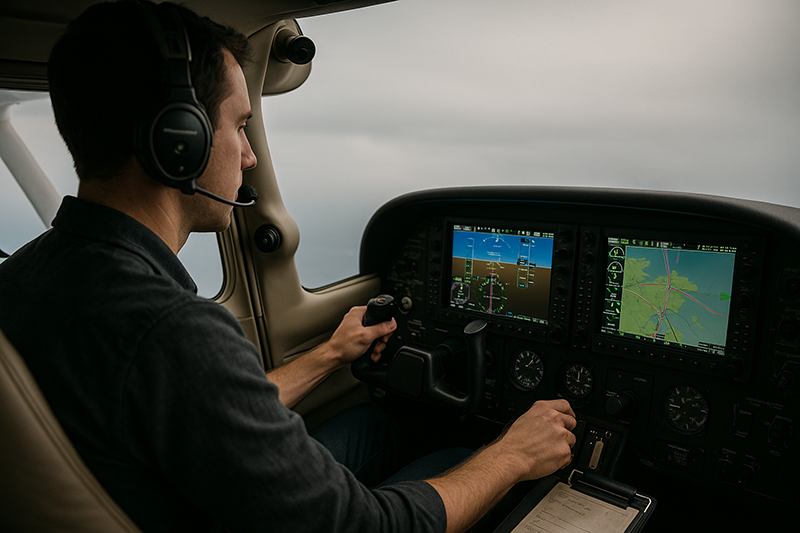
IFR route amendments can arrive at the most inconvenient time: during a climb, while being vectored near busy airspace, in turbulence, or just as the pilot is setting up for the next phase of flight. A reroute that looks simple on paper can quickly raise cockpit workload when it changes navigation, fuel planning, communication flow, terrain awareness, or the arrival sequence. For pilots operating under instrument flight rules, the skill is not only copying the amended clearance correctly. The real task is managing workload well enough to keep flying the airplane, maintaining situational awareness, and integrating the new clearance into the flight safely.
This article focuses on the practical side of managing IFR route amendments. It is written for instrument students, instrument-rated pilots, flight instructors, and aviation professionals who want a disciplined method for handling changes without letting the cockpit get ahead of them. The goal is to help pilots understand why amendments create workload, how to prioritize tasks when ATC changes the plan, and how to build training habits that make reroutes less disruptive in real-world operations.
What an IFR Route Amendment Really Changes
An IFR route amendment is any ATC-issued change to the route, altitude, fix sequence, procedure, or clearance limit that affects how the flight will proceed. In practice, pilots often think of a route amendment as a new string of fixes, airways, or direct-to instructions. That is only part of the story. A route amendment can also change the mental model of the flight. It can alter where the aircraft is going next, how much time remains before the next turn, what terrain or airspace lies ahead, which frequencies may come next, and whether the original fuel and weather assumptions still make sense.
The workload comes from the gap between the clearance you expected and the clearance you actually receive. Before the amendment, the pilot may have built a plan around a specific departure route, airway, arrival, or approach transition. After the amendment, the pilot must verify the new clearance, enter or select the new route, cross-check it, brief any implications, and continue managing the aircraft. If the aircraft is single-pilot, all of that happens while also handling control, communication, navigation, and systems management.
Route amendments are common enough that instrument pilots should expect them. Weather deviations, traffic management, special-use airspace, flow control, unavailable fixes, sector workload, or local procedures can all lead to changes. The point is not to treat every amendment as a surprise or inconvenience. The point is to treat every amendment as a normal IFR event that deserves a structured response.
Why Route Amendments Increase IFR Workload
Instrument flying is a workload management exercise even before ATC changes the route. The pilot must maintain aircraft control, comply with clearances, monitor instruments, communicate, navigate, manage automation, interpret weather, and stay ahead of the airplane. A route amendment adds new tasks and creates potential conflicts among them.
The first workload increase is communication. The pilot must listen carefully, identify that the clearance applies to the flight, copy the amended route accurately, and read it back in a way that confirms the important elements. If the clearance includes unfamiliar fixes, similar-sounding names, or rapid instructions, the risk of misunderstanding rises. When the pilot is task-saturated, the temptation is to accept the clearance too quickly. A professional response is to slow the exchange when needed and ask for clarification before acting on an uncertain clearance.
The second workload increase is navigation. A revised clearance is not complete in the cockpit until it is translated into a usable navigation plan. That may mean loading a new fix sequence, modifying a flight plan, intercepting a course, selecting a new airway, activating a leg, or verifying that the correct waypoint is displayed. In older avionics, this can require more manual entry. In modern glass cockpits, the task may look easier but still requires careful verification. Automation can reduce workload only when the pilot confirms that it is doing what the clearance requires.
The third workload increase is situational awareness. A route amendment can move the flight closer to terrain, weather, airspace boundaries, holding fixes, or a different arrival path. It can also change the expected timing of descent, fuel checks, passenger briefings, or approach preparation. The pilot should not treat route entry as a clerical task. It is a navigation and risk-management task.
The fourth workload increase is prioritization. The aircraft still needs to be flown. Airspeed, altitude, heading, attitude, configuration, and engine or power settings remain the foundation. When the pilot puts all attention into the avionics, the aircraft may drift from an assigned altitude or heading. When the pilot focuses only on flying, the clearance may not be incorporated correctly. Workload management is the bridge between these demands.
The Core Priority: Aviate, Navigate, Communicate
The familiar sequence of aviate, navigate, communicate remains useful because it reminds pilots that the aircraft comes first. It does not mean communication is unimportant. It means that no clearance amendment is worth losing basic aircraft control or altitude discipline. When workload spikes, the pilot should return to a simple question: what must be done right now to keep the airplane safe and compliant?
Aviate means maintain control and comply with any current heading, altitude, and speed assignments. If hand-flying in instrument conditions, that may mean delaying route entry until the aircraft is stable or using the autopilot if it is installed, functioning properly, and appropriate for the situation. If the pilot is already near an assigned altitude or entering a busy phase of flight, the best workload decision may be to stabilize the aircraft first, then work the amendment.
Navigate means understand where the aircraft is and where the amended clearance requires it to go. Navigation is not just pressing direct-to. It includes verifying that the selected fix is the intended fix, the course makes sense, and the aircraft will not inadvertently proceed somewhere ATC did not clear it to go. When a clearance includes multiple fixes, a pilot should be careful not to create a partial route that skips a required element.
Communicate means copy, read back, and clarify. A pilot who is not ready to accept a complex amendment can tell ATC that they need the clearance repeated, need it in smaller segments, or are unable to accept a specific clearance if safety requires it. Clear, professional communication is part of workload management. Silence, guessing, or pretending to understand a clearance is not.
How Pilots Should Understand IFR Route Amendments
The best way to understand an IFR route amendment is to break it into three layers: clearance, cockpit setup, and operational consequence. The clearance is what ATC authorized or assigned. The cockpit setup is how the pilot programs, selects, or flies it. The operational consequence is what the change means for fuel, timing, weather, descent planning, and pilot workload.
The clearance layer requires exactness. Pilots should distinguish between a heading, a vector, a direct-to clearance, a route clearance, and an instruction to join or resume a published route. These are not interchangeable. A heading may be temporary and does not by itself rewrite the full route. A direct-to clearance changes the next navigation target. An amended route may replace part of the previously cleared route. A clearance limit or holding instruction can create additional obligations. Because phraseology and local practices can vary in complexity, pilots should read back the elements that matter and ask questions when the meaning is not clear.
The cockpit setup layer requires patience and verification. Modern navigators can make reroutes look deceptively simple. A pilot may enter a fix, activate a leg, and watch the magenta line appear. The important question is whether the displayed route matches the clearance, not whether the avionics accepted the input. The pilot should compare the clearance, the flight plan page, the map display, and the aircraft’s actual track. If the aircraft is flying an assigned heading while the pilot enters the route, the pilot should avoid prematurely coupling the autopilot to navigation mode unless cleared and ready to proceed accordingly.
The operational consequence layer is where experienced IFR judgment shows. A route amendment may add distance or time. It may take the aircraft toward weather that was not originally part of the plan. It may change arrival expectations or require a different approach briefing. It may create a need to update fuel calculations or consider an alternate strategy. The earlier a pilot recognizes these consequences, the less likely the amendment is to become a last-minute problem.
Why This Matters in Real-World Aviation
In training, route amendments are often presented as a communication and avionics exercise. In real-world aviation, they are a workload, judgment, and threat-management exercise. The difference matters. A pilot who can copy a clearance on the ground may still struggle when the same type of clearance arrives in instrument meteorological conditions, at night, during a climb, with passengers aboard, or while deviating around weather.
Single-pilot IFR is especially sensitive to workload spikes because there is no second crewmember to copy, enter, verify, and brief the change. Even in two-pilot operations, route amendments require coordination. One pilot may fly while the other handles communication and flight management system entries, but both must maintain a shared understanding of the new plan. The same principle applies in a training aircraft: the instructor and student should be clear about who is flying, who is programming, and who is monitoring.
Route amendments also matter because they can create subtle errors. A pilot might enter the wrong waypoint with a similar identifier, activate the wrong leg, skip an airway transition, or misunderstand whether a heading is a temporary vector or the beginning of a new route. These errors may not be immediately obvious, especially if the aircraft continues generally in the expected direction. The safest pilots build cross-check habits that catch small mistakes before they become navigation deviations.
Another real-world factor is time compression. A reroute given in cruise may be manageable. The same reroute issued close to a descent point, arrival transition, or busy terminal area may compete with approach setup, weather review, frequency changes, and aircraft configuration. Pilots should recognize when the timing of an amendment makes it operationally significant, even if the clearance itself is not long.
Managing the Clearance Copy and Readback
The first task is to receive the route amendment correctly. That sounds obvious, but many cockpit errors begin with an incomplete or uncertain clearance. Pilots should have a reliable method for copying reroutes. This may be paper, an electronic flight bag scratchpad, a panel-mounted note feature, or another cockpit tool. The method matters less than the habit: capture the clearance before trying to manipulate the avionics.
When the clearance is lengthy, it is acceptable and often wise to ask ATC to repeat it or provide it in segments. A pilot should not allow perceived frequency pressure to override accuracy. Controllers also benefit when pilots read back clearances correctly and ask for clarification early rather than correcting a navigation error later.
Good readbacks are complete enough to confirm the route, but not so rushed that they introduce new uncertainty. If a fix name is unfamiliar, spell it back if appropriate or ask for phonetics. If the route includes an airway, confirm the entry and exit points. If the clearance changes altitude, speed, or heading along with the route, those elements deserve careful attention because they directly affect separation and aircraft operation.
A useful habit is to separate copying from programming. Trying to enter a clearance into the navigator while ATC is still issuing it can cause the pilot to miss part of the instruction. In higher workload moments, copy first, read back, then program when the aircraft is stable. If the pilot is receiving vectors, there may be time to enter the route while continuing on the assigned heading. If the pilot is expected to turn immediately, the initial navigation response may need to be simple and deliberate before deeper flight plan cleanup occurs.
Using Automation Without Letting It Lead You
Automation can be an excellent workload management tool during IFR route amendments, but it must remain under the pilot’s command. Autopilots, GPS navigators, flight directors, moving maps, and electronic flight bags can reduce manual workload and improve situational awareness. They can also create new workload if the pilot becomes absorbed in menu navigation, mode changes, or flight plan editing.
The key is mode awareness. If the autopilot is flying a heading assigned by ATC, the pilot should know whether the system is in heading mode, navigation mode, approach mode, altitude hold, vertical speed, or another selected mode. When a new route is entered, the pilot should understand what will happen if navigation mode is armed or activated. Will the aircraft turn immediately? Will it intercept a leg? Is the active waypoint correct? Is the CDI source correct? These are practical questions, not just technical details.
Flight management errors often occur when the pilot assumes the system understands the clearance. It does not. The system only follows the data and modes selected by the pilot. A magenta line may be compelling, but it is not a clearance by itself. The clearance lives in the pilot’s understanding and ATC communication. The avionics are a tool for executing that clearance.
When workload is high, pilots should consider simpler automation strategies. For example, maintaining an assigned heading while sorting out a route may be safer than immediately building a complex flight plan and coupling the autopilot to it. Conversely, if the aircraft is properly set up and the route is verified, using the autopilot to maintain altitude and track can free attention for weather, fuel, and communication tasks. The best choice depends on aircraft equipment, pilot proficiency, and the phase of flight.
Common Mistakes or Misunderstandings
One common mistake is treating a reroute as an avionics problem instead of a flight management problem. The pilot becomes focused on entering waypoints and forgets to ask whether the route is reasonable, whether the aircraft is still on the assigned heading or altitude, and whether the new route affects weather or fuel decisions. Avionics accuracy is important, but it is only one part of the task.
Another mistake is accepting a clearance the pilot has not fully understood. Some pilots hesitate to ask for a repeat because they do not want to sound unprepared. In IFR operations, clarification is a mark of professionalism. A pilot who does not understand a clearance should not guess. Asking for a repeat, phonetic spelling, or a simplified amendment is better than flying an uncertain route.
A third misunderstanding involves direct-to clearances. A direct-to instruction may be straightforward, but the pilot still needs to verify the correct waypoint and understand what happens after reaching it. If the fix appears multiple times in a database or has a similar name to another fix, selection errors are possible. The pilot should confirm the identifier, location, and relationship to the rest of the route.
A fourth mistake is failing to brief the new plan. Even in a single-pilot cockpit, the pilot benefits from a short self-brief: “Cleared direct ABC, then V123 to DEF, expect arrival from the west. I am on heading mode now, will verify the route, then go nav when cleared.” This verbal or mental summary helps align communication, navigation, and automation. In a crew environment, the briefing keeps both pilots working from the same plan.
Another risk is allowing workload to build silently. If the amendment arrives during a demanding phase of flight, the pilot may need to ask for delay vectors, request present heading, or advise unable if a clearance cannot be safely accepted. Pilots should be careful with the word unable and use it appropriately, but they should also remember that safety requires honest communication about aircraft and pilot capability.
Practical Example: Reroute During a Busy Climb
Consider a single-pilot IFR flight departing a metropolitan airport in a normally aspirated training aircraft equipped with a GPS navigator and autopilot. The pilot was cleared as filed, expecting to fly a published departure transition to an airway. Shortly after takeoff, while climbing through a few thousand feet in instrument conditions, ATC issues: “N12345, cleared direct LORAN, then V268 to BRAVO, then as filed. Maintain seven thousand.”
The pilot is hand-flying because the aircraft is still being trimmed and configured after takeoff. The frequency is busy. The clearance is not extremely long, but it arrives at a time when workload is already elevated. The unsafe response would be to look down, start twisting knobs, and let altitude or heading wander while trying to enter the route from memory.
A better response begins with aircraft control. The pilot stabilizes the climb attitude, confirms the assigned altitude, and maintains the current heading or instruction. The pilot copies the clearance on a kneeboard or electronic scratchpad, reads it back carefully, and asks for confirmation if any fix is uncertain. If the autopilot is appropriate to use and the pilot is proficient with it, engaging it in a suitable mode may reduce workload. If not, the pilot continues hand-flying and delays nonessential tasks until the aircraft is stable.
Next, the pilot enters LORAN, verifies the identifier and location, adds the airway segment and exit fix if the navigator supports that workflow, and checks the route visually against the moving map. The pilot confirms that the aircraft will not turn unexpectedly unless that action is intended and cleared. If ATC expects an immediate turn direct LORAN, the pilot must manage that promptly. If more time is needed, the pilot can advise ATC and request a heading while programming.
Once the route is entered, the pilot performs a brief operational review. Does the new route add distance? Does it point toward weather? Does the climb performance remain adequate for the assigned altitude and terrain environment? Does the change affect the expected arrival or fuel reserve planning? This review may take only moments, but it changes the amendment from a cockpit scramble into a managed IFR event.
Best Practices for Pilots
Managing IFR route amendments well begins before the first call to clearance delivery. Pilots who expect change are less disrupted by it. During preflight planning, review likely routes, nearby fixes, airways, departure procedures, arrival gates, and weather deviations. In busy airspace, look at common routings when available and consider how ATC might move traffic around constraints. This preparation does not guarantee a specific clearance, but it builds geographic familiarity that reduces surprise.
During flight, keep the cockpit organized for quick copying. A pen, stylus, scratchpad, or EFB note area should be ready. Charts should be accessible. The flight plan should be easy to review. The pilot should know how to insert, delete, and verify waypoints in the installed avionics before flying single-pilot IFR in actual conditions. Training should include reroutes, not just perfect clearances flown exactly as filed.
Use a deliberate rhythm when an amendment arrives:
- Stabilize the aircraft and confirm current flight path control.
- Copy the clearance before programming it.
- Read back the route, altitude, and any heading or speed changes clearly.
- Enter the amendment only when workload permits.
- Verify the route on the flight plan page and map before relying on automation.
- Reassess fuel, weather, terrain, and arrival planning if the change is operationally meaningful.
This sequence is not meant to be rigid. It is a workload framework. The pilot may need to turn immediately, request clarification, or ask for delay vectors depending on the situation. The important habit is to avoid mixing every task together at once.
Flight instructors should teach route amendments as a normal part of instrument training. A useful training technique is to give students realistic amendments at inconvenient but safe moments in simulated IFR, then evaluate not only whether they entered the route correctly, but how they prioritized. Did they maintain altitude? Did they ask for clarification? Did they verify the active waypoint? Did they brief the new plan? Did they become fixated on the avionics? These behaviors are often more revealing than the final magenta line.
Professional pilots can apply the same principle through crew resource management. When a reroute arrives, one pilot should remain clearly responsible for flying and monitoring the aircraft while the other handles the clearance and flight management entries. Both pilots should confirm the new route before it becomes the active navigation path. Ambiguity in task sharing can be just as hazardous as ambiguity in the clearance.
Training for Better Reroute Management
Good reroute management is a trainable skill. It improves when pilots practice under realistic workload, not just in quiet cruise flight. Instrument training should include route amendments during climbs, descents, vectors, holds, missed approach scenarios, and simulated weather deviations. The objective is not to overload the student for its own sake. The objective is to develop task prioritization and calm cockpit habits.
Instructors should scale complexity carefully. A beginner may start with a simple direct-to amendment in visual conditions or under the hood with the instructor handling radios. Later, the student can copy a multi-fix clearance, modify a GPS flight plan, and decide whether to request clarification or delay. Advanced students can practice amendments while managing abnormal distractions, passenger questions, or changing weather information in a controlled training environment.
Debriefing is essential. After the scenario, the instructor should ask what the pilot heard, what they understood, what they entered, and how they verified it. If an error occurred, the goal is to identify the breakdown. Was it a listening problem, a copying problem, an avionics problem, a mode awareness problem, or a prioritization problem? The answer helps the pilot develop targeted corrective habits.
Simulator sessions can be especially valuable because they allow instructors to introduce reroutes without real-world risk. A pilot can practice pausing the automation, maintaining assigned headings, entering airways, and recognizing wrong-waypoint errors. However, simulator training should be connected back to the aircraft the pilot actually flies. Buttonology, screen layout, autopilot modes, and database behavior vary by equipment.
Workload Management in Different Phases of Flight
The same route amendment can create different workload depending on when it occurs. In cruise, the aircraft may be stable, the pilot may have time to copy and review the change, and fuel implications may be easier to evaluate. During departure or arrival, time compression makes the same clearance more demanding.
During departure, the pilot is managing climb performance, configuration, obstacle and terrain awareness, departure instructions, and frequency changes. A route amendment during this phase should be handled with special discipline. If hand-flying in IMC, the pilot may need to prioritize attitude and altitude control before working through a complex route entry. If the clearance requires an immediate navigation change, the pilot should make the simplest safe entry first and refine the flight plan later when workload permits.
During cruise, pilots should use the lower workload period to get ahead. If ATC issues a reroute that affects the arrival, the pilot can update fuel estimates, review weather, brief the new arrival or approach expectation, and consider whether the change affects alternate planning. This is also the best time to clean up the flight plan and remove outdated route segments that could cause confusion later.
During descent and arrival, route amendments can be particularly disruptive because they compete with approach briefing, altimeter settings, crossing restrictions if assigned, speed management, and configuration planning. Pilots should be cautious about heads-down time. If the aircraft is being vectored, it may be better to maintain heading mode and altitude discipline while the route is reviewed. If the amendment changes the arrival or approach transition, the pilot should take time to brief what changed rather than assuming the previous plan still applies.
Risk Management Questions After a Reroute
After the amended route is entered and verified, the pilot should step back and ask a few risk management questions. These questions do not need to become a formal checklist every time, but they should be part of the pilot’s mental scan.
First, does the new route affect fuel? The change may be minor, or it may add distance, delay, or headwind exposure. The pilot should compare the updated estimated time en route and fuel remaining with personal, company, or regulatory planning requirements as applicable. If the route creates concern, the time to address it is early.
Second, does the new route affect weather strategy? A reroute around traffic or airspace may move the aircraft closer to convective activity, icing conditions, lower ceilings, or stronger winds. The pilot should not assume that an ATC route amendment is a weather avoidance solution unless that is clearly part of the communication and the pilot has verified the weather picture. ATC can be an important resource, but the pilot remains responsible for decisions necessary for the safe conduct of the flight.
Third, does the new route affect terrain or minimum altitude awareness? In many IFR operations, assigned altitudes and published routes provide structure, but pilots should still maintain awareness of terrain and obstacle environment, especially when operating in mountainous areas or at night. If a reroute seems inconsistent with safe altitude planning or aircraft performance capability, the pilot should clarify with ATC and use appropriate judgment.
Fourth, does the new route affect arrival preparation? If the amendment changes the direction from which the aircraft will arrive, the likely runway, arrival procedure, or approach transition may change. A pilot who continues briefing the old approach plan may be unprepared when the next clearance arrives.
Frequently Asked Questions
What should I do first when ATC gives me an IFR route amendment?
Maintain aircraft control first. Confirm the aircraft is stable on the assigned heading, altitude, and speed, then copy the clearance accurately. If the clearance is unclear or too complex to handle safely at that moment, ask ATC to repeat it, break it into segments, or provide a vector while you get organized.
Is it acceptable to ask ATC for a repeat or clarification?
Yes. Pilots should ask for clarification whenever a clearance is uncertain. A correct readback and shared understanding are far safer than guessing at a fix, airway, altitude, or routing. Professional communication includes speaking up when the workload is high or the clearance was not fully understood.
Should I immediately program the GPS after receiving a reroute?
Not always. Copy and understand the clearance first. If the aircraft is stable and workload permits, program the route and verify it before relying on it. If you are hand-flying in a demanding phase of flight, you may need to stabilize the aircraft, use appropriate automation, or request additional time before entering a complex route.
How can I avoid selecting the wrong waypoint?
Verify the identifier, name, location, and relationship to the cleared route. Be alert for similar-sounding fixes or duplicate identifiers in different regions or databases. Cross-check the flight plan page and moving map before activating the route or coupling the autopilot to navigation mode.
What if the amended route creates fuel or weather concerns?
Reassess the flight promptly. If the new route affects fuel reserves, weather avoidance, terrain clearance awareness, or arrival planning, communicate with ATC as needed and make conservative decisions. A route clearance does not remove the pilot’s responsibility to manage the overall safety of the flight.
How should instructors teach IFR route amendment workload?
Instructors should create realistic reroute scenarios that require students to copy, read back, program, verify, and brief changes while maintaining aircraft control. The debrief should focus on prioritization, communication, avionics use, and situational awareness, not just whether the student eventually built the correct route.
Key Takeaways
- IFR route amendments should be handled as a workload management task, not just a GPS programming task.
- Maintain aircraft control, copy the clearance accurately, verify the route, and manage automation deliberately.
- After accepting a reroute, reassess fuel, weather, terrain awareness, and arrival planning before the change creates a time-critical problem.