
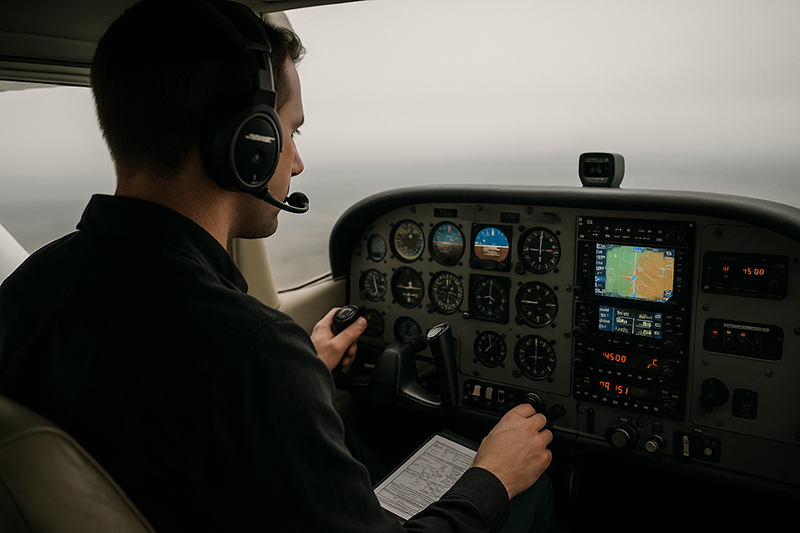
IFR task management is one of the most practical skills a pilot can develop because instrument flying compresses time, increases communication demands, and requires disciplined attention control. In visual conditions, a pilot may have more outside references and more forgiving workload cues. In instrument meteorological conditions or on a busy IFR clearance, the cockpit can become demanding quickly. The difference between a flight that feels organized and one that feels behind the airplane often comes down to how well the pilot prioritizes, sequences, and delegates tasks.
For instrument students, IFR-rated pilots, flight instructors, and aviation professionals, task management is not a single technique. It is a habit pattern that combines planning, cockpit organization, instrument scan, automation use, radio discipline, checklist management, weather thinking, and decision-making. This article focuses on practical strategies that pilots can apply in training and real-world IFR operations without turning cockpit management into a rigid checklist. The goal is simple: reduce unnecessary workload so the pilot has enough mental capacity left for the tasks that matter most.
What IFR Task Management Really Means
IFR task management is the pilot’s ability to organize cockpit duties in the correct order, at the correct time, while maintaining aircraft control and situational awareness. In practical terms, it means knowing what must be done now, what can wait, what can be prepared early, and what should be simplified when the workload rises.
Instrument flying creates a predictable set of competing demands. The pilot must maintain control of the aircraft by reference to instruments, comply with clearances, navigate accurately, communicate with air traffic control, monitor weather and fuel, use checklists, configure the aircraft, brief procedures, and make decisions as conditions change. Each task may be manageable by itself. The challenge comes when several tasks arrive together, such as a frequency change during a descent, a revised approach clearance, a runway change, and turbulence that makes the instrument scan harder to maintain.
Good task management is not about doing everything faster. It is about doing the right thing first. A pilot who rushes through every task may appear busy but still be poorly organized. A pilot who deliberately protects aircraft control, confirms the clearance, sets up navigation, and delays nonessential tasks until workload permits is usually managing the flight more effectively.
A helpful way to think about IFR task management is to divide cockpit duties into three broad categories: control tasks, navigation and procedural tasks, and communication or administrative tasks. Control tasks include attitude, power, trim, airspeed, altitude, and course control. Navigation and procedural tasks include programming avionics, loading or briefing an approach, setting minimums, identifying fixes, and managing descent planning. Communication and administrative tasks include radio calls, copying clearances, updating a nav log, making passenger announcements, or retrieving charts. In high workload moments, control tasks must remain protected. The rest must be sequenced carefully.
Why This Matters in Real-World Aviation
Task saturation is a major practical threat in IFR flying. It does not always feel dramatic. It may begin with a small delay in setting up the approach, a missed radio call, or uncertainty about whether the correct fix is active in the navigator. As workload increases, the pilot may narrow attention onto one task and lose track of another. This is sometimes called fixation, and it can affect pilots at any experience level.
In the real world, IFR flights rarely unfold exactly as briefed. ATC may assign a new altitude, vector the aircraft through expected course lines, change the runway, ask for best forward speed, or clear the aircraft direct to a fix that was not part of the original plan. Weather may require a deviation. A passenger may become uncomfortable. An autopilot may disconnect or behave differently than expected. The pilot may need to troubleshoot a radio, adjust a route, or manage ice avoidance in aircraft and conditions where that is operationally relevant.
Flight training sometimes makes IFR procedures appear more linear than they feel in actual operations. A training approach may start with a quiet setup, a stable intercept, and plenty of time to brief. Operational IFR may involve short vectors, frequency congestion, late clearances, and rapidly changing arrival expectations. That does not make IFR flying unmanageable. It means pilots need a repeatable system for staying ahead without becoming rigid.
Effective IFR task management supports safety in several ways. It helps the pilot maintain aircraft control, which is always the foundation. It reduces the chance of missing a clearance or entering incorrect avionics data. It improves approach preparation and makes it easier to recognize when the aircraft is no longer in a stable, manageable position. It also supports better decision-making because a less overloaded pilot is more likely to evaluate options clearly.
For instructors, task management is also a teaching priority. Many instrument students can explain a hold, brief an approach plate, or tune avionics correctly while sitting at a desk. The harder skill is doing those things while flying the aircraft, listening to ATC, and interpreting the larger flight picture. Instructors should train not only the procedure, but also the timing and prioritization of the procedure.
The Foundation: Aviate, Navigate, Communicate
The familiar priority of aviate, navigate, communicate remains one of the best mental models for IFR task management. Its value is not that communication is unimportant. In the IFR system, communication is essential. The point is that radio work and avionics management must not displace aircraft control.
Aviate means maintaining control of attitude, altitude, airspeed, heading, configuration, and energy. In instrument conditions, this begins with a disciplined instrument scan and a clear understanding of what the aircraft should be doing. If the aircraft is climbing, descending, turning, slowing, or configuring, the pilot should know whether that change is intentional and whether it matches the clearance and procedure.
Navigate means knowing where the aircraft is, where it is going, and what navigation source or guidance is being used. It includes verifying the active leg, confirming course guidance, identifying fixes, and understanding whether the aircraft is being vectored, flying an airway, proceeding direct, or flying a published segment. In modern cockpits, navigation also means knowing what the automation is commanding and whether the displayed guidance makes sense.
Communicate means using clear, timely, and concise radio communication. In IFR operations, communication also includes asking for clarification, requesting delay vectors, advising ATC when unable, and stating intentions when necessary. Good communication is part of task management because it can reduce workload. A pilot who requests a vector, a slower speed, or more time may prevent task saturation from becoming an unstable situation.
Instructors should be careful not to teach aviate, navigate, communicate as a slogan only. Students need to practice applying it under pressure. For example, if an instrument student is heads-down trying to load an approach while altitude begins to wander, the instructor can pause the scenario and ask: What task just took priority away from aircraft control? This turns a slogan into a cockpit habit.
Planning Ahead Without Overplanning
Good IFR task management often starts before the engine starts. Preflight planning is not simply route selection and weather review. It is the first opportunity to reduce future cockpit workload. A pilot who anticipates likely departures, arrival flows, alternate options, terrain considerations, fuel planning, and expected approach procedures will have fewer surprises later.
Before departure, pilots can prepare by reviewing the clearance route, identifying complex segments, studying departure procedures that may apply, organizing charts, and setting up avionics in a way that supports the clearance actually received. If the flight involves unfamiliar airspace or a busy terminal environment, the pilot should spend extra time understanding the arrival and approach possibilities. The purpose is not to memorize every possible outcome. The purpose is to build enough familiarity that a change in plan does not feel like a completely new flight.
Overplanning can also become a problem. A pilot who becomes attached to one expected approach or one arrival plan may be surprised when ATC assigns something different. Flexible planning is better than brittle planning. Pilots should know the most likely plan, but also understand the nearby alternatives. For example, if the forecast suggests a wind shift near arrival time, it is useful to review more than one approach option before the workload increases.
A practical preflight technique is to identify the high workload windows. These are periods when multiple tasks are expected to overlap. Examples include clearance delivery and taxi at a complex airport, departure into IMC, top of descent planning, arrival into busy airspace, approach setup, final approach, missed approach, and landing rollout in low visibility. Once the pilot knows where workload will peak, tasks can be moved earlier. Briefing an approach, setting bugs, reviewing frequencies, and organizing charts are all easier before the high workload window begins.
Cockpit Organization and Flow
A well-organized cockpit reduces unnecessary task load. This is true in a technically advanced aircraft and in a basic training airplane. Charts, checklists, pens, tablets, backup devices, oxygen equipment if applicable, flashlights for night operations, and performance references should be placed where they can be reached without interfering with aircraft control.
Organization is not only physical. It is also procedural. Pilots benefit from consistent cockpit flows, meaning habitual sequences used to set up avionics, brief procedures, configure the aircraft, and verify critical items. A flow is not a substitute for an appropriate checklist, but it can help the pilot configure the cockpit efficiently before using the checklist to confirm.
For IFR flying, a practical flow might include confirming the active navigation source, setting the course or desired track, reviewing altitude constraints or assigned altitudes, verifying the approach loaded in the navigator, setting communication frequencies, setting minimums if the equipment supports it, reviewing the missed approach conceptually, and confirming the autopilot or flight director mode if used. The exact flow depends on the aircraft and avionics. The important point is consistency. A pilot who changes the setup sequence every flight is more likely to miss a step when workload increases.
Tablet management deserves special attention. Electronic flight bags are powerful tools, but they can become a distraction if the pilot spends too much time zooming, panning, switching pages, or troubleshooting connectivity. Before entering a high workload phase, the needed charts should be available, the device should be charged or powered, brightness should be appropriate, and backup access should be considered. If the tablet becomes distracting, the pilot should return attention to aircraft control and use simpler available resources until workload allows troubleshooting.
Managing the Instrument Scan Under Workload
Instrument scan is the pilot’s continuous process of gathering, interpreting, and cross-checking flight information. It is central to IFR task management because every other task competes with the scan. When a pilot looks down to program avionics, write a clearance, or brief a procedure, the scan is interrupted. Short interruptions may be acceptable when the aircraft is stable. Long interruptions can allow deviations to develop unnoticed.
The practical solution is not to avoid all heads-down work. IFR flying requires some heads-down tasks. The solution is to break tasks into small pieces and return to the flight instruments frequently. Instead of trying to load an entire approach in one continuous heads-down period, a pilot can select the procedure, return to the scan, choose the transition, return to the scan, verify the course, return to the scan, and then brief the key points. This rhythm helps prevent the aircraft from becoming an unmanaged platform while the pilot is absorbed in avionics.
Trim and power management also support the scan. A well-trimmed aircraft requires less physical and mental effort to control. Stable power settings reduce the number of variables the pilot must monitor. When appropriate, using known pitch and power combinations can make transitions more predictable. Pilots should be careful, however, not to treat any pitch and power setting as universal. Aircraft configuration, loading, environmental conditions, and equipment vary. The aircraft flight manual and training in that specific aircraft remain the appropriate references for performance and limitations.
In turbulent conditions, task management becomes even more important because the scan demands more attention. A pilot may need to accept small, controlled deviations while avoiding overcontrol. Trying to complete nonessential cockpit tasks during moderate workload turbulence can quickly lead to frustration and degraded performance. In that environment, simplify. Fly the aircraft, ask for help if appropriate, and delay nonessential tasks until conditions or workload improve.
Using Automation Without Becoming Managed by It
Autopilots, flight directors, GPS navigators, moving maps, and integrated avionics can greatly reduce workload when used correctly. They can also create new forms of workload when the pilot does not understand modes, data entry, sequencing, or failure behavior. Good IFR task management includes deciding when automation is helpful, when hand flying is better for learning or awareness, and when automation should be simplified.
The first rule of automation management is mode awareness. The pilot should know what the system is doing now, what it will do next, and what source is driving the guidance. If the aircraft is not doing what the pilot expects, the pilot should promptly intervene. That may mean selecting a simpler mode, hand flying, disconnecting the autopilot if appropriate, or asking ATC for time to sort out the issue. The cockpit should never become a debate between the pilot and the automation while the aircraft drifts away from the assigned path or altitude.
Automation should be set up during lower workload periods whenever possible. Loading an approach while level in cruise or while receiving vectors with time available is very different from trying to build the full procedure close to the final approach course. Pilots should also verify the setup. The fact that a procedure is loaded does not mean it is correctly activated, sequenced, or matched to the clearance.
It is also valuable to practice automation downgrades. Pilots should be comfortable flying with reduced automation, such as raw data navigation, basic heading and altitude modes, or hand flying with conventional instruments if the aircraft is equipped and the pilot is trained for that operation. The point is not to reject technology. The point is to avoid becoming dependent on a single automation path. If the system becomes confusing, simpler is often safer.
Communication as a Workload Tool
IFR communication is not just about readbacks. It is a workload management tool. Pilots sometimes hesitate to ask ATC for help because they do not want to sound unprepared. In reality, clear communication can improve the safety and orderliness of the operation. If the pilot needs a delay vector, a slower speed, a repeat of the clearance, or clarification of a routing, asking early is usually better than trying to force a rushed setup.
Concise radio technique helps preserve mental bandwidth. Before transmitting, the pilot should know the purpose of the call. Long, uncertain transmissions increase frequency congestion and may add to cockpit stress. A concise request such as needing vectors to finish approach setup, requesting a lower workload routing if available, or advising unable to accept a speed or altitude instruction when appropriate can resolve a problem before it grows.
Copying clearances is another area where task management matters. If a clearance is complex, the pilot should maintain aircraft control first, write or enter only what can be safely managed, and ask for a repeat or clarification if needed. In a single-pilot cockpit, it may be better to request a short delay before accepting a complicated change while descending or configuring. In a crew environment, dividing duties between pilot flying and pilot monitoring is a primary workload management strategy, but both pilots still need shared understanding.
Single-Pilot IFR: Managing a Smaller Margin
Single-pilot IFR demands disciplined task management because there is no second pilot to handle radios, cross-check avionics, retrieve charts, or catch small errors. That does not mean single-pilot IFR is inherently unmanageable. It means the pilot must be intentional about reducing task load before it accumulates.
The single-pilot IFR cockpit benefits from early setup, simplified procedures, conservative decision-making, and honest workload assessment. A pilot should recognize personal limits before the aircraft reaches the final approach segment or enters complex terminal airspace. Fatigue, unfamiliar avionics, night operations, convective weather avoidance, low ceilings, high traffic density, and aircraft equipment issues can all increase workload. Individually, each factor may be manageable. In combination, they can leave little room for error.
One of the most important single-pilot skills is knowing when to stop adding tasks. If the airplane is not stabilized, the approach is not briefed, or the avionics are not correctly configured, the pilot should not simply continue because the clearance has been issued. Requesting vectors, delaying the approach, climbing to a safer altitude if appropriate and cleared, holding, diverting, or executing a missed approach are all normal IFR tools. The pilot does not need to salvage a rushed setup.
Another single-pilot strategy is to standardize personal callouts. Even alone, verbalizing key items can improve awareness. Examples include stating the assigned altitude, approach mode armed or not armed, course alive, glideslope or glidepath alive, final approach fix crossing, minimums, missed approach point, and missed approach actions. Callouts should be concise and should support, not replace, instrument cross-checking.
Teaching IFR Task Management
Flight instructors play a crucial role in developing IFR task management. It is tempting to focus training on procedural completion: Did the student enter the hold correctly, intercept the localizer, brief the approach, and descend at the right time? Those items matter, but they do not fully reveal whether the student can manage workload. A student may complete a procedure correctly in calm conditions but become overloaded when a small change is introduced.
Effective instrument instruction should include realistic workload layering. This does not mean overwhelming the student for entertainment. It means gradually introducing the kinds of changes that occur in IFR operations: a new frequency during setup, a revised missed approach instruction, a runway change, a request to maintain a speed, a temporary autopilot failure if appropriate to the training environment, or an unexpected hold clearance. The instructor can then evaluate how the student prioritizes.
Debriefing should focus on decisions and timing, not just outcomes. If the student drifted off altitude while loading an approach, ask what task captured attention. If the student missed a radio call during a chart briefing, discuss whether the briefing should have been completed earlier or broken into smaller parts. If the student continued an unstable setup, discuss the option to request delay vectors or execute the missed approach. This approach teaches judgment, not just compliance with a sequence.
Instructors should also model calm cockpit behavior. Students often imitate the instructor’s tone and pacing. A rushed instructor can unintentionally teach that IFR is a race. A disciplined instructor who slows the cockpit, prioritizes aircraft control, and uses clear communication demonstrates the habits students need after certification.
Common Mistakes and Misunderstandings
One common misunderstanding is that task management means multitasking. In reality, humans are often switching attention rapidly rather than truly performing several demanding cognitive tasks at once. In IFR flying, excessive switching can cause missed information, incomplete actions, and weak cross-checking. Better task management often means reducing the number of active tasks, not trying to juggle more of them.
Another mistake is treating avionics programming as the flight’s central task. Modern navigators and displays are valuable, but the airplane still needs to be flown. If programming becomes difficult, the pilot should simplify. Use vectors, basic navigation, a hold, or a delay request as appropriate. A correctly flown simple clearance is better than an unstable flight path caused by trying to perfect a complex display setup.
A third mistake is briefing too late. Pilots sometimes wait until close to the airport to review the approach in detail. That may work in a low workload environment, but it leaves little margin if ATC changes the plan, weather deteriorates, or a passenger or equipment issue arises. Briefing early does not mean committing early. It means being prepared enough to adapt.
Another recurring error is failing to verify. Loading a route, approach, or altitude into equipment is only part of the task. The pilot must confirm that the active clearance, navigation source, displayed route, altitude selection, and autopilot mode match the intended operation. Many task management problems come from assuming the equipment is set correctly because the pilot remembers touching the button or knob.
Pilots may also underestimate the workload of descent planning. Descents combine energy management, terrain and altitude awareness, ATC instructions, passenger comfort, weather, and approach setup. If the descent begins late or the aircraft remains high and fast, the pilot may spend the arrival trying to catch up. Planning descent early and requesting help when needed can prevent an unstable arrival.
Finally, some pilots view a missed approach or request for delaying vectors as a failure. In IFR operations, those are normal tools. Continuing an approach without adequate setup, stability, or situational awareness is not a demonstration of skill. Skill includes recognizing when the safest option is to pause, climb, reconfigure, or try again.
Practical Example: A Busy Arrival in IMC
Consider a single-pilot IFR flight in a light aircraft arriving at a towered airport with low ceilings and moderate traffic. The pilot has reviewed the expected RNAV approach during cruise and has the airport weather, likely runway, and alternate plan in mind. Before descent, the pilot loads the expected approach, reviews the minimum altitude structure, identifies the final approach fix, checks the missed approach conceptually, and places the correct chart where it is easy to view.
During descent, ATC assigns a different runway and clears the pilot direct to an initial fix for another approach. This is where task management becomes more important than speed. The pilot first confirms aircraft control and the assigned altitude. Next, the pilot reads back the clearance and turns toward the assigned fix as appropriate. Because the airplane is stable and there is still time, the pilot begins changing the approach in the navigator, but does it in small steps with frequent returns to the flight instruments.
As the aircraft approaches the terminal area, the pilot realizes the new approach is not fully briefed and the airplane is being vectored closer to the final approach course. Rather than rushing, the pilot advises ATC that more time is needed for setup and requests a vector. This is a task management decision. It prevents a late, heads-down scramble close to the approach. With additional time, the pilot verifies the active approach, confirms the final course, reviews the missed approach, sets the appropriate references, and stabilizes the aircraft.
On final, the pilot limits tasks to flying the approach, monitoring guidance, making required configuration changes according to aircraft procedures, and making necessary callouts. Nonessential tasks wait. If the aircraft becomes unstable, if the correct navigation guidance is not available, or if situational awareness is lost, the pilot is prepared to execute the missed approach. The success of the arrival was not based on doing everything quickly. It was based on recognizing workload, prioritizing aircraft control, and using available IFR tools to create time.
Best Practices for Pilots
The best IFR task management habits are simple, repeatable, and adaptable. They should work in a basic trainer, a high-performance single, a technically advanced aircraft, and a crewed cockpit, though the details will vary. The pilot’s goal is to reduce workload before it peaks and to preserve enough attention for aircraft control and decision-making.
- Prepare before workload rises. Review likely procedures, organize charts, set up avionics, and identify high workload windows before the arrival or approach becomes busy.
- Break cockpit tasks into small pieces. Avoid long heads-down periods. Program, verify, scan, and then continue.
- Verify rather than assume. Confirm navigation source, active leg, altitude selection, course guidance, and automation mode.
- Use communication to create time. Ask for clarification, vectors, repeats, or delay when needed. A timely request can prevent task saturation.
- Simplify when confused. If automation or avionics become distracting, return to basic aircraft control and a simpler plan that is appropriate for the clearance and situation.
- Brief early and update as needed. A brief is not a one-time speech. It is a working mental model that should be adjusted when the plan changes.
- Respect personal workload limits. Fatigue, weather, unfamiliar equipment, night conditions, and busy airspace can combine quickly. Make conservative decisions before the cockpit becomes saturated.
These practices are not meant to replace aircraft-specific procedures, checklists, training syllabi, or company standard operating procedures. They are cockpit management principles that help pilots apply those procedures more effectively.
How to Build IFR Task Management Into Personal Minimums
Personal minimums are often discussed in terms of weather, crosswind, fuel, and runway conditions. IFR task management should also be part of that discussion. A pilot may be legally qualified and the aircraft may be properly equipped, yet the combination of conditions may exceed the pilot’s current workload capacity.
For example, a newly instrument-rated pilot might choose to avoid single-pilot night IFR to minimums at an unfamiliar airport until gaining more experience. Another pilot might be comfortable in widespread stable IMC but not in convective weather environments requiring frequent deviations. A pilot transitioning to new avionics may set conservative limits until buttonology and mode awareness become more fluent. These are not signs of weakness. They are examples of managing risk before it becomes cockpit workload.
Personal minimums should be reviewed honestly after flights. If a pilot felt rushed, confused, or behind the aircraft, the debrief should ask why. Was the setup late? Was the route unfamiliar? Were the avionics not understood? Was the weather more demanding than expected? Did the pilot hesitate to ask ATC for help? These questions turn experience into improved future performance.
Maintaining Situational Awareness
Situational awareness in IFR flying means understanding the aircraft’s current state, position, clearance, environment, and expected next event. Task management and situational awareness are closely connected. When task management breaks down, situational awareness usually narrows. The pilot may know one detail very well, such as the next button to press, while losing the larger picture of altitude, terrain, weather, traffic flow, or approach sequencing.
A useful technique is to periodically ask three questions: What is the aircraft doing? What am I cleared to do? What happens next? These questions are simple, but they expose many IFR errors. If the aircraft is descending but the clearance does not support that descent, something is wrong. If the navigator is tracking to a fix but the pilot cannot explain why that fix is active, something needs verification. If the approach is about to begin but the missed approach has not been reviewed, the workload plan is incomplete.
In crew operations, situational awareness is shared through callouts, briefings, and cross-checks. In single-pilot operations, the pilot must create similar discipline alone. Spoken callouts, written notes, and consistent flows can help maintain the big picture when workload rises.
Frequently Asked Questions
What is the most important IFR task management priority?
Aircraft control comes first. In practical terms, that means maintaining attitude, altitude, airspeed, heading, configuration, and energy before allowing radios, avionics, or paperwork to consume attention. Navigation and communication remain important, but they should not displace control of the aircraft.
How can student pilots improve IFR workload management?
Students can improve by practicing early setup, cockpit flows, short heads-down task segments, concise radio calls, and consistent approach briefings. Instructors should gradually introduce realistic changes so students learn prioritization, not just procedure completion.
Is automation always the best way to reduce IFR workload?
Automation can reduce workload when the pilot understands it and verifies what it is doing. It can increase workload when mode awareness is weak or programming becomes a distraction. Pilots should be comfortable simplifying automation or hand flying when appropriate.
When should a pilot ask ATC for more time?
A pilot should ask before workload becomes unmanageable. If the approach is not set up, a clearance is unclear, the aircraft is high or fast, or avionics programming is taking too much attention, requesting vectors, clarification, or delay can be a sound task management decision.
How does task management differ in single-pilot IFR?
Single-pilot IFR requires more deliberate workload reduction because one person must fly, navigate, communicate, monitor systems, and make decisions. Early preparation, simple cockpit organization, personal callouts, and conservative go-around or missed approach decisions are especially important.
Can a missed approach be used as a task management tool?
Yes. If the aircraft is not stable, the pilot is not properly set up, required guidance is not available, or situational awareness is degraded, executing a missed approach can create time and space to reorganize. It should be treated as a normal IFR option, not a failure.
Key Takeaways
- IFR task management is the disciplined sequencing of cockpit duties so aircraft control, navigation, communication, and decision-making remain organized under workload.
- Safety improves when pilots prepare early, reduce long heads-down periods, verify avionics and automation, and use ATC communication to create time when needed.
- Training should emphasize prioritization, realistic workload changes, personal limits, and the judgment to simplify, delay, hold, divert, or miss the approach when conditions require it.