
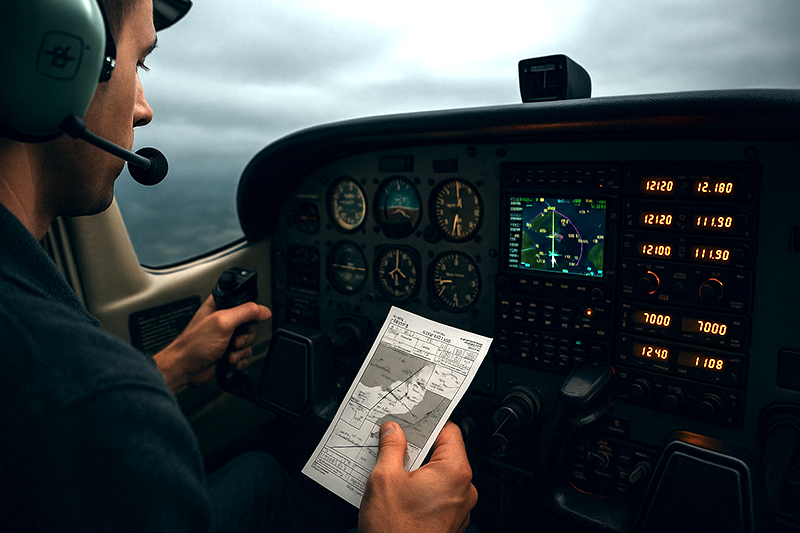
IFR task management is one of the most important skills a pilot develops after learning the mechanics of instrument flying. Holding altitude, tracking a course, briefing an approach, talking to air traffic control, configuring the airplane, and monitoring weather are all manageable tasks by themselves. The challenge is doing them in the right order, at the right time, while the aircraft continues moving through a complex and unforgiving environment.
For instrument students, task management often feels like a speed problem. Everything seems to happen too fast. For experienced pilots, the problem is usually more subtle. Workload builds gradually, small delays compound, and the pilot may not recognize the loss of margin until the flight is already behind the airplane. This article explains practical IFR task management strategies that pilots, instructors, and aviation professionals can use to improve planning, cockpit flow, communication, automation use, and decision-making in real-world instrument operations.
What IFR Task Management Really Means
Task management is the pilot’s ability to organize, prioritize, and complete cockpit duties without losing control of the aircraft, situational awareness, or decision-making capacity. In instrument flying, that includes aircraft control, navigation, communication, systems management, weather interpretation, approach preparation, checklist use, and contingency planning.
The most useful way to understand IFR task management is not as a checklist of chores, but as a continuous process of attention management. The pilot decides what matters most right now, what can wait, what should have been done earlier, and what can be simplified or delegated. In a single-pilot IFR cockpit, there may be no one to share the workload. In a crew environment, task management also includes communication, role clarity, and cross-checking.
A well-managed IFR flight usually looks calm from the outside. Frequencies are changed promptly, clearances are read back accurately, checklists are completed without rushing, and the approach is briefed before the airplane is already descending toward the final approach course. That calmness is rarely accidental. It comes from staying ahead of the airplane and protecting mental bandwidth before the workload peaks.
The opposite is easy to recognize. The pilot is still loading the approach while being vectored toward final, the weather is deteriorating, the airplane is not configured, ATC issues a heading and altitude change, and a missed radio call adds another layer of pressure. The pilot may still be capable, but the sequence of tasks has become reactive instead of planned. IFR task management is the discipline that prevents routine complexity from becoming operational confusion.
Why Task Management Matters in Real-World IFR Flying
Instrument flying compresses time. In visual conditions, a pilot can often look outside, judge spacing, and make small corrections with broad visual cues. In instrument conditions or night operations, the pilot depends more heavily on instruments, procedures, avionics, and clearances. That increases the importance of sequencing tasks correctly.
Task management matters because IFR flight rarely presents one problem at a time. A route amendment may arrive while the pilot is reviewing weather. A descent clearance may come just as the aircraft approaches a crossing restriction. A clearance to intercept the localizer may be issued while the pilot is troubleshooting an unexpected avionics mode. None of these events is unusual, but together they can overload attention if the pilot has not built a manageable cockpit rhythm.
Good task management also supports regulatory and procedural compliance. Pilots must operate within their clearances, comply with applicable procedures, maintain aircraft control, and use available information appropriately. The practical point is not to memorize regulatory language in the cockpit. The practical point is to create habits that make compliance the natural result of organized flying.
In training, task management separates a pilot who can fly instruments from a pilot who can conduct an IFR flight. An instrument student may be able to hold headings and altitudes on a training flight but still struggle when asked to copy a clearance, brief a procedure, update avionics, and prepare for an approach. That is normal. Instrument training is partly about building aircraft control skill, but it is equally about learning how to manage workload while maintaining safe priorities.
For experienced pilots, the risk is often complacency. Familiar routes, familiar avionics, and routine weather can make workload feel predictable. Then an amended clearance, unexpected holding instruction, runway change, or equipment issue disrupts the plan. The pilot who has a strong task management structure can absorb the change. The pilot who is already operating at the edge of capacity may fall behind quickly.
The Core Priority: Aviate, Navigate, Communicate
The traditional priority sequence of aviate, navigate, communicate remains one of the most useful task management tools in IFR flying. It is simple, memorable, and effective when applied correctly. Aviate means maintain aircraft control and energy management. Navigate means know where the aircraft is, where it is going, and what terrain, airspace, and procedure constraints apply. Communicate means interact with ATC and other resources as needed, but not at the expense of aircraft control.
Some pilots misunderstand this sequence as permission to ignore communication until everything else is perfect. That is not the intent. In IFR operations, communication is often essential to navigation and separation. The point is that if workload spikes, the pilot’s first responsibility is to keep the aircraft under control. A late radio call is usually easier to recover from than an altitude deviation, loss of control, or unstable approach.
A practical application might sound like this: the pilot receives a rapid series of instructions while hand-flying in turbulence. Instead of trying to program the entire route change immediately, the pilot first stabilizes pitch, power, and trim. Next, the pilot confirms the assigned heading or altitude that affects immediate navigation. Then the pilot reads back the clearance and, if needed, requests clarification or delay. This preserves the hierarchy of safety.
In modern cockpits, aviate also includes managing automation. Autopilots, flight directors, GPS navigators, and integrated flight decks can reduce workload, but only when the pilot understands what the system is doing. If automation behavior becomes confusing during a critical phase, the pilot should be prepared to simplify. That may mean selecting a basic lateral or vertical mode, hand-flying, using heading mode temporarily, or asking ATC for delay vectors while the cockpit is reorganized.
Build Workload Margin Before You Need It
The best IFR task management happens before the busy part of the flight. Workload margin is the extra mental and operational capacity available when something changes. Pilots build that margin by completing predictable tasks early, reducing unnecessary cockpit activity, and creating a clear plan for likely next events.
Before departure, workload margin begins with route review, weather review, performance planning, avionics setup, clearance expectations, and departure procedure familiarity. In flight, it continues with early approach setup, top-of-descent planning, fuel awareness, weather updates, and a realistic alternate plan when conditions warrant. These actions do not eliminate workload, but they move it to lower-pressure portions of the flight.
A common IFR trap is saving tasks for later because the cockpit is quiet now. The pilot may think, “I’ll brief the approach when I get closer,” or “I’ll load the arrival after the next frequency change.” Sometimes that works. But IFR workload is not evenly distributed. It tends to arrive in clusters. A better habit is to use quiet time intentionally. When the airplane is stable in cruise and communication is light, prepare for the descent and arrival. Review expected altitudes, frequencies, approach options, missed approach instructions, and weather considerations before ATC and aircraft configuration demand more attention.
Margin also comes from knowing when to slow the operation down. If ATC issues a clearance that creates an unreasonable workload, pilots can request clarification, delay vectors, a different altitude, or additional time when appropriate. The exact phrase depends on the situation, but the principle is straightforward: do not let cockpit organization collapse because you were reluctant to speak up. A professional request for help is a normal part of safe IFR operations.
Use Cockpit Flows Without Abandoning Checklists
A cockpit flow is a consistent physical or mental path through related tasks. For example, a pilot might use a pre-descent flow that reviews altimeters, fuel, avionics, approach setup, navigation source, radios, engine parameters, and passenger briefing items. The advantage of a flow is that it reduces hesitation. The pilot does not have to invent the sequence every time.
However, flows are not replacements for checklists. The practical relationship is “flow first, checklist to verify.” The flow accomplishes the tasks efficiently. The checklist confirms that critical items were not missed. This combination is especially valuable in IFR flying because it keeps routine work structured while preserving a verification step.
The best flows are aircraft-specific and phase-specific. A flow used in a simple training aircraft will not match the flow used in a technically advanced aircraft. A departure flow will not match an approach flow. Instructors should help students develop flows that align with the aircraft, the installed equipment, and the school or operator’s procedures. Pilots transitioning to a new aircraft should avoid importing old habits without confirming they fit the new cockpit.
Flows also help with interruption recovery. IFR cockpits are full of interruptions: frequency changes, traffic advisories, reroutes, turbulence, passenger questions, and avionics alerts. When a pilot is interrupted during a flow, a defined starting point makes it easier to resume without guessing. Some pilots use verbal cues such as “back to the approach setup” or “restart the before-landing flow” to reset attention after an interruption.
Brief the Approach Before It Becomes Urgent
Approach briefing is one of the most valuable IFR task management tools because it converts a complex procedure into a mental model before the airplane is close to the airport. A good briefing is not a dramatic reading of every printed item. It is a focused review of what the pilot must know to fly, monitor, and, if necessary, discontinue the approach safely.
A practical approach briefing should identify the airport and procedure, navigation source, final approach course, key altitudes, minimums appropriate to the operation, missed approach procedure, runway environment, lighting or visual references as applicable, expected configuration, and any unusual notes or constraints. The level of detail should match the operation. A familiar visual-backed instrument approach in good conditions may require a concise review. A nonprecision approach at an unfamiliar airport in low weather deserves more deliberate preparation.
The briefing should happen early enough that the pilot can ask questions and correct setup errors before intercepting the final approach course. If the approach is changed late, the pilot must decide whether the new plan can be briefed and flown safely. Sometimes the right answer is to accept the change. Sometimes the safer answer is to request vectors or additional time.
Instructors should teach students to brief for understanding, not performance. A student who can recite a briefing but cannot explain the missed approach or identify the step-down fixes has not reduced workload. The briefing should answer the pilot’s real cockpit questions: What am I expecting next? What altitude protects me here? What mode should the avionics be in? What will make me go missed? Where will I go after the missed approach begins?
Manage Automation as a Tool, Not a Distraction
Automation can be a major task management advantage in IFR flying. An autopilot can reduce physical workload. A GPS navigator can organize routing, procedure sequencing, and situational awareness. A flight director can provide precise guidance. But automation introduces its own tasks: mode selection, data entry, cross-checking, and error detection.
The key is to use automation deliberately. Before the flight, the pilot should understand the expected setup and any limitations or operating procedures for the installed equipment. In flight, the pilot should verify that the aircraft is following the intended lateral and vertical guidance. The question is not simply, “Is the autopilot on?” The better question is, “What mode is active, what mode is armed, and what will the aircraft do next?”
Mode awareness is central to IFR task management. Many automation surprises are not equipment failures. They are misunderstandings about what the system was commanded to do. A pilot may expect the aircraft to capture an altitude, track a course, or descend along a path, but the active modes may not support that expectation. Regularly scanning the flight mode annunciations, navigation source, course guidance, and altitude selections helps prevent automation from becoming a hidden workload generator.
There is also a time to simplify. If programming a complex route change during a busy phase is consuming too much attention, a pilot may use a simpler method that preserves safety and compliance. Depending on the equipment and clearance, that might involve heading mode, direct-to navigation, basic altitude hold, or asking ATC for vectors. The goal is not to use the most sophisticated feature. The goal is to keep the aircraft safely managed.
Communication as a Workload Management Skill
Clear radio communication is more than etiquette. It is a task management skill. Concise, accurate communication reduces uncertainty and prevents extra cockpit workload. Long, disorganized transmissions often create the opposite effect. The pilot who knows what to say and when to say it preserves attention for flying.
Good IFR communication begins with active listening. Before key phases of flight, pilots should anticipate likely calls. During departure, that may include heading, altitude, and frequency changes. During arrival, that may include descent clearances, speed assignments, runway changes, vectors, and approach clearances. Anticipation makes radio calls easier to process because the pilot already has a mental category for the instruction.
Readbacks should be accurate and complete for the information that matters to the clearance. If unsure, ask. Guessing at a clearance because the frequency is busy can create more workload later. It is better to request a repeat or clarification than to fly an instruction that was misunderstood.
Communication also includes telling ATC when workload is high. Pilots sometimes hesitate to admit they need time, especially during training or checkride preparation. In actual IFR operations, asking for a delay vector, a repeat, or a slower sequence can be a sign of sound judgment. ATC cannot manage cockpit workload directly, but controllers can often provide options when the pilot communicates the need clearly and professionally.
Weather Decisions and Task Saturation
Weather can turn a manageable IFR flight into a high-workload event. Low ceilings, convective activity, icing potential, turbulence, strong winds, and rapidly changing conditions all increase task demands. The pilot must interpret information, update the plan, and sometimes make time-sensitive decisions while still flying the airplane.
Task saturation becomes especially dangerous when the pilot continues with the original plan even though the workload has changed. A route that was reasonable in smooth air with a stable forecast may become much more demanding with turbulence, deviations, and an amended arrival. A pilot who recognizes the rising workload early can create options: divert, hold, ask for vectors around weather, climb or descend if appropriate and available, or delay the approach until the cockpit is ready.
Weather task management should start before departure. Pilots should identify the major threats, not just determine whether the flight is legally or technically possible. What weather could increase workload? Where are the escape routes? Which airports offer realistic options? What information will be needed en route? A preflight plan that identifies decision points is easier to execute than one that assumes conditions will unfold perfectly.
In flight, weather information should be integrated carefully. Datalink weather, onboard radar, ATC information, pilot reports, and visual cues each have strengths and limitations. Pilots should understand the equipment they use and avoid treating any single display as a complete picture. From a task management standpoint, the goal is to make weather decisions early enough that they do not collide with approach setup, descent planning, or fuel concerns.
Common Mistakes and Misunderstandings
One of the most common IFR task management mistakes is confusing activity with priority. A pilot may be very busy entering data, switching pages, or reviewing charts while the airplane drifts from altitude or heading. Being busy does not mean the right task is being managed. The most important task is the one that protects control, clearance compliance, and situational awareness.
Another mistake is waiting too long to prepare for the approach. Late setup is a classic pathway to rushed flying. The pilot may load the approach correctly but fail to verify the navigation source, brief the missed approach, review minimums, or configure the aircraft on time. The result is often an unstable or poorly monitored approach, especially in single-pilot operations.
Overreliance on automation is also common. Automation can reduce workload, but it does not remove the need to monitor. Pilots can become so confident in the system that they stop asking whether the aircraft is doing what they intended. Conversely, some pilots underuse available automation because they are uncomfortable with it, increasing workload unnecessarily. The better approach is balanced competence: know how to use automation, know how to monitor it, and know how to revert to simpler methods.
A fourth mistake is accepting too much too quickly. Pilots may accept a runway change, short approach, immediate descent, or complex reroute without considering cockpit readiness. There is value in being cooperative, but cooperation does not require unsafe compression of tasks. If the aircraft is not ready, the pilot should manage the pace.
Finally, pilots sometimes fail to reset after an error or interruption. A missed frequency change, incorrect entry, or unstable moment can trigger frustration. That frustration consumes attention. A better habit is to acknowledge the issue, correct what matters, and deliberately return to the priority sequence. Professional cockpit management includes emotional discipline.
Practical Example: A Busy Arrival in IMC
Consider a single-pilot IFR flight in a light aircraft arriving at an unfamiliar towered airport. The pilot is in instrument conditions, descending from cruise, and expecting an RNAV approach to Runway 18. Weather is above minimums but low enough that a visual approach is not expected. The airplane is equipped with a GPS navigator and autopilot.
During cruise, the pilot reviews the expected approach, loads it into the navigator without activating it prematurely, checks the destination weather, notes the missed approach instructions, and identifies the likely descent profile. The pilot also tunes or prepares relevant frequencies and reviews the aircraft configuration plan. This is quiet-time workload management.
As the aircraft nears the terminal area, ATC assigns a lower altitude and a vector. The pilot sets the altitude selector, confirms the autopilot mode, reads back the clearance, and verifies the descent rate. A few minutes later, ATC advises that Runway 18 is unavailable and asks whether the pilot can accept the RNAV approach to Runway 27. This is the moment where task management matters.
A reactive pilot might immediately accept, begin twisting knobs, search for the chart, and try to rebrief while descending and changing frequencies. A more disciplined pilot first maintains aircraft control and confirms the assigned heading and altitude. Then the pilot evaluates workload. If the new approach can be safely loaded, briefed, and flown with available time, the pilot accepts and proceeds methodically. If not, the pilot responds with a request such as needing vectors for setup or requesting additional time before the approach clearance.
Once given time, the pilot loads the new approach, verifies the correct runway and transition or vectors-to-final setup, reviews the final approach course, key altitudes, minimums, missed approach, and navigation source. The pilot confirms the autopilot and navigator modes, then returns attention to aircraft control and ATC instructions. The difference is not that the second pilot knows more procedures. The difference is that the second pilot controls the pace of task completion.
If later the aircraft becomes high or fast on final, task management again determines the outcome. Instead of salvaging an unstable approach through excessive cockpit activity, the pilot can execute the missed approach or request alternate handling as appropriate. Good task management includes knowing when to stop trying to make a plan work.
Best Practices for IFR Task Management
Effective IFR task management is built through habits, not slogans. The following practices are useful in training and real-world operations because they address the way workload actually develops in the cockpit.
- Prepare during low-workload periods. Use cruise and level segments to set up avionics, review weather, brief procedures, and plan descents.
- Maintain a clear priority sequence. Aircraft control, navigation, and communication should remain the foundation when workload increases.
- Use flows and checklists together. Flows create efficiency. Checklists provide verification.
- Confirm automation modes. Know what is active, what is armed, and what the aircraft will do next.
- Ask for time when needed. Delay vectors, clarification, or a repeat can prevent rushed decisions.
- Brief for understanding. The approach briefing should prepare the pilot to fly, monitor, and go missed if necessary.
- Debrief workload, not just technical errors. After a flight, identify when workload increased and what could have been done earlier.
Instructors can strengthen these habits by building realistic workload into training without overwhelming the learner. For example, an instructor might introduce a late runway change only after the student has basic aircraft control and procedure knowledge in place. The teaching point should not be chaos. The teaching point should be how to slow down, prioritize, and recover structure.
Pilots flying technically advanced aircraft should practice both automated and manual task management. It is not enough to know how to fly a coupled approach on a calm day. Pilots should also understand how to manage a mode surprise, reselect a navigation source, fly a heading and altitude while reprogramming, and continue safely if a nonessential feature becomes unavailable.
Single-pilot IFR pilots should be especially protective of workload. Without another pilot to cross-check, every cockpit task competes for the same attention. That does not make single-pilot IFR unsafe by definition, but it does require disciplined preparation and conservative pacing. If the cockpit is becoming saturated, the pilot should simplify the operation before the situation demands perfection.
Training IFR Task Management
Task management can and should be trained deliberately. It is not merely a personality trait or something pilots acquire automatically with flight time. Instructors can help students develop task management by making workload visible, discussing priorities during preflight briefings, and debriefing cockpit decisions after the flight.
A useful instructional method is to separate technical skill from workload skill at first, then gradually combine them. For example, a student may first learn to fly headings, altitudes, climbs, descents, and standard-rate turns under the hood or in a simulator. Next, the instructor adds radio calls, navigation changes, and approach briefings. Later, the instructor introduces realistic interruptions, amended clearances, and weather decisions. This progression allows the student to build capacity rather than simply experience overload.
Scenario-based training is particularly valuable for IFR task management. Instead of practicing isolated approaches, the instructor can create a flight that includes clearance copying, departure procedures, en route decision-making, arrival planning, and an approach change. The goal is to teach the student how tasks connect across the entire flight.
Debriefing should include questions such as: When did you first feel behind? Which task could have been completed earlier? What information did you wish you had reviewed before descent? Did automation reduce workload or increase it? When would it have been appropriate to ask ATC for more time? These questions help pilots identify patterns rather than merely correct individual mistakes.
How to Know You Are Getting Behind
One of the most valuable IFR skills is recognizing the early signs of task saturation. Pilots often know they are behind only after the situation becomes obvious. Better task management comes from noticing the smaller indicators.
Common signs include repeated heading or altitude corrections, missed radio calls, uncertainty about the next fix, rushing through checklists, unexplained automation behavior, losing track of assigned clearances, or feeling irritated by normal ATC instructions. Another warning sign is narrowing attention. The pilot may focus intensely on one display or one problem while neglecting the broader flight picture.
When these signs appear, the solution is not to work faster at every task. The solution is to prioritize and simplify. Stabilize the aircraft. Confirm the clearance. Use basic modes if automation is confusing. Delay nonessential tasks. Ask ATC for clarification or additional time if needed. If on approach and the aircraft is not in a safe, stable position to continue, be prepared to discontinue the approach.
Professional pilots are not immune to workload. They are trained to recognize it, communicate about it, and manage it through procedures and discipline. General aviation pilots can apply the same principle at an appropriate scale. The cockpit should never depend on pretending that workload is not rising.
Frequently Asked Questions
What is IFR task management?
IFR task management is the process of prioritizing and completing cockpit duties during instrument flight. It includes aircraft control, navigation, communication, checklist use, avionics management, weather evaluation, and approach preparation. The goal is to stay ahead of the airplane without sacrificing safety or situational awareness.
How can student pilots improve IFR task management?
Student pilots improve by building repeatable flows, briefing approaches early, practicing radio communication, learning avionics thoroughly, and debriefing workload after each lesson. Simulator sessions and scenario-based training can also help students practice task sequencing before facing the same workload in actual flight.
Does automation solve IFR workload problems?
Automation can reduce workload when used correctly, but it does not solve task management by itself. Pilots must understand the active modes, verify the navigation source, monitor aircraft performance, and be ready to simplify if automation becomes confusing or distracting.
When should a pilot ask ATC for more time?
A pilot should consider asking for more time when a clearance, approach change, reroute, descent, or cockpit issue creates more workload than can be safely managed at the current pace. Requests for vectors, clarification, or delayed acceptance can help the pilot regain organization.
What is the biggest IFR task management mistake?
A common mistake is delaying predictable tasks until the busiest phase of flight. Approach setup, weather review, descent planning, and briefing should be completed early when possible. Waiting too long compresses workload and increases the chance of errors.
How should instructors teach task management?
Instructors should teach task management as a specific skill. That includes structured cockpit flows, realistic scenarios, automation awareness, communication practice, and debriefing decisions. The objective is not to overload the student, but to help the student learn how to prioritize and recover when workload increases.
Key Takeaways
- Strong IFR task management begins before the busy phase of flight by completing predictable tasks early and preserving workload margin.
- When workload rises, return to the fundamentals: maintain aircraft control, confirm navigation and clearance requirements, then communicate clearly.
- Training should develop not only instrument flying precision, but also the pilot’s ability to brief, sequence, simplify, and ask for time when needed.