
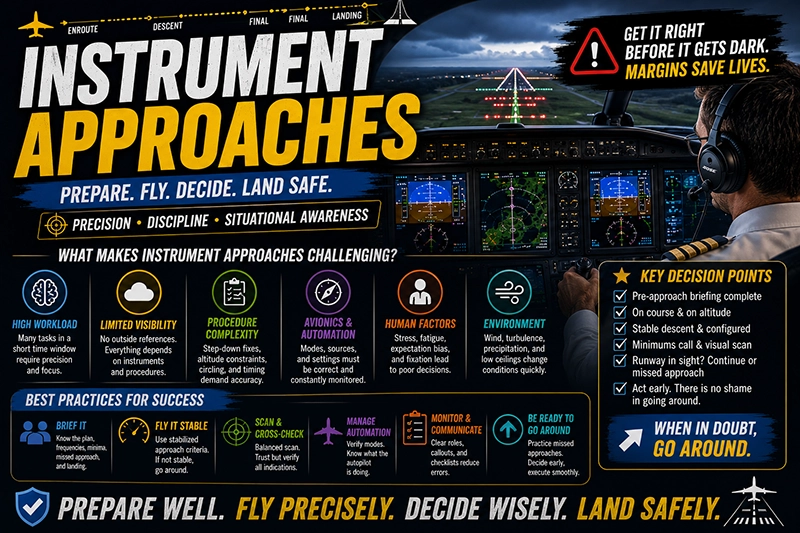
Instrument approaches are a routine part of modern aviation, yet they remain one of the most demanding phases of flight for pilots. Whether flying a short cross-country in a single-engine trainer or operating a turbine transport, executing an instrument approach correctly requires accurate flying, timely decision-making, and continuous cross-checking of instruments, procedures, and the environment.
This article examines what makes instrument approaches challenging, explains the operational and human factors that increase risk, and offers practical training and operational guidance to help pilots improve performance and safety. The discussion is written for pilots, student pilots, flight instructors, and aviation professionals who want an operationally useful understanding rather than a checklist of steps.
What an Instrument Approach Actually Requires
At its core, an instrument approach is a planned procedure that brings an aircraft from the en route environment to a position from which a safe landing can be made when visual references are available. The procedure integrates navigation guidance, published procedure design, aircraft systems, and pilot technique. Successful completion involves maintaining required altitudes and headings, intercepting and tracking guidance, managing descent profiles, monitoring aircraft performance, and timely transition to visual references when they appear.
These tasks are carried out in a condensed time window, often under degraded external cues such as reduced visibility, low ceilings, turbulence, or heavy workload. The combination of precise flying, systems management, and decision-making under pressure creates the challenge.
Why Instrument Approaches Matter in Real-World Aviation
Instrument approaches are where navigation, weather, human performance, and aircraft systems converge. In everyday operations they determine whether a flight can be completed safely and efficiently. From a safety perspective, approach and landing phases represent a disproportionate share of incidents and accidents across aviation types because they compress procedural tasks into a brief, high-stakes period close to terrain and obstacles.
For flight training, instrument approaches are a core competency for IFR-rated pilots. Training that emphasizes understanding why procedures are designed the way they are, plus realistic mixture of unexpected tasks, will better prepare pilots to manage real-world variations. For operators and flight departments, consistent approach proficiency reduces risk of go-arounds, unstable approaches, or controlled-flight-into-terrain events.
Core Factors That Make Instrument Approaches Challenging
Understanding the common contributors to difficulty helps frame training and operational mitigation. The most consistent themes are:
- High task density. Pilots must fly precise headings, manage airspeeds and configuration, set and monitor radio navigation, brief the approach, and prepare for missed approach actions simultaneously.
- Limited visual cues. In IMC, pilots cannot rely on outside visual references and must trust instruments and published minima until the runway environment is visible.
- Procedure complexity. Some approaches include step-down fixes, altitude constraints, circling segments, or nonprecision lateral guidance that demands careful planning and timing.
- Navigation and avionics integration. Switching between nav sensors or modes, interpreting instrument indications, and ensuring autopilot/flight director coupling is correct are frequent sources of errors.
- Human factors. Stress, fatigue, task fixation, poor communication, and expectation can undermine situational awareness and degrade performance.
- Environmental factors. Wind shear, gusting winds, turbulence, precipitation, and low ceilings change aircraft handling and decision points rapidly.
How Pilots Should Understand Instrument Approach Challenges
Think of an instrument approach as a sequence of decision windows rather than a single task. Each stage presents a limited set of critical decisions: which arrival and approach to fly, how to configure the aircraft, when to descend, whether to continue or go around, and how to transition from instruments to visuals. Treat each decision window as a discrete opportunity to confirm the plan and cross-check key parameters.
Develop mental models for the approach. Before initiating descent, know the missed approach path, minimum safe altitudes along the route, and the conditions that would lead you to execute a missed approach. Mental rehearsal reduces hesitation and task saturation when the workload spikes.
Use the aircraft and automation as aids, not replacements, for basic flying skills. Autopilots and flight directors can greatly reduce workload when properly coupled to approach guidance, but they require correct mode awareness. Misinterpretation of an automation mode or unintended disconnects often contribute to unstable approaches.
Navigation Guidance Types and Their Operational Implications
Instrument approaches use a variety of navigation sources: precision approaches that provide vertical and lateral guidance, like ILS or GBAS; nonprecision approaches that offer lateral guidance only, like VOR or RNAV LNAV; and approaches with advisory vertical guidance, such as LNAV/VNAV or LPV where available. Each type affects decision-making:
- Precision approaches provide precise glidepath guidance that allows stabilized descent profiles but require strict monitoring of localizer and glideslope signals.
- Nonprecision approaches require pilots to manage descent in steps or continuous descent final approaches without vertical guidance, increasing workload and timing demands.
- Advisory vertical guidance improves descent profile but pilots must understand any operational differences from full precision approaches and applicable minima for aircraft and equipment.
Pilots must be familiar with the navigation capability installed and approved in their aircraft and be able to interpret the approach chart symbology for the selected procedure. Mode awareness - knowing what the autopilot or flight director is doing and why - is critical when using automation.
Common Mistakes and Misunderstandings
Poor outcomes typically follow a small set of recurring errors. Understanding these common mistakes helps prioritize training and cockpit discipline.
- Inadequate approach briefings. Skipping or rushing the briefing leads to uncertainty about frequencies, missed approach procedures, or altitude constraints.
- Mode confusion with automation. Pilots sometimes assume the autopilot is following the approach when it is not engaged or is in the wrong mode.
- Altitude and descent management errors. Descents initiated too late or rushed profiles create unstable approaches that often end in late go-around decisions.
- Overreliance on single instruments. Fixating on one needle or readout can cause loss of broader situational awareness, especially when instruments disagree.
- Poor cockpit communication. Lack of clear roles between pilot flying and pilot monitoring increases the chance that configuration or checklist items are missed.
- Failure to execute timely missed approaches. Hesitation when a required decision point is reached increases exposure to terrain and unstable conditions.
Practical Example: Single-Engine IFR into a Busy Regional Airport
Imagine a single-engine IFR flight arriving at a busy regional airport with a broken cloud layer at 700 feet and moderate crosswind reported. The pilot selects an RNAV (GPS) approach with LNAV/VNAV minima available but knows the aircraft does not have approved VNAV for published vertical guidance. The pilot must:
- Confirm that the selected approach is compatible with aircraft equipment and pilot qualifications.
- Brief the approach including missed approach, runway environment, and go-around criteria.
- Plan a descent profile that maintains stabilized airspeed and configuration given the wind conditions.
- Monitor autopilot/flight director modes and be ready to disconnect if crosswind or turbulence requires manual control.
- Decide on a missed approach promptly if the runway environment does not become visible at the appropriate descent point.
In this scenario the combination of marginal weather, equipment limitations, and environmental conditions create the classic set-up for a challenging approach. A pilot who pre-briefs, monitors automation modes, and establishes firm go-around criteria will be positioned to make a timely, safe decision.
Best Practices for Pilots
Practical habits and training emphases reduce the risk associated with instrument approaches. Implement these practices into routine flying and instruction.
- Thorough approach briefing. Include runway orientation, frequencies, inbound course, initial descent point, altitude constraints, missed approach routing, and anticipated configuration changes.
- Mode awareness training. Practice identifying autopilot and flight director modes during approaches and rehearsing manual reversion scenarios in case of mode confusion or automation failure.
- Stabilized approach criteria. Define and adhere to stabilized approach parameters for your aircraft and operation. If parameters are not met by a reasonable point, conduct a missed approach.
- Cross-check and scan discipline. Maintain a scan that balances primary flight instruments and navigation guidance, avoiding fixation on a single display or instrument.
- Delegate monitoring tasks when flying single pilot. Use published callouts, onboard automation, or avionics features to reduce workload during critical segments.
- Regular hands-on practice. Maintain manual flying proficiency for approach and landing phases, including partial panel and unusual attitude recovery.
- Practice missed approaches. Regularly execute missed approach procedures in training to build speed and confidence when a go-around decision is required.
Training Recommendations for Instructors
Flight instructors should design instrument training to reproduce realistic workload and decision demands. Stereotypical lab-style practice where every approach proceeds to landing misses the critical skills pilots need for operational flying. Instead, construct training that includes:
- Interruptions near critical points that force the pilot to recover task prioritization.
- Automation failures and mode confusion scenarios so pilots learn to recognize and correct mode errors quickly.
- Weather variations and crosswind techniques to reinforce stabilized approach criteria under less-than-ideal conditions.
- Missed approach proficiency including precise navigation and energy management during climb and reconfiguration.
Debrief each exercise with a focus on decision points and cognitive processes rather than only aircraft control. Discuss what cues the pilot recognized, which assumptions were made, and what triggered a change of plan.
Common Misunderstandings About Approaches and How to Correct Them
Several misconceptions persist in instrument training and operations:
- Misconception: Automation always reduces risk. Automation reduces workload when used correctly but can create complacency or mode confusion. Teach pilots to verify mode and cross-check guidance.
- Misconception: If the glidepath indicator is alive, the approach is safe. A functioning glidepath signal is one input. Cross-check minima, aircraft configuration, and wind conditions before committing to continue.
- Misconception: Stabilized approaches only matter for transport category aircraft. Stabilized approach criteria are useful across aircraft categories because they promote predictable energy states and safer landings.
Address these misunderstandings by incorporating scenario-based training and emphasizing why procedural discipline matters, not just how to fly the instruments.
Checklist vs. Judgment: Where to Draw the Line
Checklists standardize important items and reduce omission errors, but judgment remains central to approach safety. For example, a checklist will not tell a pilot whether turbulence and gusting winds at the runway create an unstable approach despite items being completed. Good instrument flying blends checklist discipline with conservative judgment rooted in aircraft performance, environmental assessment, and personal minimums.
Establish personal or company minimums that supplement published minima where appropriate. Personal minimums should be conservative, realistic, and practiced so the pilot can make prompt, confident go-around decisions when conditions deteriorate or approach stabilization criteria are not met.
Human Factors: Cognitive Load, Expectation, and Communication
Human factors play a central role in approach safety. Cognitive load peaks during descent and final approach and can be exacerbated by fatigue, surprise, or interruptions. Expectation bias - assuming a stable approach because everything has gone right so far - can delay a go-around decision.
Good cockpit communication mitigates these risks. Clear callouts between pilot flying and pilot monitoring, explicit handoffs during checkout changes, and using simple, standardized phrases reduce ambiguity. In single-pilot operations, vocalizing critical parameters out loud can function as a self-monitoring tool.
Regulatory and Procedural Considerations (Practical, Non-Specific)
Pilots must follow published procedures and respect any equipment or aircraft limitations that apply to a chosen approach. Regulations and procedure notes can affect which approaches are available and under what conditions. Because regulatory specifics vary and may change over time, pilots should consult current publications, company procedures, and approved avionics documentation when planning an approach.
Operationally, ensure that approach selection is consistent with aircraft equipment, pilot qualifications, and company or personal minimums. When discrepancies or uncertainties arise about procedure applicability, treat them as triggers to select an alternate approach or airport where the operation can be conducted within clear limitations.
Frequently Asked Questions
What makes a nonprecision approach more demanding than a precision approach?
Nonprecision approaches typically lack continuous vertical guidance, forcing pilots to manage descent in steps or maintain a specific vertical profile without glidepath cues. This increases timing demands and workload, especially in the final approach segment when outside visual cues are limited.
How should I prepare for an approach when automation fails?
Preparation begins before the approach. Know the missed approach and alternative navigation methods to fly the procedure manually. During training, practice partial-panel and manual flying with simulated automation failures so mode awareness and manual handling skills remain sharp.
When is the right time to execute a missed approach?
The right time is when required visual references have not been acquired at or before the prescribed decision altitude or minimum descent altitude, or when the approach becomes unstable. In practice, make the decision early rather than late; a timely missed approach preserves options and reduces exposure to terrain and unexpected conditions.
Can I use vertical guidance advisory (like advisory VNAV) in my aircraft?
Use of advisory vertical guidance depends on aircraft equipment and regulatory approvals. Pilots should verify whether the installed avionics and aircraft certification support advisory vertical guidance on the selected approach and follow applicable operational guidance and company procedures.
How do wind and turbulence change approach technique?
Wind and turbulence impact energy management. Expect wider speed and descent control margins, anticipate gusts, and consider increasing approach speed within safe limits. Crosswind technique for touchdown and the need for go-arounds due to unstable approach energy states should be practiced in appropriate training environments.
Practical Tools and Technology That Help
Modern avionics and cockpit tools reduce uncertainty and workload when used correctly. Synthetic vision, enhanced flight displays, and head-up displays provide situational awareness by combining terrain, runway, and guidance cues. Flight director and autopilot coupling to approach guidance reduce hands-on workload when pilots maintain proper mode awareness.
However, technology is not a substitute for basic skills. Maintain manual flying proficiency, interpretation of raw data (e.g., raw NAV/OBS needles or raw CDI indications), and the ability to revert to basic navigation methods if advanced systems are unavailable or unreliable.
Key Takeaways
- Practical takeaway: Treat each instrument approach as a sequence of decision windows and brief the missed approach and key decision points in advance.
- Safety takeaway: Prioritize stabilized approach criteria and make timely missed approach decisions rather than forcing a landing.
- Training takeaway: Emphasize automation mode awareness and realistic scenario-based practice including automation failures and high-workload interruptions.
Instrument approaches demand disciplined procedure, strong piloting skills, and good judgment. Focus training and operational practice on the decision points, automation understanding, and manual handling skills necessary to manage the compressed workload and minimize risk. Conservative personal minimums, clear briefing practices, and routine missed approach proficiency are practical, high-value habits that reduce incidents during approaches.