
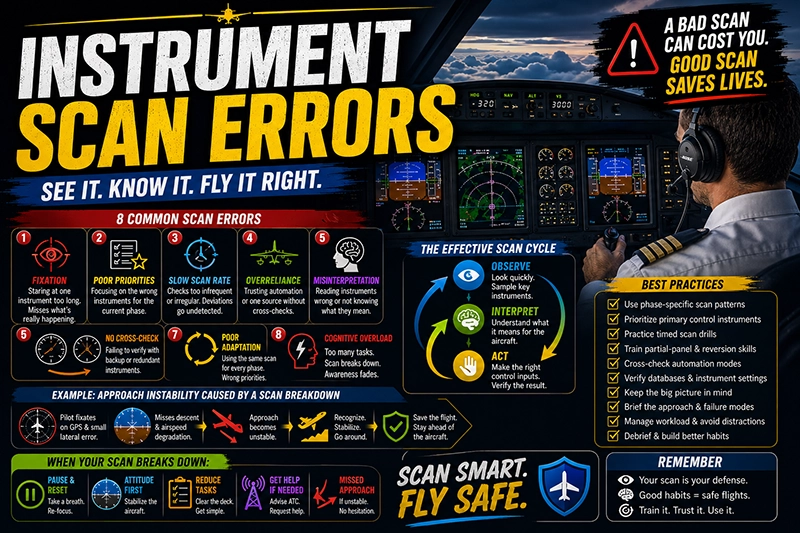
Instrument scan errors are one of the most common contributors to loss of situational awareness and poor control during instrument flight. Whether you are a student working toward an instrument rating, a newly certificated instrument pilot, a flight instructor, or an experienced operator refreshing skills, recognizing how and why instrument scans break down is essential to safe, precise instrument flying.
This article explains the typical instrument scan errors pilots make, why they matter in the cockpit, and how to fix them through deliberate practice, cockpit discipline, and scenario-based training. The goal is practical: reduce fixation, improve cross-checks, and strengthen decision-making when instruments become the primary source of attitude, navigation, and performance information.
What Is an Instrument Scan and the Core Concept
An instrument scan is the continuous visual and cognitive process of monitoring flight instruments to determine attitude, airspeed, altitude, heading, vertical speed, navigation guidance, and engine performance. The scan is not simply looking at instruments; it is a prioritized, rhythmic cross-check where each instrument contributes to a real-time mental model of the aircraft's state.
At its best, a scan integrates three activities: observe, interpret, and act. Observe means visually sampling instruments in a pattern that avoids fixation. Interpret means understanding what those instrument indications imply for flight path and control inputs. Act means making the inputs necessary to maintain or correct the flight path, then continuing the scan to verify the result.
Why Instrument Scan Errors Matter in Real-World Aviation
Instrument scan errors translate directly into operational risk. In instrument meteorological conditions, instruments are the primary source of attitude and navigation information. An incomplete or incorrect scan can cause deviations from assigned altitudes, headings, or approach profiles. These deviations increase the chance of controlled flight into terrain, airspace incursions, unstable approaches, missed approaches, and near midair collisions in busy terminal environments.
Beyond safety, scan failures affect workload management. When a pilot fixates on a single instrument or misreads one gauge, workload increases, leading to degraded performance in communications, automation management, and decision-making. In a training environment, poor scanning habits are often a root cause of failed maneuvers, failed approaches, or incomplete instrument currency practice.
How Pilots Should Understand Instrument Scan Behavior
Understanding instrument scanning means recognizing it as a cognitive skill that responds to deliberate training. Effective scanning is adaptive and phase-dependent. The scan pattern you use on a precision approach is different from the scan used during cruise or in a departure climb. The right pattern prioritizes the instruments most relevant to the immediate flying task.
Priority-based scanning assigns higher frequency of checks to instruments that provide direct feedback for immediate control. For example, during attitude control tasks the primary flight instruments (attitude indicator, airspeed, altimeter) are checked more frequently than navigation displays. During precision approaches, glideslope and localizer (or vertical guidance on the PFD) move to the top of the priority list.
Conceptually, pilots should think of the scan as having two layers: primary control instruments and supporting instruments. Primary control instruments give the clearest, fastest feedback for corrective inputs. Supporting instruments confirm and refine the pilot's control inputs. Successful scanning balances both layers and maintains a rhythm so no instrument is neglected for too long.
The Most Common Instrument Scan Errors
These errors are organized by the underlying cognitive or procedural problem they expose rather than by a single instrument type. Each error includes why it happens and the operational consequences.
1. Fixation on a Single Instrument
What it is: Fixation occurs when a pilot stares at one instrument for too long and neglects the rest of the panel. This often happens when a needle is not centered, a light is illuminated, or a navigation display shows conflicting information.
Why it happens: Stress, surprise, or perceived urgency redirects attention. Pilots sometimes assume the single instrument contains the whole solution and ignore corroborating data.
Consequences: Fixation can mask developing errors in attitude, heading, altitude, or airspeed until the aircraft is significantly off-profile. Fixation reduces situational awareness of other tasks, for example communications or automation modes.
2. Improper Instrument Prioritization
What it is: Treating less relevant instruments as primary for the current flight phase. For example, obsessing over GPS cross-track deviation during a high-workload approach setup rather than monitoring glidepath and airspeed.
Why it happens: Lack of phase-specific scanning training and poor mental models about which instruments matter most for a task.
Consequences: The pilot may successfully track lateral navigation but fail to capture or maintain the descent profile, creating unstable approaches or altitude deviations.
3. Slow or Irregular Scan Rate
What it is: Infrequent or uneven sampling of instruments that causes late detection of deviations or failure to detect trends such as increasing descent rate or airspeed decay.
Why it happens: High workload, lack of practice, and panic can interrupt the regular rhythm of the scan. Pilots may also spend too much time interpreting each reading rather than sampling and synthesizing.
Consequences: Trends are missed. Small deviations can grow into large errors before corrective action is taken.
4. Overreliance on Automation or a Single Navigation Source
What it is: Trusting the autopilot, flight director, or a single GPS source without cross-checks from other instruments or navigation aids.
Why it happens: Modern avionics are reliable and convenient, but mode mismanagement, sensor outages, or misconfigured autopilot modes can create misleading guidance.
Consequences: Mode confusion may lead to incorrect autopilot responses. If a navigation source fails without detection, the aircraft can track an incorrect course or altitude while the pilot assumes the automation is correct.
5. Misinterpreting Instrument Indications
What it is: Reading an instrument incorrectly or misunderstanding what a particular indication means under current conditions, including glass cockpit symbology or flag indications.
Why it happens: Complex displays require correct mode awareness. Pilots who are not fully current on their avionics suite may misread indications or fail to recognize inoperative flags.
Consequences: Misinterpretation can cause inappropriate control inputs, delayed recognition of failures, and incorrect decisions in approach or diversion scenarios.
6. Inadequate Cross-Check of Redundant Instruments
What it is: Failure to corroborate primary instrument indications with independent systems such as comparing heading with GPS track or verifying altimeter with ATIS/altimeter setting changes.
Why it happens: Time pressure and overconfidence in a single instrument source often reduce the habit of confirming with backups.
Consequences: Undetected instrument failures or mis-set altimeters can persist and lead to altitude or lateral deviations.
7. Poor Scan Adaptation to Flight Phase
What it is: Using a one-size-fits-all scan pattern for all phases of flight rather than adapting scanning to takeoff, climb, cruise, approach, and missed approach phases.
Why it happens: Insufficient training and mental preparation for phase-specific tasks.
Consequences: Important parameters for the current phase may be ignored, producing unstable or unsafe flight paths during critical phases such as approach and landing.
8. Cognitive Overload and Task Saturation
What it is: When the pilot's cognitive capacity is exceeded by simultaneous tasks, leading to missed or superficial instrument checks.
Why it happens: High traffic density, complex weather, equipment failures, and communications load can combine to overwhelm a single pilot.
Consequences: Reduced scan quality, delayed reactions, and an increased chance of errors in control or navigation decisions.
Practical Example: A Missed Approach Triggered by Scan Breakdowns
Imagine an IFR approach into a busy terminal area with a single pilot in IMC. During the final approach, the pilot becomes preoccupied with a small lateral deviation shown on the GPS and spends extra time trying to correct it visually on the navigation display. This fixation reduces the frequency of checks on the attitude indicator and airspeed. Simultaneously, a glidepath deviation develops because crosswind drift was not countered effectively.
If the pilot does not quickly detect the increasing descent rate and failing airspeed, the approach can become unstable inside the final approach segment. The correct mitigation is recognizing the scan has become unbalanced, reverting to primary control instruments to stabilize attitude and airspeed, and executing a missed approach if stabilized approach criteria are not met. This example shows how a seemingly small navigation correction can cascade into a serious approach instability when scan priorities shift.
How to Recognize Scan Breakdowns in Your Own Flying
Self-detection is the first corrective step. Signs that your scan is breaking down include frequent radio readbacks errors, late recognition of deviations, an abrupt shift in workload without corresponding changes in the environment, and a feeling of tunnel vision. Flight instructors should actively observe these behaviors during lessons and create situations that expose them safely.
Best Practices for Pilots to Reduce Instrument Scan Errors
Practical training and disciplined cockpit techniques reduce the likelihood and consequences of scan failures. The following are proven practices to build and maintain an effective instrument scan.
- Phase-specific scan patterns: Develop and rehearse scan patterns tailored to takeoff, climb, cruise, approach, and missed approach. Know which instruments require the highest sampling frequency for each phase.
- Priority-based scanning: Train to identify and sample primary control instruments more frequently while allowing supporting instruments to be checked at a lower rate.
- Timed scan drills: Practice short timed exercises where you sample the six-pack or primary PFD elements within a fixed cadence to build rhythm and prevent fixation.
- Partial-panel practice: Regularly simulate failures so you must interpret backup instruments and maintain control without key displays.
- Automation cross-checks: When using autopilot or flight director, confirm mode annunciations and cross-check navigation sources and basic flight parameters.
- Brief the approach and failure modes: Before a high-workload segment, brief which instruments will be primary, expected values, and actions for common failures to reduce surprise and confusion.
- Use simple mental models: Adopt quick heuristics such as "attitude and power control equals airspeed and altitude" while cross-checking instruments for confirmation.
- Debrief and record errors: After flights, identify moments when scan quality fell and plan targeted practice to address them.
Training Exercises to Improve the Scan
Include regular, focused training that builds scanning discipline under realistic workload. Examples include:
- Single-pilot instrument approaches flown to a stabilized approach criteria, then a missed approach if criteria are not met.
- Partial-panel tracking tasks where the instructor covers primary instruments and the student must maintain attitude and heading from standby instruments.
- Timed instrument sampling where the student calls out values from each instrument in a structured order to reinforce rhythm and prioritization.
- Automation failure drills where students must recognize and correct mode confusion or autopilot misbehavior while maintaining basic control.
Common Mistakes and Misunderstandings
Pilots and instructors often misunderstand the nature of scanning as a single technique that works for all aircraft and situations. Common mistaken beliefs include thinking the same scan is adequate for glass and steam cockpits, or assuming that instrument flying is purely mechanical and does not require active judgment about which readings matter most for a given moment.
Another misunderstanding is believing that more instrument checks equal better scanning. Frequent checks without prioritization or proper interpretation merely increase workload. A skilled scan is purposeful; it intentionally samples instruments that answer specific control or navigation questions.
Finally, pilots sometimes assume automation removes the need to scan. Automation can help manage tasks but requires vigilant monitoring. Automation failure in IMC without an adequate scan-backup plan is a common factor in incidents where the aircraft drifted off course or descended below assigned altitudes.
How Instructors Can Teach Better Scan Habits
Flight instructors should teach scanning as a layered skill: start with rhythm and priority, then add complexity. Use graduated exposure: begin in VMC under simulated instrument conditions, progress to actual IMC or instrument simulator sessions, and reinforce with partial-panel work and busy-with-simulated-failures sessions.
Encourage students to vocalize what they see. Callouts during practice help externalize internal models and expose misinterpretations. Use scenario-based training where the scan must adapt to changing tasks, such as an unexpected engine problem during an instrument approach or an ATC reroute in IMC.
Glass Cockpit Considerations
Glass avionics change the visual layout and available information but do not eliminate common scan errors. The primary risks in glass cockpits include mode confusion, overreliance on a single primary flight display, and neglect of engine or system warnings on secondary displays. When the PFD is the primary source for attitude and navigation, ensure you know where backup attitude, airspeed, and navigation instruments are and how to interpret their flags.
Train specifically on how the flight director, autopilot, and navigation displays integrate. Practice switching sources and interpreting annunciations and warning messages so you can quickly detect mismatches between systems.
Checklist: What to Do When You Suspect Your Scan Has Broken
If you feel your scan deteriorating, take immediate, simple steps to recover control and situation awareness. This is not an exhaustive checklist but a set of practical actions.
- Call a short time-out to reestablish priorities and brief immediate goals for the next minute.
- Verify primary flight instruments for attitude and airspeed, then correct attitude first to stabilize the aircraft.
- Reduce extraneous tasks. Defer nonessential radio transmissions, programming, or checklist items until stabilized.
- Announce to ATC if you need a moment to stabilize or request vectors or hold as necessary.
- Execute a missed approach or diversion if the approach becomes unstable or a critical instrument failure occurs.
Frequently Asked Questions
What is the best instrument scan technique?
There is no single universally best technique. Effective scanning is priority-based and phase-dependent. A good starting point is to identify primary control instruments for the task and sample them in a rhythmic cycle that prevents fixation. Instructors should tailor techniques to the aircraft and avionics suite and train students to adapt their scans to the situation.
How can I stop fixating on a single instrument?
Build a structured scanning rhythm with timed drills and deliberate practice. Use instructor-led scenarios that intentionally provoke fixation so students learn to recognize the feeling and recover. Practicing partial-panel and cross-check exercises helps reinforce trust in multiple instruments.
Does automation reduce the need to scan?
No. Automation reduces manual control workload, but it increases the requirement for monitoring. Pilots must verify automation modes and cross-check automation outputs against primary flight instruments and navigation sources. Mode awareness and cross-check discipline are essential to prevent automation-related errors.
How often should I practice instrument scanning?
Regular, focused practice is more effective than sporadic sessions. Incorporate short scanning drills into routine flights and plan comprehensive instrument practice sessions that include approaches, partial-panel work, and automation failures. Instructors should evaluate scan quality during every instrument lesson.
What should I do during an instrument failure in IMC?
Prioritize attitude control using standby or remaining reliable instruments, call for assistance if needed, declare an emergency when appropriate, and fly to VMC or an alternate as required. Use established partial-panel procedures, reduce workload, and execute a stabilized missed approach or diversion if the failure affects the ability to continue safely.
Final Thoughts on Building Reliable Scan Habits
Instrument scanning is a foundational pilot skill that blends visual technique, cognitive processing, and procedural judgment. It is developed through structured practice, realistic scenarios, and honest feedback. Pilots who cultivate adaptable, priority-based scanning reduce their exposure to preventable errors and increase their capacity to manage unexpected events.
Key Takeaways
- Practical takeaway: Use phase-specific, priority-based scan patterns and rehearse them until they become automatic under workload.
- Safety takeaway: Fixation, slow scan rate, and overreliance on a single source are common precursors to approach instability and loss of situational awareness.
- Training/decision-making takeaway: Regular partial-panel exercises, automation mode cross-checks, and scenario-based training reduce scan errors and improve in-flight decision-making.