
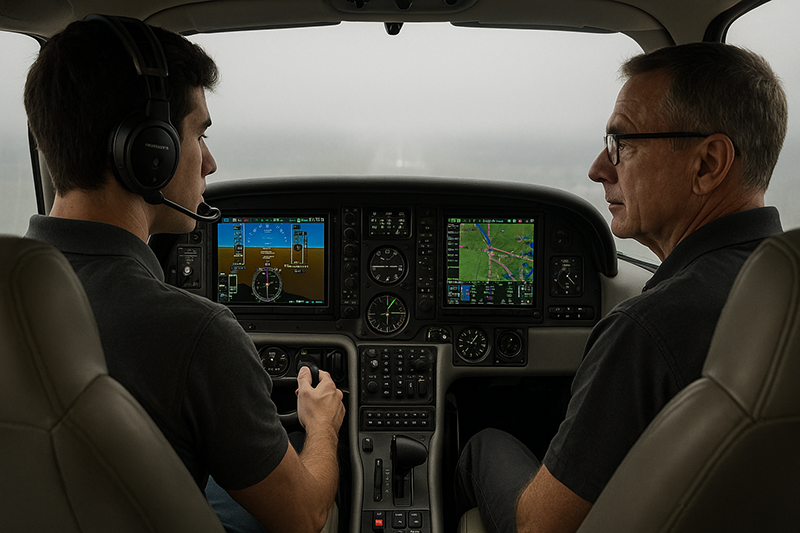
Instrument scan problems are among the most common reasons pilots struggle during instrument training, proficiency checks, simulator sessions, and real-world IFR flying. A good instrument scan is not simply looking at every instrument in a fixed order. It is an active cross-check that helps the pilot detect aircraft attitude, performance, navigation progress, and system health before small deviations become large problems.
For student instrument pilots, the scan often feels like a speed contest. The eyes move quickly, the workload rises, and the airplane still drifts away from the assigned altitude, heading, course, or airspeed. For experienced pilots, the challenge is different. Automation, advanced avionics, fatigue, weather, and single-pilot workload can quietly weaken scan discipline. This article explains common instrument scan problems and solutions in practical cockpit language so pilots and instructors can diagnose weak habits, improve training, and build a more reliable IFR cross-check.
What an Instrument Scan Is Really Supposed to Do
An instrument scan is the pilot’s organized method of gathering information from the flight instruments and avionics, interpreting that information, and making timely control or power corrections. The goal is not to stare at instruments. The goal is to maintain aircraft control, confirm performance, navigate accurately, and manage workload while operating without reliable outside visual references.
In basic attitude instrument flying, pilots usually learn to relate pitch, bank, power, and trim to aircraft performance. The attitude indicator, altimeter, vertical speed indicator, airspeed indicator, heading indicator, turn coordinator or turn rate information, navigation displays, and engine instruments all contribute different pieces of information. No single instrument tells the whole story in every phase of flight.
A strong scan has three characteristics. First, it is purposeful. The pilot knows which information matters most at the moment. Second, it is selective. The pilot gives priority to the instruments most relevant to the current task, such as pitch and power during a climb or localizer and glideslope tracking during an approach. Third, it is interpretive. The pilot does not merely notice that the altitude is changing. The pilot asks why it is changing, whether the trend is acceptable, and what correction is needed.
This is where many scan problems begin. Pilots may move their eyes across the panel but fail to process the meaning of what they see. They may correct an altitude deviation without noticing that airspeed is decaying. They may chase a course needle without recognizing that an excessive bank correction has created an unstable approach. A reliable scan connects instrument indications to aircraft control.
Why Instrument Scan Problems Matter in Real-World IFR Flying
In visual conditions, a pilot can often detect unwanted pitch, bank, or yaw with peripheral vision and outside references. In instrument conditions, those natural references are absent or unreliable. The airplane may be accelerating, slowing, banking, climbing, or descending without the pilot sensing the change accurately. The instrument scan becomes the pilot’s primary defense against spatial disorientation, altitude deviations, course deviations, unstable approaches, and automation surprises.
Instrument scan problems also affect communication and decision-making. A pilot who is overloaded trying to regain altitude may miss an air traffic control instruction or delay setting up the next approach segment. A pilot fixated on a moving map may not notice a trend toward low airspeed. A pilot who trusts the autopilot without monitoring the flight path may be surprised when the aircraft does not do what was expected.
In training, scan weaknesses often show up as repeated small errors: drifting heading during altitude changes, chasing the vertical speed indicator, overcorrecting on the localizer, or failing to maintain a stabilized descent. In actual IFR, those same weaknesses can compound quickly because weather, radio work, avionics setup, turbulence, approach briefings, and traffic management all compete for attention.
The most important point is that scan quality directly supports aircraft control. A pilot does not need a perfect eye pattern. A pilot needs a disciplined cross-check that detects important deviations early enough for smooth, proportionate corrections.
The Most Common Instrument Scan Problems
Instrument scan problems tend to fall into several predictable categories. Understanding these patterns helps pilots and instructors identify the real cause of a performance issue instead of simply telling the pilot to “scan faster.” In many cases, the problem is not slow eyes. It is misplaced attention, weak interpretation, poor trim, lack of anticipation, or failure to prioritize.
Fixation on One Instrument
Fixation occurs when a pilot concentrates on one instrument or display so intensely that other important indications are neglected. A pilot may stare at the altimeter while heading drifts, focus on the localizer needle while the glideslope moves away, or become absorbed in programming avionics while airspeed changes unnoticed.
Fixation often happens when the pilot feels behind the airplane. The brain wants to solve the most obvious problem first, so it locks onto the instrument showing the deviation. Unfortunately, while the pilot is focused on one error, other parameters may begin to deteriorate. The solution is not simply to look away more often. The solution is to recognize that no single indication should monopolize attention for long unless the situation specifically demands it.
Omission of Critical Instruments
Omission is the failure to include an important instrument or information source in the scan. This may happen when a pilot forgets to monitor engine power during level-off, neglects the heading indicator during a climb, or fails to check airspeed while correcting altitude. In technically advanced aircraft, omission may include overlooking annunciations, flight mode changes, autopilot status, or navigation source selection.
Omission can be especially subtle because the pilot may feel busy and engaged. The scan is active, but incomplete. The aircraft’s performance then begins to change in a way the pilot did not expect. A common example is leveling from a climb, reducing pitch, but delaying power adjustment or trim. The airplane accelerates, trim pressure builds, and the pilot’s workload increases.
Overemphasis on the Wrong Instrument
Overemphasis is different from fixation. The pilot may continue scanning, but assigns too much importance to a less useful indication for the current task. A classic example is chasing the vertical speed indicator during altitude control. The vertical speed indicator can show trend information, but it may lag or fluctuate depending on aircraft and system characteristics. If the pilot makes aggressive pitch changes based only on vertical speed, altitude and airspeed control may suffer.
Another example is over-controlling on a navigation needle. A pilot who tries to keep the needle perfectly centered with frequent large bank changes may produce an unstable flight path. On many instrument tasks, smooth trend control is more valuable than instant needle correction.
Mechanical or Rigid Scanning
A mechanical scan is an eye movement pattern performed without enough thought. The pilot may look from attitude indicator to altimeter to heading indicator to airspeed indicator in a memorized sequence, regardless of whether the aircraft is climbing, turning, intercepting a course, configuring for an approach, or managing an autopilot mode.
Early in training, a simple scan pattern can be useful because it prevents fixation and builds discipline. As the pilot advances, the scan must become more flexible. During a constant airspeed climb, pitch, airspeed, power, and heading may deserve more attention. During a precision approach, attitude, power, course guidance, descent path, airspeed, altitude, and configuration all need to be integrated. A rigid pattern may miss the changing priorities of each phase of flight.
Failure to Interpret Trends
Instrument flying is largely trend management. A good pilot notices not only where the aircraft is now, but where it is going. Is the altitude deviation increasing or decreasing? Is the airspeed stabilizing, accelerating, or decaying? Is the course needle moving toward center or away from it? Is the bank angle appropriate for the required correction?
Pilots who struggle with trends often make corrections late. They wait until an assigned altitude has already been crossed before adjusting pitch. They allow the localizer needle to move significantly before correcting. They notice airspeed only after the aircraft is already outside the desired range. The better technique is to use early indications to make small corrections before the deviation becomes large.
Control Chasing Instead of Aircraft Management
Control chasing occurs when the pilot reacts to every small instrument movement with immediate control input. This can create a cycle of overcorrection. The aircraft climbs, the pilot pushes. The aircraft descends, the pilot pulls. The heading drifts, the pilot banks too much. The navigation needle moves, the pilot makes a large turn back. The result is a busy cockpit and an unstable airplane.
Aircraft control during instrument flight should be smooth and proportional. Small deviations usually need small corrections. Larger deviations need planned corrections that consider pitch, bank, power, trim, and configuration. The scan should support stable aircraft management, not rapid and disconnected control movements.
Automation Monitoring Gaps
Modern avionics and autopilots can reduce workload, but they do not eliminate the need for an instrument scan. In fact, automation changes the scan. The pilot must monitor flight path, flight director cues, autopilot engagement, navigation source, armed and active modes, altitude capture behavior, and aircraft energy state. A pilot who assumes the automation is doing the intended task without verification can become vulnerable to mode confusion or delayed recognition of an error.
The scan in an automated cockpit should include both “what is the aircraft doing?” and “what is commanding it to do that?” This includes checking whether the aircraft is tracking the correct course, descending or climbing as expected, maintaining appropriate speed, and using the intended navigation guidance.
How Pilots Should Understand Instrument Scan Solutions
The best solution to scan problems is not a universal scan pattern. It is a disciplined cross-check built around control, performance, navigation, and configuration. Pilots should think in terms of what information is needed now, what could change next, and what would indicate that the aircraft is no longer doing what was intended.
A useful mental model is to separate the scan into three related tasks. The first is control: pitch, bank, power, trim, and configuration. The second is performance: altitude, vertical speed trend, airspeed, heading, turn rate, and flight path. The third is navigation and systems: course guidance, approach indications, GPS or navigation source, autopilot modes, engine indications, and other aircraft-specific displays.
During basic maneuvers, control instruments help the pilot set the desired attitude and power. Performance instruments confirm whether the aircraft is doing what the pilot intended. Navigation instruments confirm where the aircraft is going relative to the route or procedure. When those three tasks are connected, the scan becomes meaningful rather than mechanical.
For example, if a pilot is assigned a climb to a new altitude, the first question is not “Which instrument do I stare at?” The better question is “What pitch and power setting should produce the desired climb, and how will I confirm the aircraft is performing correctly?” The pilot sets pitch and power, trims, confirms airspeed and vertical trend, monitors heading or navigation course, and anticipates the level-off. That is an instrument scan with purpose.
On an instrument approach, the scan becomes more demanding because altitude, speed, descent path, lateral guidance, configuration, power, timing, and missed approach readiness all matter. The pilot must avoid becoming so focused on one needle that the rest of the aircraft state is ignored. The scan should expand and contract based on the phase of flight, but it should never disappear.
Primary and Supporting Instruments in Practical Terms
Pilots often hear the terms “primary” and “supporting” instruments during instrument training. In practical cockpit use, this means that some instruments are more directly useful for a specific aircraft control task at a specific moment, while other instruments confirm or support the interpretation.
In straight-and-level flight, the attitude indicator helps maintain the desired pitch and bank, while the altimeter and heading indicator confirm altitude and heading. The airspeed indicator and power setting help confirm energy management. If the airplane starts to climb, the altimeter shows the result, the attitude indicator helps identify the pitch correction, and the airspeed indicator may reveal whether the correction affects speed.
During a constant-rate turn, bank control and heading awareness become more prominent. During a climb, pitch and power are closely tied to airspeed and vertical performance. During a descent, pitch, power, airspeed, and altitude trend must be managed together. During an approach, course guidance and descent path become more important, but not at the expense of attitude, airspeed, altitude, power, and configuration.
The practical takeaway is that the “primary” instrument changes with the task. A weak scan often comes from using the same emphasis for every maneuver. A stronger scan adapts to the flight condition while preserving an overall awareness of the airplane.
Common Mistakes and Misunderstandings
One common misunderstanding is that faster scanning automatically improves instrument flying. Speed matters only if the pilot is actually interpreting the indications. Rapid eye movement without understanding can hide a weak cross-check. A pilot may look at the altimeter ten times and still fail to recognize that the airplane is entering a persistent climb because the pitch attitude and trim state are not being managed.
Another mistake is believing that the attitude indicator alone is enough. The attitude indicator is central to instrument flying, but it must be cross-checked against performance. The airplane can be in a familiar attitude and still accelerate, decelerate, climb, descend, or drift because of power, trim, configuration, turbulence, or instrument interpretation errors. Performance instruments confirm what the attitude is producing.
A third mistake is trying to correct every deviation instantly. Instrument flying rewards smoothness and anticipation. Large, abrupt corrections can create new deviations, particularly during approaches or while hand-flying in turbulence. A good scan helps the pilot decide whether a deviation is real, whether it is increasing, and what correction is appropriate.
Some pilots also underestimate the effect of poor trim. An out-of-trim aircraft demands constant control pressure, which steals attention from the scan. The pilot may become so occupied with holding pitch or bank that navigation, communication, and systems monitoring suffer. Trim is not a substitute for flying the airplane, but it is an important workload management tool.
In glass cockpit aircraft, a frequent misunderstanding is that more information always improves awareness. Large displays can provide excellent situational awareness, but they can also attract attention away from basic flight path control. The moving map, traffic display, weather display, and flight plan page are valuable tools, yet they must be integrated into the scan without replacing core attitude, performance, and navigation monitoring.
Practical Example: Localizer Intercept in IMC
Consider a pilot flying a training approach in actual or simulated instrument conditions. Air traffic control vectors the aircraft to intercept a localizer. The pilot is hand-flying, configuring the airplane, communicating with ATC, and preparing for the descent. This is exactly the kind of situation where instrument scan problems can appear.
At first, the pilot focuses on the localizer needle. As the needle begins to move, the pilot makes a large turn toward the final approach course. Because attention is fixed on the navigation display, the pilot does not notice that altitude has drifted 150 feet high and airspeed has increased during the turn. The airplane rolls out close to the course, but now the pilot is high, fast, and working harder than necessary. The scan problem was not failure to see the localizer. The problem was overemphasis on one instrument and omission of energy and altitude control.
A more disciplined scan would start before the intercept. The pilot would confirm heading, altitude, airspeed, power, navigation source, and approach setup. As the localizer comes alive, the pilot would use a reasonable intercept correction while continuing to check attitude, altitude, airspeed, and power. Once established, the pilot would reduce the intercept angle, verify course tracking, and prepare for glideslope or step-down altitude management as appropriate for the procedure being flown.
In this example, the solution is not a memorized sequence of eye movements. The solution is priority management. During the intercept, lateral guidance matters, but aircraft control still comes first. The pilot must maintain altitude and speed while intercepting. Once established, the scan shifts to tracking, descent planning, configuration, and missed approach readiness.
Training Techniques That Improve the Instrument Scan
Good scan training should be deliberate. Simply flying more approaches may reinforce poor habits if the pilot does not understand what is going wrong. Instructors can help by identifying the type of scan error, not just the result. “You lost altitude” is less useful than “Your attention stayed on the course needle while pitch and power were not cross-checked.”
One effective training method is to isolate basic aircraft control before adding full approach workload. Straight-and-level flight, climbs, descents, standard-rate turns, and level-offs remain valuable because they reveal whether the pilot understands pitch, power, trim, and performance relationships. If a pilot cannot maintain altitude and heading comfortably in basic maneuvers, adding avionics programming and approach procedures will likely increase workload rather than solve the scan problem.
Another useful technique is verbalization. The pilot briefly says what the airplane is doing and what correction is being made: “Altitude trending low, slight pitch increase, trim, heading steady.” This should not become a constant narration in normal flying, but during training it can reveal whether the pilot is interpreting or merely looking.
Partial-panel and instrument failure training can also strengthen cross-check skills when conducted appropriately with an instructor or safety pilot under suitable conditions. The purpose is not to make normal flying harder for its own sake. The purpose is to teach the pilot to use remaining reliable information, recognize inconsistent indications, and maintain control when an instrument or display is unavailable or suspect.
Scenario-based training is especially valuable. A pilot who can hold altitude in cruise may still struggle when copying a clearance, loading an approach, briefing a missed approach, and preparing for descent. Real IFR workload is dynamic. Training should include task management, automation monitoring, and decision-making along with hand-flying precision.
Best Practices for Pilots
Strong instrument scanning is built from repeatable habits. These habits should be simple enough to use under workload, but flexible enough to adapt to different aircraft, avionics, and phases of flight. The most effective pilots continuously ask: What should the airplane be doing? What is it actually doing? What is changing? What do I need to correct now, and what can wait?
The following practices help prevent many common scan problems:
- Begin with aircraft control. Maintain attitude, power, trim, and configuration before becoming absorbed in navigation or avionics tasks.
- Use performance instruments to confirm results. Do not assume a pitch or power setting is producing the desired outcome without checking altitude, airspeed, heading, and trend.
- Scan for trends, not just numbers. Early movement often matters more than a late deviation.
- Make small, smooth corrections when appropriate. Avoid chasing every minor fluctuation with large control inputs.
- Anticipate high-workload moments. Level-offs, intercepts, frequency changes, approach setup, configuration changes, and missed approach preparation deserve extra attention.
- Monitor automation actively. Verify modes, navigation source, altitude targets, and flight path rather than assuming the system is doing what was intended.
- Keep the aircraft trimmed. Proper trim reduces physical workload and frees attention for the cross-check.
- Debrief scan errors specifically. Identify whether the problem was fixation, omission, overemphasis, poor trend recognition, or task saturation.
These practices are not aircraft-specific operating limitations or regulatory requirements. They are practical habits that support disciplined instrument flight. Pilots should always integrate them with the aircraft flight manual, avionics guides, instructor guidance, and applicable operating procedures.
How Instructors Can Diagnose Scan Weaknesses
Flight instructors often see the result of a scan problem before they see the cause. The student loses altitude, overshoots a heading, allows airspeed to drift, or becomes unstable on an approach. The instructor’s job is to determine why. Was the student fixated? Did the student fail to understand pitch and power? Was the airplane out of trim? Did avionics programming overload the pilot? Was the correction too aggressive?
A useful teaching approach is to separate performance errors from scan errors. If the pilot sees the deviation but does not know how to correct it, the issue may be aircraft control knowledge. If the pilot knows the correction but sees the deviation late, the issue may be scan timing or prioritization. If the pilot sees and corrects the deviation but creates another one, the issue may be overcontrol or lack of trim.
Instructors should also be careful with the phrase “keep your scan moving.” While well-intended, it may not tell the learner what to do differently. More precise coaching might be: “After you set pitch for the climb, confirm airspeed and heading, then return to attitude before the airspeed decays,” or “During the localizer intercept, include altitude and power in your scan so you do not trade course tracking for energy control.”
Debriefing should be specific and practical. A student who understands the type of scan error can practice intentionally. A student who only hears that the scan is weak may respond by moving the eyes faster without improving aircraft control.
Instrument Scan in Glass Cockpit Aircraft
Glass cockpit aircraft have changed the appearance of the instrument scan, but not the underlying need for cross-checking. The primary flight display may combine attitude, altitude, airspeed, vertical speed, heading, navigation guidance, and flight director cues in one location. That can make information easier to access, but it can also create display fixation.
In a glass cockpit, pilots should maintain a clear distinction between flight path control and situational awareness tools. The primary flight display supports immediate control and performance monitoring. The navigation display, moving map, traffic, terrain, weather, and flight plan pages support planning and awareness. Both are important, but during high-workload phases, basic flight path control must remain the priority.
Flight mode annunciations deserve special attention in automated aircraft. If the autopilot or flight director is being used, the pilot should verify what modes are active and armed. The aircraft’s actual behavior should then be compared with the pilot’s expectation. If the airplane is not climbing, descending, turning, or capturing as expected, the pilot should intervene using appropriate aircraft procedures and maintain control.
Glass cockpit proficiency also requires knowing when to stop programming. If avionics work is taking attention away from aircraft control, the pilot may need to use the autopilot if appropriate, ask for delaying vectors, hold an altitude, simplify the task, or revert to a basic mode of operation. The exact action depends on aircraft equipment, phase of flight, clearance, and pilot proficiency.
Building a More Reliable Cross-Check
A reliable instrument scan is built through repetition, feedback, and honest assessment. Pilots should practice not only when everything is calm, but also when workload increases in a controlled training environment. The goal is to make the scan resilient enough that it survives radio calls, turbulence, avionics changes, abnormal indications, and approach workload.
One helpful practice is to brief scan priorities before each maneuver or phase of flight. Before a climb, think pitch, power, airspeed, heading, trim, and level-off. Before an approach, think attitude, power, speed, course, descent path, altitude gates, configuration, and missed approach readiness. Before using automation, think mode, target, source, and flight path. This mental briefing takes only seconds, but it prepares the pilot to scan with purpose.
Pilots should also develop a healthy respect for workload saturation. When the scan begins to narrow, errors multiply. Signs of saturation include repeated missed radio calls, late corrections, fixation on one display, uncertainty about aircraft mode, and loss of altitude or speed awareness. Recognizing these signs early allows the pilot to simplify, stabilize, and regain situational awareness.
Ultimately, the best instrument scan is not the one that looks most impressive. It is the one that keeps the airplane under control, detects deviations early, supports accurate navigation, and leaves enough mental capacity for decisions.
Frequently Asked Questions
What is the most common instrument scan problem?
Fixation is one of the most common scan problems. A pilot focuses on one instrument, such as the altimeter, localizer, or airspeed indicator, while other important indications are neglected. The solution is to maintain a purposeful cross-check that includes aircraft control, performance, navigation, and system status.
Should pilots use the same scan pattern in every phase of flight?
No. A basic scan pattern can help during early training, but an effective instrument scan must adapt to the task. A climb, level-off, holding pattern, localizer intercept, and instrument approach each require different emphasis. The pilot should prioritize the instruments most relevant to the current phase while still maintaining overall aircraft awareness.
How can I stop chasing the needles on an instrument approach?
Start by making smaller, smoother corrections and watching the trend. Instead of reacting aggressively to every movement, ask whether the needle is moving toward center or away from it. Combine course guidance with attitude, power, airspeed, and descent path monitoring so the approach remains stable.
Does an autopilot replace the need for an instrument scan?
No. An autopilot can reduce workload, but the pilot must still monitor the aircraft’s flight path, active modes, navigation source, altitude targets, airspeed, and system behavior. Automation changes the scan; it does not eliminate it.
How do instructors help students improve a weak instrument scan?
Instructors can identify the specific scan error rather than only pointing out the deviation. The problem may be fixation, omission, overemphasis, late trend recognition, poor trim, or task saturation. Specific feedback helps the student practice the right correction.
Is a glass cockpit easier for instrument scanning?
A glass cockpit can make information easier to see because many indications are integrated on one display. It can also create new scan problems, such as display fixation or mode confusion. Pilots still need disciplined cross-checking and strong automation monitoring habits.
Key Takeaways
- A strong instrument scan is a purposeful cross-check of aircraft control, performance, navigation, and systems, not simply fast eye movement.
- Common scan problems include fixation, omission, overemphasis, rigid scanning, poor trend recognition, overcontrol, and weak automation monitoring.
- Pilots improve by prioritizing the right instruments for the phase of flight, making smooth corrections, staying ahead of workload, and debriefing scan errors specifically.