
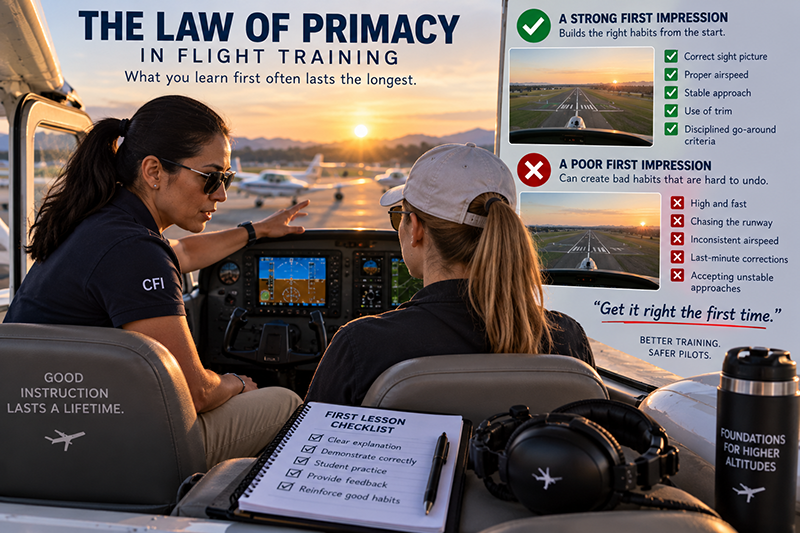
The law of primacy in flight training is a simple idea with serious consequences: what a pilot learns first is often what the pilot remembers most deeply. In aviation, that first impression may be a sight picture on final approach, a scan pattern in instrument flight, a radio phrase, a checklist habit, or the way a student responds when the airplane gets slow. If the first lesson is accurate, disciplined, and reinforced correctly, it becomes a foundation. If it is sloppy, rushed, or misunderstood, it can become a habit that takes much longer to correct than it took to create.
This matters because flight training is not only the transfer of information. It is the formation of behavior under time pressure, workload, noise, distraction, and consequence. Pilots do not rise to the level of a classroom explanation when the workload increases. They tend to fall back on what was practiced, what felt normal, and what was accepted early. For student pilots, flight instructors, training managers, and experienced aviators learning a new aircraft or procedure, the law of primacy explains why the first exposure to a task deserves more care than it often receives.
Good initial instruction is not about perfectionism. It is about preventing avoidable rework. A student who is introduced to landings with a clear sight picture, consistent airspeed control, proper use of trim, and disciplined go-around criteria is building from stable material. A student who is allowed to drag the airplane in, chase the runway with pitch, or treat a checklist as a memory game may still progress, but the instructor has inherited a second job: teaching the task and unteaching the wrong version of the task at the same time.
What the Law of Primacy Means in Aviation Training
Primacy is one of the classic principles of learning used in aviation education. In practical terms, it means the first way a learner receives, practices, and emotionally experiences a skill or concept has a strong influence on how that learner understands it later. First learning creates a mental model. It tells the student what normal looks like, what matters, what can be ignored, and how success feels.
In flight training, those first mental models are powerful because flying is multisensory. The student is not just hearing an explanation. The student is seeing the runway perspective change, feeling control pressure, hearing engine sound, interpreting radio calls, and trying to manage anxiety. A first lesson that pairs the correct explanation with the correct sensation gives the student a usable reference. A first lesson that pairs confusion with a maneuver can create resistance, fear, or an incorrect association that remains long after the briefing is forgotten.
Primacy does not mean a pilot can never relearn. Pilots relearn all the time. They transition to new avionics, new aircraft, new operating environments, and new procedures. However, unlearning is often slower than learning because the old behavior has already been connected to a sense of normal. When the pilot becomes busy or uncertain, that older behavior may return. This is why instructors often see a corrected habit improve during a focused lesson, then reappear during a stage check, cross-country flight, instrument approach, or checkride preparation.
The law of primacy applies to knowledge, skills, and attitudes. Knowledge includes concepts such as angle of attack, aircraft performance, weather decision-making, or airspace rules. Skills include control touch, checklist use, radio communication, instrument scan, and energy management. Attitudes include how a pilot views risk, preparation, standard operating practices, and personal minimums. Of the three, attitude primacy may be the most difficult to undo. A student who first learns that shortcuts are normal may need more than technical correction. The student needs a change in professional identity.
Why the First Lesson Is So Hard to Undo
The first lesson is hard to undo because it becomes the default. A default is not always a conscious decision. It is the behavior that appears when attention is elsewhere. In flying, attention is almost always divided. A student turning base to final may be managing bank angle, airspeed, wind correction, traffic, radio calls, runway alignment, descent rate, and instructor comments. Under that workload, the student is unlikely to invent a new technique. The student will use the one that was practiced first and reinforced most often.
Early learning also carries emotional weight. If a student first experiences stalls as a frightening surprise, later stall training may be filtered through that anxiety. If a student first experiences radio communication as public embarrassment, microphone hesitation can persist. If a student first experiences instrument flying as a frantic chase of needles, it may take time to rebuild the concept around attitude, power, trim, and organized scan. The original emotional imprint does not make improvement impossible, but it changes the instructional task.
Another reason primacy is durable is that early errors can hide behind partial success. A student may land safely while carrying too much speed. A pilot may navigate successfully while overrelying on automation. A trainee may complete a checklist while reading words without verifying configuration. Because the outcome was acceptable, the flawed method feels validated. The longer the flawed method produces apparently successful outcomes, the harder it becomes to challenge.
Instructors sometimes underestimate this because they recognize the correct standard intellectually. The student, however, is building a standard from experience. If the instructor tolerates imprecise procedures early, the student may interpret tolerance as approval. Silence in the cockpit is instructional. When a deviation is allowed to pass without clarification, the student may learn that it is not important.
Why This Matters in Real-World Aviation
Primacy matters in real-world aviation because aircraft do not care whether a habit was intentional. A pilot who learned to manage airspeed casually may carry that habit into short-field operations, gusty approaches, high-density-altitude departures, or aircraft transitions. A pilot who learned to brief approaches as a paperwork exercise may continue that pattern when flying in busy terminal airspace. A pilot who learned to accept unstable approaches as normal may be less likely to initiate a timely go-around when the situation calls for it.
Many aviation safety problems are not caused by a lack of information alone. Pilots often know the correct answer when asked in a classroom. The problem appears when workload rises and the pilot behaves according to older habits. That is where primacy becomes operational. It bridges the gap between what a pilot can recite and what a pilot actually does.
For example, checklist discipline is often shaped very early. If a student first learns that checklists are used to confirm configuration and manage risk, that student is more likely to respect them later. If the student first learns that checklists are something to rush through after everything is already done from memory, the checklist may become a ritual instead of a safety tool. The difference may not show up on a calm local training flight. It can matter greatly during a distraction, an abnormal indication, a runway change, or a complex arrival.
Primacy also matters in aircraft transitions. An experienced pilot moving from one aircraft type to another may bring strong habits from the previous airplane. Some transfer is helpful. Basic airmanship, weather judgment, and cockpit discipline remain valuable. But aircraft-specific procedures, control forces, sight pictures, avionics workflows, and performance margins may differ. The first transition lesson should therefore be structured carefully. It should identify what carries over, what changes, and what must not be assumed.
In crew environments, primacy influences communication. A pilot who first learns that challenge and response are normal, respectful, and expected is more likely to speak up. A pilot who first learns that cockpit hierarchy discourages questions may hesitate when assertive communication is needed. Even in single-pilot operations, the same principle applies internally. A pilot trained early to verbalize threats, set limits, and make conservative decisions is more likely to recognize those behaviors as part of normal professionalism.
How Pilots Should Understand This Topic
Pilots should understand primacy as a warning and an opportunity. The warning is that poor early technique has a long memory. The opportunity is that excellent early technique creates a strong foundation. Instructors do not need to overload a new student with every detail on day one. They do need to decide which habits must be correct from the beginning.
For a first flight lesson, the goal may not be to produce precise maneuver performance. The goal may be to create the right relationship with the airplane: smooth control inputs, outside visual references, coordinated use of rudder, respect for checklists, and awareness that the airplane responds to attitude, power, configuration, and trim. The student may not master those items immediately, but the instructor can introduce them in the correct order and with the correct meaning.
For ground instruction, primacy means teaching concepts before shortcuts. A student learning weather should not begin with a habit of scanning only one graphic or one app color. A student learning performance should not begin with a casual assumption that the airplane will perform the same every day. A student learning airspace should not be trained to memorize isolated trivia without understanding communication, clearance, equipment, and operational context. Early knowledge should be organized around how pilots actually use it.
For experienced pilots, primacy becomes relevant any time a new procedure is introduced. The first time a pilot uses a new avionics function, programs a flight management system, flies a new autopilot mode, or practices an emergency profile, the instructor or mentor should slow the process down. The first repetition should be correct, deliberate, and explained. Speed can come later. A fast but confused first repetition is not efficient if it creates weeks of correction.
Primacy should not be confused with rigidity. Good training does not mean there is only one acceptable technique for every task. Aviation includes aircraft differences, environmental variables, company procedures, and instructor preferences. The issue is not whether every pilot says the same words or moves a switch with the same rhythm. The issue is whether the first learned method is safe, intentional, compatible with aircraft guidance, and transferable to real operations.
The Instructor’s Role in Protecting First Learning
Flight instructors are the gatekeepers of primacy. Their choices in the first few lessons shape more than immediate performance. They shape the student’s definition of normal. This places a premium on preparation, consistency, and restraint.
Preparation matters because first explanations should be simple without being false. A new student does not need an advanced aerodynamics lecture before touching the controls, but the student does need accurate language. If the instructor uses misleading shortcuts, those shortcuts can harden into misconceptions. For example, explaining pitch and power in a way that ignores the relationship among attitude, energy, configuration, and performance can create confusion later during approaches, slow flight, and instrument training.
Consistency matters because students compare what instructors say with what instructors tolerate. If an instructor teaches stabilized approach criteria but then regularly accepts unstable approaches without a go-around or debrief, the student learns the practical standard from the action, not the briefing. If an instructor says checklist discipline is important but interrupts every checklist and allows items to be skipped, the student learns that checklists are secondary.
Restraint matters because instructors can accidentally teach dependence. If the instructor talks continuously, corrects every small deviation instantly, or takes the controls before the student has time to think, the first lesson may teach that flying is something the instructor manages. Effective instruction introduces the correct model, allows guided practice, and then creates room for the student to detect and correct errors within safe limits.
A useful instructor question is: What is the student learning from this moment besides the task I intended to teach? During taxi, the student may be learning whether centerline control matters. During runup, the student may be learning whether abnormal indications are investigated or rationalized. During preflight, the student may be learning whether inspection is a thoughtful process or a walkaround performance. These impressions accumulate.
Common Mistakes or Misunderstandings
One common misunderstanding is that primacy only matters during the very first flight. In reality, every new task has its own first lesson. The first steep turn, first instrument scan, first night landing, first crosswind takeoff, first airspace transition, first emergency descent, first glass cockpit lesson, and first aircraft checkout all create primacy effects. A pilot may be advanced in one area and a beginner in another.
Another mistake is assuming that enthusiasm can compensate for poor structure. A memorable first lesson is valuable, but intensity without accuracy can imprint the wrong lesson more strongly. A dramatic demonstration may capture attention, but if the student leaves with the wrong conclusion, the instructor has created a vivid misconception. The best first lessons are engaging and accurate.
Instructors also sometimes allow early errors to continue because they do not want to discourage the student. Encouragement is important, but it should not be confused with permissiveness. A student can be supported and corrected at the same time. Early correction, delivered calmly and specifically, is usually kinder than allowing a weak habit to grow until it becomes frustrating to change.
Students can misunderstand primacy by believing that the first way they learned something must always be the best way. That is not true. A first instructor may have been excellent, average, or simply different. Aircraft and procedures vary. As pilots mature, they should be willing to refine their technique when presented with better information, aircraft-specific guidance, or operational experience. Respect for primacy should not become resistance to improvement.
Another common problem is confusing rote memory with primary learning. A student may memorize a checklist flow, airspace mnemonic, or emergency sequence before understanding its purpose. Memorization has a place in aviation training, especially where immediate recall is needed, but rote learning alone is fragile. Strong primacy connects the action to the reason behind it. The pilot should know not only what to do, but why it matters and how to verify that it worked.
Practical Example: The First Landing Lessons
Landing instruction is one of the clearest examples of the law of primacy in flight training. Consider a student pilot beginning pattern work in a typical training airplane. On the first few approaches, the student is trying to interpret a large amount of new information: runway alignment, wind drift, descent angle, airspeed, trim, power changes, flap configuration, radio calls, traffic spacing, and the changing visual picture near the runway.
If the instructor allows the student to focus only on getting the airplane onto the runway, the student may learn that a landing is successful if the touchdown is not too hard. That is a narrow and potentially misleading standard. The student may begin to accept excessive airspeed, poor alignment, late corrections, or unstable descent as long as the final touchdown feels acceptable. Later, the instructor may struggle to convince the student that the approach matters more than the last second of the flare.
Now consider a different first landing lesson. Before entering the pattern, the instructor explains that a good landing begins with a good traffic pattern, a stable approach, proper airspeed control, runway alignment, and a willingness to go around. During the approach, the instructor keeps the task manageable. The student may handle some elements while the instructor assists with others. The instructor calls attention to the sight picture, drift correction, pitch attitude, and power changes. If the approach becomes unsuitable for continued landing practice, the instructor demonstrates or directs a go-around as a normal maneuver, not a failure.
In the second version, the student may not land perfectly. That is expected. But the first lesson teaches the right definition of success. The student learns that the approach is part of the landing, that go-arounds are normal, and that stable aircraft control matters more than forcing a touchdown. Those impressions can influence the student’s flying for years.
This same logic applies beyond primary training. A pilot transitioning to a heavier, faster, or more complex aircraft must not let previous landing habits define the new airplane. The first landing lesson in the new aircraft should emphasize aircraft-specific speeds, configuration timing, sight picture, energy management, and go-around technique. The pilot should not be left to discover major differences through trial and error at low altitude.
Best Practices for Pilots and Instructors
The best way to use the law of primacy is to design first exposures deliberately. This does not require making training stiff or intimidating. It requires identifying the few things that must be correct from the start and protecting them.
Before a new maneuver or procedure, the instructor should brief the purpose, the desired outcome, the key cues, and the common error most likely to create a wrong habit. The briefing should be short enough to remember and specific enough to guide performance. During the maneuver, the instructor should avoid flooding the student with commentary. Afterward, the debrief should connect what the student felt and saw to the correct concept.
Students can help by approaching first lessons with patience. It is tempting to rush toward solo, checkride tasks, advanced avionics, or complex procedures. But in aviation, slow correct learning is often faster than fast incorrect learning. A student who builds accurate fundamentals early usually spends less time repairing preventable habits later.
For pilots already correcting an old habit, the process should be intentional. The pilot must first identify the old trigger. Does the habit appear under stress, during radio congestion, when high on final, when hand-flying instruments, or when operating unfamiliar avionics? Then the pilot needs a replacement behavior that is practiced correctly in realistic conditions. Simply being told to stop doing something is rarely enough. The brain needs a new default.
Several practical habits support better primacy in aviation training:
- Introduce new skills with accurate, simple explanations before adding exceptions and refinements.
- Demonstrate the desired standard clearly, then let the learner practice with focused feedback.
- Correct safety-critical habits early, calmly, and consistently.
- Treat checklist use, go-around decisions, clearing turns, and risk management as normal from the beginning.
- Debrief not only what happened, but what the pilot may have learned from it.
- When transitioning aircraft or avionics, slow down the first repetition and verify the pilot understands the new logic.
Instructors should also protect the learning environment. Fatigue, frustration, rushed scheduling, weather pressure, and aircraft maintenance delays can degrade instruction. A first lesson conducted under unnecessary stress may teach the student that confusion and pressure are normal parts of training. Some pressure is unavoidable in aviation, but avoidable pressure should not define the first exposure to a critical skill.
How Primacy Affects Safety Culture
Safety culture begins earlier than many pilots realize. It starts when a student sees how the instructor handles a marginal weather day, an unexpected maintenance issue, a fuel planning question, or a personal limitation. These moments may be more influential than formal lectures because they show the student what pilots actually do.
If the instructor models conservative decision-making, the student learns that professionalism includes saying no, delaying a flight, asking questions, and using available resources. If the instructor normalizes pushing limits, dismissing concerns, or treating rules as obstacles, the student may absorb that attitude before having enough experience to challenge it.
Primacy is also important in training organizations. A school that introduces students to standard procedures early can build a shared operating language. A school that leaves each student to absorb inconsistent habits from different instructors may create confusion. Standardization does not eliminate instructor personality or technique, but it should protect core safety behaviors.
For individual pilots, safety culture can be rebuilt through deliberate retraining. A pilot who recognizes a weak early habit should not view it as a personal defect. It is a training problem that can be addressed. The key is to replace the old pattern with a better one, practice it until it becomes normal, and seek feedback from qualified instructors or mentors when needed.
Correcting a Bad First Lesson
Because the first lesson can be hard to undo, correction requires more than explanation. The pilot must notice the old behavior, understand why it is undesirable, learn a better behavior, and practice that better behavior under conditions where the old habit would normally return.
For example, suppose a pilot learned to make large, abrupt control inputs during landing flare. A later instructor may explain smooth control pressure, but explanation alone may not change the habit. The pilot needs demonstrations, guided practice, stabilized approaches, attention to sight picture, and perhaps exercises that isolate pitch control and peripheral vision. The instructor may need to reduce workload at first, then gradually reintroduce crosswind, traffic, and runway variation.
Correction is most effective when it is specific. Telling a pilot to be smoother is less useful than identifying the moment the abrupt input begins, the visual cue that triggers it, and the replacement action. The instructor might say that as the runway begins to widen in the pilot’s view, the pilot should transition the eyes toward the far end of the runway, maintain alignment with rudder, and increase back pressure gradually as needed. The goal is to replace a vague criticism with a repeatable action.
Old habits may reappear during stress, and that should be expected. A good retraining plan includes enough repetition and variation to make the new habit durable. If the pilot only performs well in calm air with an instructor prompting each step, the new learning may not yet be strong enough. The test is whether the pilot can apply the corrected behavior while managing normal cockpit workload.
Frequently Asked Questions
What is the law of primacy in flight training?
The law of primacy means that what a pilot learns first tends to create a lasting impression. In flight training, the first way a maneuver, procedure, habit, or attitude is taught can become the pilot’s default behavior, especially under workload or stress.
Does primacy mean a pilot cannot fix a bad habit?
No. Pilots can correct weak habits and relearn procedures. The point is that correction usually requires deliberate practice, clear feedback, and repetition. A habit learned incorrectly at first may take more effort to replace than a habit taught correctly from the beginning.
How can instructors apply primacy during early lessons?
Instructors can apply primacy by keeping first lessons accurate, structured, and focused on essential habits. They should demonstrate the correct standard, correct important errors early, avoid misleading shortcuts, and make safety behaviors such as checklist discipline and go-arounds normal from the start.
Why does primacy matter for experienced pilots?
Experienced pilots encounter primacy whenever they learn a new aircraft, avionics system, procedure, or operating environment. Prior habits may help, but they can also interfere. The first transition lesson should clearly identify what is different and establish the correct new habit before speed or complexity is added.
What are examples of primacy in aviation safety?
Examples include early habits related to checklist use, stabilized approaches, radio communication, weather decision-making, fuel planning, automation management, and go-around decisions. If these are introduced properly, they support safer operations. If they are introduced casually, they may create long-term vulnerabilities.
How should a pilot unlearn an incorrect technique?
The pilot should identify the old habit, understand the trigger that brings it back, learn a specific replacement technique, and practice it with feedback. The new behavior must be repeated in realistic conditions until it becomes the more natural response.
Key Takeaways
- The law of primacy in flight training means first learning often becomes the pilot’s default, so early lessons should be accurate, deliberate, and reinforced correctly.
- Safety-critical habits such as checklist discipline, stabilized approaches, go-around decisions, and aircraft control standards should be protected from the beginning.
- Bad first lessons can be corrected, but they require specific retraining, realistic practice, and consistent feedback to replace the old behavior with a safer default.