
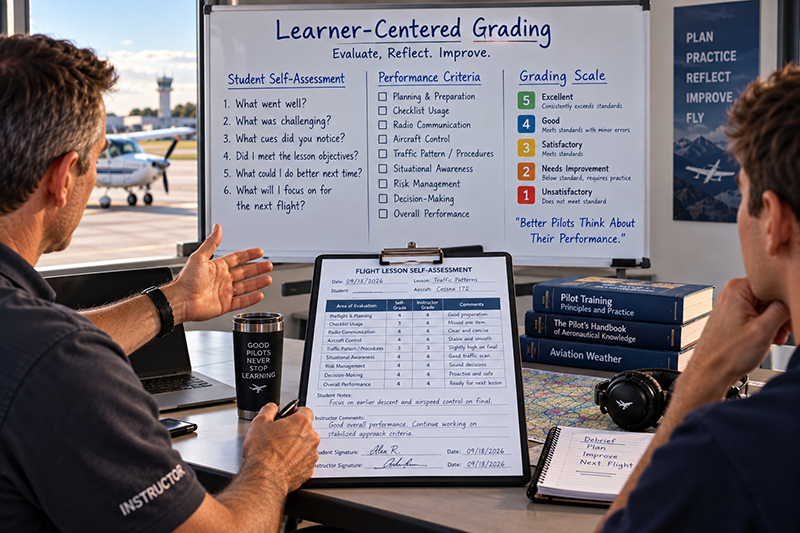
Learner-centered grading is a practical way to help flight students evaluate their own performance instead of waiting passively for an instructor to announce a grade. In aviation training, that matters because safe pilots must learn to judge their own planning, aircraft control, checklist discipline, radio work, risk management, and decision-making long before a practical test or a solo flight places them in command.
For pilots and instructors, learner-centered grading is not a softer standard and it is not a replacement for objective evaluation. It is a training method that makes the standard more visible. The instructor still evaluates performance, protects safety, and ensures training stays aligned with the applicable certificate, rating, school, or operator expectations. The difference is that the student is asked to participate actively in the evaluation process. When done well, the result is a more useful debrief, stronger self-awareness, and better transfer of learning from one lesson to the next.
What Learner-Centered Grading Means in Aviation Training
In traditional grading, the instructor observes a maneuver, procedure, briefing, or scenario and then tells the student what was satisfactory and what was not. That has value, especially when safety is at stake or when the student does not yet understand the standard. But if the entire evaluation comes from the instructor, the student may learn to fly for approval rather than learn to evaluate performance against an aviation standard.
Learner-centered grading shifts part of the evaluation conversation to the learner. After a traffic pattern, steep turn, cross-country planning session, abnormal procedure, or weather decision scenario, the instructor asks the student to assess what happened. The student compares the outcome to the lesson objective, identifies strengths and weak areas, explains what cues were missed, and proposes a correction for the next attempt. The instructor then confirms, refines, or redirects that assessment.
The key word is centered, not controlled. The student is involved in the grading process, but the instructor does not give up instructional authority. In aviation, the instructor remains responsible for maintaining safety, giving accurate feedback, and ensuring the learner understands the performance standard. Learner-centered grading works best when it is anchored to clear criteria, not feelings. A student might feel that a landing was acceptable because it was smooth, but a better assessment asks whether the approach was stabilized, airspeed was managed, centerline control was maintained, touchdown was appropriate for the condition, and the go-around option was actively considered.
This method supports a deeper kind of learning. Pilots do not just need to know whether a maneuver was good or bad. They need to know why it was good or bad, how they recognized it, and what they will do differently next time. Those habits are directly connected to real-world aeronautical decision-making.
Why This Matters in Real-World Aviation
Aviation is full of moments where no instructor, examiner, chief pilot, or dispatcher is sitting beside the pilot to provide an instant grade. A pilot must self-assess continuously. Was that takeoff briefing complete enough for the runway and wind conditions? Is the climb performance matching expectations? Did the workload rise because of weather, traffic, avionics confusion, or a weak plan? Is the approach still stable, or is the pilot simply hoping it will work out?
Self-evaluation is not an academic exercise. It is part of command judgment. A pilot who can honestly evaluate performance in real time is more likely to correct small deviations before they become large ones. That may mean calling for a go-around, asking for a delay vector, slowing the aircraft earlier, re-briefing a procedure, discontinuing a training maneuver, or admitting that the conditions are exceeding the pilot's current proficiency.
Flight training often focuses on technical skill because technical skill is visible. An instructor can see altitude control, heading control, bank angle, touchdown point, and checklist flow. But the less visible skill is self-monitoring. Learner-centered grading gives instructors a structured way to teach that skill. Instead of only saying, You were 150 feet low, the instructor can ask, What cues told you the altitude was getting away from you? When did you first notice it? What correction did you choose? What would have prevented it?
Those questions train the student to notice performance drift. In real operations, drift is often subtle. A pilot might accept a slightly rushed preflight, then a slightly incomplete passenger briefing, then a slightly high workload taxi, then a departure with a frequency already missed. None of those moments may feel dramatic by itself, but together they show a pattern. Learner-centered grading helps students recognize patterns rather than treating each error as an isolated event.
For instructors, this approach also improves the quality of the debrief. A debrief that simply lists errors can become discouraging or forgettable. A debrief that helps the student explain causes, cues, corrections, and standards is more likely to produce a meaningful change in behavior. It also gives the instructor insight into the student's thinking. Sometimes a student knows a maneuver was poor but misunderstands the reason. Sometimes the student flew acceptably but used fragile reasoning that could fail in a more demanding situation. Learner-centered grading brings that reasoning into view.
How Pilots Should Understand This Topic
Pilots should understand learner-centered grading as a disciplined self-assessment process. It is not the student negotiating a grade. It is not the instructor avoiding difficult feedback. It is not a discussion about whether a lesson felt successful. It is a way to connect the learner's observations to the performance standard and the safety consequences of the task.
A useful learner-centered grading conversation usually has three parts. First, the student describes what happened. This should be factual and specific. Instead of saying, The approach was bad, the student might say, I turned base late, carried extra airspeed, and crossed the threshold higher than planned. Second, the student compares that performance with the desired outcome. The desired outcome may come from a lesson objective, aircraft operating practice, instructor briefing, school syllabus, or practical test standard appropriate to the training goal. Third, the student identifies a correction. The correction should be actionable, such as planning the descent earlier, verbalizing airspeed targets, setting a personal gate for go-around, or asking for more time before accepting a clearance.
This structure is especially useful because it prevents vague self-critique. Many students can say, I need to be better with landings, radios, or navigation. Fewer can identify the exact part of the task that is breaking down. Is the landing problem caused by approach planning, airspeed control, visual aiming point, roundout timing, crosswind correction, or an unstable final? Is the radio problem caused by phraseology, task saturation, poor anticipation, or not writing down instructions? Learner-centered grading helps isolate the real learning need.
For student pilots, the process may feel awkward at first. Early in training, students often lack the experience to know what good performance looks like. That is normal. The instructor can provide simple prompts such as, What went as planned? What changed? What did you notice first? What would you repeat? What would you change? Over time, the student's answers should become more precise and more closely tied to operational risk.
For certificated pilots, learner-centered grading can be equally valuable in flight reviews, instrument proficiency work, transition training, recurrent training, and scenario-based training. A pilot returning after time away from flying may technically complete a maneuver but still notice poor cockpit organization, weak checklist flow, or slow recognition of automation mode changes. A learner-centered debrief allows those issues to be addressed honestly before they appear during a high-workload flight.
The Instructor's Role in Learner-Centered Grading
The instructor's role is to create the conditions for accurate self-assessment. That begins before the flight. If the lesson objective is vague, the debrief will be vague. If the instructor only says, We will work on takeoffs and landings, the student may judge the flight by comfort or smoothness. If the instructor says, Today we will focus on stabilized final approach, crosswind correction, centerline alignment, and go-around recognition, the student has a clearer basis for evaluating performance.
During the flight, the instructor should decide when to let the student continue and when to intervene. Learner-centered grading never requires an instructor to allow unsafe conditions to develop for the sake of discovery. Safety intervention is still part of professional instruction. After an intervention, however, the debrief can still be learner-centered. The instructor might ask, What did you see just before I took the controls? What trend was developing? What were your options? How could we identify that earlier next time?
In the debrief, the instructor should listen before correcting. This does not mean accepting an inaccurate student assessment. It means discovering how the student understands the event. If the student underrates performance, the instructor can help build confidence by identifying what met the standard. If the student overrates performance, the instructor can guide the learner back to objective criteria. If the student focuses on the wrong issue, the instructor can redirect attention to the factor that mattered most.
The strongest instructor feedback is specific, behavior-based, and connected to future action. A comment such as, Your traffic pattern work was inconsistent, may be true but incomplete. A more useful version might be, Your downwind spacing changed on each circuit, which made your base turn and descent planning harder. On the next pattern, choose a consistent ground reference and verbalize your abeam point, power reduction, and target airspeed. That kind of feedback gives the student something to observe and do.
Building Self-Assessment Into Flight Lessons
Learner-centered grading works best when it is built into training from the beginning rather than saved for checkride preparation. A new student can start with simple self-assessment. After a lesson on straight-and-level flight, the student might identify whether altitude, heading, or trim required the most attention. After a taxi lesson, the student might assess brake use, centerline tracking, airport signage awareness, and radio readiness. These early reflections teach the habit of comparing performance to a standard.
As training progresses, the self-assessment can become more sophisticated. In cross-country training, a student can evaluate planning assumptions, fuel awareness, navigation checkpoints, diversion readiness, weather interpretation, and cockpit workload. In instrument training, the student can assess scan breakdowns, briefing quality, altitude awareness, course intercepts, missed approach readiness, and automation management. In commercial or instructor training, the learner can evaluate precision, instructional clarity, energy management, risk communication, and consistency under pressure.
The most effective method is often a short, structured debrief immediately after the task or flight. A long lecture can dilute the learning. A better approach is to focus on the highest-value points. What was the lesson objective? What evidence shows whether it was met? What was the most important safety issue? What one or two changes will improve the next flight? This keeps the student engaged and prevents the debrief from becoming a list of every small imperfection.
Written self-assessment can also be useful. A training notebook, digital lesson record, or post-flight reflection can help the student track recurring themes. The goal is not paperwork for its own sake. The goal is to build a record of learning that shows patterns. If the student repeatedly notes rushed checklist use, late power changes, or weak wind correction, the instructor and student can address the root cause rather than treating each lesson as a fresh surprise.
Common Mistakes or Misunderstandings
One common misunderstanding is that learner-centered grading means the student decides whether performance was satisfactory. In aviation training, standards matter. A student may participate in the evaluation, but the instructor must still ensure the outcome is honest and accurate. If an approach is unstable, a procedure is missed, or situational awareness is poor, the debrief must say so clearly. Learner-centered grading should make standards more understandable, not more flexible.
Another mistake is relying on confidence as a substitute for competence. A student may feel comfortable after a smooth flight while missing important risk cues. Another student may feel discouraged even though the flight showed measurable improvement. The instructor's job is to help separate emotion from evidence. Confidence is useful when it is based on demonstrated skill and sound judgment. It can be hazardous when it grows faster than proficiency.
A third mistake is turning self-assessment into self-criticism. Some motivated students are hard on themselves and may label an entire lesson as a failure because of one error. That kind of thinking can interfere with learning. Good grading identifies both strengths and areas for improvement. In aviation, recognizing what went well is not ego. It helps the pilot repeat effective behaviors under pressure.
A fourth issue is vague language. Terms like good, bad, better, smooth, sloppy, or nervous may describe how the flight felt, but they do not explain performance. Aviation learners need operational language. Did the pilot maintain aircraft control? Was the checklist used at the right time? Were radio calls anticipated? Was the aircraft configured appropriately? Was the landing decision made early enough? Did the student recognize a developing risk before the instructor pointed it out?
Finally, instructors sometimes ask students to self-grade without first teaching them how. Early learners may not know the standard, the cues, or the risk significance. They may focus on the most obvious event rather than the most important one. A student might obsess over a firm touchdown while ignoring the fact that the approach was unstable. The instructor must coach the self-assessment process until the student can evaluate performance with increasing independence.
Practical Example: A Learner-Centered Landing Debrief
Consider a student pilot practicing landings in a single-engine training aircraft on a day with a modest crosswind. The preflight briefing sets the objective: fly a consistent traffic pattern, maintain appropriate approach speed, apply crosswind correction, and make a timely go-around decision if the approach becomes unstable. The instructor tells the student that the debrief will focus less on whether each touchdown feels smooth and more on whether the approach and decision-making support a safe landing.
On the first pattern, the student extends downwind because of traffic and turns base later than planned. The aircraft becomes slightly high on final. The student reduces power, lowers the nose, and allows airspeed to increase. The landing is smooth, but the touchdown occurs farther down the runway than intended. After clearing the runway, the instructor asks the student to evaluate the approach.
A traditional debrief might begin with the instructor saying, You were high and fast. In a learner-centered debrief, the instructor first asks, How did that approach compare with our plan? The student initially says, The landing felt pretty good. The instructor follows with, What about the approach path and touchdown point? The student then recognizes that the smooth touchdown did not mean the approach met the objective. The student identifies the late base turn, the extra airspeed, and the delayed decision to go around as the main issues.
The instructor confirms the assessment and adds context. A smooth landing can still come from a poorly managed approach. The next objective is to manage spacing earlier and set a personal decision point. If the aircraft is not stable by that point, the student will initiate a go-around rather than trying to salvage the landing. On the next circuit, the student verbalizes spacing, corrects for the crosswind earlier, and chooses a go-around when the approach again becomes high. That go-around becomes a successful training outcome because the student recognized the problem and made the safer decision.
This example shows why learner-centered grading is valuable. The grade is not about praising or criticizing the student. It is about helping the student connect evidence, standards, and action. The student learns that a safe pilot does not judge a landing by comfort alone. A safe pilot evaluates the entire sequence: planning, configuration, airspeed, alignment, aiming point, wind correction, and the willingness to discontinue the approach.
Best Practices for Pilots and Instructors
Learner-centered grading works best when both the instructor and student understand the purpose. The goal is to build a pilot who can evaluate performance accurately when flying alone, with passengers, in weather, at unfamiliar airports, or under operational pressure. That requires honesty, structure, and consistency.
Before the lesson, define what success looks like. A lesson objective should be specific enough that the student can observe performance. Instead of saying, We will improve navigation, identify the behaviors that matter: maintain situational awareness, verify checkpoints, manage fuel and time estimates, communicate clearly, and identify diversion options. The clearer the target, the more useful the self-assessment.
During the lesson, invite short moments of reflection when workload permits. In cruise flight, an instructor might ask, What is your next decision point? After a maneuver, the instructor might ask, What was your first cue that the altitude was changing? These questions should not overload the student during critical phases of flight, but well-timed prompts can help the learner connect perception and action.
After the lesson, keep the debrief focused. A useful structure is to ask what met the objective, what did not meet the objective, why it happened, and what the next action will be. The instructor should correct inaccurate conclusions and add technical detail where needed. The student should leave with a clear understanding of both strengths and priorities.
For pilots using learner-centered grading outside formal instruction, the same habits apply. After a personal flight, ask whether the preflight planning matched actual conditions, whether workload was managed effectively, whether any shortcuts appeared, and whether any decision should be made earlier next time. This kind of private debrief is a mark of professionalism, not a sign of weakness.
- Use objective criteria whenever possible, including lesson objectives, aircraft procedures, and the applicable training standard.
- Separate the quality of the outcome from the quality of the decision-making process.
- Discuss both what went well and what needs correction.
- Focus on causes and cues, not just the final error.
- End each debrief with a specific plan for the next flight or practice session.
Using Learner-Centered Grading for Risk Management
Risk management is one of the strongest reasons to use learner-centered grading. Pilots do not manage risk only by memorizing rules or acronyms. They manage risk by recognizing changing conditions, comparing those conditions to personal and operational limits, and making timely decisions. Self-assessment is the bridge between knowledge and action.
In a weather scenario, for example, a student may be asked to plan a VFR cross-country with marginal conditions nearby. The point of the exercise is not simply to choose go or no-go. The learner should evaluate the quality of the information used, the assumptions made, the alternatives considered, and the triggers that would cause a delay, diversion, or cancellation. After the scenario, the instructor can ask the student to grade the decision process. Did the student seek current information? Did the student identify terrain, fuel, daylight, and alternates? Did the student consider personal proficiency? Did the student leave room for uncertainty?
This kind of grading helps students avoid a dangerous training habit: believing that every scenario has one neat answer. Real aviation decisions often involve changing information, incomplete certainty, and competing pressures. Learner-centered grading teaches pilots to evaluate the process as well as the result. A good decision process can still lead to a conservative no-go. A poor decision process can sometimes be followed by an uneventful flight, but that does not make the process sound.
For instructors, the safety value is significant. Students reveal how they think about risk. They may show a tendency to press on, to defer too much to technology, to underestimate workload, or to rely on the instructor to rescue the situation. Once those tendencies are visible, they can be trained.
How This Supports Checkride and Career Preparation
Although learner-centered grading should not be limited to checkride preparation, it supports practical test readiness because the applicant must demonstrate not only mechanical skill but also judgment, planning, and awareness. A pilot who can explain performance honestly is usually better prepared for scenario-based questions, in-flight corrections, and post-maneuver discussion.
During final preparation for a certificate or rating, learner-centered grading can help identify whether the learner is merely performing rehearsed tasks or actually understands the operation. If a student can state what went wrong, why it happened, and how to prevent it, that student is developing durable proficiency. If the student can only wait for the instructor to supply the answer, more training may be needed before independent operation.
The same habit matters beyond the training environment. Professional aviation depends on continuous evaluation. Crew briefings, simulator sessions, line checks, maintenance test flights, safety management discussions, and personal proficiency flights all rely on honest assessment. A pilot who learns early to debrief without defensiveness is better prepared for the culture of continuous improvement that aviation demands.
Frequently Asked Questions
Is learner-centered grading the same as letting the student choose the grade?
No. The student participates in evaluating performance, but the instructor remains responsible for accurate assessment and safety. Learner-centered grading helps the student understand the standard and compare performance against it. It does not lower the standard or turn grading into a negotiation.
Can this method work with brand-new student pilots?
Yes, but the questions should be simple at first. A new student may not be ready to evaluate every detail of a maneuver, but they can identify what they noticed, what felt controlled, what required help, and what they want to improve. The instructor gradually teaches more precise self-assessment as the student gains experience.
How does learner-centered grading improve safety?
It builds the habit of noticing performance drift and decision errors before they become serious. A pilot who can self-assess is more likely to recognize an unstable approach, rising workload, poor weather plan, checklist lapse, or loss of situational awareness and take corrective action earlier.
What should an instructor do if the student self-assessment is wrong?
The instructor should correct it clearly and professionally. A wrong self-assessment is still useful because it shows how the student is thinking. The instructor can then connect the discussion back to objective criteria, aircraft control, procedure, risk management, and the lesson objective.
Does learner-centered grading replace written syllabi or training records?
No. It complements them. Training records document progress and requirements, while learner-centered grading improves the quality of the evaluation conversation. Both can support a more organized and effective training program when used properly.
Can certificated pilots use this outside formal training?
Absolutely. After any flight, a pilot can debrief planning, aircraft handling, communication, workload, and decisions. This is especially useful after challenging weather, unfamiliar airspace, night operations, instrument practice, or flights that felt rushed or disorganized.
Key Takeaways
- Learner-centered grading helps flight students compare their own performance to clear aviation training objectives rather than relying only on instructor judgment.
- The safety value comes from better self-monitoring, earlier recognition of performance drift, and more honest decisions during real flight operations.
- Instructors should keep the process objective, correct inaccurate self-assessments, and use each debrief to build the student's next action plan.