
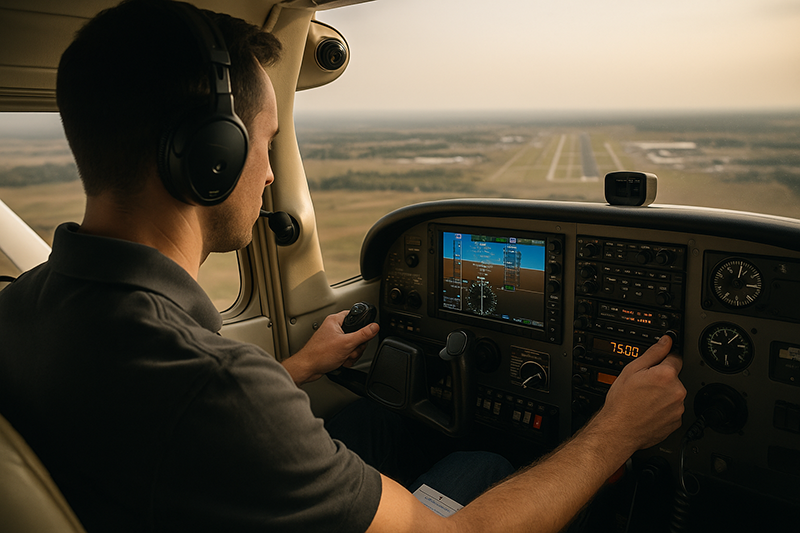
Lost communications procedures are one of those topics many general aviation pilots review for a checkride, then hope never to use. In real flying, however, a radio failure can happen during a local training flight, a night cross-country, a busy terminal arrival, or an IFR flight in instrument meteorological conditions. The pilot who has already thought through the problem will be far more effective than the pilot who starts learning the procedure after the radios go quiet.
This article explains practical lost communications procedures for GA pilots with an emphasis on cockpit priorities, VFR and IFR decision-making, transponder use, airspace considerations, and communication alternatives. It is written for pilots, student pilots, instructors, and aviation professionals who want more than a memorized answer. The goal is to turn a regulatory and training topic into a usable mental model for real operations.
What Lost Communications Really Means
A lost communications event is not always a complete electrical failure or a dead radio. It may be a broken microphone, an audio panel set incorrectly, a headset plug not fully seated, a stuck push-to-talk switch, a missed frequency change, a failed receiver, a failed transmitter, or a simple volume or squelch problem. The first practical step is recognizing that “no radio contact” can have many causes, and the correct response depends on whether you can still hear, still transmit, or neither.
In training, pilots often describe the event as “lost comm,” but in the cockpit the diagnosis matters. If you can hear ATC but cannot transmit, you still have valuable information. ATC may issue instructions, ask you to ident, or coordinate with other aircraft based on what they believe you can do. If you can transmit but cannot hear, your radio calls may still help ATC and other pilots understand your intentions. If both transmitting and receiving are lost, you need to rely on the procedures, your clearance, visual signals when applicable, and conservative decision-making.
The pilot’s first responsibility remains aircraft control. A communications failure should not become a flight path failure. Aviate, navigate, and communicate is not just a slogan. During lost communications, the order matters. Fly the airplane, maintain terrain and obstacle clearance, keep the flight on a predictable path, and only then troubleshoot or attempt alternate communications.
Why This Matters in Real-World Aviation
Radio communication is a major layer of safety in modern general aviation, but it is not the only layer. Airspace rules, published procedures, transponder codes, flight plans, clearances, light gun signals, and predictable pilot behavior all help keep aircraft separated when voice communication is unavailable. A pilot who understands these layers can reduce confusion and help ATC anticipate the aircraft’s next move.
The safety risk is not only the radio failure itself. The greater hazard is often the distraction that follows. Pilots may stare at the radio stack, twist knobs repeatedly, descend without a plan, forget to monitor fuel, drift off course, or enter airspace without considering what others expect. In IMC, that distraction can quickly erode instrument scan and situational awareness. In VFR near a towered airport, it can cause the pilot to miss traffic, misunderstand light gun signals, or make an unexpected pattern entry.
For flight instructors, lost communications training is also a valuable way to teach decision-making. It forces students to connect regulations, airspace knowledge, cockpit management, aircraft systems, and practical judgment. The best training is not simply asking, “What squawk code do you use?” It is asking, “What would you do right now, in this airspace, with this weather, this fuel state, this clearance, and this airport ahead?”
The First Minute: Confirm, Troubleshoot, and Stabilize
The first minute after suspected radio failure should be calm, deliberate, and disciplined. Many apparent radio failures are cockpit setup problems. Before assuming the communication system has failed, check the obvious items without allowing troubleshooting to consume your attention.
Verify that the correct frequency is selected and active, not sitting in standby. Check the volume, squelch, audio panel selection, intercom controls, headset plugs, push-to-talk switch, microphone selection, and circuit breakers if appropriate for the aircraft and if doing so does not distract from flying. Try the other radio if installed. If the aircraft has a handheld radio, use it early rather than treating it as a last resort. If you are using a panel-mounted GPS or navigator with a frequency database, confirm the frequency from a reliable source and make sure you did not transpose digits.
It is also useful to determine whether the problem is transmit, receive, or both. If you hear other aircraft but ATC does not answer, attempt a radio check on the current frequency. If you can reach another aircraft, ask for a relay. If you suspect you are transmitting but cannot receive, continue making concise position and intention reports as appropriate. Those calls may still be heard by ATC or nearby traffic, even if you receive no reply.
If the radio failure is connected to a broader electrical issue, the decision becomes more serious. A dark panel, abnormal alternator indication, battery discharge, or multiple avionics failures may affect navigation, lights, flaps, landing gear indications, or other systems depending on aircraft design. In that case, follow the aircraft’s approved checklist and consider whether the safest choice is to land at a suitable airport sooner rather than continue troubleshooting in flight.
VFR Lost Communications Procedures
For a VFR pilot, the practical lost communications question is usually: “Can I continue safely and legally to a suitable airport, and what will other pilots or ATC expect me to do?” If you are outside controlled airspace that requires two-way communication, the event may be manageable with normal see-and-avoid practices, careful planning, and self-announced intentions where transmissions are possible. If you are approaching, entering, or operating within airspace that requires communication, the problem becomes more complex.
In VFR conditions, a conservative response is usually to remain clear of airspace where two-way communication is required unless you have already established communication and the situation permits continued predictable flight. If you are inbound to a towered airport and cannot communicate by radio, you should understand light gun signals and plan to remain visible, predictable, and clear of conflict. If you are not certain that landing at a towered airport is the best option, diverting to a suitable nontowered airport may reduce workload and complexity, provided weather, fuel, terrain, and airport suitability support that decision.
At a towered airport, look for light gun signals from the tower. These signals are a backup method for controlling aircraft without radio communication. Pilots should review the meaning of steady and flashing red, green, and white signals before flight training operations at towered airports, not after a radio problem begins. In the airplane, acknowledge light gun signals in a practical way, such as rocking wings during the day or flashing landing or navigation lights at night when appropriate and safe.
At a nontowered airport, lost communications still require discipline. If you can transmit but cannot receive, make standard traffic pattern calls and clearly state that you are unable to receive. If you cannot transmit, fly a standard and predictable traffic pattern when practical, watch carefully for traffic, use exterior lights as appropriate, and avoid nonstandard maneuvers that would surprise other pilots. Entering the pattern in a conventional way is more valuable than trying to improvise a clever solution.
IFR Lost Communications Procedures
IFR lost communications procedures require special attention because the pilot may be in cloud, on an ATC clearance, and operating in airspace where predictability is essential. The commonly taught memory aids for IFR lost communications are useful, but they should be understood as a framework rather than a substitute for judgment and regulatory knowledge.
One important principle is that if an IFR aircraft loses communications while in VFR conditions, or later encounters VFR conditions, the practical expectation is to continue under VFR and land as soon as practicable when that can be done safely. This helps remove the aircraft from the IFR system and reduces uncertainty for ATC. Pilots should not use an IFR lost communications route as an excuse to continue into complex IMC if a safe VFR landing option is available.
If the flight is in IMC and communications are lost, IFR procedures focus on two major questions: what route to fly and what altitude to maintain. Pilots often remember the route priority with the acronym AVEF: Assigned, Vectored, Expected, Filed. In practical terms, this means you start with the last route assigned by ATC. If you were being radar vectored, proceed by a logical route to the fix, route, or airway specified in the vector clearance when applicable. If ATC told you to expect a further route, use that expected route when appropriate. If none of those apply, the filed flight plan route becomes the reference.
Altitude is commonly taught with the acronym MEA: Minimum, Expected, Assigned. The pilot considers the highest of the applicable minimum IFR altitude, the altitude ATC said to expect, and the last assigned altitude. In practice, this is about protecting obstacle clearance and preserving ATC predictability. Pilots should understand the applicable minimum altitude for the segment being flown, including published minimum enroute altitudes, minimum obstacle clearance altitudes where used, minimum vectoring or IFR altitudes when known through ATC assignment, and procedure altitudes. The details can vary with route and clearance, so training should include real chart scenarios rather than only reciting the acronym.
Clearance limit and expected further clearance time are also important. If ATC issued a clearance limit and an expected further clearance time, that information affects timing. If no expected further clearance time was received, pilots should understand the standard IFR lost communications timing concepts associated with the clearance limit and the filed or amended estimated time of arrival. This area is regulatory and should be reviewed directly in current FAA materials during training, because precise timing matters and memory alone is not enough.
Transponder Use and Electronic Clues
The standard transponder code for radio communications failure is 7600. Selecting 7600 tells ATC that the aircraft has a communications problem. If the aircraft is already using a discrete transponder code, changing to 7600 is generally the recognized way to signal the condition. Pilots should avoid experimenting with codes or switching repeatedly unless there is a clear reason. A stable, predictable transponder response is useful to controllers.
If ATC can see your aircraft on radar or ADS-B displays, they may still be able to anticipate your route, altitude, and intentions based on your clearance, track, and transponder code. This is why predictable flying is so important. When a pilot abruptly changes altitude, turns away from the expected route, or departs a clearance without a safety reason, the situation becomes harder for everyone.
Modern avionics may provide additional options, but they do not eliminate the need to know the basic procedure. Some aircraft have datalink capability, satellite communication, or electronic messaging through installed equipment. Many GA aircraft do not. A cell phone may work on the ground or at low altitude in some areas, but it should not be relied upon as the primary solution in flight. If a phone call to ATC or flight service becomes a safe and practical option, it can be helpful, but it should not distract from aircraft control or conflict avoidance.
How Pilots Should Understand This Topic
The best way to understand lost communications is to think in terms of expectations. What does ATC expect you to do? What do other pilots expect you to do? What did your clearance authorize? What will keep the aircraft clear of terrain, obstacles, weather hazards, and traffic? When pilots answer those questions in order, the procedures become more logical.
For VFR flight, the key is usually to remain visual, avoid airspace conflicts, choose a suitable landing airport, and communicate intentions by any available safe method. For IFR flight, the key is to preserve the clearance structure, comply with the lost communications route and altitude logic, and avoid improvising unless safety requires it. In both cases, the pilot should reduce workload, use all available resources, and avoid turning a communication problem into a navigation or aircraft control problem.
Preflight planning makes a major difference. Before an IFR flight, review the route, filed alternates when applicable, expected departure and arrival procedures, minimum altitudes, and likely clearance limits. Before VFR flight near busy airspace, consider what you would do if the radio failed before entering, while inside, or while inbound to land. If you carry a handheld radio, make sure it is charged, accessible, and compatible with your headset or cockpit noise environment. A backup radio buried in a flight bag behind the rear seat is not a practical backup.
Instructors can improve training by creating scenarios that require judgment. For example, simulate a receiver failure on downwind at a towered airport, a transmitter failure while receiving flight following, or complete radio failure while approaching the initial approach fix in IMC during a simulator session. The value is in the discussion: what did the pilot know, what could the pilot verify, what did ATC likely expect, and what was the safest predictable action?
Common Mistakes or Misunderstandings
One common mistake is assuming that every lost communications event requires the same response. A VFR pilot outside busy airspace, an IFR aircraft in IMC on an airway, and a student pilot in the traffic pattern at a towered airport all face different problems. The procedure must fit the environment.
Another mistake is troubleshooting too long. Pilots can become absorbed in the radio stack and lose altitude, heading, airspeed, or traffic awareness. A quick, organized troubleshooting flow is appropriate. Extended troubleshooting should wait until the aircraft is stable, clear of immediate hazards, and on a known plan.
A third misunderstanding is treating the transponder code as the whole procedure. Squawking 7600 is helpful, but it does not decide where to fly, what altitude to maintain, whether to continue VFR, or which airport to use. It is a signal, not a solution.
Some pilots also over-apply IFR memory aids without understanding their limits. AVEF and MEA are useful, but they are not magic words. They must be connected to the actual clearance, route, charted altitudes, expected further clearance information, and current flight conditions. A pilot who memorizes the acronyms but cannot apply them to a real clearance has not finished learning the procedure.
Another risk is pressing on to the original destination when a safer nearby landing option exists. This is especially relevant in VFR conditions. If communications are lost and the destination is under complicated airspace, marginal weather, or heavy traffic, a suitable alternate airport may be the better decision. Pilots should be careful not to let plan continuation bias control the outcome.
Finally, some pilots forget that light gun signals and nontowered pattern discipline need periodic review. These are not obscure trivia items. They are backup systems. If a pilot cannot remember the meaning of a steady green or flashing red signal, the time to fix that knowledge gap is during recurrent training, not while circling a towered airport with a silent radio.
Practical Example
Consider a private pilot flying a normally aspirated single-engine airplane on an IFR cross-country in visual conditions above a scattered cloud layer. The pilot is receiving vectors from approach control toward the destination. The controller assigns a heading and altitude, then the radio goes quiet. The pilot calls approach, receives no answer, tries the previous frequency, checks the audio panel, verifies the headset connections, and switches to the second radio. Still nothing. Other aircraft are faintly audible on one radio, but no one responds to the pilot’s transmissions.
The pilot first maintains aircraft control and continues the assigned heading and altitude while troubleshooting. Because the aircraft is in VFR conditions and can remain VFR, the pilot evaluates nearby airports and weather. Rather than continue toward a busy Class C destination with uncertain communication, the pilot selects a suitable nontowered airport in good weather, remains clear of airspace requiring communication, squawks 7600, and begins a predictable diversion. If able to transmit, the pilot broadcasts intentions on the appropriate traffic advisory frequency while stating that receiver capability may be unreliable. If unable to transmit, the pilot flies a standard pattern, watches carefully for traffic, uses exterior lights, lands, clears the runway, and contacts ATC by phone after shutdown as appropriate.
Now change one condition: the same pilot is in IMC on a cleared route, cannot maintain VFR, and has lost both transmit and receive capability. The decision is different. The pilot should follow the IFR lost communications route and altitude logic based on the clearance, assigned or expected route, filed route, applicable minimum IFR altitudes, and any expected further clearance information. The safest action is not to improvise a direct route simply because it looks shorter on the GPS. In IMC, predictability is a major safety tool.
This example shows why lost communications training must include context. The right answer depends on weather, clearance, airspace, aircraft capability, fuel, terrain, and available airports. A pilot who thinks only in terms of one memorized answer may make the wrong choice in a real event.
Best Practices for Pilots
Good lost communications management begins before engine start. During preflight planning, identify the airspace along the route, note likely frequencies, review towered airport light gun signals, and consider diversion options. For IFR flights, review minimum altitudes and the route structure so the clearance makes sense if communication is lost later. If you do not understand a clearance when it is issued, ask for clarification while the radios still work.
In the cockpit, keep communication equipment organized. Know how the audio panel works. Know how to swap radios quickly. Keep a handheld radio accessible if you carry one, and practice using it on the ground. Make sure batteries are charged and adapters are available. For aircraft with complex avionics, practice basic radio and audio panel failure scenarios with an instructor so you are not learning menu logic in flight.
When a failure occurs, use a calm sequence: fly the airplane, confirm the problem, try reasonable alternate communication methods, set the appropriate transponder code when warranted, and proceed according to VFR or IFR lost communications expectations. Avoid unnecessary frequency changes once the situation is clear, because ATC may be trying to reach you on the last assigned frequency. If you can still transmit, make concise calls that include who you are, where you are, what the problem is, and what you intend to do.
The following habits are especially useful in GA operations:
- Brief lost communications actions before IFR departures and before entering complex terminal airspace.
- Keep current charts available so minimum altitudes, airport data, and frequencies can be verified quickly.
- Use standard phraseology and predictable flight paths when partial communication remains possible.
- Review tower light gun signals during recurrent training and before operations at towered airports.
- Do not allow troubleshooting to degrade aircraft control, instrument scan, traffic awareness, or fuel management.
For instructors, the best practice is to teach lost communications as an applied scenario. Ask the student to explain not only what they would do, but why. Then change one variable, such as weather, airspace, clearance limit, fuel state, or available airport, and discuss how the decision changes. That style of training builds judgment instead of rote recall.
Training Considerations for Student Pilots and Flight Instructors
Student pilots should learn lost communications procedures early enough that the topic feels normal rather than intimidating. A simple training exercise might begin at a nontowered airport: the instructor asks the student to continue the pattern while imagining that the radio can transmit but not receive. The student practices scanning for traffic, making clear position reports, and flying a standard pattern. Later, the instructor can introduce towered airport light gun review, controlled airspace considerations, and IFR scenarios when appropriate for the student’s certificate or rating.
Instrument students need deeper scenario work. They should practice applying IFR lost communications logic to actual clearances, not just textbook routes. A good simulator session might include a departure clearance, radar vectors, an expected altitude, a clearance limit, and then a simulated radio failure. The student should identify the route, altitude, timing considerations, and approach plan, then explain the reasoning. The instructor should emphasize that current regulations and FAA guidance must be reviewed directly, because precision matters in IFR lost communications.
Recurrent training is equally important for certificated pilots. Many pilots fly for years without using light gun signals or applying IFR lost communications procedures in realistic detail. That makes the knowledge perishable. A short review during a flight review, instrument proficiency check, or safety meeting can reveal gaps before they matter.
Frequently Asked Questions
What transponder code should a pilot use for lost communications?
The recognized transponder code for radio communications failure is 7600. Selecting it helps ATC identify that the aircraft has a communications problem. The code does not replace the need to follow appropriate VFR or IFR procedures and make safe decisions based on the situation.
Should a VFR pilot continue to the destination after a radio failure?
Not automatically. A VFR pilot should consider weather, fuel, airspace, traffic, airport suitability, and workload. If the destination involves complex controlled airspace or a towered airport and a suitable alternate is available, diverting may be the safer and simpler option.
What should an IFR pilot do if communications fail in VFR conditions?
If an IFR pilot is in VFR conditions, or later reaches VFR conditions, the practical expectation is to continue visually and land as soon as practicable when safe. Pilots should review the current regulation and FAA guidance during training because exact IFR lost communications requirements matter.
Are AVEF and MEA enough to handle IFR lost communications?
No. AVEF and MEA are useful memory aids for route and altitude decisions, but they must be applied to the actual clearance, expected route or altitude, filed route, charted minimum altitudes, clearance limit, and flight conditions. They are starting points for analysis, not a complete substitute for understanding.
Can a pilot use a cell phone to contact ATC during a radio failure?
A phone may be useful in some circumstances, especially on the ground or when workload is low, but it should not be relied on as the primary in-flight solution. Aircraft control, navigation, traffic avoidance, and established lost communications procedures remain the priority.
How often should pilots review light gun signals?
Pilots should review light gun signals often enough to recognize and respond without hesitation. A practical time to review them is before solo training at towered airports, before flight reviews, before operating into unfamiliar towered airports, and during recurrent safety training.
Key Takeaways
- Lost communications procedures work best when pilots first fly the airplane, stabilize the situation, and diagnose whether the failure affects transmitting, receiving, or both.
- For VFR operations, predictable flying, airspace awareness, light gun knowledge, and a willingness to divert can reduce risk after a radio failure.
- For IFR operations, pilots must understand the practical meaning of assigned, expected, filed, and minimum altitude concepts, then verify the current regulatory details during training.