
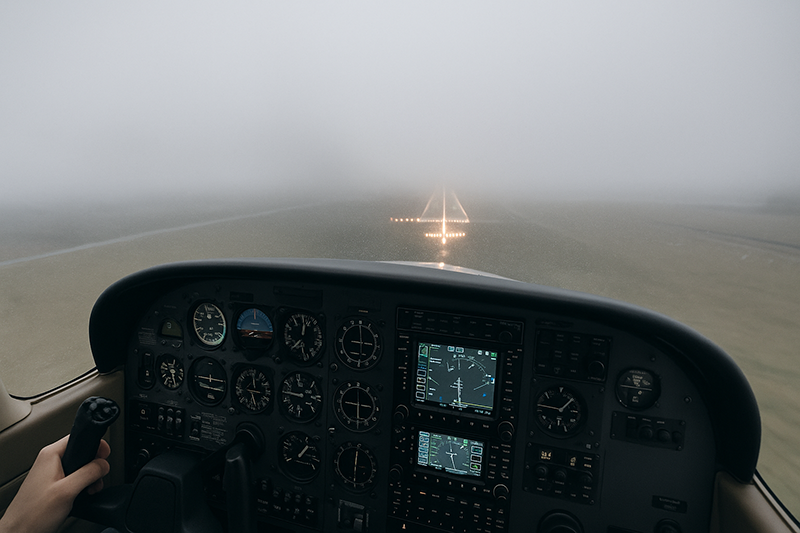
Low-ceiling arrivals demand more from a pilot than simply loading an instrument approach and waiting for the runway to appear. When cloud bases are low, the arrival becomes a disciplined exercise in weather interpretation, approach selection, aircraft configuration, cockpit workload management, and missed approach readiness. The risk is not that low ceilings are automatically unsafe. The risk is arriving without a clear plan for what the weather allows, what the aircraft and pilot are prepared to do, and when the safest choice is to stop descending or go somewhere else.
For student pilots, instrument students, flight instructors, and experienced aviators, preparing for low-ceiling arrival scenarios is one of the most valuable ways to build practical judgment. It connects preflight weather analysis with real cockpit decision-making. It also exposes weak habits quickly: vague alternate plans, rushed approach briefings, overconfidence in automation, and the temptation to press below a sensible decision point. This article explains how to think through a low-ceiling arrival before it becomes a high-workload surprise.
What Low-Ceiling Arrival Planning Really Means
A low ceiling is generally understood as a cloud base that limits how much visual reference a pilot will have near the airport. In practical terms, it affects whether a VFR arrival is reasonable, whether an instrument approach is needed, which approach offers the most useful guidance, how much time the pilot will have to transition visually, and whether the airplane can be landed from a stabilized position after breaking out of the clouds.
Low-ceiling arrival planning is not just an IFR skill, although it is central to instrument flying. It also matters to VFR pilots because ceilings can deteriorate, local terrain can reduce available maneuvering room, and marginal visual conditions can create pressure to continue when turning around or diverting would be smarter. A VFR pilot who launches toward a forecast low ceiling without a conservative out can find the final portion of the flight becoming progressively more restrictive.
For IFR pilots, the main question is not simply, “Is the weather above minimums?” The better question is, “If the weather is near minimums, can I fly the procedure precisely, manage the aircraft configuration early, identify the required visual references, and execute the missed approach immediately if the approach does not become landable?” That mindset turns the arrival from a hope-based event into a controlled operation.
Good planning also separates the legal question from the operational question. Published approach minimums, pilot qualifications, aircraft equipment, weather reporting, and operating rules all matter. But a legal arrival can still be a poor operational choice if the pilot is tired, unfamiliar with the airport, facing strong winds, dealing with equipment issues, or flying into a complex runway and taxi environment. Low ceilings reduce the margin for sorting out those details late.
Why Low Ceilings Matter in Real-World Aviation
The last portion of a flight is often where workload peaks. The pilot may be descending, communicating with air traffic control, configuring the aircraft, navigating to an initial or intermediate fix, reviewing missed approach instructions, monitoring automation, and assessing rapidly changing weather. Add a low ceiling, and the visual transition may occur close to the runway environment with limited time to evaluate alignment, descent rate, runway condition cues, and landing distance.
In training, low-ceiling scenarios reveal whether a pilot can maintain instrument discipline all the way to the proper point. Many instrument students fly well in the middle of an approach but become imprecise near minimums because they are searching outside too early. Experienced pilots can make the opposite mistake by staying heads-down too long after acquiring useful visual cues. The skill is not one or the other. The skill is a deliberate transition from instruments to visual references while maintaining aircraft control and a stable flight path.
For flight instructors, low-ceiling arrival discussions are an opportunity to teach risk management rather than rote procedure. An instructor can ask: What makes this approach preferable? What is the missed approach plan? What runway lighting is available? What if the ceiling lowers during the descent? How much fuel remains after a missed approach? Is the alternate truly practical, or is it just a name on the flight plan? These questions help pilots think beyond the plate.
For operators and aviation professionals, the low-ceiling arrival also affects dispatch thinking, crew coordination, passenger expectations, and schedule pressure. A professional crew may have more procedural structure than a single-pilot general aviation pilot, but the core safety issue remains the same: the airplane must be flown within clear limits, and the crew must be willing to discontinue the approach when the required conditions are not met.
Reading the Weather Before the Arrival
A low-ceiling arrival begins well before the descent. The pilot should understand the ceiling trend, visibility, precipitation, temperature and dew point spread, wind, terrain, and any relevant airport remarks or forecasts. Ceiling and visibility are related but not interchangeable. A reported ceiling may be adequate for an approach, while visibility, rain, snow, mist, or runway lighting conditions may still make the visual segment difficult. Conversely, visibility may be good under a low overcast, but the aircraft may not break out until late in the approach.
Trends are often more useful than a single observation. A ceiling that has been gradually lifting may suggest improving conditions, while a ceiling that is fluctuating around approach minimums calls for a more conservative plan. Pilots should avoid treating a single favorable report as a guarantee. Weather observations are snapshots, and the conditions along the final approach path may not match the exact value reported at the airport sensor.
Nearby airports can add useful context. If several airports in the area show similar low ceilings, the weather system may be widespread and diversion choices may be limited. If the destination is an isolated pocket of lower weather, a nearby alternate may be much more attractive. The key is to look beyond the destination line on the flight plan and ask what the whole arrival environment is doing.
Ceiling height also interacts with terrain and obstacles. An airport in flat terrain may provide a simpler missed approach environment than one surrounded by rising ground or obstacles, but the published procedure is still the governing path for obstacle clearance when flying IFR. Pilots should review the missed approach routing, climb expectations, and navigation setup before they are needed. A low ceiling is not the time to first discover that the missed approach includes a turn, a hold, or a navigation source change.
Choosing the Right Approach for a Low Ceiling
When more than one instrument approach is available, approach selection matters. An approach with vertical guidance or a precise vertical path can reduce workload and improve path awareness, provided the aircraft and pilot are properly equipped and the procedure is authorized for use. Lateral-only approaches can be flown safely, but they require disciplined altitude management and careful attention to stepdown fixes or advisory vertical guidance when applicable.
The best approach is not always the one with the lowest published minimums. Runway length, wind, approach lighting, missed approach complexity, terrain, aircraft performance, avionics familiarity, and pilot proficiency all affect the decision. A slightly higher-minimum approach to a better-aligned runway with a simpler missed approach may be operationally preferable to a lower-minimum approach that creates a difficult circle, tailwind, or high workload.
Circling approaches deserve particular caution in low-ceiling scenarios. Circling requires visual maneuvering close to the airport, often at low altitude, while maintaining the appropriate protected area and runway alignment. If a straight-in approach is available to a suitable runway, it will often be the less complex option. If circling is necessary, the pilot should be realistic about proficiency, aircraft category, wind, lighting, terrain, and whether the ceiling provides enough practical room for a stable visual maneuver.
For aircraft equipped with modern avionics, automation can be very helpful, but it is not a substitute for understanding the procedure. The pilot should know what mode is active, what the aircraft is tracking, what altitude constraints apply, and when the autopilot should be disconnected if hand flying is required or preferred. Automation surprises near minimums are often the result of weak setup and monitoring earlier in the approach.
Briefing the Arrival Without Rushing
A useful approach briefing is not a memorized speech. It is a mental rehearsal of the arrival. Before descending into the terminal area, the pilot should be able to explain the route to the approach, the final approach course, key altitudes, decision altitude or minimum descent altitude as applicable, missed approach instructions, runway environment, lighting, expected landing configuration, and taxi plan after landing.
In a single-pilot cockpit, the briefing should simplify the approach, not consume attention at the worst time. Many pilots benefit from briefing early, then reviewing only the critical items closer to the final approach fix. That review might include the inbound course, minimum altitude or decision point, initial missed approach instructions, and the first action after a missed approach is initiated. The goal is to reduce hesitation.
For a two-pilot crew or an instructor-student pairing, the briefing should establish roles. Who is flying? Who is monitoring? What callouts will be used? When will the landing be abandoned? How will deviations be handled? Even in training, this matters. Students learn better when they understand that a missed approach is not a failure. It is a planned maneuver that protects the flight when the approach does not meet the required conditions.
Low ceilings also make taxi planning more important. After landing, visibility may be limited by mist, precipitation, darkness, or unfamiliar airport geometry. Pilots should review the expected runway exit, hotspot information if available, ground control frequency, and likely taxi route. The arrival is not over until the aircraft is safely clear of the runway and parked.
Stabilized Approach Thinking Near Minimums
A stabilized approach means the aircraft is on the correct flight path, in the proper configuration, at an appropriate speed, with a controlled descent rate, and with only small corrections required. Exact stabilized approach criteria can vary by aircraft, operator, and training program, so pilots should use the standards that apply to their operation. The underlying principle is universal: if the airplane is not in a position to land safely, continue with the missed approach or go around.
Low ceilings compress the visual segment. When the runway environment becomes visible, the pilot may have only a short time to confirm alignment and make the landing decision. That is why configuration and speed should not be left until the last moments. Chasing airspeed, adding flaps late, correcting from an unstable descent, or trying to salvage a poor alignment after breaking out are warning signs that the approach is no longer disciplined.
The transition from instrument references to visual references should be intentional. Until the required visual references are available and the aircraft can be safely maneuvered for landing, instrument scan remains essential. Once visual references are adequate, the pilot should shift attention outside while preserving awareness of speed, sink rate, and runway alignment. The best arrivals feel unhurried because the important decisions were made early.
Lighting can significantly affect this transition. Approach lights, runway edge lights, touchdown zone lights, and visual glide slope indicators can help orientation, but pilots must understand what each system does and does not provide. Lights may create a strong impression of being aligned with the airport while the aircraft still needs careful verification of runway position and descent path.
Missed Approach Planning Is Part of the Arrival
In low-ceiling operations, the missed approach is not an afterthought. It is part of the arrival plan. A pilot who treats the missed approach as unlikely may be slow to execute it, uncertain about navigation, or reluctant to climb away when visual cues are inadequate. The correct mindset is simple: fly the approach expecting to land only if the conditions are met, and be fully prepared to miss if they are not.
Before beginning the approach, the pilot should know the initial pitch and power response, the first altitude, the first turn or routing requirement, and the navigation source needed after the missed approach point or decision point. If the procedure includes a hold, the pilot should understand the entry well enough to fly it without a scramble. In modern avionics, this also means knowing how the missed approach sequence is activated and verified.
Fuel planning is closely tied to missed approach planning. A low-ceiling destination with marginal nearby weather calls for enough fuel to fly the approach, miss, proceed to a suitable alternate or another planned destination, and retain required reserves consistent with the applicable rules and good operating judgment. Rather than relying on optimism, pilots should decide in advance how many approaches they are willing and able to attempt.
One of the most important habits is verbalizing the missed approach trigger. Examples include reaching the decision altitude without adequate visual reference, arriving at the missed approach point without the runway environment in sight, becoming unstable below a defined point, losing required visual reference during the visual segment, or receiving an instruction that cannot be safely complied with. The exact language should match the procedure and operation, but the decision should never be improvised at the last second.
Common Mistakes and Misunderstandings
One common mistake is using reported ceiling as the only decision factor. Ceiling matters, but visibility, wind, runway lighting, precipitation, terrain, aircraft equipment, and pilot proficiency all shape the risk. A ceiling above the published minimum does not guarantee an easy landing, and a pilot should not allow a single number to override the full operational picture.
Another mistake is briefing the approach but not the missed approach. Pilots often spend time discussing inbound courses and minimums while giving only a quick glance to the missed approach instructions. In actual low weather, the missed approach may be the most time-critical maneuver of the arrival. If it is not briefed, it is not truly planned.
A third misunderstanding is assuming that automation reduces the need for instrument proficiency. Autopilots, flight directors, GPS navigators, and integrated avionics can reduce workload when used correctly. They can also create complacency. Pilots must monitor modes, confirm course guidance, manage altitude constraints, and be ready to hand fly. The aircraft is still the pilot’s responsibility.
VFR pilots sometimes misunderstand low ceilings as a problem only for instrument-rated pilots. In reality, a lowering ceiling can turn a routine VFR arrival into a trap, especially near rising terrain, at night, or in unfamiliar airspace. A conservative VFR pilot should maintain wide margins, obtain updated weather, and divert early rather than trying to sneak under a ceiling that is becoming less forgiving.
Finally, some pilots delay the go-around because they interpret it as a failure. This is a cultural and training problem, not a technical one. A missed approach or go-around is a normal, professional outcome when the approach is not working. Instructors should reinforce that the safest pilots are often the ones who discontinue early and decisively.
Practical Example: A Low-Ceiling IFR Arrival
Consider a single-pilot instrument-rated pilot flying a well-equipped piston airplane to a familiar regional airport in the evening. The destination is reporting a low overcast with visibility that is acceptable but not generous. The wind favors the runway served by an approach with vertical guidance. A nearby airport is reporting higher ceilings and has a suitable runway, making it a practical alternate if the destination becomes unusable.
During cruise, the pilot reviews the destination trend rather than waiting until top of descent. The ceiling has been fluctuating but remains near the planned approach minimums. The pilot updates the fuel calculation and decides that only one approach will be attempted before diverting. That decision removes pressure from the final segment. There will be no debate after a miss.
Before descent, the pilot loads and verifies the approach, reviews the final approach course, checks the minimum altitude or decision altitude as applicable, and briefs the missed approach. The pilot also reviews the runway lighting and expected taxi route. Because the ceiling is low, the airplane is configured early enough to avoid rushing near the final approach fix. The autopilot is used to reduce workload, but the pilot monitors every mode and altitude capture.
On final, the aircraft remains on speed and on path. Near the decision point, the pilot sees approach lights but does not yet have enough visual reference to continue to a normal landing under the applicable conditions. The pilot initiates the missed approach promptly, follows the published procedure, advises air traffic control, and proceeds toward the alternate. Nothing about the outcome is dramatic because it was briefed before the descent began.
This example illustrates a key point: successful low-ceiling arrival planning is not measured only by landing at the destination. It is measured by whether the pilot maintained control, followed the procedure, made timely decisions, and preserved safe options.
Best Practices for Pilots Preparing for Low-Ceiling Arrivals
The best practices for low-ceiling arrivals are habits, not isolated tasks. They begin with honest weather interpretation and continue through approach selection, briefing, configuration, decision-making, and post-landing surface movement. A pilot who builds these habits in training is better prepared when actual weather is less forgiving than expected.
- Plan the arrival before top of descent. Review weather, approach options, fuel, alternates, and the missed approach while workload is still manageable.
- Select the approach for the whole operation. Consider runway alignment, guidance, lighting, wind, missed approach complexity, and personal proficiency, not just the lowest minimums.
- Brief the missed approach as carefully as the landing. Know the initial climb, routing, altitude, navigation setup, and communication plan.
- Configure early enough to be stable. Avoid turning the final segment into a race to slow down, descend, and complete checklists.
- Use personal minimums intelligently. Personal minimums should reflect recent experience, aircraft capability, airport familiarity, weather complexity, and fatigue.
- Make the go-around decision promptly. If the approach is not stable or the required visual references are not available, execute the missed approach without hesitation.
Flight instructors can strengthen these habits by training beyond perfect-weather approaches. Scenario-based training should include deteriorating ceilings, runway changes, missed approach navigation, automation mode errors, and diversion decisions. The objective is not to surprise the learner for entertainment. The objective is to build calm, repeatable decision-making under realistic workload.
Training Considerations for Student and Instrument Pilots
Student pilots should understand low ceilings even before beginning instrument training. Weather judgment is part of safe VFR flying, and ceiling limitations are central to whether a flight can be conducted with adequate terrain clearance, visibility, and legal weather margins. A student pilot does not need to fly an instrument approach to learn that marginal weather requires conservative choices.
Instrument students should practice the mental flow of a low-ceiling arrival repeatedly. The mechanics of tracking a localizer, GPS course, or final approach path are important, but the larger skill is managing workload while staying ahead of the airplane. The student should learn to brief clearly, set up avionics accurately, descend on profile, recognize deviations early, and execute the missed approach without being prompted.
Instructors should be careful not to create the impression that every approach must end in a landing. In simulated low-weather training, a well-executed missed approach should be treated as a successful training outcome when the scenario calls for it. That reinforces the judgment pilots need in actual instrument meteorological conditions.
For recurrent training, low-ceiling scenarios are excellent tools for exposing rust. A pilot who has not flown approaches recently may still remember the procedure academically but struggle with timing, radio work, configuration, or avionics management. Practicing in a simulator, aviation training device, or aircraft with an instructor can restore proficiency before the pilot faces a low ceiling alone.
Special Considerations for Night and Unfamiliar Airports
Low ceilings at night deserve extra respect. Visual cues are reduced, peripheral references may be limited, and lights can be misleading if the pilot is tired or task saturated. A runway environment that is obvious in daylight may be harder to interpret at night, especially with precipitation on the windshield or glare from lighting.
Unfamiliar airports add another layer of complexity. The pilot may not know local terrain impressions, runway slope, lighting layout, common wind patterns, or taxiway geometry. None of these factors changes the published procedure, but they affect workload and situational awareness. When flying to an unfamiliar airport in low weather, extra preparation is not optional in a practical sense. It is what keeps the pilot ahead of the flight.
Runway contamination, braking action reports when available, and crosswind should also be considered. A low-ceiling approach that ends in a fast or long landing on a wet or slippery runway can create a serious problem after the instrument portion of the flight is technically complete. The landing decision should include runway condition and aircraft performance considerations appropriate to the specific aircraft and operation.
Frequently Asked Questions
What is the main risk in a low-ceiling arrival?
The main risk is reduced margin during the transition from instrument flight to visual landing. Low ceilings can leave little time to correct an unstable approach, confirm runway alignment, or recover from poor planning. The safest preparation includes a stable approach, a clear missed approach plan, and conservative decision-making.
Should pilots always choose the approach with the lowest minimums?
No. The lowest minimums may not produce the safest or most practical arrival. Pilots should also consider wind, runway length, approach lighting, vertical guidance, missed approach complexity, terrain, aircraft equipment, and personal proficiency.
How early should the missed approach be briefed?
The missed approach should be briefed before the approach begins, ideally before workload increases in the terminal area. The pilot should know the first climb action, routing, altitude, navigation setup, and communication plan before reaching the final segment.
Can a VFR pilot safely arrive when ceilings are low but still legal?
Possibly, but legality alone is not enough. A VFR pilot should consider terrain, visibility, airspace, daylight, precipitation, escape routes, and whether the ceiling is trending lower. If the flight requires scud running or leaves no practical way out, diverting or delaying is the safer choice.
What should a pilot do if the runway appears late and the airplane is not stable?
The pilot should go around or fly the missed approach as appropriate. Breaking out of the clouds does not obligate the pilot to land. If the airplane is not aligned, configured, on speed, and descending on a safe path, continuing the landing is not justified.
How can instructors make low-ceiling training more effective?
Instructors can use realistic scenarios that require weather evaluation, approach selection, avionics setup, missed approach execution, and diversion decisions. The training should reward sound judgment, including the decision not to land when conditions or aircraft state are unsuitable.
Key Takeaways
- Prepare for low-ceiling arrivals before descent by reviewing weather trends, approach options, fuel, alternates, and missed approach instructions.
- A stable approach and prompt missed approach decision are more important than forcing a landing from a poor position.
- Regulatory minimums, aircraft capability, pilot proficiency, and real-world operating conditions must all be considered together.