
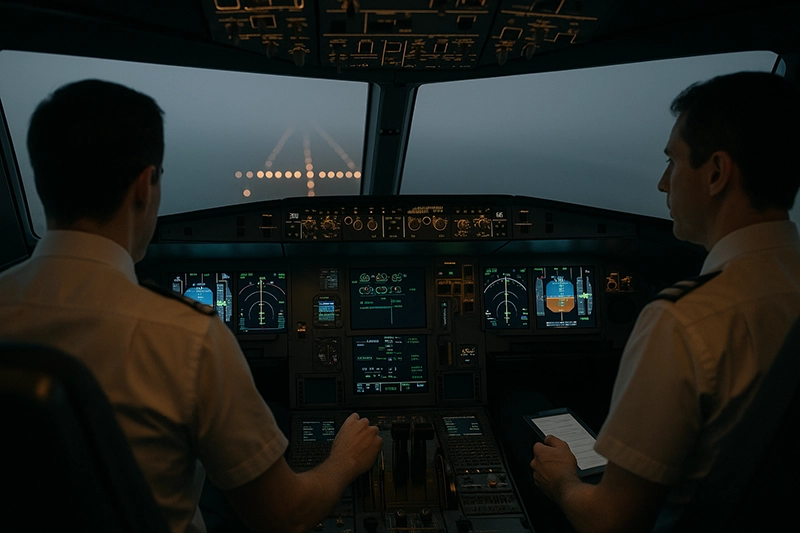
Low visibility approaches are a core skill for instrument-rated pilots and flight crews. Learning how to fly them safely changes how you brief, scan instruments, manage automation, and prepare for a missed approach. Whether you are a student pilot building fundamental instrument flying, an instructor teaching approaches, or a professional pilot maintaining operational currency, the procedures and judgment that go into low visibility approaches determine whether an approach ends in a stable landing or a prompt, safe missed approach.
This article explains how pilots train for low visibility approaches, why the training matters in real operations, and how to turn technical knowledge into confident decision-making. The primary keyword low visibility approaches appears early in this introduction because approach technique and decision-making are the central focus. Read on for practical training sequences, common mistakes, a detailed scenario, and a set of best practices you can use during instruction flights, simulator sessions, or line operations.
How pilots train for low visibility approaches
Training for low visibility approaches is layered. It begins with classroom and briefing work, progresses into procedural practice in a simulator or training device, and culminates with supervised or qualified in-aircraft practice when conditions and aircraft approvals permit. The training path mirrors how risk is reduced: first by intellectual understanding, then by procedural rehearsal, and finally by supervised execution in the aircraft.
Ground study covers instrument approach theory, approach lighting systems, runway and taxi lighting, procedure charts, and the meaning of published minima and runway visual references. Training emphasizes a clear understanding of the approach type being flown. For example, pilots must recognize the navigation guidance available from an instrument landing system, localizer, RNAV procedure with vertical guidance, or a non-precision approach, and know how that guidance relates to the point at which they are expected to acquire visual references to continue to land.
Simulator work is central. Modern full-flight simulators, fixed-base simulators, and qualified flight training devices allow repetition of the exact approach, including failures, reduced visual cues, and transition to ground lighting conditions. Simulator sessions should include procedure execution, automation management, missed approach initiation, and degraded navigation or visual aid failures. Practicing the missed approach is as important as practicing the final approach because low visibility increases the probability that a landing will not be completed.
In-aircraft training, when feasible, follows simulator sessions and is typically conducted with an instructor and safety pilot. This phase focuses on the human factors of actual flight: workload management, communication with air traffic control, use of autopilot and flight director modes, and the feel of the aircraft during final approach. It also provides an opportunity to practice transitions from instrument references to visual references in marginal conditions and to rehearse precise go-around timing.
Why this matters in real-world aviation
Low visibility approaches directly affect flight safety, operating efficiency, and airport throughput. In airline or commercial operations, the ability to continue approaches into low visibility can reduce diversions and delays, but it also concentrates risk during a high-workload phase of flight. Training reduces that risk by creating predictable crew behavior and shared expectations.
From a safety perspective, the final approach and landing phase is one of the most accident-prone parts of flight. When visibility is reduced, pilots have a smaller margin for visual cues, a higher reliance on aircraft instruments and automation, and less time to detect and correct deviations. Proper training reduces errors in automation mode selection, misinterpretation of the runway environment, and the improper continuation of an unstabilized approach.
Operationally, airports and operators often require specific approvals, equipment, or crew qualifications before flying certain low visibility procedures. Training prepares pilots to comply with operator policies, to brief and execute approaches consistently, and to coordinate effectively with controllers and dispatch. For single-pilot and general aviation operations, the training emphasis may be on conservative decision-making and knowing when to divert early rather than press on in marginal conditions.
How pilots should understand the core concepts
To train effectively, pilots must move beyond memorizing steps and toward an integrated understanding of how instruments, lighting, and human perception interact near the runway. Four concepts are central: stabilization, decision points, automation management, and visual acquisition.
Stabilized approach. A stabilized approach is one where aircraft configuration, power, descent rate, and flight path are predictable and within acceptable tolerances by a defined altitude above the runway. In low visibility conditions, the stabilized approach concept becomes stricter. Training emphasizes getting the aircraft configured early, establishing the correct glide path and airspeed, and avoiding last-moment corrections that can overload the pilot.
Decision points. Instrument approaches include published points where pilots must have specific visual references or execute a missed approach. Pilots are trained to brief those points precisely, to know what visual cues count as enough reference, and to be ready to transition to a missed approach without hesitation. Practicing the timing and the physical actions to initiate missed approaches builds the reflex necessary under stress.
Automation management. Modern aircraft commonly use flight directors, autopilots, and autothrottle systems. Training addresses when automation should be used, when manual flying is preferable, and how to monitor automation outputs critically. In many cases, flying the final segment with an engaged autopilot reduces workload, but pilots must be fluent in mode awareness and the consequences of mode transitions, especially close to the ground.
Visual acquisition and runway environment. Low visibility reduces the available cues from the runway environment. Pilots are trained to recognize the progressive cues that lead to a visual landing: approach lighting, runway threshold and runway edge lights, touchdown zone lights, and runway centerline lights. Training clarifies which lights and cues are sufficient to continue and which are not conclusive. The transition from instrument reference to visual guidance is practiced until it becomes a reliable, repeatable action.
Training components and methods
Effective training for low visibility approaches uses a variety of methods to build competence and confidence. These components include scenario-based simulator sessions, procedures training, rehearsal of contingencies, sensory and spatial orientation training, and focused debriefs.
Scenario-based simulator sessions. Use realistic scenarios that combine weather, ATC interactions, aircraft system failures, and time pressure. Include normal approach flows, crosswind conditions, partial failures of navigation or lighting systems, and missed approach transitions. Well-designed scenarios force pilots to practice judgment and workload management under conditions that mimic operational reality.
Procedural training. Rehearse callouts, briefings, and the sequence of actions for different instrument approach types. Emphasize consistent phraseology between pilot and instructor or between crew members. Procedural fluency means fewer surprises when workload rises.
Contingency rehearsal. Practice the most likely failures for the operation, such as loss of glideslope or autopilot anomalies, and rehearse degraded visual cue situations like glare, shallow approach angles, or intermittent runway lighting. Training should include ‘what-if’ drills that force quick decision-making and smooth transitions to missed approaches.
Sensory and spatial orientation training. Low visibility often increases the risk of spatial disorientation and visual illusions. Instructors should debrief pilots on illusions such as false horizons created by lights or terrain, and use simulator exercises to reproduce the sensation of cue loss. The goal is to strengthen instrument scan habits and to recognize the limits of peripheral visual references in degraded conditions.
Debrief and performance analysis. After each session, review objective data from the simulator or flight recording. Focus on deviations from the stabilized approach profile, timing of decisions, autopilot mode changes, and communication quality. Constructive debriefs that identify specific behavior to improve are more effective than broad evaluative statements.
Common mistakes and misunderstandings
Pilots often make predictable errors when practicing or flying low visibility approaches. Awareness of these mistakes is essential to training because identifying the mistake is the first step to correcting it.
Over-reliance on automation. Pilots sometimes let automation mask underlying deviations until the approach is too far from stabilized to recover. Training should emphasize continuous monitoring of guidance, cross-checking instruments, and being ready to disconnect automation if it fails to maintain the stabilized profile.
Late decision-making. Waiting too long to decide whether to continue or go missed reduces margins and increases the likelihood of a rushed, unsafe maneuver. Practice setting clear go/no-go criteria in the briefing and committing to a decision at the published or briefed point.
Poor transition from instruments to outside references. Some pilots find it difficult to smoothly switch from instrument cross-check to visual references. Training should practice that transition so the pilot can align visual cues with instrument indications without abrupt control inputs.
Inadequate briefing and task sharing. In crew operations, unclear division of responsibilities and ineffective briefings create confusion. Training must include clear roles for who manages radios, who flies, and who monitors, and should rehearse callouts that confirm visual acquisition and continuation decisions.
Misreading lighting and visual illusions. Weather and lighting produce optical effects that can mislead pilots about distance, angle, or runway alignment. Training must include exposure to these illusions in a simulator and instruction on conservative interpretation of ambiguous cues.
Practical training example: a realistic scenario
Scenario: An instrument-rated pilot is flying a regional turboprop at night toward an airport with instrument landing capability. The weather briefing indicates a low cloud ceiling and variable visibility. ATC clears the crew for the published instrument approach, and the crew briefs the approach, missed approach, and who will call the runway environment.
Training steps during the scenario:
-
Pre-approach briefing: The crew confirms navigation aids, decision point, runway lighting options, expected runway visual cues, and a go-around plan. They confirm autothrust and autopilot modes, and who will fly the approach and make the visual call.
-
Final approach: With the aircraft established on the final approach path and the aircraft configured, the pilot flying monitors flight path and airspeed while the pilot monitoring scans for lighting cues and traffic information. The crew is prepared to fly with the autopilot engaged because the operator’s procedures allow it in these conditions.
-
Missed approach rehearsal: Before reaching the decision point, the pilot flying confirms the missed approach path and power settings. The pilot monitoring confirms the automation modes and stands ready to call missed approach if visual cues are not adequate.
-
Decision and transition: At the decision point, the pilot monitoring reports the lack of sufficient visual references. The pilot flying executes the missed approach without delay, transitions to the missed approach flight director mode, retracts flaps as appropriate, and complies with ATC for climbing and route changes.
Training value: This scenario reinforces briefing discipline, role clarity, automation management, and decisive missed approach execution. It emphasizes the need to rehearse contingencies before final approach and to treat the decision point as non-negotiable.
Best practices for pilots
Below are practical habits and decision-making principles that improve safety and consistency when training for or flying low visibility approaches. These are intended as best practices, not regulatory rules.
-
Brief the approach thoroughly. Include go/no-go criteria, missed approach path and altitudes, expected runway lighting, and automation modes. A focused, short briefing creates shared expectations between crewmembers.
-
Practice the missed approach every time you fly the approach. Rehearsing the physical control inputs and autopilot mode changes reduces hesitation under stress.
-
Use automation deliberately. Know which modes will be engaged, how they present guidance, and when to disconnect. Always monitor the automation’s performance, especially during autopilot-to-manual transitions.
-
Prioritize stabilized approaches. If stabilized parameters are not met in the final segment, go missed. Training should stress early configuration and precise speed control to enable stability.
-
Be conservative with visual interpretation. If visual cues are intermittent, degraded, or deceiving, choose the missed approach; do not try to 'salvage' a doubtful approach.
-
Include human factors in training. Fatigue, task fixation, expectation bias, and poor communication can degrade performance. Use scenario training to expose and mitigate these risks.
-
Debrief with objective metrics. Use available flight data to review glide path adherence, airspeed control, stability, and timing of decisions. Focus debriefs on specific behaviors to change.
Frequently Asked Questions
Can simulator training replace real-world practice for low visibility approaches?
Simulators are extremely effective for practicing procedures, failures, and decision-making in a controlled environment. High-fidelity full-flight simulators replicate aircraft responses and visual cues closely. However, actual experience in the aircraft adds sensory and workload elements that simulators cannot fully reproduce. Training programs typically combine both methods for the best overall proficiency.
Should I always use the autopilot on low visibility approaches?
There is no universal rule that autopilot must be used. The decision depends on the aircraft, the pilot’s experience, and operator policies. Autopilots can reduce workload and improve path tracking, but pilots must be fully aware of autopilot modes and be ready to disconnect and fly manually if automation behaves unexpectedly.
What visual cues count as sufficient to continue an approach?
Sufficient visual cues vary by approach type and operational standards. Generally, pilots need a clear visual reference that allows them to judge the aircraft’s position relative to the runway and make a safe landing. Training clarifies the specific cues (such as threshold or approach lights) that crews use as part of their go/no-go criteria.
How do I avoid visual illusions at night or in low visibility?
Avoid relying on a single ambiguous visual cue. Cross-check instrument indications, look for multiple runway lighting elements that confirm distance and alignment, and maintain stabilized flight until visual references are confirmed. Training in simulators that reproduce common illusions helps pilots recognize and reject misleading cues.
How often should pilots practice low visibility approaches to stay proficient?
Proficiency depends on operator requirements and individual experience. Regular practice in simulators and review of procedures helps maintain skills. For many pilots, scheduled simulator sessions that include low visibility scenarios coupled with line or supervised flights when available provide an appropriate balance. Specific frequency expectations should follow an operator’s training program or an instructor’s guidance.
Key Takeaways
- Practical takeaway: Train the full sequence—briefing, stabilized approach, and missed approach—so each part is automatic during high workload.
- Safety takeaway: Favor conservative decisions when visual cues are marginal; a timely missed approach preserves safety margins.
- Training and decision-making takeaway: Combine simulator repetition with in-aircraft practice and structured debriefs to build reliable judgment and crew coordination.
Low visibility approaches test pilot skill, judgment, and crew coordination. Effective training turns complex procedures into practiced responses and reinforces conservative decision-making. For instructors and operators, the emphasis should be on realistic scenarios, objective performance feedback, and instilling the discipline to execute missed approaches without hesitation when required.
Finally, because operational rules, minima, and equipment approvals vary by operator and jurisdiction, always respect the published procedures and the policies in your operations manual. Use the training techniques described here to make safe, consistent decisions in the real-world environment where lives, equipment, and schedules depend on reliable performance.