
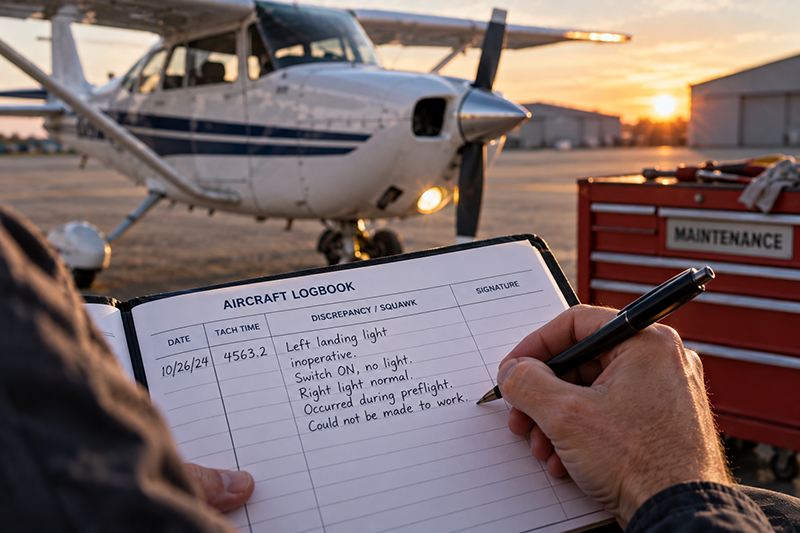
Maintenance squawks are one of the most important communication tools in aviation, yet they are often written in a hurry, after a flight, with just enough detail to remind the pilot what was annoying. That is not enough. A squawk is not merely a complaint about an airplane. It is the starting point for troubleshooting, maintenance action, airworthiness decisions, and sometimes a safety conversation between pilots, instructors, dispatchers, aircraft owners, and technicians.
A well-written maintenance squawk describes the symptom, the conditions under which it appeared, and whether the problem can be reproduced. Those three elements help a mechanic move from a vague report to a focused investigation. They also help pilots avoid the common trap of diagnosing a problem from the cockpit when the more useful task is to describe exactly what the airplane did, what the pilot saw, heard, smelled, felt, and did in response.
For student pilots and renters, writing better squawks is part of learning how to care for an aircraft. For instructors, it is part of teaching professional habits. For aircraft owners and operators, it can reduce wasted troubleshooting time, improve maintenance tracking, and help prevent small anomalies from becoming larger operational problems. This article explains how to write maintenance squawks that are clear, practical, and useful without pretending the pilot is the mechanic.
What a Good Maintenance Squawk Really Does
A maintenance squawk is a written report of an aircraft discrepancy, abnormal indication, unusual behavior, or suspected defect. In everyday flight school and general aviation language, pilots use “squawk” to describe almost anything that needs attention, from a landing light that does not illuminate to a rough engine indication during run-up. In larger operations, the process may be tied to a formal aircraft logbook, discrepancy record, maintenance tracking system, or electronic reporting tool.
The purpose is the same in every setting: capture enough information so that the next person responsible for the aircraft can understand what happened. That person may be an aircraft mechanic, inspector, chief instructor, maintenance coordinator, owner, dispatcher, or another pilot reviewing the aircraft status before flight. A squawk that says “radio bad” forces everyone else to guess. A squawk that says “COM 1 receives normally but transmits weak and unreadable after engine start; COM 2 normal; problem noted on ground frequency and tower frequency; headset worked normally on COM 2” gives maintenance a starting point.
The best squawks are not long for the sake of being long. They are specific. They identify the system involved, the symptom observed, the flight condition, any relevant cockpit indications, what the pilot did, and whether the issue happened once or repeatedly. They avoid unsupported conclusions such as “alternator failed” when the pilot actually observed a low-voltage annunciation, a discharge indication, or avionics behavior that could have several causes.
A useful squawk respects the difference between observation and diagnosis. Pilots are trained to recognize abnormal conditions and respond to them. Mechanics are trained and certificated to inspect, troubleshoot, repair, and return aircraft to service within applicable requirements. Good writing keeps those roles aligned. The pilot reports the facts clearly. The mechanic uses those facts to investigate the aircraft.
Symptoms, Conditions, and Reproducibility
Three questions make almost every maintenance squawk better: What was the symptom? Under what conditions did it happen? Can it be reproduced?
The symptom is the observable behavior. It may be a cockpit indication, sound, vibration, smell, system response, control feel, fluid leak, avionics problem, lighting issue, or performance-related abnormality. “Oil pressure fluctuated between the lower green range and mid-green range” is a symptom. “Engine seemed wrong” is not precise enough. “Right brake pedal felt soft during taxi and required more pedal travel than the left brake” is a symptom. “Brakes bad” leaves too many possibilities.
The conditions describe the context. Aircraft systems behave differently depending on power setting, phase of flight, electrical load, temperature, altitude, fuel tank selection, configuration, avionics mode, engine temperature, or whether the aircraft is on the ground or airborne. A problem that appears only during taxi may lead maintenance in a different direction than a problem that appears only at cruise power. A radio issue that occurs with one headset but not another is different from a radio issue that affects every headset and both transmit and receive functions.
Reproducibility describes whether the problem can be made to happen again under the same or similar conditions. Some discrepancies are constant. A light does not illuminate at all. A door latch does not secure properly. A tire is visibly damaged. Other discrepancies are intermittent. A display flickers once after engine start. A vibration appears only during descent. A transponder reply light behaves unexpectedly only in a certain avionics configuration. Intermittent squawks are among the hardest to troubleshoot, and they require the best pilot descriptions.
A strong squawk ties these ideas together. Instead of writing “engine rough,” a pilot might write: “During run-up at normal run-up power, engine ran rough during left magneto check; roughness improved after leaning briefly at increased rpm on the ground, then returned on second left magneto check; right magneto check normal; no abnormal engine instruments noted.” This does not diagnose the cause. It gives maintenance the symptom, conditions, and repeatability.
Why This Matters in Real-World Aviation
Aircraft maintenance is built on information. A mechanic can inspect what is visible, test what can be tested, and troubleshoot from the available evidence. When the written report is vague, the troubleshooting process often starts with a conversation: When did it happen? Was the engine hot or cold? Which radio? Which side? Which phase of flight? Did it happen again? Did the circuit breaker trip? Was there a smell? Did the annunciator remain on or flicker?
If the pilot is still available, that conversation may solve the problem quickly. If the pilot has gone home, the aircraft may sit while maintenance attempts to duplicate the issue. If the issue cannot be duplicated and the original description is weak, the result may be an unresolved discrepancy, an unnecessary component replacement, or a repeated squawk after the next flight. None of those outcomes helps safety, scheduling, or confidence in the aircraft.
In flight training, better squawks also improve student decision-making. Students learn that aircraft are not judged by whether they are convenient to fly today. They are judged by whether the observed condition is understood, properly recorded, and handled through the appropriate maintenance and airworthiness process. A student who writes “landing light out” and walks away may be technically reporting a problem, but a student who notes “landing light switch on, no landing light illumination observed during preflight; taxi light normal” is learning the habit of precise aircraft status reporting.
For instructors, the squawk process is a teaching opportunity. A flight instructor can ask, “What did you observe, when did it happen, and what changed when you tried a different configuration?” That simple debrief builds systems knowledge and encourages disciplined cockpit observation. It also prevents students from confusing suspicion with fact. “The battery is dead” may be the student’s guess. “Master on, no avionics fan, no panel lights, ammeter showed no charge during attempted start, propeller did not rotate” is a more useful report, assuming those were the actual observations.
For aircraft owners and operators, good squawks support maintenance planning. A pattern of repeated alternator, avionics, brake, or engine-related symptoms may not be obvious if every report is written differently or too vaguely. Clear descriptions allow trends to emerge. If several pilots report that a door seal whistles only above a certain airspeed, or a GPS loses position after engine start with a specific electrical load, maintenance has a better chance of finding the underlying issue.
How Pilots Should Understand This Topic
Pilots do not need to become maintenance technicians to write good squawks. They need to become accurate observers. That means paying attention to the aircraft during normal operation, knowing what “normal” looks and feels like, and recording abnormal behavior in plain language.
The key is to describe the aircraft, not your theory. If the airplane pulls left during taxi, say that. Do not immediately write “nosewheel steering broken” unless there is a specific, verified reason to say so. If the alternator warning light illuminated, report the light, the electrical indication, the load condition, and what happened after following the appropriate checklist or procedure. Avoid writing “alternator failed” unless that failure has been confirmed through proper maintenance evaluation.
Good squawks often include the following types of information, written naturally rather than as a rigid form:
- System or component involved: Identify the affected system as specifically as practical, such as COM 1, landing light, right fuel quantity indication, left brake, cabin heat, autopilot altitude hold, or engine oil pressure indication.
- Observed symptom: Describe what happened using sensory or instrument-based detail. Include indications, sounds, vibration, smell, feel, or visible condition.
- Phase of operation: Note whether the issue occurred during preflight, engine start, taxi, run-up, takeoff roll, climb, cruise, descent, approach, landing, shutdown, or postflight.
- Configuration and conditions: Include relevant aircraft configuration, power setting, avionics mode, electrical load, outside conditions, or whether the engine was hot or cold when the issue appeared.
- Pilot action and result: If you followed a checklist, changed a selection, cycled a switch, reduced load, changed tanks, switched radios, or compared another instrument, record what changed and what did not.
- Repeatability: Say whether the problem happened once, happened repeatedly, remained constant, disappeared, or could not be duplicated later.
That level of detail does not require mechanical expertise. It requires disciplined reporting. In many cases, the difference between a poor squawk and a good squawk is one extra sentence.
Pilots should also understand that some squawks have immediate operational significance. A missing inspection cover, abnormal flight control feel, fuel odor, brake problem, engine roughness, fluid leak, unreliable instrument, electrical smoke smell, or uncommanded trim movement should not be treated as minor simply because the aircraft was able to complete the last flight. The aircraft’s next flight should be considered only after the discrepancy has been evaluated through the proper maintenance and operational process.
Other squawks may not stop a flight in all circumstances, depending on the aircraft, equipment, regulations, operating rules, and approved procedures that apply. Pilots should not guess their way through those decisions. If an item is inoperative, abnormal, or uncertain, the correct next step is to consult the applicable aircraft documents, operating procedures, maintenance personnel, and responsible authority for that operation. The written squawk is part of that process, not a substitute for it.
Common Mistakes or Misunderstandings
The most common squawk-writing mistake is being too vague. “Autopilot doesn’t work” is a classic example. Autopilots can fail to engage, fail to hold a mode, disconnect unexpectedly, trim excessively, ignore a navigation source, fail a self-test, produce a warning, or behave normally in one mode and abnormally in another. A useful report might say, “Autopilot engaged in heading mode after climb, then disconnected within approximately 10 seconds with a disconnect tone; repeated twice; altitude hold not tested after disconnect; electric trim operated normally by manual switch.”
Another mistake is diagnosing the problem instead of describing it. “Starter bad” may be tempting, but the mechanic needs to know what happened. Did the propeller not move? Did the starter engage but rotate slowly? Was there a clicking sound? Did the starter continue after releasing the switch? Were the battery and electrical indications normal? Was the engine hot after a fuel stop or cold before the first flight of the day? Those details matter.
A third mistake is omitting the conditions. “Vibration in flight” is important, but it is incomplete. Vibration may depend on airspeed, engine rpm, propeller setting, configuration, power changes, flap position, landing gear position, or whether the aircraft is climbing, descending, or level. The pilot should describe when the vibration started, where it was felt, whether it changed with power or airspeed, and whether any instruments or sounds changed at the same time.
Pilots also sometimes fail to report intermittent problems because the airplane later seemed normal. That is risky thinking. Intermittent discrepancies are still discrepancies. If a low-voltage annunciation appeared briefly after takeoff and then disappeared, that event may still be useful to maintenance. If a fuel quantity indication dropped to zero momentarily and then returned, that deserves a clear report. If the issue cannot be duplicated on the ground, the original pilot’s description may be the most valuable evidence available.
Another misunderstanding involves circuit breakers and resets. Pilots should follow the aircraft’s approved procedures and training regarding abnormal electrical conditions. From a squawk-writing standpoint, if a breaker was found popped, reset, or left alone, that fact should be recorded accurately. Do not hide it because the system appeared to work later. Maintenance needs to know the sequence of events.
Finally, pilots sometimes use humor or shorthand that does not help maintenance. “Thingy loose,” “radio possessed,” or “plane hates cold mornings” may be memorable, but they are not professional records. Plain language is better. If a knob is loose, identify the knob. If a radio display flickers when the panel dimmer is adjusted, say so. If the engine takes longer to start on cold mornings, describe the actual starting behavior and conditions.
Practical Example: Turning a Vague Squawk Into a Useful Report
Consider a common training aircraft scenario. A student and instructor return from a local lesson and the student writes, “COM 1 bad.” The airplane goes to maintenance, and the mechanic powers the avionics on. COM 1 receives the local weather broadcast. The radio transmits on the ground. No obvious fault appears. The aircraft may be returned to service, or additional troubleshooting may be attempted without a clear path.
Now consider a better version of the same squawk: “COM 1 received ATIS normally before engine start. After engine start and during taxi, tower reported our COM 1 transmissions were weak and unreadable. We switched to COM 2 using the same headset and tower reported transmissions normal. COM 1 receive remained normal. Issue repeated on ground frequency after landing with engine running. No issue noted with intercom.”
This version gives maintenance several useful clues. The receive side appeared normal. The problem involved transmit quality. The same headset worked on COM 2, which may reduce suspicion of the headset as the sole cause. The issue appeared with the engine running and repeated after landing. The intercom seemed normal. The mechanic still must troubleshoot properly, but the report is no longer a mystery.
A similar improvement can be made with engine, brake, and instrument discrepancies. Instead of “left brake weak,” write: “During taxi after landing, left brake required noticeably more pedal travel than right brake to achieve similar braking; no pulling during landing rollout noticed; no visible fluid on ramp during postflight walk-around.” Instead of “oil pressure weird,” write: “Oil pressure indication fluctuated within the green range during cruise and descent; no oil temperature abnormality observed; no visible oil leak found during postflight; indication steady during run-up before departure.” These examples do not determine airworthiness or diagnose a repair. They help the right people evaluate the aircraft.
Best Practices for Pilots
The best squawk-writing habit is to take notes while the details are fresh. A pilot does not need to compose a perfect report in flight, especially during a high workload event, but a few written notes after shutdown can preserve important facts. Time, phase of flight, power setting, indication, and pilot action are often forgotten quickly after the aircraft is parked and the next lesson or meeting begins.
Use the aircraft’s exact language when it helps. If the annunciator reads “LOW VOLTS,” write that rather than paraphrasing vaguely. If the avionics unit displays a specific message, copy the message as accurately as practical. If a digital engine monitor shows a specific cylinder indication or system alert, record the actual indication if you can do so safely and accurately. Do not let note-taking distract from flying the aircraft.
Separate what you know from what you suspect. A professional squawk might say, “Possible headset issue not ruled out” or “Problem occurred with two headsets” if that is true. It might say, “Pilot suspects loose connection at right seat push-to-talk because transmit failed only from right seat” if the observation supports that suspicion. The important point is to distinguish the observation from the conclusion.
When appropriate and allowed by the operator’s procedures, photographs can help. A photo of an annunciation, a fluid stain, a loose fairing, a damaged tire, or an instrument message can preserve evidence that may disappear later. However, photos should supplement the written squawk, not replace it. A mechanic still needs to know when the symptom occurred and what the pilot observed.
Use consistent aircraft terminology. Say “left” and “right” from the pilot’s normal seated orientation. Identify front or rear, pilot side or copilot side, upper or lower, inboard or outboard when relevant. For avionics, identify the unit, mode, frequency, navigation source, or display if known. For engine discrepancies, describe the indication rather than jumping to a component diagnosis.
If an issue affected safety of flight, say that plainly. “Returned to airport due to rough engine after takeoff” is more useful than “engine rough.” “Aborted takeoff during roll due to door opening” is more useful than “door latch problem.” These statements give operational context. They also alert the next reviewer that the discrepancy was significant in the pilot’s judgment.
At the same time, avoid exaggeration. Not every flicker, nuisance, or comfort item is an emergency. Professional reporting is calm, factual, and complete. The goal is not to dramatize the airplane’s behavior. The goal is to make the aircraft’s condition understandable.
Teaching Better Squawks in Flight Training
Flight instructors can build better maintenance reporting habits early by making squawk writing part of postflight debriefing. After a lesson, ask the student to describe one normal system behavior and one abnormal or questionable observation. Even when no actual squawk is needed, that conversation develops the skill of comparing expected and observed aircraft behavior.
When a real discrepancy occurs, resist the temptation to write the report for the student every time. Instead, guide the student through the thinking process. What did you notice first? What instrument or system was involved? What were we doing at the time? Did it happen again? What did we do, and what changed? This method teaches judgment, not just paperwork.
Instructors should also model humility. If the cause is not known, say so. “We observed a roughness on the left magneto check” is better than confidently declaring a cause that maintenance has not confirmed. Students learn from that tone. They become more likely to report accurately rather than impressively.
For training organizations, consistent squawk quality can improve aircraft availability and maintenance communication. A standardized discrepancy form or electronic reporting field can help, but only if pilots understand what to enter. The form should encourage narrative detail where needed, not reduce every issue to a one-word category. A well-designed process helps both the line pilot and the technician.
Maintenance Communication Is a Safety Skill
Good squawks are part of aviation safety culture. They show that pilots take aircraft condition seriously and understand that maintenance communication is not someone else’s problem. A pilot who notices and reports small abnormalities accurately helps protect the next pilot who may fly the airplane in different weather, at night, with passengers, or on a longer route.
There is also a human factors benefit. Vague discrepancies create ambiguity. Ambiguity creates assumptions. Assumptions can lead to missed faults or repeated troubleshooting. Clear squawks reduce uncertainty by anchoring the discussion in observable facts.
That does not mean every squawk will produce an immediate, obvious fix. Aircraft are complex. Intermittent electrical faults, avionics behavior, vibration, and engine indications can require careful troubleshooting. Sometimes maintenance may inspect and test the system without duplicating the issue. In those cases, a detailed squawk still matters because it becomes part of the aircraft’s history. If the same symptom appears again, the prior report may reveal a pattern.
Professional pilots often speak in precise operational language because precision reduces risk. Maintenance reporting deserves the same discipline. “At 4,500 feet in cruise, autopilot altitude hold began a slow climb of approximately 200 feet before disconnect; no trim warning observed; hand-flying normal afterward” is aviation language that helps. It is factual, concise, and operationally meaningful.
Frequently Asked Questions
What is the most important part of a maintenance squawk?
The most important part is a clear description of the observed symptom. A mechanic needs to know what the aircraft actually did before troubleshooting can be focused. The best squawks also include the conditions and whether the problem could be repeated.
Should pilots diagnose the problem in the squawk?
Usually, pilots should avoid diagnosing the cause unless it has been confirmed. It is better to describe the indication, behavior, sound, smell, feel, or visible condition. If you have a suspicion, label it as a suspicion and keep the observed facts separate.
How should I write up an intermittent aircraft problem?
Describe exactly when it happened, how long it lasted, what conditions existed, what actions you took, and whether it happened again. Intermittent problems can be difficult to duplicate, so the pilot’s original description may be especially valuable.
Is a minor squawk still worth reporting?
Yes, if it is an aircraft discrepancy, abnormal indication, or condition that should be evaluated under the applicable procedures for that aircraft and operation. Small details can reveal patterns over time, and the next pilot should not have to rediscover the same issue without context.
What if I am not sure whether something is a real problem?
Report what you observed and state the uncertainty plainly. For example, “Possible unusual vibration during climb; not felt during cruise or descent; no abnormal engine indications observed.” Then ask an instructor, owner, mechanic, or responsible operational authority for guidance before assuming the aircraft is acceptable for the next flight.
Can photos replace a written squawk?
No. Photos can be helpful, especially for visible damage, leaks, messages, or annunciations, but they do not explain the operating conditions or sequence of events. A short written description should accompany any photo used for maintenance reporting.
Key Takeaways
- A strong maintenance squawk describes the symptom, the operating conditions, and whether the issue was repeatable.
- Pilots should report observable facts rather than unsupported diagnoses, especially with intermittent electrical, avionics, engine, brake, or instrument discrepancies.
- Better squawk writing improves communication between pilots and maintenance personnel, supports safer airworthiness decisions, and builds professional aviation habits.