
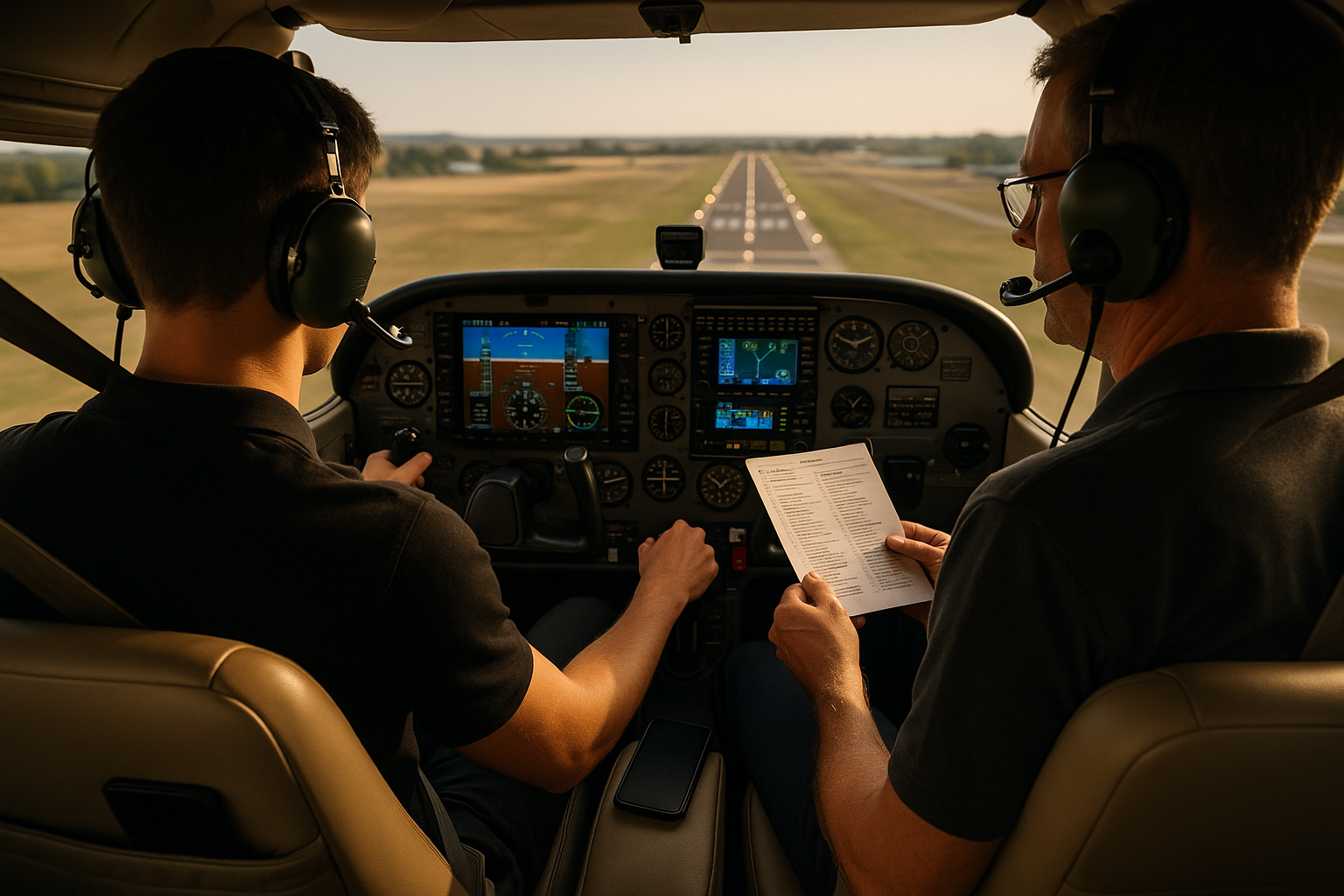
Distraction management is a core skill for any pilot. In the cockpit, distractions range from routine but urgent tasks to subtle cognitive interruptions that degrade situational awareness. Learning how to manage distractions improves safety, reduces errors, and strengthens decision-making under pressure.
This article explains what cockpit distractions look like, why they matter, and how pilots can build reliable habits to limit their impact. It is written for pilots, student pilots, flight instructors, and aviation professionals who need practical methods for managing attention in single-pilot and multi-crew operations.
Understanding Distractions in the Cockpit
Distractions are events or stimuli that pull attention away from the flying task. They can be classified by source and effect. Common categories include visual distractions, auditory distractions, cognitive interruptions, and task saturation. Visual distractions remove the pilot's eyes from the outside or instruments. Auditory distractions compete for listening resources. Cognitive interruptions cause a pilot to shift mental focus away from the current procedure. Task saturation occurs when available time or resources are insufficient for the number of tasks.
Recognize that not all distractions are external. Internal distractions such as fatigue, stress, personal concerns, or uncertainty about a configuration or performance calculation can be just as disruptive as a ringing phone or a surprise checklist item. Managing distractions means addressing both the stimulus and the pilot's capacity to respond.
Why This Matters in Real-World Aviation
Distractions directly affect safety. A diverted scan, an unfinished checklist, or an unresolved anomaly can lead to missed callouts, incorrect configuration, or delayed decisions. Even in general aviation where operations are flexible, the same human limits apply. In multi-crew environments, distractions can break coordination and reduce mutual monitoring. In training, distraction management influences how students learn to prioritize tasks and maintain situational awareness.
For instructors and operators, the operational cost of distraction includes additional training burden, increased pilot workload, and the potential for incidents that require lengthy investigations. For single-pilot operators, a single distraction can be the difference between a routine flight and a forced diversion.
How Pilots Should Understand Distraction Mechanisms
Human attention is limited. Pilots do not multitask like a computer. When attention shifts, performance on the original task degrades. This is not a moral failing; it is a predictable human factor. Understanding basic attention mechanics helps pilots predict where errors happen and place countermeasures where they matter most.
Key concepts to internalize are task prioritization, attention switching cost, and checklist-driven memory support. Task prioritization means identifying the most safety-critical task and preserving resources for it. Attention switching cost is the delay and potential loss of information that occurs when moving focus between tasks. Checklists reduce reliance on memory and capture the steps that are prone to omission after an interruption.
Another useful idea is the difference between primary tasks and secondary tasks. Flying the aircraft, maintaining safe flight, and navigating toward a safe destination are primary tasks. Items such as non-essential radio chatter, administrative paperwork, or entertainment device setup are secondary and should be deferred during critical phases.
Common Cockpit Distraction Types and Their Effects
Not all distractions are equally hazardous. Recognizing the type helps determine the response.
- Planned interruptions. These include ATC frequency changes, required briefings, or checklist items. They are predictable but still consume time and attention.
- Unplanned interruptions. Mechanical anomalies, unexpected weather, or passenger needs. These demand immediate assessment of priority.
- Social distractions. Non-essential conversation with passengers or crew can degrade task focus. Social comfort is important, but timing matters.
- Technological distractions. Mobile phones, tablets, and connectivity alerts can capture attention quickly. Even a glance at a message can break scan patterns.
- Cognitive distractions. Mental workload caused by fatigue, stress, personal issues, or high uncertainty. These reduce working memory and decision bandwidth.
How Pilots Should Understand This Topic in Practical Terms
Practical distraction management is about predictable responses rather than ad hoc reactions. Establish routines, use checklists, and make clear verbal callouts. Routines reduce the need to plan each step anew and conserve cognitive capacity. Checklists serve as external memory and as a structured pause to reset attention. Verbal callouts create mutual awareness in multi-crew operations and provide a simple accountability loop in single-pilot operations when possible.
Instructors should train students to apply time management and task triage. Teach students to identify the highest risk in a moment, then protect it. For example, during approach, the priority is stable flight path and configuration. Non-essential tasks should be deferred until after stable flight is confirmed.
Common Mistakes and Misunderstandings
Pilots sometimes treat distraction management like a single action rather than a continuous habit. The most common mistakes include:
- Trying to multitask during high workload phases. Attention switching increases error and slows response time.
- Allowing non-essential conversations or passenger demands during takeoff, climb, approach, and landing phases.
- Failing to brief expected interruptions. A short, explicit briefing that identifies who will manage an interruption reduces confusion later.
- Overreliance on automation without monitoring. Automation can reduce workload, but it also introduces new monitoring tasks that can be interrupted.
- Skipping or rushing checklists. Interruptions increase the risk that an incomplete checklist leaves the aircraft improperly configured.
- Underpreparing for known distractions. If you know a task will require attention, prepare a clear handover or pause technique in advance.
Practical Example: A Realistic Flight Training Scenario
Imagine a single-pilot cross-country in a light twin during a late afternoon approach to a busy traffic pattern. The pilot receives an unexpected maintenance advisory light indicating a non-critical system. At the same time, ATC issues a frequency change and a runway assignment. A passenger asks about flight time remaining while the pilot is preparing to configure the aircraft for landing.
How to manage this sequence:
- Prioritize. Determine the safety-critical tasks: maintaining a stabilized approach and communicating with ATC. Defer the passenger question until after the aircraft is configured and stabilized.
- Use a short interruption protocol. Acknowledge the maintenance advisory with a quick instrument scan and classify it as critical or non-critical. If the advisory does not require immediate action, annotate it mentally or on the checklist and continue the approach.
- Employ a brief, structured checklist. Run the pre-landing flow and callouts in sequence out loud. This externalizes the checklist and reduces the chance of omission.
- Communicate to the passenger. A concise statement such as "I'll answer that after landing" manages expectations and removes social pressure.
- After landing and securing the aircraft, debrief. Note what caused the interruption and whether any steps were missed. Use this debrief to update future procedures and personal routines.
This example demonstrates an underlying principle: interruptions are inevitable, but predictable responses reduce risk.
Best Practices for Pilots
Adopt habits that reduce the frequency and impact of distractions. These habits should be practiced until they become automatic and combined with a culture of mutual accountability in multi-crew operations.
- Use flows, not memory. Develop a physical flow pattern for cockpit scans that you perform before key transitions. A flow reduces memory load and helps you detect when something is out of place.
- Standardize callouts and responses. Callouts should be concise and unambiguous. Instructors should reinforce call and response during training flights so both student and instructor know who owns each task.
- Brief interruptions. In training and operations, include likely interruptions in briefings. Knowing who will handle an unexpected radio frequency change or a passenger request reduces confusion.
- Establish a pause-and-check habit. When interrupted, take a one-scan pause: eyes to instruments, confirm primary flight parameters, then return to the interrupted task or resume the checklist where you left off.
- Protect critical phases. Make critical phases such as takeoff, climb, approach, and landing a time to limit non-essential tasks and conversation.
- Limit device interruptions. Silence personal devices and stow non-essential crew devices during critical phases.
- Practice single-pilot resource management. SRM techniques adapt CRM principles for single-pilot operations. Use external resources, such as ATC, briefing materials, automation, and passengers as appropriate, but always prioritize aircraft control.
- Train for interruptions. Use scenario-based training that introduces timed or unplanned interruptions. Debrief specifically on how interruptions were handled and what could be improved.
- Use checklists as control points. A checklist is more than a list; it is a decision gate. If an interruption occurs during a checklist, return to the checklist with a read-back or challenge-response to confirm completion.
- Debrief and document near-misses. If an interruption leads to an omission or an unsafe state, debrief promptly and document the event for learning. A low-blame culture supports honest reporting and effective change.
Training Recommendations
Flight instructors should include distraction management in every lesson that increases complexity. Introduce distractions in a controlled manner so the student learns to prioritize and recover. Use progressively challenging scenarios where the instructor introduces interruptions at critical moments and then reviews the student's recovery strategies.
For multi-crew operations or advanced flight training, practice formalized handovers and interruption protocols. Emphasize mutual monitoring and the use of verbal confirmation to re-establish shared situational awareness after an interruption.
Human Factors: Attention, Memory, and Workload
Understand that working memory capacity is limited. When a pilot switches tasks, they often lose a portion of the context from the interrupted task. Short pauses or delays in resuming can make it difficult to recall where they left off. Checklists and flows act as external memory aids to bridge this gap.
Workload is both objective and subjective. Objective workload refers to quantifiable tasks and required inputs. Subjective workload is how the pilot experiences task difficulty. Two pilots facing the same set of tasks may experience different subjective workload because of training, fatigue, or stress. Recognizing this variance helps pilots anticipate when they are more vulnerable to distraction.
Organizational and Procedural Tools
Operators and training organizations can support distraction management with clear procedures. Encourage briefings that include expected interruptions, require callouts for key configuration changes, and standardize interruption recovery procedures. Where possible, design cockpit procedures to minimize simultaneous tasks during critical transitions.
Procedural discipline supports safety culture. Organizations that build interruption management into embedded procedures see better adherence in practice. For smaller operators, clear personal SOPs or training syllabi help create consistency.
Technology and Distraction
Modern avionics can reduce some aspects of workload but also introduce new attention demands. Displays that aggregate information reduce scan time, but complex interfaces can distract if the pilot must troubleshoot a system problem. Use technology deliberately: configure automation thoughtfully and maintain monitoring discipline. When an advisory or caution indicates a system state change, use a structured approach to decide when to troubleshoot and when to prioritize flying tasks.
Common Mistakes or Misunderstandings Revisited
Misunderstanding the role of automation is common. Pilots sometimes assume automation will solve a problem and then become distracted from monitoring. Another misunderstanding is treating checklists as mere formality rather than as a mitigation against memory failure. Lastly, pilots often underestimate the cumulative effect of small distractions over a long flight.
Frequently Asked Questions
What counts as a dangerous distraction in the cockpit?
Any event that significantly reduces attention to flight path, configuration, or communication responsibilities qualifies. A distraction becomes dangerous when it causes a missed step, an incorrect configuration, loss of situational awareness, or delayed decision-making.
How should I handle unexpected interruptions during approach?
Prioritize aircraft control and stable flight first. Acknowledge the interruption, classify whether it requires immediate action, and use a short pause to confirm primary flight parameters. Defer non-essential tasks until stable flight is established.
Can single pilots effectively use CRM techniques?
Yes. Single-pilot resource management adapts CRM principles for a single operator. Use automation thoughtfully, involve ATC as a resource for traffic or reroute assistance, and use verbalization and checklists to externalize memory demands.
Are electronic devices a major distraction risk?
Electronic devices can be a distraction source when they generate alerts or prompt non-essential use. Best practice is to silence unnecessary notifications and stow devices during critical phases. Use devices as tools only when they support primary flight tasks.
How can instructors evaluate a student's distraction management skills?
Design scenarios that include predictable and unpredictable interruptions. Observe how the student prioritizes tasks, uses checklists, makes callouts, and recovers situational awareness. Debrief with specific feedback and practice until behaviors become habitual.
Key Takeaways
- Practical takeaway: Use flows, checklists, and briefings to externalize memory and reduce the cognitive cost of interruptions.
- Safety takeaway: Prioritize aircraft control and stabilized flight before troubleshooting or addressing non-essential tasks.
- Training takeaway: Teach distraction management through progressive scenario-based training and debriefs that focus on recovery strategies.
Managing distractions is not a single skill to be learned once. It is a continuous discipline that combines procedural rigor, human factors awareness, and practiced recovery techniques. Whether flying as a single pilot or as part of a crew, deliberate habits and structured responses reduce risk and improve decision-making under workload.
If you are an instructor, incorporate interruption scenarios into routine training. If you are a pilot, test your personal flows and checklist discipline in low-risk settings until they become automatic. The modest investment in rehearsal pays dividends in safety and resilience when interruptions inevitably occur in the cockpit.