
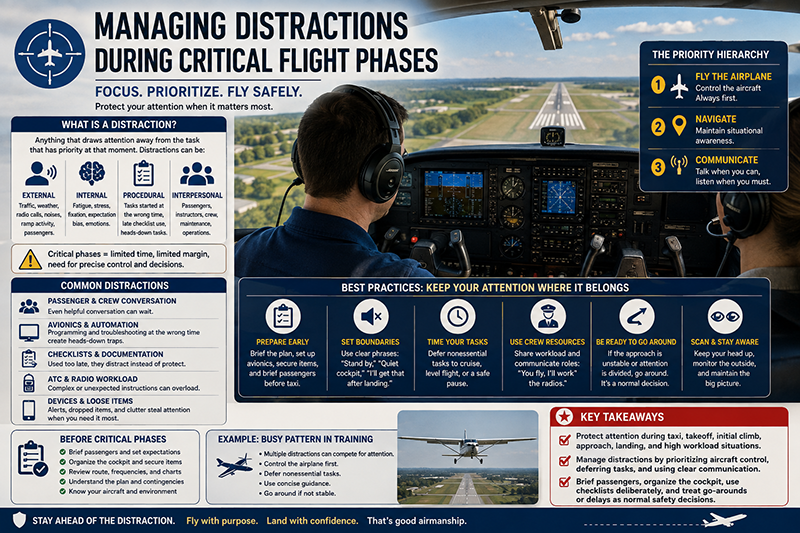
Managing distractions during critical flight phases is one of the most practical safety skills a pilot can build. Takeoff, initial climb, approach, landing, taxi, and other high workload segments of flight leave little room for divided attention. These are the moments when aircraft energy is changing quickly, altitude margins may be limited, air traffic control instructions may arrive at an inconvenient time, and a small interruption can disturb a well-planned flow.
Distraction management is not only about ignoring a ringing phone or delaying a conversation. It is about protecting attention when the aircraft, environment, and crew workload demand disciplined focus. For student pilots, this skill often begins with simple cockpit organization and instructor-guided habits. For certificated pilots, it matures into deliberate workload management, assertive communication, and the confidence to pause nonessential tasks. For flight instructors and aviation professionals, it becomes a teachable part of risk management and crew resource management.
This article explains how pilots should think about distractions during critical phases of flight, why they matter operationally, common mistakes that increase risk, and practical techniques for keeping the cockpit focused when workload is highest. The goal is not to create a rigid script for every airplane or operation. The goal is to help pilots recognize when attention is becoming fragmented and to build habits that keep the airplane under control, the flight path stable, and the crew aligned.
What Counts as a Distraction in the Cockpit?
A cockpit distraction is anything that draws attention away from the task that has priority at that moment. Some distractions are obvious, such as a passenger asking a question during short final, a mobile device alert during taxi, or loose papers sliding across the cockpit after rotation. Others are subtle. A pilot may become distracted by programming avionics, troubleshooting a minor annunciation, searching for a chart, reviewing a checklist too late, or thinking ahead to a parking assignment while still managing the landing rollout.
Distractions can be external, internal, procedural, or interpersonal. External distractions include radio calls, traffic, weather, airport lighting, wildlife, ramp activity, and abnormal noises. Internal distractions include fatigue, stress, expectation bias, fixation, and emotional responses to a mistake. Procedural distractions occur when a task is started at the wrong time or when the pilot allows a low-priority item to interrupt a high-priority flight task. Interpersonal distractions involve passengers, instructors, crew members, maintenance personnel, or operational personnel who unintentionally interrupt a critical flow.
The most dangerous distractions are often not dramatic. A pilot may glance down to change a frequency, then realize the aircraft has drifted from centerline. A student may focus on a minor airspeed variation and stop correcting for crosswind. A pilot flying an approach may accept a last-minute runway change, begin reprogramming equipment, and lose the mental picture of altitude, heading, configuration, and descent path. In each case, the distraction competes with aircraft control and situational awareness.
Critical phases of flight are not defined by a single universal list for every pilot and operation. In practical training and operations, they commonly include taxi, takeoff, initial climb, arrival, approach, landing, and any period of abnormal, emergency, or high workload operation. A pilot should also treat any low-altitude maneuvering, pattern work, missed approach, traffic conflict, or complex clearance as a critical attention period. The defining feature is not the name of the phase. It is the combination of limited time, limited altitude or maneuvering margin, and the need for precise aircraft control and timely decisions.
Why Distractions Matter in Real-World Aviation
Aviation is a task-rich environment. Even in a simple training airplane, a pilot may be controlling pitch, bank, power, trim, airspeed, heading, altitude, configuration, radio communication, navigation, traffic scanning, and checklist usage at nearly the same time. Modern avionics can reduce workload when used properly, but they can also create new opportunities for heads-down attention at exactly the wrong moment.
The issue is not that pilots are careless. The issue is that human attention has limits. When a pilot shifts attention to one task, another task receives less attention. During cruise, that tradeoff may be manageable. During takeoff roll, short final, or a busy taxi clearance at an unfamiliar airport, the same tradeoff can become significant. The aircraft may be close to the ground, close to other traffic, close to obstacles, or close to the edge of a stabilized operating window.
Distraction also affects decision-making. A pilot who is interrupted may forget where they were in a checklist, misremember an instruction, miss a configuration item, or continue an approach that no longer meets their own stability criteria. A pilot who becomes fixated on solving a minor equipment issue may delay the basic priorities of aircraft control, navigation, and communication. This is why many instructors teach a simple hierarchy: fly the airplane first, then navigate, then communicate. The exact wording may vary, but the principle is durable. Aircraft control and flight path management must remain primary.
In multi-crew and training environments, distractions can spread through the cockpit. If one pilot becomes absorbed in a nonessential task, the other pilot may assume the first pilot is still monitoring. If an instructor begins explaining a concept at the wrong time, the student may stop scanning outside or stop making necessary corrections. If a passenger asks a question during a high workload period, the pilot may feel social pressure to answer instead of delaying the conversation. Good cockpit discipline protects everyone from these small attention traps.
For aviation operators, distraction management is also a professionalism issue. Briefings, standard operating procedures, sterile cockpit habits, and workload planning help crews avoid unnecessary conversation and unnecessary tasks during high workload periods. In general aviation, the same concept can be applied without formality. A solo pilot can brief passengers before engine start. A flight instructor can tell a student when conversation will pause. A renter pilot can organize charts, devices, and cockpit items before taxi. The principle is simple: remove avoidable distractions before the airplane reaches the phase where attention is most expensive.
How Pilots Should Understand Critical Flight Phases
A useful way to define a critical flight phase is to ask three questions. First, is the aircraft close to the ground or close to other hazards? Second, is the aircraft changing configuration, speed, altitude, or direction rapidly? Third, would a delayed correction or missed callout create a meaningful risk? If the answer to any of these is yes, the pilot should treat that period as attention-critical.
Taxi is a good example. Some pilots think of taxi as low risk because the aircraft is on the ground and moving slowly. In practice, taxi can involve complex clearances, runway crossings, signage, other aircraft, vehicles, hotspots, changing visibility, brake management, and unfamiliar airport geometry. A pilot who becomes distracted by avionics setup, passenger questions, or paperwork during taxi may miss a hold short instruction, turn early, or lose track of position. This is why many experienced pilots finish as much setup as practical before taxi and stop the aircraft if they need to resolve a nonessential task.
Takeoff and initial climb deserve special discipline because the aircraft is accelerating, runway remaining is decreasing, and options change quickly. The pilot must monitor directional control, engine indications appropriate to the aircraft, airspeed, attitude, rotation, obstacle clearance, climb performance, and traffic. If something interrupts the takeoff flow, the pilot needs a clear plan that was considered before the power came up. That plan will vary by aircraft, runway, conditions, and training, so it should be briefed in practical terms rather than improvised under pressure.
Approach and landing involve a different attention challenge. The pilot is managing descent path, speed, configuration, alignment, wind correction, landing clearance or traffic advisories, runway environment, and go-around readiness. Distractions during this phase often lead to unstable approaches, late configuration changes, missed callouts, or poor flare timing. The safest response to a late distraction is often to discontinue the approach or go around if the aircraft is not in a condition to land safely. A go-around is a normal maneuver, not an admission of failure.
Abnormal and emergency situations are also critical phases, even if they occur in cruise. A cockpit warning, unusual vibration, electrical issue, sick passenger, or unexpected weather encounter can absorb attention immediately. The same discipline applies: control the aircraft, maintain a safe flight path, assign or prioritize tasks, and avoid rushing into troubleshooting before the airplane is stabilized. A minor problem can become a major problem if it distracts the pilot from basic aircraft control.
Types of Distractions Pilots Should Anticipate
Distractions are easier to manage when they are anticipated. The cockpit will never be perfectly quiet, and pilots should not expect all interruptions to disappear. Instead, pilots should know which distractions are likely during each phase and make a plan before they happen.
Passenger and Crew Conversation
Conversation is one of the most common cockpit distractions because it feels harmless. A passenger may ask about the view during climbout, a friend may point to traffic during short final, or a crew member may begin a nonessential discussion while the aircraft is still taxiing. Even useful conversation can be harmful if it occurs at the wrong time. A professional response is brief, calm, and clear: “Stand by,” “I’ll answer after landing,” or “Quiet cockpit until we are clear of the runway.”
Avionics and Automation
Avionics can increase situational awareness, but programming them at the wrong time can create a heads-down trap. GPS flight plan changes, radio tuning, transponder entries, autopilot mode changes, and tablet navigation adjustments can all draw attention away from attitude, airspeed, altitude, runway alignment, and traffic. Pilots should understand their equipment well enough to use it efficiently, but they should also know when not to use it. If a task can wait until level-off, cruise, or a safe pause, it usually should.
Checklists and Documentation
Checklists are essential tools, but they must be integrated into the flow of flight. A checklist used too late can become a distraction rather than a safeguard. For example, attempting to complete a lengthy before-landing checklist after the aircraft is already inside a busy pattern may reduce the pilot’s ability to monitor spacing, configuration, and wind correction. Good checklist discipline includes knowing when to use flows, when to verify with the checklist, and when to pause rather than rush.
Air Traffic Control and Radio Workload
Radio communication can become distracting when instructions are complex, rapid, or unexpected. A runway change, amended clearance, frequency change, or traffic advisory may arrive during an already busy moment. Pilots should feel comfortable asking ATC to repeat, standby, or provide clarification when workload permits. If a pilot cannot safely comply with an instruction, the correct response is to communicate that limitation rather than silently attempting an unsafe or rushed action.
Personal Devices and Loose Cockpit Items
Phones, tablets, kneeboards, water bottles, pens, lens caps, and unsecured bags can all become distractions. A tablet sliding to the floor during climbout is not just inconvenient. It may tempt the pilot to reach for it at a bad time. A phone notification can break concentration. A pen rolling under a rudder pedal is more than an annoyance. Cockpit organization is a safety habit, not housekeeping.
Common Mistakes and Misunderstandings
One common mistake is believing that experience eliminates distraction. Experience helps pilots recognize patterns and prioritize tasks, but it does not remove human attention limits. Highly experienced pilots can still become fixated, interrupted, or overloaded. In fact, experience can create a different hazard when a routine operation becomes so familiar that the pilot allows nonessential tasks to intrude.
Another mistake is trying to multitask during the busiest phases of flight. In reality, pilots are usually switching attention rapidly rather than performing several demanding tasks with equal quality at the same time. The more complex the tasks, the greater the chance that one will be performed poorly or forgotten. A pilot who is hand-flying an approach in gusty wind should not also be troubleshooting a tablet, briefing a passenger, and reconfiguring a flight plan unless the situation truly requires it.
A third misunderstanding is treating “sterile cockpit” as something only airline crews use. The phrase is often associated with professional operations, but the underlying idea applies broadly. During high workload periods, nonessential conversation and nonessential tasks should stop. A private pilot carrying family members can use a plain-language version: “During takeoff and landing, please keep conversation to safety items only.” A flight instructor can tell a student: “I’ll stop teaching for a moment so you can focus on the landing.”
Many pilots also underestimate the distraction created by small errors. Suppose a pilot turns final slightly high, misses a radio call, or forgets one configuration item. The first error may trigger a chain of attention shifts. The pilot begins correcting the glidepath, then responds to the radio, then notices the missed item, then rushes the checklist. The risk is not the original imperfection by itself. The risk is the pilot’s attempt to repair everything at once while the aircraft continues moving toward the runway. Recognizing when a situation is becoming rushed is a key part of distraction management.
Another common mistake is failing to brief passengers. Passengers generally want to be helpful, but they may not know when a question or comment is disruptive. A short preflight passenger briefing can prevent this. Pilots can explain that there will be quiet periods during taxi, takeoff, approach, and landing, and that safety-related observations such as smoke, fuel odor, open doors, or traffic concerns should still be mentioned clearly.
Finally, some pilots assume that a distraction must be handled immediately because it feels urgent. An alert tone, a passenger question, or a device problem may create a strong urge to act. The better question is whether the item affects the immediate safety of flight. If it does not, the pilot can defer it. If it does, the pilot should address it in priority order while maintaining aircraft control.
Practical Example: A Busy Pattern in a Training Airplane
Consider a student pilot and instructor flying left traffic at a non-towered airport in a single-engine training airplane. The student is practicing landings on a day with a mild crosswind. On downwind, another aircraft reports entering the pattern. The instructor asks the student to explain the wind correction plan. At nearly the same time, the student notices the tablet battery warning, the passenger in the rear seat asks whether they are landing now, and the aircraft drifts slightly wide on downwind.
None of these distractions is dramatic by itself. Together, they compete for attention during a critical phase. The student’s first responsibility is to maintain aircraft control and pattern position. The instructor can help by protecting the learning environment: “Quiet for a moment. Fly the airplane. We’ll handle the tablet later.” The passenger question can wait. The tablet battery warning is not an immediate flight control issue. The traffic report matters, but it should be integrated into the scan without sacrificing airspeed, altitude, and spacing.
As the aircraft turns base, the student becomes slightly fast and high. The instructor resists the urge to continue a long explanation. Instead, the instructor gives a concise prompt: “Airspeed, descent path, traffic. If it’s not stable, go around.” This keeps the student focused on priorities. On final, the aircraft remains high and the student is working too hard to salvage the approach. The instructor calls for a go-around, and the student executes it.
The lesson is not that the student failed to land. The lesson is that distraction management worked. The crew recognized that attention was overloaded, deferred nonessential tasks, kept aircraft control first, and used the go-around as a normal risk management tool. After climbout and a safe pattern reentry, the instructor can debrief the sequence: which distractions appeared, which ones mattered immediately, which ones could wait, and how the student can brief passengers and manage cockpit items more effectively next time.
Best Practices for Managing Distractions
Effective distraction management begins before engine start. A well-prepared cockpit reduces the number of tasks competing for attention later. Charts should be available, devices secured and charged, frequencies and routes reviewed, passenger expectations briefed, and loose items stowed. The pilot should know which tasks must be completed before taxi and which tasks can wait.
Before takeoff, pilots should brief the plan in a way that is appropriate to the aircraft and operation. The briefing does not need to be theatrical or lengthy. It should clarify runway, departure path, initial altitude or heading expectations, wind considerations, and the general response to an abnormality during the takeoff sequence. A clear plan reduces hesitation when workload rises.
During high workload phases, pilots should use simple verbal boundaries. “Stand by,” “quiet cockpit,” “I’ll get that after landing,” and “unable at this time” are useful phrases. They are not rude. They are professional. A pilot who protects attention is protecting the flight.
Task timing is another major tool. If a pilot needs to reprogram avionics, review a chart, troubleshoot a noncritical item, or answer a passenger question, the best option may be to wait until cruise, level flight, or another lower workload period. On the ground, stopping the aircraft in a safe location may be better than taxiing while heads-down. In the air, engaging appropriate automation may help when used correctly, but automation should not become an excuse to stop monitoring.
Workload sharing is valuable when another qualified crewmember or instructor is present. One person can fly while the other handles radios, checklists, navigation, or troubleshooting. However, workload sharing only works when roles are clear. If both pilots assume the other is monitoring, no one may be. Good crew coordination includes direct statements such as “You fly, I’ll work the radios,” or “I have the airplane.”
For single-pilot operations, the pilot must be even more deliberate. There may be no one else to catch a missed altitude, unstable approach, or taxiway error. Single-pilot distraction management depends on preparation, prioritization, and conservative decisions. If the workload becomes excessive, the pilot should simplify the situation when possible. That may mean requesting a delay, accepting vectors, going around, holding outside busy airspace, landing at a more suitable airport, or delaying nonessential cockpit tasks.
The following habits support a focused cockpit without turning the flight into a rigid checklist exercise:
- Brief passengers that quiet periods are expected during taxi, takeoff, approach, and landing.
- Secure tablets, phones, charts, water bottles, and other cockpit items before taxi.
- Complete avionics setup and route review before movement whenever practical.
- Use concise callouts or self-briefings to maintain awareness of configuration, speed, altitude, and flight path.
- Defer nonessential tasks during takeoff, climbout, approach, landing, and complex taxi operations.
- Ask for clarification or delay when an instruction or task would overload the cockpit.
- Go around when distraction, instability, or rushing compromises the approach or landing.
Teaching Distraction Management in Flight Training
Flight instructors have a special responsibility to teach attention management, not simply aircraft control. Students often believe that distractions are random events to be endured. Instructors can show that many distractions are predictable and manageable. This begins with modeling. If an instructor talks continuously through every phase of flight, students may learn that constant conversation is normal. If an instructor pauses during takeoff, approach, and landing, students learn that attention can be protected intentionally.
Instructors should also distinguish between productive training distractions and unsafe overload. It can be useful to ask a student a question during cruise or level flight to build situational awareness. It is usually less useful to introduce complex discussion while the student is struggling to maintain airspeed on short final. The goal is to challenge the student without burying the primary task of flying the airplane.
Scenario-based training is particularly effective. An instructor can ask, before flight, “What will you do if your tablet fails in the pattern?” or “How will you handle a passenger question on final?” These discussions help the student form a plan before the event occurs. Later, the instructor can create controlled opportunities to practice deferring tasks, making a go-around decision, or using assertive communication.
Debriefing is where much of the learning becomes permanent. Instead of simply saying, “You got distracted,” the instructor can ask: “What captured your attention? What task lost priority? What could have been deferred? What cue told you the approach was becoming unstable?” This teaches the student to identify the mechanics of distraction, not just the outcome.
Using Checklists Without Creating New Distractions
Checklists are designed to prevent omissions, but they require thoughtful use. A checklist should support a disciplined cockpit flow, not interrupt it. Many pilots use a flow pattern to configure the aircraft, then verify with the written checklist. The appropriate method depends on aircraft, training program, and operator procedures, but the principle remains the same: checklist usage should be timely, deliberate, and compatible with aircraft control.
If interrupted during a checklist, a pilot should avoid guessing where they left off. It is usually better to restart the checklist or return to a known point. This is especially important before takeoff and before landing, where a missed configuration or system item can matter. A pilot should not rush a checklist simply because the aircraft is moving or traffic is waiting. If necessary, stop taxiing, extend downwind if appropriate, request delay, or go around.
Electronic checklists can be helpful, but they can also draw attention into a screen. Paper checklists can be dropped, misplaced, or difficult to use in turbulence. Memory flows can be efficient, but they can become vulnerable to interruption. No checklist method is immune to distraction. The best protection is a habit of verification, a willingness to pause, and a clear understanding of which items are critical to the current phase of flight.
Automation, Tablets, and the Heads-Down Trap
Modern cockpit tools are valuable, but pilots must manage the attention they demand. A moving map, traffic display, weather product, flight management system, or autopilot mode panel can make the pilot feel more informed. However, each of these tools can also invite fixation. A pilot may stare at a screen looking for traffic instead of scanning outside. A pilot may spend time correcting a route line while drifting from assigned altitude. A pilot may troubleshoot an autopilot mode instead of hand-flying a stable attitude.
The answer is not to reject technology. The answer is to use technology at the right time, with the right level of attention. Pilots should practice common avionics tasks until they can perform them efficiently. They should also practice abandoning those tasks when the timing is wrong. If the aircraft is not stable, if a radio instruction is pending, if traffic is close, or if the runway environment requires attention, the screen can wait.
A helpful habit is to verbalize the priority: “Fly first,” “No heads-down below this point unless required,” or “I’ll set that after level-off.” In multi-crew operations, one pilot may manage the avionics while the other monitors the flight path. In single-pilot flying, the pilot must create personal boundaries that prevent optional technology tasks from intruding into critical moments.
Decision-Making When Distraction Has Already Occurred
Even disciplined pilots get distracted. The important question is what happens next. A pilot who realizes attention has been interrupted should avoid the impulse to rush. The first step is to return to aircraft control and flight path. Check attitude, airspeed, altitude, heading, power, and configuration as appropriate. Rebuild the mental picture before adding more tasks.
If the distraction occurred during taxi, stop if safe and permitted, then sort out the issue. If it occurred during an approach, evaluate whether the approach remains stable and whether all required tasks are complete. If not, go around. If it occurred during a climb or departure, maintain the aircraft safely, then handle communication or troubleshooting when workload allows.
It is also important to communicate. A pilot can tell ATC, “Stand by,” request a repeat, or advise that more time is needed. A crew member can say, “I’m saturated,” “You have the radios,” or “Let’s go around.” A solo pilot can speak aloud to regain structure. Verbalizing priorities helps reduce mental clutter and prevents an interruption from becoming a cascade.
Frequently Asked Questions
What are critical phases of flight?
Critical phases of flight are the periods when workload is high, margins may be reduced, and precise aircraft control is especially important. They commonly include taxi, takeoff, initial climb, approach, landing, missed approach, low-altitude maneuvering, and any abnormal or emergency situation.
Is passenger conversation really a safety concern?
Passenger conversation can be a safety concern when it occurs during a high workload phase or interrupts an important task. Passengers should be briefed that routine conversation will pause during taxi, takeoff, approach, and landing, while safety-related concerns should still be reported clearly.
How should a pilot handle an ATC instruction that arrives at a bad time?
The pilot should continue flying the aircraft and respond when able. If the instruction is unclear, unsafe, or creates excessive workload, the pilot can request clarification, ask for a repeat, or advise that they are unable at that moment. Safe aircraft control remains the priority.
Can automation help reduce distractions?
Automation can reduce workload when the pilot understands it and uses it at the right time. It can also become a distraction if the pilot fixates on modes, programming, or troubleshooting. Pilots should monitor automation carefully and be ready to hand-fly or simplify the operation.
What should a pilot do after realizing they missed a checklist item?
The pilot should avoid rushing and return to a known, safe point in the checklist process. Depending on the phase of flight, that may mean stopping the aircraft, delaying a task, extending the pattern if appropriate, or going around. Guessing or hurrying increases the chance of another error.
How can flight instructors teach distraction management effectively?
Instructors can model quiet cockpit discipline, brief students before high workload phases, use scenario-based training, and debrief distractions in detail. The key is to teach students how to recognize competing tasks, set priorities, and defer nonessential actions.
Key Takeaways
- Protect attention during taxi, takeoff, initial climb, approach, landing, and any abnormal or high workload situation.
- Manage distractions by prioritizing aircraft control, deferring nonessential tasks, and using clear cockpit communication.
- Brief passengers, organize the cockpit, use checklists deliberately, and treat go-arounds or delays as normal safety decisions.