
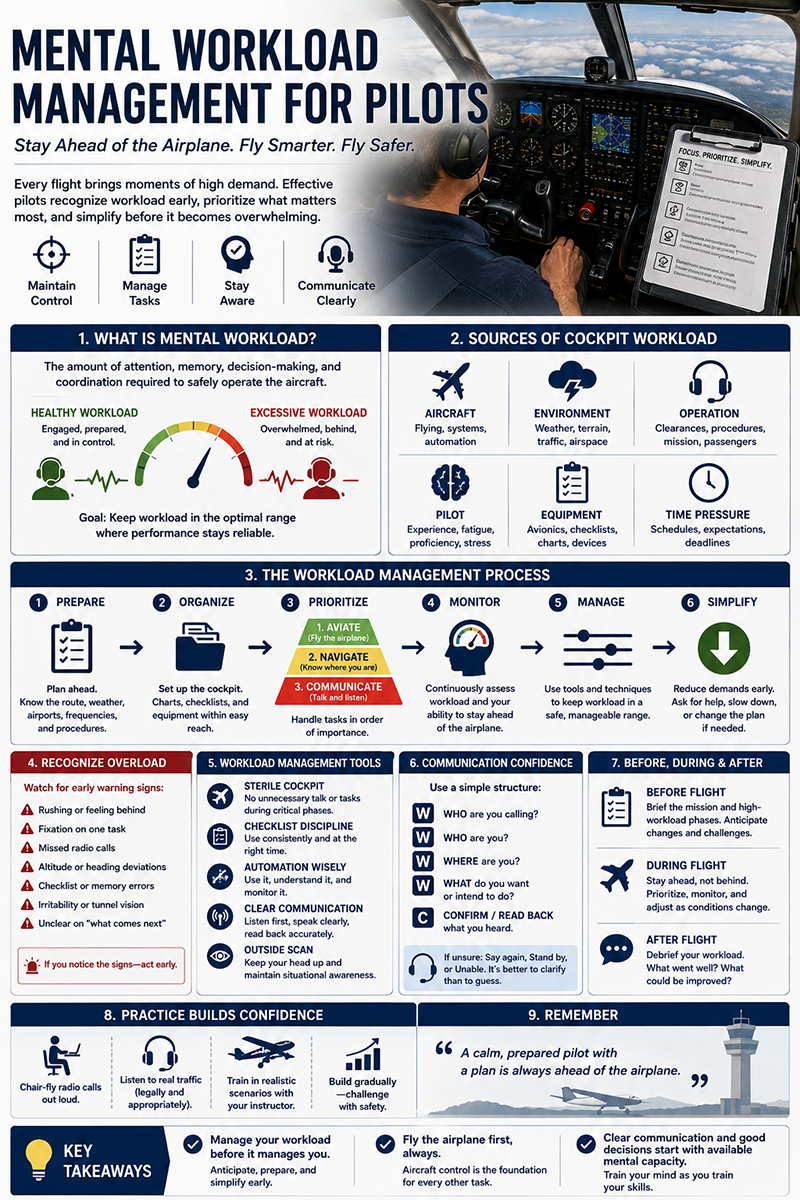
Mental workload management for pilots is the practical skill of keeping the cockpit mentally manageable while still flying the airplane accurately, communicating clearly, navigating correctly, and making sound decisions. Every pilot has experienced workload in some form: the radio gets busy, the airplane drifts from altitude, weather begins to change, a passenger asks a question, or a checklist takes longer than expected. The issue is not that workload exists. The issue is whether the pilot recognizes it early enough and uses effective habits to stay ahead of the airplane.
Good workload management is not about being unusually fast, calm, or gifted. It is built from preparation, prioritization, cockpit organization, communication discipline, automation awareness, and the willingness to simplify the operation before the situation becomes saturated. For student pilots, this skill develops through structured training and repetition. For certificated pilots, it must be maintained deliberately, especially when flying new aircraft, unfamiliar avionics, complex airspace, demanding weather, or high-tempo operations.
This article explains mental workload in practical aviation terms. It focuses on how pilots can recognize overload, manage attention, use standard procedures without becoming trapped by them, and make safer decisions when cockpit demands increase. The goal is not to remove workload from flying. The goal is to manage it so the pilot remains effective, situationally aware, and able to choose the next best action.
What Mental Workload Means in the Cockpit
Mental workload is the amount of attention, memory, perception, decision-making, and motor coordination a pilot must use to manage the flight at a given moment. It rises and falls throughout a flight. Taxiing at an unfamiliar airport may be more demanding than cruise flight in smooth weather. Entering a busy traffic pattern may require more attention than climbing through quiet airspace. An instrument approach in turbulence may require a pilot to process aircraft control, navigation guidance, altitude constraints, communications, missed approach planning, and weather information at the same time.
Workload is not automatically bad. A certain amount of task demand keeps a pilot engaged. Too little workload can lead to complacency, boredom, or reduced monitoring. Too much workload can produce task saturation, narrowed attention, delayed decisions, missed radio calls, checklist errors, altitude deviations, or poor risk assessment. The most useful pilot skill is not avoiding all workload, but keeping it within a range where performance remains reliable.
In practical terms, cockpit workload comes from several sources. The aircraft itself creates workload through control, configuration, systems, performance, and automation. The environment adds workload through weather, terrain, traffic, airspace, lighting, and runway conditions. The operation adds workload through clearances, procedures, passengers, training tasks, time pressure, and mission expectations. The pilot adds workload through experience level, fatigue, stress, proficiency, personal minimums, and familiarity with the route or equipment.
A pilot who understands workload as a dynamic condition can manage it more effectively. Rather than thinking, “I am behind,” the pilot can ask, “What is consuming my attention right now, what can wait, and what must be handled immediately?” That shift turns workload from an emotional reaction into an operational problem that can be managed.
Why This Matters in Real-World Aviation
Mental workload management matters because aviation often requires several time-sensitive tasks to be handled in the correct order. A pilot may need to maintain aircraft control, comply with an air traffic control instruction, monitor weather, configure the aircraft, brief an approach, and communicate with passengers within a short period. When the pilot’s attention becomes overloaded, important tasks can be delayed or forgotten.
In flight training, workload management is one of the major differences between knowing a maneuver and flying safely in a real operating environment. A student may be able to perform slow flight, stalls, steep turns, or landings when the instructor sets up the scenario and provides reminders. The workload increases when the student must also manage radio calls, traffic scanning, checklist use, airspace boundaries, weather decisions, and navigation. That is why instructors often add tasks gradually. The objective is not to overwhelm the student. It is to build the ability to fly accurately while managing the full cockpit environment.
For instrument pilots, workload management is central to safe operations. Instrument flying demands continuous cross-check, interpretation, and control. Add clearances, altitude restrictions, procedure changes, icing concerns, turbulence, or avionics programming, and the pilot can quickly run out of spare attention. The pilot who has briefed the approach early, loaded the avionics correctly before the high-workload phase, and planned the missed approach is in a much better position than the pilot trying to build the plan at the final approach fix.
For flight instructors, workload management is both a teaching objective and a safety responsibility. Instructors must monitor the aircraft, the student, the environment, and the lesson plan while deciding when to allow learning and when to intervene. A good instructor recognizes when a student is saturated and uses that moment for training without allowing the flight to become unsafe. Instructors also model calm prioritization. Students learn not only from what instructors say, but from how instructors handle busy moments.
For aviation professionals, workload management affects crew coordination, dispatch planning, maintenance communication, passenger handling, and operational decision-making. Even in highly structured operations, workload can increase when equipment changes, weather deteriorates, schedules compress, or abnormal situations develop. The underlying principle remains the same: the crew must preserve the ability to aviate, navigate, communicate, and decide.
How Pilots Should Understand Workload Management
Pilots should think of workload management as a continuous control process, similar to managing airspeed or energy. You do not wait until the aircraft is far too slow before correcting. In the same way, you should not wait until you are mentally saturated before reducing cockpit demands. Good workload management begins before engine start and continues until the aircraft is secured after landing.
Before flight, workload management starts with preparation. A pilot who reviews the route, weather, NOTAMs, airport layout, fuel planning, alternates, aircraft status, and expected communications reduces the number of surprises in flight. Preparation does not guarantee an easy flight, but it creates mental space. If the pilot has already considered likely runway changes, terrain concerns, airspace transitions, and diversion options, fewer decisions have to be built from scratch under pressure.
During preflight and taxi, cockpit organization becomes important. Charts, checklists, kneeboard notes, electronic flight bag settings, pens, flashlights, headsets, and backup equipment should be arranged so they can be used without unnecessary searching. A cluttered cockpit creates hidden workload. When a pilot spends attention looking for a frequency, searching for a checklist, or trying to manage loose items, that attention is not available for aircraft control or traffic awareness.
In flight, workload management relies on prioritization. The traditional aviation priority of aircraft control first, then navigation, then communication remains useful because it reflects operational reality. If the airplane is not under control, every other task becomes secondary. This does not mean communication is unimportant. It means a radio call should not be allowed to degrade aircraft control. A pilot who says “stand by” to air traffic control while stabilizing the airplane is often making a better decision than one who rushes a response while drifting from altitude or heading.
Another key concept is task timing. Many cockpit tasks are not equally urgent. Some must be done now, while others can be delayed. Configuring the aircraft on final approach may be immediate. Updating an arrival estimate may be able to wait. Responding to a passenger question can usually wait until a lower workload period. The skilled pilot constantly sorts tasks into immediate, soon, and later. This sorting reduces the feeling that everything must be handled at once.
Workload management also requires self-monitoring. Pilots should learn their personal signs of saturation. These may include rushing, fixation, missing radio calls, repeating a task without progress, feeling irritated, forgetting a checklist item, losing the mental picture, or becoming unusually quiet. Recognizing these signs early is valuable. The pilot can slow down, level off if appropriate, ask for delaying vectors when available, use the autopilot if installed and understood, request clarification, or discontinue an approach when continuing would be unwise.
The Relationship Between Workload, Situational Awareness, and Decision-Making
Situational awareness is a pilot’s understanding of what is happening, what it means, and what is likely to happen next. Mental workload directly affects that awareness. When workload is manageable, the pilot can scan the instruments, monitor traffic, listen to the radio, anticipate the next clearance, and think ahead. When workload becomes excessive, attention narrows. The pilot may focus intensely on one problem while missing other important cues.
This narrowing of attention is one reason cockpit overload can be hazardous. A pilot troubleshooting an avionics issue may forget to monitor altitude. A pilot trying to program a route amendment may miss traffic information. A pilot worried about a rough engine may delay selecting a suitable landing area. The problem is not lack of intelligence or lack of motivation. It is a normal human limitation: attention is finite.
Decision-making also changes under workload. Under pressure, pilots may choose the most familiar option, continue with the original plan, or accept a marginal situation because changing the plan feels like more work. This is why workload management and aeronautical decision-making are connected. A pilot who reduces workload early creates room for better decisions. A pilot who waits until overloaded may become less able to evaluate options objectively.
One useful technique is to verbalize the situation, even when flying alone. A simple statement such as, “Weather ahead is lowering, fuel is adequate, nearest suitable airport is ten miles west, and I have time to turn around,” helps organize thought. Verbalization brings vague concern into a structured decision. It also helps identify missing information. In crew environments, speaking clearly about workload and uncertainty supports better coordination.
Managing Workload Before the Flight Begins
Many workload problems begin before the airplane moves. A pilot who launches with incomplete planning, unfamiliar avionics settings, unclear weather expectations, or a rushed preflight has already increased the demands of the flight. The cockpit may seem manageable during taxi, but the workload penalty appears later when conditions change.
A strong preflight process should answer practical questions. What are the most likely high-workload phases of this flight? Which frequencies, routes, altitudes, or procedures are likely to change? What weather conditions could force a diversion or delay? What airport diagrams, approach charts, or performance information should be readily available? What equipment is unfamiliar or recently changed? What personal factors could affect performance today?
For student pilots, this preparation may be guided by the instructor. The instructor can ask the student to identify the busiest expected point of the lesson. For example, on a cross-country flight, the busiest phase may not be cruise. It may be the arrival into an unfamiliar airport with tower communications, pattern entry, and runway identification. By naming the high-workload phase before departure, the student begins thinking ahead.
For experienced pilots, preflight workload management often means resisting the temptation to rely on habit alone. Familiar flights can still become demanding. A runway closure, temporary flight restriction, avionics database issue, gusty wind, or passenger need can change the workload profile. A short flight is not automatically a simple flight. The pilot should prepare according to the operation, not just the distance.
Workload Management During Taxi, Takeoff, and Departure
Taxi is sometimes underestimated as a workload phase, especially by pilots who focus mainly on the airborne portion of the flight. At unfamiliar airports, taxi can require careful attention to signage, markings, airport diagrams, clearances, other aircraft, vehicles, hotspots, and runway crossing instructions. Good taxi workload management includes slowing the aircraft, stopping if necessary, briefing the route, and refusing to let uncertainty continue while moving.
Before takeoff, pilots can reduce workload by completing required checks without rushing and by briefing the departure plan. A useful takeoff briefing includes the runway, initial heading or course, expected altitude, initial frequency, emergency considerations appropriate to the operation, and any known threats such as crosswind, terrain, birds, or traffic. The briefing does not need to be theatrical. It needs to create a shared or personal mental model before the airplane accelerates.
Departure can become busy quickly. The airplane is close to the ground, configuration may be changing, climb performance must be monitored, air traffic control may issue instructions, and traffic may be present. This is not the best time to search for frequencies, troubleshoot nonessential equipment, or hold long passenger conversations. Sterile cockpit discipline, even in general aviation, is a practical way to protect attention during takeoff, climb, approach, and landing.
Managing Workload En Route
Cruise flight can appear relaxed, but it is an important time to prepare for future workload. The best pilots use lower workload periods to get ahead. They update weather, review fuel status, confirm navigation, brief arrivals, organize charts, and consider alternates before pressure builds. In this sense, cruise is not empty time. It is planning time.
En route workload often increases when the flight does not match the original plan. A heading change, unexpected turbulence, a passenger issue, reduced visibility, a system caution, or a route amendment can shift the pilot from monitoring mode to problem-solving mode. The pilot should respond by simplifying. That may mean using altitude hold or heading mode if the autopilot is available and appropriate, asking for a repeat or amended clearance, delaying nonessential tasks, or choosing a conservative option earlier rather than later.
Electronic flight bags and moving maps can help reduce workload, but they can also create it. A pilot who understands the device, has current data, uses sensible screen brightness, and avoids unnecessary button pushing may gain significant situational awareness. A pilot who tries to learn a feature during a high-workload moment may lose time and attention. Technology should support the flight, not become the flight.
Workload Management in the Traffic Pattern and Landing Phase
The traffic pattern compresses multiple tasks into a short period. The pilot must maintain spacing, configure the aircraft, communicate position, monitor wind, scan for traffic, adjust power, manage descent, and judge the runway environment. For students, this can be one of the most mentally demanding parts of training. For experienced pilots, the pattern can still become challenging when traffic is dense, winds are gusty, or the runway layout is unfamiliar.
One of the most effective workload management tools in the landing phase is stabilization. A stabilized approach concept means the aircraft is on the intended path, at an appropriate speed, properly configured, and under control with only normal corrections required. The exact criteria may vary by aircraft, operation, and training program, but the practical idea is simple: if the approach is not coming together, forcing it usually increases workload and reduces safety margin. A go-around is a normal maneuver and should be treated as a planned option, not a failure.
Workload rises sharply when a pilot tries to salvage an unstable approach while also handling radio calls, traffic spacing, wind correction, and checklist items. By contrast, going around often converts a compressed, unstable situation into a more manageable one. The pilot climbs, reconfigures, communicates as needed, and sets up again with better spacing and preparation.
Common Mistakes and Misunderstandings
A common misunderstanding is believing that workload management is mainly about working faster. In aviation, faster is not always better. A rushed pilot may skip verification, misread a clearance, select the wrong avionics field, or respond before understanding. Workload management is more often about sequencing tasks, slowing the pace when possible, and protecting the most important duties.
Another mistake is treating checklists as interruptions rather than workload tools. A checklist is designed to support memory and standardization. However, checklists must be used intelligently. Reading a checklist while the aircraft is drifting from assigned altitude or while traffic avoidance is required can be poor timing. The pilot must maintain aircraft control and choose an appropriate moment to run or resume the checklist.
Pilots can also overestimate the workload-reducing value of automation. Autopilots, flight directors, GPS navigators, and integrated avionics can be excellent tools, but only when the pilot understands what mode is active, what the system is commanding, and how to disconnect or revert to basic control. Automation confusion can increase workload quickly. If the system is not doing what the pilot expects, the safest short-term solution may be to simplify the mode selection or hand-fly, depending on conditions, proficiency, and aircraft equipment.
Another common problem is delaying communication. Pilots sometimes hesitate to tell air traffic control that they need more time, a repeat, a vector, a lower workload clearance, or assistance. Clear communication can reduce workload. A simple request such as “unable,” “say again,” “stand by,” or “request vectors” can prevent a small workload issue from becoming a larger one. Pilots should use proper phraseology and good judgment, but they should not allow pride or embarrassment to block communication.
Some pilots also underestimate personal condition. Fatigue, dehydration, illness, stress, medication effects, and emotional distraction can reduce available mental capacity. A flight that is normally easy may become demanding when the pilot is not at full capability. Personal minimums should account for the pilot’s condition, not just aircraft capability and weather.
Practical Example: A Busy Arrival in Marginal Weather
Consider a private pilot flying a well-equipped single-engine airplane to an unfamiliar towered airport. The weather is legal for the pilot’s operation, but visibility is lower than expected and the ceiling is not generous. During cruise, the pilot receives updated weather and learns that the landing runway has changed. The arrival now requires a different traffic pattern entry, a new tower frequency, and a slightly longer route around nearby airspace.
A pilot with weak workload management may continue toward the airport while trying to reprogram the navigator, brief the airport diagram, listen to traffic, answer a passenger question, and descend all at once. The airplane begins drifting below the intended altitude. The pilot misses part of a radio call and becomes irritated. The arrival is still manageable, but the pilot is now reacting instead of leading.
A pilot using strong workload management responds differently. While still en route and before the descent becomes urgent, the pilot levels the workload. The passenger is told that the cockpit will be quiet during arrival. The pilot confirms the airport diagram, reviews the runway and pattern direction, sets the tower frequency in standby, and verifies the navigation change. If more time is needed, the pilot slows down, requests a vector, or delays descent as appropriate. The pilot keeps flying the airplane first and treats avionics programming as secondary to aircraft control.
On approach to the airport, traffic becomes a factor and the tower issues sequencing instructions. The pilot reads back the clearance, keeps the pattern entry simple, and maintains a stable speed. If the aircraft is not configured and stabilized at the appropriate point, the pilot goes around rather than forcing the landing. The key difference is not that the second pilot had less to do. The second pilot actively managed when and how each task was handled.
Best Practices for Pilots
Effective workload management is built from habits that make the cockpit predictable. These habits do not replace skill. They protect skill by keeping the pilot’s attention available for the right task at the right time.
- Brief the high-workload phases before they arrive. Identify the most demanding parts of the flight, such as taxi at an unfamiliar airport, departure in busy airspace, weather deviations, arrival, approach, or landing.
- Use low-workload periods wisely. Cruise is a good time to review weather, fuel, arrival procedures, alternates, and cockpit setup.
- Keep aircraft control at the top of the priority list. Radio calls, avionics entries, and passenger needs should not be allowed to compromise basic flying.
- Simplify early. Slow down, ask for clarification, delay nonessential tasks, use appropriate automation, or choose a less demanding option before saturation develops.
- Know your equipment before you need it. Avionics and automation reduce workload only when the pilot understands their operation and limitations.
- Practice go-arounds and missed approaches as normal outcomes. Discontinuing an unstable or overloaded approach is a sign of sound judgment.
- Communicate workload when appropriate. In crew operations, say when you are task saturated. In single-pilot operations, use concise requests to reduce complexity.
Flight instructors can strengthen these habits by designing lessons that gradually increase workload. For example, an instructor might first teach a maneuver in a quiet practice area, then add navigation, radio work, simulated distractions, or decision-making elements. The goal is not to surprise the student unfairly. The goal is to help the student build capacity while maintaining safe margins.
Pilots can also debrief workload after every flight. Useful questions include: When was I busiest? What task surprised me? What could I have prepared earlier? Did technology help or distract me? Did I communicate clearly? Did I continue with a plan after it stopped making sense? This type of debrief turns routine flying into continuous improvement.
Training Mental Workload Management
Mental workload management can and should be trained. It improves when pilots practice under realistic conditions, receive thoughtful feedback, and learn to recognize the early signs of saturation. A lesson does not need to be dramatic to be valuable. Even a normal cross-country flight can be used to practice timing, prioritization, and cockpit organization.
Scenario-based training is especially useful. Rather than asking only whether a pilot can perform a task, scenario-based training asks whether the pilot can manage the task in context. For example, can the pilot divert while maintaining altitude, communicating clearly, monitoring fuel, and choosing a suitable airport? Can the pilot reject a landing attempt when spacing, configuration, or wind correction is not working? Can the pilot use automation appropriately without losing awareness of aircraft state?
Instructors should be careful to distinguish productive workload from excessive overload. A student who is challenged but still learning may benefit from continued coaching. A student who is saturated may need the instructor to reduce task demand, take over temporarily, or pause the scenario for teaching. The purpose is skill development, not embarrassment.
Experienced pilots benefit from recurrent training that includes abnormal scenarios, avionics review, instrument procedures, and decision-making practice. Many workload problems appear when pilots are rusty, when they transition to new equipment, or when they face a situation they have not practiced recently. Recurrent training helps rebuild mental pathways before they are needed in flight.
Single-Pilot Workload Management
Single-pilot operations deserve special attention because there is no second crewmember to share tasks, cross-check decisions, or manage communications. The single pilot must act as aircraft handler, navigator, communicator, systems manager, and decision-maker. That does not mean single-pilot flying is unsafe by nature, but it does mean workload discipline is essential.
Single-pilot workload management depends heavily on preparation and standard routines. Frequencies should be anticipated. Charts should be accessible. Checklists should be used consistently. Personal minimums should be realistic. If workload becomes excessive, the pilot should reduce complexity rather than attempting to prove capability. That may mean diverting earlier, declining a complex clearance, requesting vectors, holding outside busy airspace, or waiting for better weather.
Passengers can either increase or reduce workload depending on how they are briefed. A short passenger briefing can explain when conversation is welcome and when the pilot needs a quiet cockpit. Passengers can also be asked to help with simple nonoperational tasks, such as watching for traffic or holding a chart, provided the pilot does not rely on them for required pilot duties.
Automation and Workload: Help, Trap, or Both?
Automation is one of the most important workload tools in modern aviation, but it must be managed deliberately. A functioning autopilot can reduce physical control workload, allowing the pilot to review charts, communicate, manage systems, or make decisions. A moving map can improve positional awareness. Flight planning software can help organize route and weather information. These tools are valuable when used correctly.
The trap is assuming automation always reduces workload. If the pilot is unsure which mode is engaged, enters the wrong waypoint, mismanages altitude capture, or focuses on troubleshooting instead of flying, automation can become a distraction. Pilots should understand the basic operating logic of their equipment, practice common changes before flight, and remain ready to revert to simpler modes or hand flying.
A practical automation question is: “What is the airplane doing, why is it doing that, and what will it do next?” If the pilot cannot answer, workload is likely increasing. The solution is not always to disconnect immediately, but it is always to regain understanding. Simplify the automation, verify the flight path, and prioritize aircraft control.
Frequently Asked Questions
What is mental workload management for pilots?
Mental workload management is the pilot’s ability to organize attention, prioritize tasks, and maintain aircraft control and situational awareness when cockpit demands increase. It includes preparation, task timing, communication, checklist use, automation management, and decision-making.
How can a student pilot improve workload management?
A student pilot can improve by preparing each lesson carefully, using checklists consistently, verbalizing priorities, practicing radio work, staying organized in the cockpit, and debriefing busy moments after each flight. Workload capacity improves with structured repetition and realistic training.
What are signs that a pilot is becoming task saturated?
Common signs include rushing, fixation on one task, missed radio calls, altitude or heading deviations, checklist confusion, irritability, silence, repeated errors, or loss of the overall flight picture. Recognizing these signs early allows the pilot to simplify before performance deteriorates.
Does automation always reduce pilot workload?
No. Automation can reduce workload when the pilot understands it and uses it appropriately. It can increase workload when the pilot is confused about modes, enters incorrect information, or focuses on the system instead of the aircraft and flight path.
What should a pilot do when workload becomes too high?
The pilot should maintain aircraft control, reduce nonessential tasks, communicate clearly, ask for clarification or assistance when appropriate, simplify the flight path, and consider conservative options such as delaying, diverting, going around, or discontinuing an approach.
Why is workload management important for flight instructors?
Flight instructors must manage their own workload while monitoring the student, aircraft, environment, and lesson objectives. They also teach students how to recognize saturation, prioritize tasks, and make safe decisions under realistic cockpit demands.
Key Takeaways
- Mental workload management for pilots is a practical skill built through preparation, prioritization, cockpit organization, and disciplined task timing.
- Workload becomes a safety concern when it narrows attention, weakens situational awareness, or leads the pilot to rush, fixate, or continue an unstable plan.
- Training should include realistic scenarios, early recognition of task saturation, effective communication, automation understanding, and the judgment to simplify or discontinue when needed.