
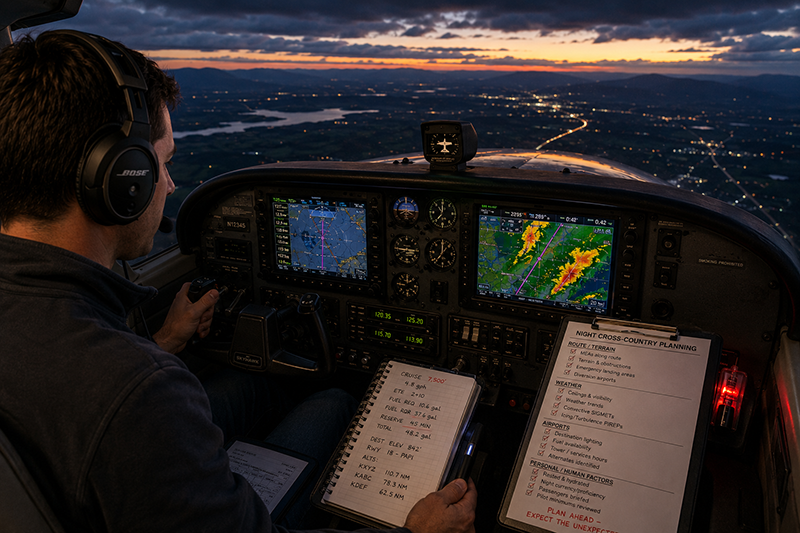
Night cross-country hazards are easy to underestimate because the airplane may feel familiar, the route may look simple on a planning app, and the weather may appear benign at sunset. Yet flying after dark changes nearly every part of a VFR or IFR trip. Visual references become weaker, terrain and obstacles are harder to detect, weather cues are less obvious, and fatigue can quietly reduce a pilot’s margin before the airplane ever leaves the ramp.
For student pilots, private pilots, instrument pilots, and flight instructors, night cross-country flying is not just daytime flying with the lights turned down. It requires a different style of planning, a more conservative view of escape options, and a sharper understanding of human limitations. The hazards that matter most are often not dramatic. They are subtle: a dark departure path, a missing horizon, a fuel stop with limited services, an unlit tower, haze that erases ground lights, or a pilot who assumes an airport will be easy to find because it was easy in daylight.
What Makes Night Cross-Country Flying Different
A cross-country flight at night compresses several risk areas into one operation. The pilot must navigate over unfamiliar terrain, manage fuel and weather decisions, communicate in the airport and en route environment, and maintain aircraft control with fewer natural visual cues. In daylight, the pilot’s eyes can often confirm the big picture: terrain, roads, lakes, towers, smoke, rain shafts, airport layout, and traffic. At night, those cues may be incomplete, misleading, or absent.
The most important difference is that night reduces the reliability of outside visual information. A well-lit city can make orientation easier, but rural terrain, water, forests, mountains, and sparsely populated areas can look like a dark void. A pilot may be legally operating under visual flight rules and still have very little useful outside reference. That gap between legal visibility and practical visual usefulness is one of the most important night cross-country lessons.
Night also changes the way pilots judge distance and height. Bright lights may look closer than they are. A runway with unfamiliar lighting intensity, width, or surrounding terrain can produce visual illusions. A long, well-lit runway may encourage a shallow approach if the pilot misjudges height. A narrow or dimly lit runway may make the aircraft appear higher than it is. Sloping terrain, black-hole approaches, and limited peripheral cues can all interfere with normal visual judgment.
For pilots training toward certificates or ratings, night cross-country work is valuable because it exposes these factors in a structured way. For experienced pilots, the lesson is more operational: night planning should be treated as a distinct risk management exercise, not as a copy of the daytime plan.
Hazard 1: Reduced Visual References and the False Horizon
The most obvious night hazard is darkness, but the more precise hazard is reduced visual reference. A pilot may still see lights, stars, reflections, or distant towns, yet those references may not provide a reliable attitude picture. Over dark terrain or water, the lack of a visible horizon can gradually pull the pilot’s attention inside the cockpit. If the pilot is not proficient at instrument cross-check, even a VFR night flight can begin to feel like an instrument flight.
A false horizon can occur when a line of lights, a sloping cloud layer, terrain lighting, or shore lighting suggests an apparent horizon that is not level. The risk is not limited to dramatic situations. A pilot turning away from a city toward a dark area, climbing after departure, or descending toward a rural airport can experience momentary disorientation if outside cues do not match the aircraft instruments.
The practical defense is to treat night attitude control as an instrument-supported task. Even on a clear night, pilots should make regular use of the attitude indicator, heading indicator or directional display, altimeter, vertical speed trend, and other flight instruments appropriate to the aircraft. This does not mean staring inside. It means using the panel to verify what the outside view cannot reliably provide.
Hazard 2: Black-Hole Approaches to Dark Airports
A black-hole approach occurs when an airport is surrounded by very little ground lighting, commonly over dark terrain or water. The runway lights may be visible, but the surrounding visual environment provides few depth cues. Without those cues, pilots can misjudge glidepath, height, and distance from the runway. The approach may feel normal until the airplane is lower, higher, faster, or farther from the desired path than the pilot realizes.
This hazard is especially relevant on night cross-country flights because the destination airport may be unfamiliar. A pilot arriving at a rural field after a long leg may see the runway environment and feel relieved, then relax at the exact time precise energy management becomes critical. If the airport lacks visual glidepath guidance, or if that guidance is out of service, the pilot must be ready to manage the descent using known altitudes, distances, aircraft performance, and a stabilized approach concept.
A practical technique is to brief the arrival before beginning the descent. Know the field elevation, traffic pattern altitude if applicable, runway length, lighting type, surrounding terrain, and whether visual glidepath indicators are available. When flying IFR, use published procedure guidance when available and appropriate. When flying VFR, build a mental picture of where the aircraft should be at key points rather than relying only on how the runway looks.
Hazard 3: Weather That Is Harder to See at Night
Weather is not more forgiving after sunset. It is often harder to interpret. In daylight, pilots can sometimes see lowering ceilings, precipitation shafts, building cumulus, haze layers, and terrain partially obscured by moisture. At night, the same weather may be hidden until the aircraft is close to it. A dark cloud ahead may blend into the sky. Haze can scatter city lights and reduce the visible horizon. A temperature and dew point spread that seemed acceptable earlier may narrow as the evening cools.
Night VFR into deteriorating weather deserves particular respect. The pilot may have fewer visual escape cues and less time to recognize that a cloud layer, mist, or precipitation area is becoming a serious problem. If terrain is nearby, the margin becomes even thinner. For IFR pilots, night weather still matters because convective activity, icing potential, turbulence, low ceilings, and fuel decisions remain operational threats regardless of rating or equipment.
Good night cross-country planning uses more than a quick look at a radar image. Pilots should evaluate ceilings, visibilities, temperature and dew point trends, winds aloft, forecast changes, NOTAMs, pilot reports when available, and the quality of alternates along the route. The key question is not simply whether the flight can be launched. The better question is whether the pilot has practical options if the weather becomes less favorable than expected.
Hazard 4: Terrain and Obstacles That Disappear
Terrain awareness is one of the most critical night cross-country hazards. Mountains, ridges, towers, wind turbines, wires, and rising terrain may be difficult or impossible to see until very late, and some hazards will not be visible at all from the cockpit. A route that is comfortable by day can become significantly less forgiving after dark, especially in areas with sparse lighting or complex terrain.
Modern moving maps and terrain displays can be useful aids, but they do not replace disciplined altitude planning. Pilots should choose cruise altitudes and routes that provide suitable terrain and obstacle clearance, while also considering airspace, weather, performance, oxygen considerations where applicable, and emergency landing options. A direct line on a tablet may not be the best night route if it crosses dark high terrain, large bodies of water, or areas with few suitable diversion airports.
Obstacle lighting can also mislead. Some towers are lighted, some lights may be hard to distinguish from surrounding ground lights, and a pilot should not plan to see every obstacle visually. Night planning should assume that terrain and obstacles are primarily managed before the flight through route selection, altitude planning, chart review, and cockpit situational awareness.
Hazard 5: Airport Lighting, NOTAMs, and Arrival Assumptions
Many night cross-country flights end at airports the pilot has not visited in the dark. That creates a simple but common trap: assuming the airport will look like it does on a chart or in daylight. Runway lights, taxiway lights, approach lighting, visual glidepath systems, rotating beacons, fuel services, and tower operating status can vary. Some lighting systems may be pilot-controlled, some may have limitations, and some may be unavailable.
Before departure, pilots should review airport information and applicable notices for the departure airport, destination, and realistic alternates. This is not administrative housekeeping. At night, airport services and lighting can determine whether an airport is a practical option. A runway that is acceptable in daylight may be far less suitable at night if lighting is limited, the surrounding terrain is dark, or the pilot is unfamiliar with the airport layout.
Taxi hazards also deserve attention. After landing, the pilot may face unfamiliar taxiway geometry, closed pavement, confusing lights, or reduced signage visibility. A current airport diagram, slow taxi speed, and willingness to ask for progressive taxi instructions at towered airports can prevent a high-workload arrival from becoming a surface navigation problem.
Hazard 6: Fuel Planning When Services Are Limited
Fuel planning at night should be conservative because diversion choices may be fewer in practical terms. An airport may be open, but fuel may not be available. Self-serve equipment may be unavailable, a card reader may fail, or services may be limited outside normal hours. Weather, headwinds, routing changes, and missed approaches or go-arounds can also consume fuel that looked generous during planning.
The legal fuel requirement is only the floor, not necessarily the best operational target for a night cross-country. A prudent pilot considers the specific route, airport options, weather trend, aircraft fuel system, personal experience, and likelihood of delay. The question is not only, “Do I have the required reserve?” It is also, “If the destination becomes unattractive, where can I go with enough fuel to make an unhurried decision?”
Night also increases the seriousness of an off-airport landing. In daylight, a forced landing may be difficult but at least the pilot can evaluate fields, roads, and obstacles. At night, selecting a landing area may involve incomplete information. That does not mean night flying should be avoided altogether. It means fuel, engine management, and route selection deserve extra care because the consequences of losing options are greater.
Hazard 7: Fatigue, Circadian Low Points, and Task Saturation
Fatigue is one of the most frequently underestimated night cross-country hazards. A pilot may begin the day with work, family obligations, training, or travel, then launch in the evening believing a short flight is manageable. As the flight continues, the cockpit becomes quieter, the visual scene becomes less stimulating, and the body’s normal sleep rhythm may reduce alertness.
Fatigue affects more than whether a pilot feels sleepy. It can reduce attention, slow problem solving, weaken short-term memory, and make a pilot more likely to accept a poor plan because changing it feels inconvenient. At night, fatigue also interacts with workload. A weather deviation, unexpected radio frequency change, unfamiliar arrival, or avionics issue can become harder to manage when the pilot’s mental reserve is already low.
Instructors can help students by treating fatigue as a real preflight factor, not a soft personal preference. A student who flies a night cross-country after a full day of school or work may be technically qualified but not in the best condition to learn or perform. Professional pilots and experienced general aviation pilots face the same human limitation. Experience does not eliminate fatigue.
Hazard 8: Cockpit Lighting and Night Vision Management
Night vision is fragile. Bright cockpit lights, tablet screens, flashlights, strobes reflected in clouds, or a sudden look at a bright ramp area can reduce a pilot’s ability to see outside in low light. Once night adaptation is degraded, it takes time for the eyes to recover. Pilots should plan cockpit lighting before takeoff rather than improvising in the climb or during an arrival.
The goal is not to make the cockpit as dim as possible. The goal is usable lighting that supports instrument reading, chart use, checklist use, and outside scanning without unnecessary glare. Many pilots find that screen brightness settings, panel dimmers, backup flashlights, and organized cockpit layout are as important as the route itself. A dropped flashlight or a tablet set too bright can become a surprisingly disruptive cockpit problem.
Night vision also affects traffic scanning. Aircraft lights can be difficult to judge for distance and closure rate. A stationary light may be an aircraft on a collision course, a star, a ground light, or a distant tower. Pilots should use available traffic information as an aid when equipped, communicate clearly in the traffic pattern, and maintain an active scan without assuming that lights tell the whole story.
Hazard 9: Overreliance on GPS and Automation
GPS navigation and moving maps are extremely useful at night, but they can also encourage a pilot to accept a route without fully understanding it. Direct-to navigation may take the airplane over darker terrain, higher terrain, water, fewer airports, or less favorable weather. Autopilots can reduce workload, but they can also mask a pilot’s declining situational awareness if the pilot becomes a passenger in the process.
A strong night cross-country plan includes technology, but it is not dependent on any single display. The pilot should know the route structure, nearby airports, terrain considerations, minimum safe altitudes appropriate to the operation, communication frequencies, and weather escape options. If the tablet overheats, the charging cable fails, or the panel GPS becomes distracting, the pilot should still have enough navigation structure to continue safely or divert.
Automation management is especially important during arrivals. A pilot who is tired, descending into an unfamiliar airport, managing radio calls, and programming avionics may become task saturated. When workload rises, simplify. Level off if appropriate, slow down within safe operating limits, ask for help from air traffic control when available, or divert before the situation becomes compressed.
Why This Matters in Real-World Aviation
Night cross-country hazards matter because they expose the difference between aircraft capability, pilot qualification, and practical readiness. An airplane may be properly equipped, the pilot may be current, and the weather may be above basic minimums, yet the flight can still carry unnecessary risk if the route crosses dark terrain, the pilot is fatigued, the destination lighting is uncertain, or weather options are weak.
In training, night cross-country flying is a powerful way to teach aeronautical decision-making. Students learn that safe planning is not limited to drawing a line and calculating groundspeed. They must think about what they can see, what they cannot see, what they will do if the destination changes, and how to manage an airplane when the outside world is less helpful.
For certificated pilots, the same lessons apply at a higher level. Night operations reward disciplined habits: earlier weather decisions, more careful fuel planning, conservative routing, better cockpit organization, and honest personal minimums. A pilot who has flown the same route many times in daylight may need to redesign it for night, especially if it crosses mountains, forests, water, or sparsely populated terrain.
How Pilots Should Understand Night Cross-Country Risk
The best way to understand night cross-country risk is to separate legal possibility from operational wisdom. Regulations establish minimum standards for equipment, qualifications, and operating rules, but they do not evaluate every human, terrain, weather, and airport factor in a specific flight. That evaluation belongs to the pilot in command, with guidance from instructors, dispatch procedures where applicable, aircraft documents, weather briefings, and sound judgment.
A useful mindset is to ask three questions. First, what will be harder to detect at night? Second, what options disappear or become less attractive after dark? Third, what will I do before the flight to keep the workload manageable? These questions move the pilot beyond simple go or no-go thinking and into practical risk management.
For example, if a route crosses a dark rural area, the hazard is not merely that the area is dark. The hazard is that the pilot may have limited visual attitude reference, fewer visible forced landing options, less terrain awareness from outside cues, and fewer obvious checkpoints. A safer plan might use a slightly longer route along better lighted corridors, near more airports, or at an altitude that improves both communication and terrain margin, assuming aircraft performance and airspace considerations support it.
Common Mistakes and Misunderstandings
One common mistake is treating night currency or recent experience as the same thing as night proficiency. A pilot may meet applicable requirements but still be rusty at night landings, cockpit lighting management, instrument cross-check, or unfamiliar airport arrivals. Proficiency is demonstrated by smooth workload management, not simply by the passage of a requirement.
Another mistake is assuming that clear weather means low risk. A perfectly clear night over dark terrain can still leave a pilot with few outside visual references. Conversely, a hazy night near city lights may create reflections and reduced contrast that make the horizon difficult to interpret. Clear does not always mean visually easy.
Pilots also underestimate how different airports look at night. A runway that is obvious in daylight may blend into nearby roads, industrial lighting, or a town. Taxiway lights can create confusing patterns, especially at airports with construction or complex layouts. Visual glidepath systems, if available, must be identified correctly and interpreted in the context of a stabilized approach.
A fourth misunderstanding is believing that more technology automatically solves night risk. Technology improves situational awareness when used correctly, but it can also pull attention into the cockpit. Pilots should avoid heads-down programming at low altitude, during traffic pattern entry, or while maneuvering close to terrain. If a task can wait, let it wait. If it cannot wait, create time and space before doing it.
Practical Example: A Familiar Route That Changes After Sunset
Consider a private pilot planning a 170-nautical-mile VFR flight from a suburban airport to a smaller rural airport for a weekend visit. The pilot has flown the route several times in daylight. The direct course crosses farmland, a broad unlit forested area, and a low ridgeline before descending into the destination valley. The forecast calls for good visibility, but the temperature and dew point are expected to move closer together later in the evening. The destination has runway lights and self-serve fuel, but the pilot has not landed there at night.
A daytime plan might reasonably favor the direct route. At night, the same route deserves a second look. The forested area offers few visible emergency landing choices. The ridgeline may be difficult to see. The destination valley may be darker than expected. If mist develops, the pilot could arrive with fewer visual cues and limited alternates nearby.
A more conservative night plan might follow a slightly longer route near towns, highways, and intermediate airports. The pilot might choose an earlier departure to arrive before the lowest fatigue period, call ahead or verify fuel availability, review destination lighting procedures, brief a stabilized approach plan, and identify two practical diversion airports before takeoff. The route may take a few extra minutes, but it increases situational awareness and preserves options.
The important lesson is that the aircraft did not change, and the pilot’s certificate did not change. The operating environment changed. Good night flying is the discipline of recognizing that change before it creates pressure in the cockpit.
Best Practices for Safer Night Cross-Country Flights
Effective night cross-country planning starts earlier than many pilots expect. The best time to solve night problems is on the ground, with full lighting, full information, and no cockpit workload. That means reviewing the route for terrain and obstacles, choosing realistic alternates, verifying airport lighting and services, and evaluating weather trends rather than only current conditions.
Pilots should also brief the departure. Night departures can be deceptive, especially from airports near dark terrain or water. Know the initial heading, safe altitude targets, obstacle environment, and the point at which the aircraft will transition from runway visual cues to instrument-supported climb. If the departure environment is complex, consider whether an IFR clearance, a different runway, a different time, or a different route would reduce risk.
During cruise, maintain an active instrument scan even in VFR conditions. Cross-check altitude, heading, navigation position, engine indications, fuel status, and outside visual references. Use automation to reduce workload if proficient with it, but do not allow automation to replace situational awareness. Periodically ask, “If I had to divert now, where would I go?”
Arrival planning should happen well before descent. Review the airport diagram, runway lighting, field elevation, traffic pattern information, wind, terrain, and missed approach or go-around options. A go-around at night should be expected as a normal tool, not treated as an embarrassing event. If the runway picture does not look right, if the aircraft is not stabilized, or if the pilot is uncertain about position, going around creates time to rebuild the approach.
- Plan night routes with terrain, lighting, alternates, and emergency options in mind, not just shortest distance.
- Use instruments to verify attitude and altitude whenever outside references are weak or misleading.
- Confirm destination and alternate lighting, services, and airport layout before departure.
- Set cockpit lighting, tablet brightness, and backup flashlights before takeoff.
- Make earlier diversion decisions at night because visual and fuel margins can shrink quickly.
Training Value for Students and Flight Instructors
Night cross-country instruction should go beyond completing a route. It should teach students how to think in an environment where visual information is reduced. Instructors can ask students to identify dark areas, terrain features, diversion airports, fuel options, and lighting considerations during planning. In flight, the instructor can emphasize instrument cross-check, workload management, and the difference between seeing lights and truly understanding position.
Students should also experience how quickly cockpit organization matters. A misplaced chart, an overly bright screen, an unbriefed frequency, or a confusing airport layout can consume attention. These are not small details at night. They are the details that keep the pilot ahead of the airplane.
For flight reviews and recurrent training, night cross-country scenarios are useful even if the flight itself occurs in daylight. A ground discussion can explore what would change after sunset, which airports would remain practical, how weather trends would affect the decision, and what personal minimums the pilot would apply. Scenario-based training helps pilots identify weak points before they encounter them alone.
Frequently Asked Questions
Is night VFR cross-country flying safe?
Night VFR cross-country flying can be conducted safely when the pilot, aircraft, route, weather, and airport options are suitable. The risk increases when pilots treat night like daytime flying, rely on weak visual cues, accept marginal weather, or fail to plan realistic alternates.
What is the biggest hazard on a night cross-country flight?
There is no single hazard for every flight, but reduced visual reference is often central. It affects attitude control, terrain awareness, weather recognition, airport identification, and approach judgment. Fatigue, fuel planning, and airport lighting can compound the risk.
Should VFR pilots use instruments more at night?
Yes. Even when operating under VFR, pilots should use flight instruments to support attitude, altitude, heading, and navigation awareness at night. This is especially important over dark terrain, water, or any area where the natural horizon is weak.
How can pilots reduce black-hole approach risk?
Pilots can reduce black-hole approach risk by briefing the airport environment, using visual glidepath guidance when available, monitoring altitude and distance, maintaining a stabilized approach, and going around if the runway picture or aircraft energy state does not look right.
What should pilots check before choosing a night fuel stop?
Pilots should verify runway lighting, fuel availability, airport access, payment method if self-serve fuel is planned, weather, runway length, terrain, and whether the airport remains a practical option after dark. An alternate fuel plan is wise when services are uncertain.
How should instructors teach night cross-country decision-making?
Instructors should use scenario-based planning, emphasize terrain and lighting analysis, require realistic diversion planning, and teach students to manage cockpit lighting, fatigue, instrument cross-check, and stabilized approaches as connected parts of night safety.
Key Takeaways
- Night cross-country hazards often come from reduced visual cues, not from darkness alone.
- Conservative routing, fuel planning, weather evaluation, and airport lighting checks preserve options when conditions change.
- Pilots should treat night flying as an instrument-supported operation and build proficiency beyond minimum qualification or currency requirements.