
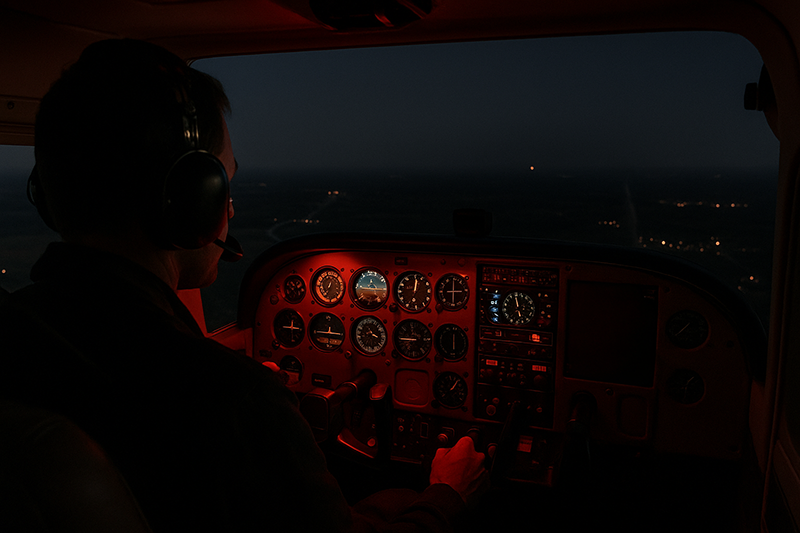
Night cross-country hazards are rarely dramatic at first. They usually appear as small gaps in planning, subtle weather changes, visual illusions, fatigue, or a route that looked simple in daylight but becomes much less forgiving after sunset. For pilots, student pilots, flight instructors, and aviation professionals, night flying is not simply daytime flying with a darker windscreen. It changes how the pilot sees, navigates, manages energy, interprets weather, and makes decisions.
A night cross-country can be a rewarding flight. Smooth air, cooler temperatures, less traffic in some areas, and excellent visibility of lights can make night operations feel precise and professional. That same environment can also hide terrain, reduce outside visual references, make weather harder to recognize, and increase the consequences of a delayed decision. The purpose of this article is to help pilots think beyond the obvious night flying checklist and recognize the hazards that are easy to miss before departure, en route, and during the arrival phase.
Why Night Cross-Country Flying Is Different
The most important difference at night is not darkness alone. It is the loss of reliable visual information. In daylight, a pilot can often see terrain, cloud buildups, haze, precipitation shafts, surface texture, open fields, smoke, and the shape of an airport environment. At night, many of those cues disappear or become ambiguous. A clear horizon may be visible over a city but nearly absent over water, desert, forest, farmland, or mountains. Roads can look like runways. Isolated lights can create a false sense of distance. A brightly lit airport can appear closer than it is, while a dark runway can appear farther away.
Night flying also changes workload. The pilot must interpret instruments more deliberately, manage cockpit lighting, read charts or electronic displays without degrading night vision, and maintain orientation while outside references are limited. Small distractions can become larger problems because fewer visual cues are available to correct them. A simple frequency change, a head-down moment with a tablet, or a search for a checklist can allow altitude, heading, or airspeed to drift if the pilot is not disciplined.
Cross-country operations add another layer. The aircraft is away from the familiar training area, often crossing mixed terrain, changing weather, different airspace, and unfamiliar airports. A pilot who is comfortable flying at night around the home airport may discover that a longer night route demands more conservative planning and a more active risk management mindset.
Search Intent: What Pilots Really Want to Know
Pilots searching for night cross-country hazards are usually looking for practical answers, not theory alone. They want to know what can go wrong, what is commonly overlooked, and how to plan a safer flight without turning every night trip into an impossible mission. Student pilots may be preparing for night training or a night cross-country lesson. Certificated pilots may be refreshing skills before a family trip or business flight. Flight instructors may be looking for better ways to teach risk awareness beyond the required maneuvers.
The best answer starts with a simple idea: night cross-country safety depends on margins. More fuel margin, more altitude margin, more weather margin, more runway margin, more time margin, and more personal readiness margin. Darkness reduces the pilot’s ability to detect and recover from developing threats. A plan that is legal and reasonable in daylight may deserve additional scrutiny after dark, especially in single-engine aircraft, unfamiliar terrain, marginal weather, or remote areas.
Hazard 1: Overestimating Night Visibility
Night visibility can be deceptive. City lights may be visible for many miles, giving the impression that the atmosphere is clear. Yet haze, smoke, mist, shallow fog, or a cloud layer can still reduce forward visibility and make the horizon indistinct. A pilot may see distant lights but have difficulty judging depth, identifying terrain, or recognizing that the flight is entering lower visibility.
This is especially important during descent and approach. A runway environment may appear suddenly after a long period of limited outside references, and the pilot may be tempted to continue visually without confirming a stable flight path. Conversely, bright approach lighting or surrounding urban lighting can make the runway appear closer, leading to a high or low approach depending on the illusion and airport environment.
Pilots should treat reported visibility, cloud bases, temperature-dew point spread, recent weather trends, and nearby observations as part of one picture. At night, it is wise to be skeptical of a route that depends on barely adequate visual conditions. If the horizon is not clear, if surface lights begin to blur, or if the aircraft is entering an area with fewer visual references, the pilot should be ready to rely on instruments, change altitude if appropriate, divert, or turn around before the situation becomes urgent.
Hazard 2: Missing Terrain and Obstruction Risk
Terrain avoidance at night deserves more attention than many pilots give it. In daylight, rising terrain may be obvious. At night, terrain may be completely invisible until it is illuminated by moonlight, city lights, or not at all. Obstructions such as towers, wind turbines, and antennas may be lighted, but pilots should not plan a route based on the assumption that every hazard will be easy to see from the cockpit.
Night route planning should begin with terrain and obstacle awareness. This includes reviewing maximum elevation figures, minimum safe altitudes, published route information, airport surroundings, and the terrain near any planned diversion airport. GPS terrain displays and moving maps can be excellent aids, but they are not a substitute for preflight understanding. A pilot who knows where the high terrain is located is less likely to be surprised by an alert or by the absence of visual cues.
Altitude selection is part of that strategy. A higher cruise altitude may provide more terrain clearance, more time to respond to an engine problem, better radio reception, and a wider view of lights or airports. The best altitude still depends on airspace, weather, winds, oxygen considerations when applicable, aircraft performance, and the pilot’s qualifications. The key point is that night altitude decisions should be intentional, not simply copied from a daylight habit.
Hazard 3: Treating Weather Like a Day VFR Problem
Weather avoidance is more difficult at night because clouds and precipitation may not be visible until the aircraft is close to them. Convective weather is a clear concern, but ordinary low clouds, fog, haze, and precipitation can also create serious problems for a pilot operating visually. A route that seems acceptable because it has legal weather reports along the way may still be poor for a night VFR pilot if conditions are trending downward, stations are widely spaced, or the route crosses dark, featureless terrain.
Nighttime cooling can also contribute to changes near the surface. Fog or low stratus may form in some areas when temperature and dew point converge, especially in valleys, near bodies of water, or over moist ground. Pilots should not assume that weather will remain static because it was clear at departure. The destination and alternates deserve repeated review, particularly when the arrival is scheduled later in the evening.
For instrument-rated pilots, night IFR may provide a structured system for routing, altitude, and approach procedures, but it does not remove risk. Instrument proficiency, aircraft equipment, icing potential, convective avoidance, fuel planning, alternate planning, and missed approach readiness still matter. For non-instrument pilots, a night VFR route with marginal ceilings or visibility can become a trap because the escape options are fewer and the visual cues are weaker.
Hazard 4: Underplanning Alternates and Divert Options
Many pilots plan a departure airport and a destination, then add an alternate only if required by a specific rule or procedure. At night, that mindset is too narrow. A practical night cross-country plan should include a mental map of usable diversion airports along the route. The pilot should know which airports have suitable runways, lighting, fuel availability if needed, approaches if applicable, and surrounding terrain that can be managed safely.
Airport lighting is a frequent weak point in planning. Some airports have pilot-controlled lighting, some have limited operating hours, and some services may not be available late at night. A runway that is perfectly acceptable in daylight may become a poor choice after dark if lighting, terrain, crosswind, runway length, or surface condition does not fit the pilot and aircraft. Pilots should verify airport information using current preflight resources and avoid assuming that every charted airport will be equally useful at night.
Divert planning also includes decision timing. The most useful alternate is the one selected early enough to reach it with comfortable fuel, weather, and workload margins. Waiting until the destination has already become doubtful can turn a routine diversion into a high-stress event.
Hazard 5: Fuel Planning That Ignores Night Realities
Fuel planning is not only about meeting a minimum reserve. On night cross-country flights, fuel is time, flexibility, and decision space. A headwind stronger than forecast, a reroute, an unexpected descent, a delay for traffic, a missed approach, or a diversion can consume margin quickly. Darkness can make every one of those events feel more demanding.
Good fuel planning starts with conservative estimates and continues in flight. Pilots should compare expected groundspeed, fuel burn, and time en route against actual performance. If the aircraft is not making the planned progress, the pilot should adjust early. That may mean stopping for fuel sooner, choosing a closer airport, or changing the mission plan. A night flight is not the place to stretch fuel because the pilot is close to home or because the destination is emotionally important.
Fuel stops also deserve practical planning. A fuel pump that is technically available may require a functioning credit card reader, ramp lighting, access procedures, or local knowledge. Late-night services can be limited. Before relying on a fuel stop, pilots should verify availability through current airport information and, when appropriate, a direct call to the facility.
Hazard 6: Cockpit Lighting and Night Vision Problems
Cockpit lighting is a small detail that can have a large effect. Too much light inside the cockpit can reduce the pilot’s ability to see outside. Too little light can make instruments, switches, charts, and checklists difficult to use. Electronic displays can be especially distracting if brightness is not adjusted before departure or if a device suddenly changes brightness in flight.
Night vision is affected by bright light exposure. Pilots should manage flashlights, panel lighting, tablet brightness, and phone screens carefully. A backup light source should be available and easy to reach. It should not be buried in a flight bag behind the seat. The goal is not to fly in darkness inside the cockpit. The goal is to use enough light to operate safely while preserving outside visibility and avoiding glare.
Instructors can help students by practicing cockpit setup on the ground before engine start. Where is the flashlight? How is the panel dimmed? Can the pilot read the checklist? Can the pilot identify circuit breakers or key switches without fumbling? These questions are simple, but they become important when workload rises.
Hazard 7: Visual Illusions on Approach and Landing
Night approaches are vulnerable to visual illusions. A runway surrounded by darkness can create a black-hole effect, where the pilot has few peripheral cues to judge height and distance. Sloping terrain, runway width, runway lighting intensity, and surrounding city lights can all affect depth perception. A wider runway may make the aircraft seem lower than it is. A narrower runway may make it seem higher. Bright lights can make objects appear closer, while dim lights can make them appear farther away.
The practical defense is to fly a stabilized approach using known references. That includes appropriate airspeed, descent rate, configuration, runway alignment, and glide path information when available. Visual approach slope indicators, electronic glide path guidance, and instrument cross-checks can help the pilot avoid relying on sight picture alone. If the approach does not look right, or if the aircraft is not stable, a go-around should remain a normal and available option.
Night landings also require attention after touchdown. Taxiway exits, runway edges, signs, and ramp areas may be unfamiliar. The pilot should slow down, use airport diagrams when available, and avoid rushing after landing. Many night errors occur after the hard part seems finished.
Hazard 8: Fatigue and Circadian Timing
Fatigue is one of the most underestimated night cross-country hazards. A pilot may be legal, current, and experienced but still not be mentally sharp after a full workday, a long drive to the airport, or a late departure. Night flying often takes place when the body expects rest. Decision-making, scan discipline, communication, and memory can all suffer when fatigue builds.
Fatigue management starts before the flight. Pilots should ask direct questions: How long have I been awake? Did I sleep well? Am I hungry, dehydrated, rushed, or emotionally distracted? Is the flight occurring during a time when I normally sleep? Am I planning to return the same night after a long event? These questions are not signs of weakness. They are part of professional risk management.
For flight instructors, fatigue is also a training issue. A student may perform well during a short night lesson but struggle during a longer cross-country with multiple tasks and a late arrival. The instructor should distinguish between a skill problem and an alertness problem. Both matter, but they are managed differently.
Hazard 9: Automation and Moving Map Overconfidence
Modern avionics and tablet-based navigation tools are valuable at night. They can improve situational awareness, show terrain, display weather products when available, and simplify navigation. The hazard is overconfidence. A pilot who spends too much time managing screens may reduce the instrument scan, miss traffic calls, overlook fuel trends, or fail to maintain a mental picture of the route.
Electronic weather is especially important to understand. Weather displays may not represent real-time conditions at the aircraft’s exact location. Products can have update delays, limitations, and coverage gaps. Pilots should use them as strategic planning tools rather than as permission to pick through hazardous weather. At night, the inability to visually confirm weather conditions makes this distinction even more important.
A good night cross-country pilot uses automation deliberately. The route is loaded, checked, and understood. The pilot knows how to use direct-to functions, nearest airport pages, terrain views, brightness controls, and communication frequencies without becoming heads-down for long periods. The best technology supports a prepared pilot. It does not replace one.
Hazard 10: Emergency Planning That Stops at the Checklist
Emergency planning at night is uncomfortable, which is why it is sometimes handled superficially. In a single-engine aircraft, an engine failure after dark presents a different challenge than the same failure during the day. The pilot may not be able to identify a suitable landing area visually. Even in multi-engine or turbine aircraft, abnormal situations at night can increase workload and reduce options.
This does not mean pilots should avoid all night flying. It means they should plan routes and altitudes with emergency options in mind. Flying within gliding distance of lighted areas may not always be practical, but terrain, weather, altitude, and airport spacing should influence the plan. A route over remote, mountainous, forested, or water areas deserves a higher level of scrutiny, especially in aircraft without redundant powerplants or when weather limits options.
Emergency preparation includes passenger briefing, cockpit organization, flashlight access, communication strategy, and a clear understanding of how to use avionics to locate nearby airports. The pilot should also be mentally prepared to aviate first. In a dark cockpit with alarms, passenger concern, and limited outside references, disciplined aircraft control is the foundation of every emergency response.
Why This Matters in Real-World Aviation
Night cross-country hazards matter because they often combine. A pilot may be tired, slightly behind fuel planning, approaching an unfamiliar airport, and watching the weather lower at the same time. None of those items may seem overwhelming individually. Together, they can create a situation where the pilot has fewer good options and less mental bandwidth.
In flight training, night cross-country lessons should teach more than navigation and landings. They should teach judgment. Students should learn how to evaluate a route, choose conservative altitudes, identify dark areas, manage cockpit lighting, interpret weather trends, and plan diversions. Instructors should resist the temptation to make night training a simple box-checking exercise. The operational environment is rich with lessons that shape long-term pilot behavior.
For experienced pilots, the risk is often familiarity. A pilot who has flown the same route many times may stop studying it carefully. A regular nighttime commute can feel routine until weather, fatigue, runway lighting, or an aircraft issue changes the picture. Professional habits are most valuable when the flight seems ordinary.
How Pilots Should Understand Night Cross-Country Risk
A practical way to understand night cross-country risk is to separate it into three categories: what the pilot can see, what the pilot can know, and what the pilot can still do if the plan changes. Darkness reduces what the pilot can see. Preflight planning, weather analysis, terrain review, and aircraft preparation improve what the pilot can know. Fuel, altitude, proficiency, alternates, and early decisions preserve what the pilot can do.
This framework keeps planning from becoming a mechanical exercise. For example, a pilot may legally depart on a night VFR flight, but if the route crosses dark terrain with scattered weather reports and few diversion airports, the practical risk may be higher than the paperwork suggests. Another pilot may choose a slightly longer route that follows better lighted areas, offers more airports, and avoids terrain. The second route may be less direct but more resilient.
Risk management is not about eliminating every hazard. Aviation always involves judgment. The goal is to identify the hazards that darkness makes harder to detect and then build margins before takeoff. The best night decisions are usually made on the ground, before schedule pressure, passenger expectations, or get-home thinking can interfere.
Common Mistakes or Misunderstandings
One common mistake is assuming that night currency equals night proficiency. Currency addresses recent experience under applicable rules, but proficiency is broader. It includes scan discipline, landing consistency, systems knowledge, diversion practice, weather interpretation, and comfort with abnormal procedures. A pilot can be current yet still need additional practice before launching on a demanding night cross-country.
Another misunderstanding is believing that city lights always make night flying safer. Lights can help with orientation, but they can also create illusions, hide weather, and make it harder to identify a specific airport. Urban areas may have more traffic, complex airspace, and bright visual clutter. Remote areas may have fewer distractions but also fewer emergency options. Each environment has different risks.
Pilots also sometimes treat alternates as administrative items rather than operational choices. At night, an alternate should be a place the pilot is genuinely willing and able to use. That means the runway, lighting, weather, terrain, approach options when applicable, and services should fit the aircraft and pilot.
A final mistake is delaying the decision to change the plan. Night flying rewards early action. Turning around, landing for fuel, requesting assistance, or diverting while the situation is still manageable is a mark of good judgment. Waiting for certainty can be dangerous because certainty may arrive late.
Practical Example: A Familiar Route That Changes After Sunset
Consider a private pilot flying a normally straightforward 180-nautical-mile trip in a single-engine airplane. The route is familiar in daylight. It crosses a mix of farmland, small towns, and a ridge line before descending toward a midsize airport. The forecast is VFR, winds are manageable, and the aircraft is performing normally. The pilot departs later than planned after a long workday.
During cruise, the groundspeed is lower than expected due to a stronger headwind. The pilot still expects to arrive with a legal reserve, but the cushion is shrinking. Ahead, the ridge area is darker than expected, with fewer lights and a less distinct horizon. The destination weather remains VFR, but a nearby station reports lower visibility in haze. The pilot begins adjusting the tablet brightness and checking fuel calculations, spending more time heads-down than usual.
At this point, the hazard is not one single failure. It is the combination of fatigue, reduced fuel margin, dark terrain, possible visibility reduction, and workload. A conservative pilot might choose to land at a well-lighted airport before the ridge, refuel, reassess weather, and continue only if the margin is restored. Another option might be a route change around the darker terrain if fuel and weather support it. The least desirable choice is to press ahead simply because the destination is familiar and the flight remains technically legal.
This example illustrates the central lesson of night cross-country flying: the right decision often appears before the situation looks serious. Pilots who train themselves to notice margin erosion early are better positioned to keep the flight routine.
Best Practices for Pilots
Good night cross-country technique begins well before engine start. The pilot should review the route in terms of terrain, weather, airports, lighting, fuel, airspace, and personal readiness. It is helpful to ask, “What will this route look like in the dark?” rather than simply asking whether the route is legal or direct.
Use current aviation weather, airport, and chart information during planning, and update the plan as conditions change. Verify destination and diversion airport lighting, runway suitability, fuel availability, and any operational limitations that could affect the flight. If the trip depends on a specific service after hours, confirm it directly when practical.
In the cockpit, organize for low workload. Set display brightness before departure. Place flashlights where they can be reached immediately. Load and verify navigation information, but maintain a mental picture of the route. Use autopilot if installed and appropriate, but continue to monitor aircraft state and navigation. Automation should reduce workload, not invite complacency.
During the flight, monitor margins continuously. Compare planned and actual fuel, time, weather, and groundspeed. Reassess personal condition. If fatigue increases, weather becomes uncertain, or the route no longer offers comfortable options, change the plan early. A precautionary stop at night is often a sign of strong airmanship.
- Choose routes that preserve terrain clearance, airport access, and communication options when possible.
- Maintain a disciplined instrument scan, especially over dark or featureless areas.
- Use visual approach guidance and instrument cross-checks to reduce night landing illusions.
- Keep fuel decisions conservative and verify late-night fuel availability before relying on it.
- Brief passengers so they understand sterile cockpit periods, lighting needs, and the possibility of diversion.
Training Value for Instructors and Students
Night cross-country training is an ideal setting for scenario-based instruction. Instead of simply flying from one airport to another, the instructor can ask the student to evaluate diversion choices, interpret changing weather reports, manage cockpit lighting, and explain the terrain strategy. These discussions build judgment that will matter after certification.
Instructors should be careful not to rescue every developing situation too early during training, while still maintaining safety. Allowing a student to recognize a subtle fuel trend, a confusing airport lighting environment, or a weak horizon can be more valuable than simply pointing it out immediately. The goal is to develop perception as well as procedure.
Students should understand that night flying skill grows gradually. Smooth landings are useful, but they are not the only measure of readiness. A proficient night cross-country pilot can plan conservatively, maintain orientation, manage workload, recognize illusions, and make timely decisions when the original plan stops being the best plan.
Frequently Asked Questions
What is the most commonly missed hazard on night cross-country flights?
One of the most commonly missed hazards is the loss of visual cues over dark terrain or sparsely lighted areas. Pilots may plan as if they will have the same horizon, terrain awareness, and weather recognition they have during the day. At night, those cues can be weak or absent, making altitude discipline and instrument cross-check essential.
Is night VFR safe for cross-country flying?
Night VFR can be conducted safely when the pilot, aircraft, weather, terrain, route, and alternates are suitable. The risk increases when visibility is marginal, terrain is high or remote, the pilot is fatigued, or diversion options are limited. Night VFR planning should generally be more conservative than daytime VFR planning.
Should pilots prefer IFR at night?
IFR can provide structure, obstacle clearance along assigned or published routes, and access to instrument approaches, but it requires proper rating, currency, proficiency, equipment, and weather judgment. IFR does not eliminate hazards such as icing, thunderstorms, fatigue, fuel constraints, or workload. The safer choice depends on the pilot, aircraft, route, and conditions.
How can a pilot reduce the risk of night landing illusions?
A pilot can reduce night landing illusions by flying a stabilized approach, using available visual glide path indicators, cross-checking instruments, maintaining proper airspeed and configuration, and going around if the approach becomes unstable. Familiarity with runway width, slope, lighting, and surrounding terrain also helps.
What should pilots verify about airports before a night cross-country?
Pilots should verify runway suitability, lighting, operating hours when relevant, fuel availability, communications, weather reporting, terrain, and any airport-specific procedures or limitations. Diversion airports should be evaluated with the same seriousness as the destination.
How does fatigue affect night cross-country decision-making?
Fatigue can reduce attention, slow decisions, weaken memory, and make a pilot more vulnerable to plan-continuation bias. A pilot who is tired may keep pressing toward the destination even when fuel, weather, or workload margins are shrinking. Honest self-assessment before and during the flight is a key safety practice.
Key Takeaways
- Night cross-country flying requires larger margins because darkness reduces visual cues, weather recognition, terrain awareness, and emergency options.
- The hazards pilots often miss are usually combinations of small problems, such as fatigue, fuel erosion, weak horizons, unfamiliar airports, and delayed diversion decisions.
- Strong night planning includes terrain review, conservative fuel management, verified airport lighting and services, disciplined instrument cross-check, and early willingness to change the plan.