
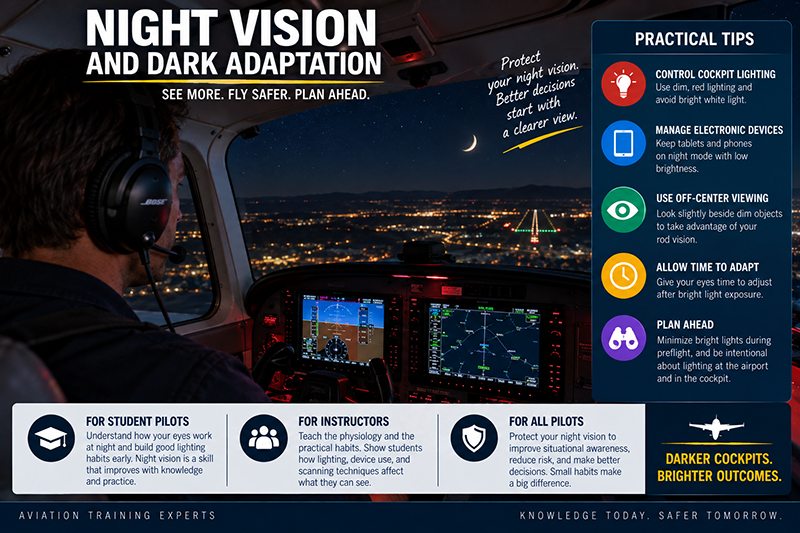
Night vision and dark adaptation are not just physiology topics for ground school. They are practical safety skills that affect how well a pilot can see traffic, terrain, cloud shapes, runway lights, obstacles, cockpit indications, and subtle cues outside the windshield. At night, the eye does not work like it does in daylight. The pilot who understands that difference is better prepared to manage lighting, scan correctly, and avoid losing valuable visual sensitivity at the worst possible time.
For many pilots, night flying feels calm and precise. The air may be smoother, radio traffic may be lighter, and city lights can make navigation visually satisfying. At the same time, night operations reduce many of the visual references pilots rely on during the day. A bright cockpit light, a glance at a tablet on full brightness, or a landing light reflecting from haze can temporarily reduce what the eyes can detect outside. This article explains how dark adaptation works, why it matters in aviation, and how pilots can protect their night vision before, during, and after flight.
What Night Vision and Dark Adaptation Mean
Night vision is the ability to detect objects, movement, contrast, and light in low-light conditions. Dark adaptation is the process by which the eyes become more sensitive after exposure to darkness. In aviation, that process matters because a pilot often moves between bright and dim environments: the ramp, the cockpit, airport lighting, approach lights, panel illumination, flashlights, tablets, and the night sky.
The human eye uses two main types of light-sensitive cells. Cones are concentrated near the center of the retina and provide sharp central vision, color perception, and detail in bright conditions. Rods are more sensitive in dim light and are better at detecting motion and faint contrast, but they do not provide the same sharp detail or color discrimination. At night, rods become much more important.
This is why a pilot may not see a dim star, unlit obstruction, or distant aircraft light when looking directly at it, yet detect it when looking slightly to the side. The center of the visual field is optimized for detail in brighter light. The rod-rich areas just outside central vision are often more useful for detecting dim objects. This is the basis for off-center viewing, a night scanning technique in which the pilot looks slightly beside an object rather than directly at it.
Dark adaptation does not happen instantly. After leaving a bright environment, the eyes gradually improve their low-light sensitivity. Some improvement occurs within the first few minutes, but more complete adaptation may take significantly longer. The exact timing varies with age, health, light exposure, fatigue, oxygenation, and the intensity of prior light. Operationally, the important point is simple: once dark adaptation is lost, it may not return quickly enough to help during a critical phase of flight.
Why This Matters in Real-World Aviation
Night flying places higher demands on instrument discipline, cockpit lighting management, visual scanning, and risk awareness. During the day, terrain, horizon, weather, and traffic may be visible through a broad range of visual cues. At night, many of those cues disappear or become ambiguous. A pilot may see airport lights but not the terrain surrounding them. A cloud layer may appear as a dark void. Haze may scatter lights and make distance judgment unreliable. A coastline, lake, or sparsely lit area can reduce outside references dramatically.
Preserving night vision helps pilots detect subtle cues earlier. This can include the position and motion of another aircraft light, the shape of an unlit cloud ahead, the outline of terrain near a dark approach path, or the difference between runway edge lights and nearby roads. It also helps during ground operations, where ramps, taxiways, service vehicles, reflective markings, and personnel may be difficult to see from a cockpit with glare or excessive interior lighting.
Night vision also affects workload. When a pilot cannot see well outside, attention often shifts inside to instruments and electronic displays. That is appropriate in many situations, especially when outside references are limited, but it can increase heads-down time. Good night cockpit setup helps maintain an effective balance: instruments readable, displays controlled, and outside vision protected as much as practical.
In training, night adaptation is often discussed as a human factors topic, but it should also be treated as an operational habit. The pilot who arrives at the aircraft from a brightly lit FBO, uses a high-intensity white flashlight during preflight, and leaves the tablet at daytime brightness may begin the flight visually disadvantaged. The pilot who plans lighting, allows time for adaptation, and avoids unnecessary glare starts with a better margin.
How Pilots Should Understand This Topic
The best way to understand night vision is to connect the physiology to cockpit behavior. Your eyes can adapt to darkness, but they are easily disrupted by bright light. Your best low-light detection may not be in the exact center of your gaze. Your perception of distance, motion, and depth can be less reliable at night. Those facts shape how you scan, how you set up the cockpit, and how you make decisions.
Off-center viewing is one of the most useful techniques. If you suspect there is traffic, terrain, a tower beacon, or a faint runway environment ahead, do not stare fixedly at the exact spot where you expect to see it. Move your eyes in small, deliberate steps and look slightly beside the area of interest. This gives the rod-dominant portions of the retina a better chance to detect weak light or movement.
Scanning at night should be deliberate rather than casual. A wide, sweeping look can miss faint objects because the image does not remain long enough on the retina. A better method is to divide the outside view into small sections, pause briefly in each, and then move to the next. At the same time, the scan must include the flight instruments. Night visual conditions can degrade rapidly, and pilots should be prepared to rely on instruments when the natural horizon or outside references are inadequate.
Cockpit lighting should be bright enough to read essential information without creating glare or washing out outside vision. This requires adjustment, not simply turning everything low. If the panel is too dim, the pilot may strain, misread information, or spend too long looking inside. If the panel is too bright, outside sensitivity suffers. The practical goal is a cockpit lighting balance that supports both instrument readability and external awareness.
Electronic displays require special attention. Tablets, phones, panel displays, moving maps, and electronic checklists can be surprisingly bright in a dark cockpit. Even a brief exposure to a bright screen can reduce dark adaptation. Night mode, reduced brightness, and thoughtful screen placement help reduce the problem. Pilots should set those preferences before taxi or before entering high-workload phases rather than adjusting them while already busy.
Color also matters, but not in a simplistic way. Red light has long been associated with preserving night vision because it tends to have less effect on rod sensitivity than bright white light. However, red light can make some colors harder to distinguish and can reduce readability of certain charts, markings, or cockpit details. Modern cockpit lighting often uses adjustable white or colored lighting designed for readability and glare control. The key is not that one color solves every problem. The key is to use the lowest practical intensity and avoid sudden bright light exposure.
Factors That Degrade Night Vision
Night vision is affected by more than cockpit lighting. Fatigue, illness, alcohol, certain medications, oxygen availability, smoke exposure, and age can all affect visual performance. Pilots should be cautious about any condition that reduces alertness, oxygenation, or visual clarity before a night flight.
Oxygen is especially relevant because the retina has a high oxygen demand. At altitude, reduced oxygen availability can affect vision before a pilot feels obviously impaired. This is one reason night flight at higher altitudes deserves conservative planning and careful attention to oxygen use when appropriate. Pilots should follow applicable oxygen regulations, aircraft guidance, and personal minimums, and they should avoid treating the legal minimum as the only safety consideration.
Windshield condition can also matter. Scratches, haze, dirt, moisture, and reflections may be much more noticeable at night because they scatter light from landing lights, strobes, ramp lighting, or city lights. A windshield that seems acceptable in daylight may create distracting glare in night operations. Clean transparencies, organized cockpit surfaces, and minimized reflections are simple but important defenses.
External lighting can create its own challenges. Beacon and strobe reflections in cloud, haze, precipitation, or ramp areas can become distracting. Landing lights can be helpful for taxi, takeoff, and landing, but they may also reflect from moisture or reduce the ability to see beyond the illuminated area. Pilots should use aircraft lighting in accordance with the aircraft’s procedures and operating environment, while recognizing that more light is not always better for visual perception.
Common Mistakes or Misunderstandings
One common misunderstanding is the belief that good daytime eyesight guarantees good night performance. A pilot may read a chart clearly in daylight and still struggle to detect dim objects at night. Night vision is a different operating mode for the eye, and it depends heavily on contrast, adaptation, scanning method, and lighting discipline.
Another mistake is using too much light during preflight. A detailed night preflight is essential, and pilots must be able to inspect fuel, oil, tires, control surfaces, lights, antennas, contamination, and general aircraft condition. The error is not using a flashlight. The error is using excessive brightness directly in the eyes, reflecting light into the cockpit, or failing to manage the transition from bright ramp lighting to dark taxi and departure conditions. A flashlight with adjustable intensity, a spare light source, and careful beam control are valuable tools.
A third mistake is relying on a tablet as if brightness does not matter. Many pilots prepare carefully, then open a bright app, message, or chart page in the cockpit and immediately compromise their dark adaptation. Night mode is useful, but it should be verified before flight. Screen brightness can also change automatically unless settings are controlled. Pilots should know how their devices behave before they are airborne.
Some pilots overtrust red lighting. Red light can be useful, but it is not magic. A very bright red light can still be disruptive, and it may make red markings, color-coded chart features, or some cockpit details difficult to interpret. The better principle is controlled illumination: use the right light, at the lowest practical intensity, directed where it is needed.
Another misunderstanding involves staring. When pilots are searching for traffic or a runway at night, they may stare directly ahead, waiting for the object to appear. That can be less effective than a structured scan with off-center viewing. Staring also increases the risk of fixation, where attention narrows and other important cues are missed. Good scanning keeps the pilot aware of instruments, outside references, traffic, and aircraft attitude.
Finally, pilots may underestimate how quickly night illusions can affect judgment. A dark area before the runway, a brightly lit runway, sloping terrain, haze, or a lack of peripheral references can distort the perception of height and distance. Night vision skills help, but they do not replace stabilized approach criteria, instrument cross-check, proper planning, and willingness to go around when the picture does not look right.
Practical Example: A Night Departure After a Bright Preflight
Consider a student pilot and instructor preparing for a night cross-country flight from a busy training airport. The aircraft is parked near a brightly lit ramp. During preflight, the student uses a powerful white flashlight to inspect the fuel caps, tire condition, oil level, control surfaces, and lighting. The inspection is thorough, but the beam repeatedly reflects from the wing, windshield, and checklist back toward the student’s eyes.
After engine start, the cockpit lights are left brighter than necessary, and the tablet is still set to daytime brightness. Taxi instructions are issued, the student begins moving, and the ramp suddenly feels visually confusing. Taxiway edge lights, blue reflectors, vehicle beacons, and signs all compete for attention. The student looks down at the tablet to confirm the taxi route and looks back outside with reduced sensitivity. The instructor notices the student is taxiing slowly, working hard to identify turns, and missing some outside movement until it is close.
The instructor stops the aircraft in a safe location, reduces cockpit and tablet brightness, confirms the taxi route, and gives the student a moment to let the eyes settle. They discuss scanning in small sectors, avoiding direct exposure to bright lights, and using the flashlight beam more carefully during future preflights. On departure, the student now has a more comfortable cockpit environment and a better outside scan. The lesson is not that bright light is forbidden. The lesson is that light must be managed as part of night operations.
Best Practices for Pilots
Protecting night vision begins before engine start. Pilots should think about the transition from daylight, indoor lighting, ramp lighting, or vehicle headlights into the aircraft. If practical, allow time for your eyes to adjust before takeoff. Avoid looking directly at bright lights. Use flashlights and cockpit lights intentionally rather than habitually.
During preflight, the priority remains a complete and accurate inspection. Do not sacrifice inspection quality to preserve dark adaptation. Instead, use proper lighting technique. Direct the beam at the item being inspected, avoid shining light into your own eyes or another person’s eyes, and use only as much brightness as needed. Carry backup lighting, since a failed flashlight at night can quickly become more than an inconvenience.
In the cockpit, set lighting before workload increases. Adjust panel lights, avionics, tablet brightness, and map lights before taxi if possible. Confirm that critical switches, controls, circuit breakers, checklists, and emergency items can be identified without excessive light. A cockpit that is too dark can be just as problematic as one that is too bright.
Use disciplined scanning. Outside, scan in small sectors and pause briefly. Use off-center viewing for dim objects. Inside, maintain a reliable instrument cross-check, especially when the horizon is weak or absent. At night, the transition from visual flight to instrument reliance can be subtle. The pilot should be mentally prepared to fly by instruments whenever outside references are insufficient.
Manage glare and reflections. Keep the windshield clean. Stow reflective objects. Be aware of white clothing, kneeboards, glossy checklists, and loose items that may reflect cockpit or exterior lights. In some aircraft, small lighting changes or repositioned devices can significantly improve the night visual environment.
Plan conservatively for conditions that reduce visual cues. Haze, smoke, precipitation, low moon illumination, sparse ground lighting, mountainous terrain, and overwater routes can all make night operations more demanding. None of these conditions automatically prevents flight, but each can reduce the effectiveness of outside vision and increase reliance on instruments, planning, and pilot proficiency.
- Set cockpit and device brightness before taxi or before entering busy airspace.
- Use off-center viewing and small-sector scanning to detect faint lights and movement.
- Avoid direct exposure to bright lights, including flashlights, tablets, and ramp lighting.
- Keep a strong instrument cross-check when outside references are limited or unreliable.
- Use appropriate oxygen, personal minimums, and conservative planning for night altitude and weather considerations.
Training Applications for Students and Instructors
Night vision training should be more than a classroom paragraph. Instructors can demonstrate the effect of lighting by having a student compare outside visibility before and after exposure to a bright cockpit display, while parked safely or during a low-workload segment. The point should be made carefully and safely, without creating distraction or reducing operational margins.
Students should practice setting up the cockpit for night flight, not simply flying after sunset. That includes organizing lighting, verifying chart readability, locating backup flashlights, adjusting displays, and briefing how to handle lighting failures. A student who can fly a good night pattern but cannot manage cockpit lighting independently is not fully prepared for real night operations.
Instructors should also connect night vision to aeronautical decision-making. If a student struggles to find an airport visually, is uncertain about terrain clearance, or loses the natural horizon, the correct response is not to keep searching visually while the airplane drifts from a safe profile. The correct response is to use instruments, navigation equipment, ATC assistance when available, published procedures when applicable, and conservative decision-making.
Scenario-based training works well. For example, an instructor might brief a night arrival into an airport surrounded by dark terrain and scattered lights. The student must plan descent, identify the runway environment, maintain a stabilized approach, manage cockpit lighting, and decide when to discontinue the approach if visual cues are inadequate. This connects physiology, cockpit management, and operational judgment in one realistic exercise.
Night Vision, Weather, and Visual Illusions
Weather can reduce night vision by lowering contrast and creating glare. Haze may make lights bloom and appear farther away or closer than they are. Moisture on the windshield can scatter landing light and runway light reflections. Clouds may be difficult to see unless they are illuminated by moonlight, city lights, lightning, or aircraft lights. A pilot may be close to cloud without recognizing it visually.
Night illusions are a major reason pilots should cross-check instruments and avoid relying exclusively on visual impressions. A runway with unusual lighting intensity or width can affect perceived height. Featureless terrain on approach can create a sensation of being higher than actual. Bright lights surrounded by darkness can distort distance perception. Sloping runways or terrain can affect the visual picture. These illusions are not signs of poor skill. They are predictable human limitations.
Dark adaptation improves the pilot’s ability to detect faint cues, but it does not eliminate illusions. The safer approach is to combine protected night vision with sound procedures: preflight planning, altitude awareness, approach briefing, instrument cross-check, stabilized descent, and go-around readiness.
Operational Takeaways for Night Flights
For a local night flight, preserving dark adaptation may mean arriving early, setting up lighting before engine start, and briefing the scan technique before departure. For a night cross-country, it may also mean reviewing terrain, lighting along the route, alternates, weather, fuel, oxygen considerations, and airport lighting activation procedures where applicable. For professional or crew operations, it may include standard cockpit lighting practices, division of duties, and communication about display brightness or glare.
Night vision is also important after landing. Taxiing at night presents real risk because the aircraft is close to obstacles, markings can be confusing, and other aircraft or vehicles may be moving nearby. After touchdown, pilots should avoid relaxing their scan too soon. Maintain taxi clearance awareness, use airport diagrams when appropriate, and manage lights so that the aircraft is visible without creating unnecessary glare or confusion.
Good night flying is a blend of preparation and humility. The pilot who respects visual limitations is more likely to use available tools properly. That includes instruments, lighting systems, checklists, navigation equipment, ATC services, and personal minimums. Preserving night vision is not an isolated technique. It is part of a larger night operations mindset.
Frequently Asked Questions
How long does dark adaptation take for pilots?
Some improvement occurs within minutes, but more complete dark adaptation often takes much longer. The exact time varies by person and conditions. From an operational standpoint, pilots should assume that bright light exposure can reduce night sensitivity quickly and that recovery may not be immediate.
Is red light always best for night flying?
Red light can help preserve some aspects of night vision, but it is not always the best choice for every task. It can make certain colors or markings harder to read, and excessive brightness can still be disruptive. Use the lowest practical light intensity and choose the light source that allows accurate reading without unnecessary glare.
Why should pilots use off-center viewing at night?
Off-center viewing helps because the most light-sensitive parts of the retina are not concentrated at the exact center of vision. Looking slightly beside a dim object can make it easier to detect faint lights, movement, or contrast.
Can cockpit displays reduce night vision?
Yes. Bright avionics, tablets, phones, and electronic charts can reduce dark adaptation and create glare. Pilots should set display brightness and night modes before high-workload phases and verify that essential information remains readable.
Does night vision affect traffic scanning?
Yes. Aircraft lights may be visible at night, but judging distance, closure rate, and relative motion can still be difficult. A structured scan, off-center viewing, instrument awareness, and proper use of traffic information systems when available all support better situational awareness.
What should a pilot do if outside visual references disappear at night?
The pilot should transition promptly to the flight instruments, maintain aircraft control, and use available navigation, communication, and procedural resources. If the flight cannot be continued safely under the existing conditions and pilot qualifications, the pilot should choose a safer course of action, such as diverting, requesting assistance, or executing a missed approach or go-around when appropriate.
Key Takeaways
- Night vision depends on dark adaptation, controlled lighting, and proper scanning rather than daytime visual habits.
- Bright lights from flashlights, tablets, ramp areas, and cockpit displays can quickly reduce the ability to detect faint outside cues.
- Use off-center viewing, disciplined instrument cross-check, conservative night planning, and practical personal minimums to improve safety margins.