
Over-the-counter medications and flying can be a risky combination when pilots treat them as ordinary household decisions instead of aeromedical decisions. A tablet that seems routine on the ground can become a meaningful flight safety factor when it affects alertness, vision, balance, reaction time, heart rate, hydration, or judgment. The medication matters, but so does the illness that caused the pilot to take it in the first place.
For student pilots, flight instructors, instrument pilots, commercial crews, and weekend aviators, the safer question is not simply whether a medication is available without a prescription. The better question is whether the pilot, the symptoms, the side effects, and the planned flight are compatible with safe operation. This article provides a practical self-assessment process pilots can use before taking the cockpit with common nonprescription medications, while recognizing that pilots should consult an aviation medical examiner, pharmacist, or qualified clinician whenever there is uncertainty.
A Safer Way to Think About OTC Medications
The term over-the-counter can create a false sense of simplicity. In everyday life, it usually means a medication can be purchased without a prescription. In aviation, that label does not automatically mean the medication is compatible with flight. Some nonprescription products can cause drowsiness, delayed reaction time, dizziness, visual changes, stomach upset, nervousness, elevated heart rate, or other effects that may be manageable on the couch but unacceptable in an aircraft.
The first principle is to separate three different issues: the condition being treated, the active ingredient being taken, and the operational demands of the flight. A pilot with nasal congestion may have difficulty equalizing pressure during climb or descent. A pilot with a fever may have degraded concentration and stamina. A pilot taking a sedating antihistamine may be technically awake but slower, less precise, and more vulnerable to task saturation. Each of those risks can exist separately, and they can also stack together.
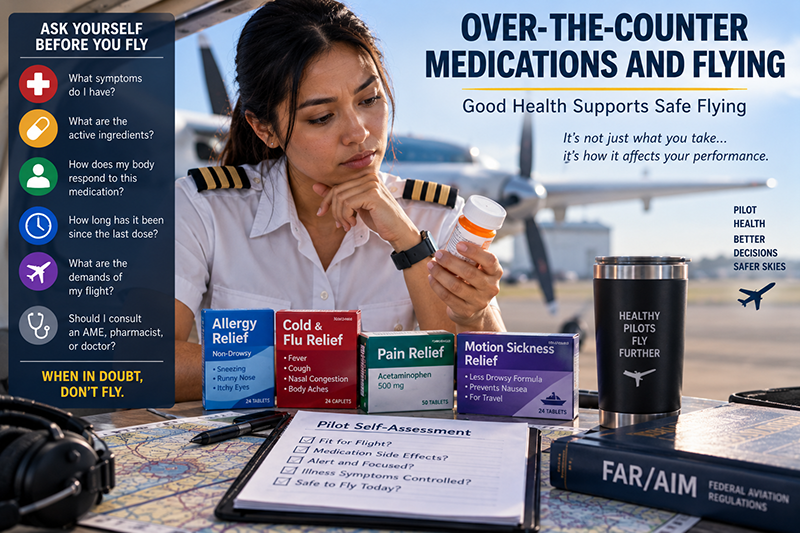
Aviation decision-making works best when pilots evaluate the whole picture rather than asking a narrow yes-or-no question about a single pill. A safer self-assessment asks: What symptoms do I have? What active ingredients am I taking? How does my body respond to this medication? How long has it been since the last dose? What flight environment am I about to enter? Who can I ask before I fly?
This process is especially important because many cold, allergy, sleep, stomach, pain, and motion sickness products contain multiple active ingredients. A pilot may think he or she is taking a simple cold medicine while actually taking a combination product that includes an antihistamine, cough suppressant, decongestant, pain reliever, or sleep-promoting ingredient. The front label may emphasize symptom relief, but the active ingredient panel is where the aviation risk discussion begins.
Why This Matters in Real-World Aviation
A cockpit is a demanding environment even on a clear day. Pilots monitor aircraft control, navigation, weather, fuel, communications, airspace, traffic, passengers, checklists, abnormal indications, and changing plans. The task load increases quickly during instrument conditions, night operations, high-density airport environments, turbulence, aircraft system issues, or training maneuvers. Any medication or illness that reduces mental sharpness can reduce the pilot's margin before an ordinary flight becomes difficult.
The aviation concern is not limited to obvious sleepiness. Many medications can create subtle impairment. A pilot may feel functional enough to drive to the airport, complete a preflight inspection, and taxi normally, yet still be slower to interpret an instrument approach clearance or recognize a deteriorating weather trend. Subtle changes in scan rate, short-term memory, coordination, or risk tolerance may not announce themselves clearly. That is what makes self-assessment difficult.
Altitude can also complicate the picture. Even in normally aspirated piston aircraft flying at modest altitudes, reduced oxygen availability, dehydration, fatigue, vibration, noise, and workload can make a pilot more susceptible to symptoms that were mild on the ground. Sinus or ear congestion may become more than an annoyance during descent. Nausea, dizziness, or headache can distract the pilot at exactly the wrong time. A medication that produces dry mouth or mild restlessness may become more bothersome during a long cross-country flight.
Training flights deserve the same level of caution. A student pilot practicing stalls, steep turns, simulated instrument flight, or emergency procedures needs full cognitive and physical performance. A flight instructor also needs the ability to observe, anticipate errors, intervene promptly, and teach clearly. Instructors sometimes normalize flying while mildly sick because schedules are busy and students are waiting. That is a poor habit pattern. Professionalism includes canceling, delaying, or modifying a flight when personal readiness is questionable.
How Pilots Should Understand This Topic
A practical pilot assessment begins with symptoms. The underlying illness may be a stronger no-go factor than the medication. A cold with sinus pressure, an allergy flare with watery eyes, a stomach illness, a migraine, a fever, or a poor night of sleep can all degrade performance. If the condition itself would make the pilot unsafe, medication does not solve the aeromedical problem. It may only mask it.
Next, pilots should look at active ingredients, not just product names. Brand names and product packaging can change, and many products come in daytime, nighttime, extra strength, multi-symptom, and extended-release versions. The active ingredient list tells the pilot what drug classes are involved. Sedating antihistamines, sleep aids, some motion sickness products, certain cough and cold combinations, and some nausea remedies are common examples of products that deserve extra caution because they may affect alertness, balance, or coordination.
Decongestants present a different kind of concern. Some pilots use them for nasal congestion, but they can cause side effects such as nervousness, jitteriness, palpitations, or sleep disruption in some individuals. They also do not remove every risk associated with sinus or ear congestion. If a pilot cannot comfortably clear the ears on the ground, relying on medication to make a descent comfortable is not a sound plan.
Pain relievers and fever reducers can also be misunderstood. The presence of pain, fever, or inflammation may indicate an illness or injury that affects flight performance. Even when the medication itself is not sedating for many users, the reason for taking it still matters. A pilot using a nonprescription pain reliever for a mild headache after dehydration faces a different risk picture than a pilot using one to push through flu-like symptoms or significant back pain.
Timing matters as well. A pilot should know how long a medication is expected to act, whether it is immediate-release or extended-release, whether it has caused side effects before, and when the last dose was taken. A common aeromedical teaching point is to allow an adequate waiting period after medication use, especially when the medication can impair alertness. The exact safe interval depends on the medication, dose, formulation, pilot response, and medical guidance. When there is uncertainty, the conservative answer is to wait and ask an aviation medical professional.
A useful way to remember the process is SAFE: Symptoms, Active ingredients, Function, and External pressures. Symptoms asks whether the illness or condition is compatible with flight. Active ingredients asks what the product actually contains and whether any component can impair performance. Function asks whether the pilot has used it before without side effects and feels fully capable of flying. External pressures asks whether schedule, passengers, money, training timelines, or pride are pushing the decision toward flight.
Common Mistakes or Misunderstandings
One common mistake is assuming that nonprescription means non-impairing. The pharmacy shelf is full of products that are safe and useful when used properly, but aviation adds performance demands that the average consumer does not face. A medication does not need to be dangerous in everyday life to be inappropriate before flying.
Another mistake is focusing only on drowsiness. Drowsiness is important, but it is not the only cockpit risk. Dizziness, blurred vision, slowed information processing, tremor, anxiety, nausea, dehydration, and distraction can all interfere with flying. A pilot who is not sleepy may still be impaired in ways that matter during radio communications, instrument scanning, traffic avoidance, or landing judgment.
Pilots also underestimate combination products. Multi-symptom cold and flu products are designed for broad relief, not for aviation decision clarity. A pilot may take one product for congestion and another for pain, not realizing that both contain similar or interacting ingredients. Duplicate dosing is a medical safety issue, and mixed side effects can complicate the pilot's self-assessment.
A third misunderstanding is believing that previous uneventful use guarantees future safety. A pilot may have taken a medication before without obvious side effects, but the flight context may be different. Fatigue, poor hydration, altitude, stress, alcohol use the night before, a different dose, a different formulation, or a more demanding flight can change the risk. Prior experience is useful, but it is not a blanket clearance.
Finally, pilots sometimes treat aeromedical decisions as private matters that do not require help. In reality, asking an aviation medical examiner, pharmacist, or clinician is a sign of discipline. Flight instructors and chief pilots can also help identify operational alternatives, such as rescheduling, flying with another qualified pilot when appropriate, changing the lesson plan, or postponing a flight until the pilot is clearly fit.
Practical Example
Consider a private pilot planning a Saturday morning cross-country flight with one passenger. The weather is VFR, but the route crosses hilly terrain and includes arrival at a busy Class D airport. The pilot has seasonal allergies and woke up with congestion and itchy eyes. Before leaving for the airport, the pilot takes an over-the-counter allergy medication from the family medicine cabinet. The label looks familiar, and the pilot has flown during allergy season before.
A safer self-assessment changes the decision. The pilot reads the active ingredient panel and notices that the medication is an older antihistamine that may cause drowsiness. The pilot also realizes that the product was taken only an hour earlier and that there is no personal experience using this exact medication before flight. The symptoms include congestion, which could become uncomfortable during descent, and the planned flight includes airspace communication, terrain awareness, passenger management, and an unfamiliar arrival airport.
Using the SAFE process, the answer becomes clear. Symptoms are present and may affect comfort and pressure equalization. Active ingredients raise a concern for sedation. Function is unproven because the pilot has not flown after taking this medication and may not yet know its full effect. External pressures exist because the passenger is expecting the trip. The safer decision is to delay or cancel the flight, contact an appropriate medical professional for guidance, and avoid using the airplane as the test environment.
This example is intentionally ordinary. Most medication-related pilot decisions do not occur during dramatic emergencies. They happen quietly in the morning before a lesson, at the hotel before a return flight, or in the hangar while trying to keep a schedule. The quality of the decision depends on whether the pilot recognizes ordinary health choices as part of preflight risk management.
Best Practices for Pilots
The best practice is to make medication decisions before the day of flight whenever possible. Pilots with recurring allergies, migraines, stomach issues, motion sickness concerns, or sleep problems should discuss aviation-compatible management strategies with an aviation medical examiner or qualified clinician in advance. Waiting until the morning of a flight invites rushed decisions and incomplete information.
Pilots should keep a personal record of medications discussed with their medical professional, including active ingredients, expected effects, personal side effects, and recommended waiting periods. This is not a substitute for current medical advice, but it helps avoid guessing at the airport. If a product label changes, the pilot should treat it as a new evaluation.
When using any new medication, pilots should not evaluate it for the first time in the cockpit. The first experience should be on the ground, away from flying duties, with enough time to observe how the body responds. Even then, a ground experience does not automatically mean the medication is compatible with flight, but it can reveal obvious side effects such as drowsiness, dizziness, stomach upset, or mental fog.
Alcohol and medications deserve special caution. Alcohol can interact with many medications and can worsen fatigue, dehydration, sleep quality, and cognitive performance. A pilot who is technically beyond a minimum alcohol waiting period may still be unfit if medication, poor sleep, illness, or residual effects are present. Fitness to fly is broader than a clock calculation.
A short set of habits can improve safety without turning the decision into bureaucracy:
- Read the active ingredient panel every time, especially on multi-symptom products.
- Consider the illness as seriously as the medication.
- Avoid flying after taking any product that causes drowsiness, dizziness, confusion, visual disturbance, or coordination problems.
- Ask an aviation medical examiner, pharmacist, or clinician when the answer is not obvious.
- Let schedule pressure lose the argument when health and medication questions remain unresolved.
Flight schools and instructors can support these habits by normalizing cancellations for health reasons. A student who cancels because of medication uncertainty should not be treated as unreliable. That student may be demonstrating exactly the kind of judgment aviation training is supposed to build.
Building the Decision Into Preflight Risk Management
Medication assessment belongs beside weather, fuel, aircraft condition, terrain, and proficiency. It is part of personal minimums. A pilot who uses a preflight risk worksheet or the IMSAFE model should give the medication element a serious review rather than a quick mental check. IMSAFE stands for illness, medication, stress, alcohol, fatigue, and emotion, and it remains useful because it reminds pilots that the aircraft is not the only system that must be airworthy.
The medication question should also be connected to the type of operation. A short daytime local flight in smooth VFR weather does not require the same workload as a night instrument cross-country in marginal conditions, but both require a fit pilot. If the pilot's condition raises any doubt, reducing the complexity of the flight may not be enough. Sometimes the right mitigation is not a shorter flight, but no flight.
For instructors, the evaluation includes both personal readiness and instructional responsibility. Demonstrating good aeromedical judgment teaches students more than any lecture about risk management. If a CFI shows up congested, medicated, fatigued, and determined to fly anyway, students learn the wrong lesson. If the instructor explains the decision to reschedule, students see professionalism in action.
Operators and flying clubs can help by encouraging early communication. Pilots should feel comfortable saying that they are reviewing a medication question and may need to delay. A culture that punishes prudent self-grounding invites concealment and poor decisions. A culture that rewards sound judgment improves safety margins for everyone.
When to Get Professional Guidance
Pilots should seek professional guidance whenever a medication is new, has central nervous system effects, is used for a significant illness, is combined with other medications, or produces any side effect that could affect flying. An aviation medical examiner is often the best starting point because aviation fitness involves both medical and operational considerations. Pharmacists can help identify active ingredients, duplicate ingredients, and common interactions. Treating clinicians can help evaluate the underlying condition and whether it is controlled well enough for normal activity.
Self-assessment is not a substitute for medical certification guidance or individualized medical advice. It is a safety filter that helps pilots recognize when the situation is clearly unsuitable, clearly low concern, or uncertain enough to require help. The uncertain category is where disciplined pilots slow down. The goal is not to find a loophole. The goal is to be fit for the actual flight.
Frequently Asked Questions
Can pilots fly after taking over-the-counter medication?
Sometimes, but the answer depends on the medication, the active ingredients, the pilot's personal response, the condition being treated, timing, and the planned flight. If the medication can impair alertness, coordination, vision, balance, or judgment, the pilot should not fly until the concern is resolved and appropriate guidance has been obtained.
Are allergy medications safe for pilots?
Some allergy medications are more likely than others to cause drowsiness or other side effects. Pilots should not assume that an allergy product is acceptable simply because it is common. The active ingredient, personal response, dose timing, and remaining allergy symptoms all matter. When in doubt, ask an aviation medical examiner or pharmacist before flying.
What if I feel fine after taking a medication?
Feeling fine is important, but it is not the whole assessment. Some impairment can be subtle, and the cockpit adds workload, altitude, vibration, and stress. Pilots should consider the medication class, active ingredients, timing, prior experience, and the demands of the flight, not just a general sense of feeling okay.
Is the illness sometimes more important than the medication?
Yes. A medication may reduce symptoms without eliminating the underlying aeromedical risk. Fever, sinus congestion, nausea, dehydration, severe pain, dizziness, or poor sleep can make a pilot unsafe even if the medication itself is not the main concern.
Should student pilots cancel lessons because of medication uncertainty?
Yes, when uncertainty remains after a reasonable self-assessment. Canceling or delaying a lesson because of medication or illness concerns is a sound risk management decision. It also builds the judgment expected of certificated pilots.
Who should pilots ask about medication and flying?
An aviation medical examiner is often the best resource for aviation-specific medical questions. Pharmacists can help explain active ingredients and interactions, and treating clinicians can evaluate the underlying condition. Pilots should use professional guidance rather than guessing when safety or certification questions are involved.
Key Takeaways
- Over-the-counter medications and flying require an aviation-focused self-assessment, not just a quick reading of the front label.
- The illness, medication side effects, timing, altitude, workload, fatigue, and external pressure can combine to reduce the pilot's safety margin.
- When a medication or symptom raises uncertainty, the safer decision is to delay the flight and consult an aviation medical examiner, pharmacist, or qualified clinician.