
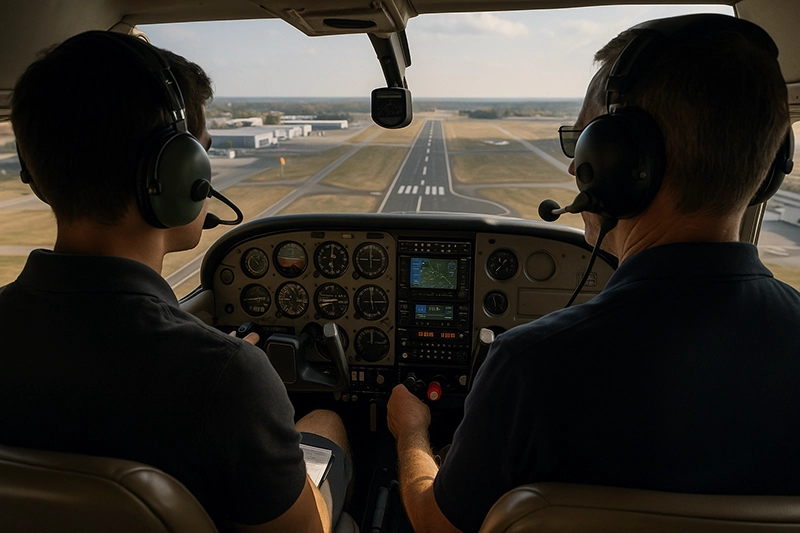
Pattern work is the bread-and-butter exercise for building safe, efficient traffic pattern operations and improving situational awareness. For pilots at all levels, focused practice in the traffic pattern sharpens scan discipline, reinforces position reporting, and strengthens decision-making under time pressure. This article explains how to use pattern work deliberately so situational awareness becomes a predictable part of your flying, not an occasional afterthought.
Continue reading to learn why pattern work matters, how instructors can structure productive sessions, what common mistakes undermine awareness, and practical techniques you can apply on your next dual or solo sortie. The primary goal is better in-cockpit decisions: clearer position awareness, timely radio calls, accurate spacing, and consistent visual scanning that reduce risk around airports.
What Pattern Work Really Is
Pattern work means repeated, focused practice of traffic pattern entries, turns, altitude and airspeed control, and runway alignments at an airport. It includes takeoffs, all legs of the pattern, landings, go-arounds, and often traffic pattern entries from the en route environment. The activity can be practiced in a variety of aircraft, and it is valuable both for basic aircraft handling and for developing the judgment required to operate safely when multiple aircraft share the airport environment.
Why This Matters in Real-World Aviation
Airports are dynamic environments. The traffic pattern is where pilots make rapid decisions with limited time and sometimes incomplete information. Effective pattern work improves:
- Position awareness: knowing where you are relative to the runway, other aircraft, and published reporting points.
- Energy management: keeping speed and configuration appropriate for the approach and landing without last-minute corrections.
- Radio discipline: making concise, timely calls that help everyone maintain shared mental models.
- Collision avoidance: scanning for other traffic and using visual acquisition techniques that reduce midair risk.
These competencies matter for flight training, commercial operations, and personal flying. Instructors use pattern work to create realistic complexity while keeping the exercise predictable and repeatable. For single-pilot operators, disciplined pattern work reduces workload spikes and provides a template for safe responses when unexpected events occur.
How Pilots Should Understand Pattern Work
Think of pattern work as a layered skill: basic aircraft control supports pattern flow, and pattern flow supports good situational awareness. Your aim is to make the low-level pattern skills automatic so cognitive resources remain available for monitoring traffic, weather changes, and radio communications.
Key elements to internalize are consistent scan patterns, timely configuration changes, and fixed anchor points for position checks. A scan pattern is a repeatable sequence of visual and instrument checks that you perform each leg of the traffic pattern. Anchor points are recognizable references that tell you when to start your descent, when to add flaps, and when to turn base. Anchor points vary by airplane and airport, so part of effective pattern work is learning to adapt anchors to the conditions while preserving margins for safety.
Structuring Pattern Work Sessions
A structured session is more productive than random repetition. For instructors and pilots planning pattern work, consider these stages within each flight:
- Warm-up: establish baseline flying control with straight-and-level flight, slow flight, and clean approaches to finalize control feel.
- Progression: practice full pattern sequences, starting with conservative tasks and increasing complexity—crosswind corrections, tighter spacing, or simulated traffic.
- Challenge: inject realistic disruptions such as simulated radio congestion, go-arounds, or brief simulated emergencies to test decision-making while maintaining safety margins.
- Debrief: review strengths and areas for improvement with objective observations—airspeed control, position judgement, scanning effectiveness, and communication clarity.
Keep sessions short enough to avoid fatigue and long enough to produce measurable improvement. For students, repeated short sessions often produce better retention than one long day of pattern work.
Common Mistakes and Misunderstandings
Poor pattern work is rarely a single error. It is usually a cascade: an unstable approach, late radio call, missed scan, and hurried correction. Here are recurring mistakes to watch for.
Overreliance on a Single Reference
Pilots sometimes lock onto a single visual cue, like the runway threshold or a nearby building, and fail to monitor airspeed, descent angle, or other traffic. This single-focus error reduces situational awareness and often leads to unstable approaches.
Inconsistent Radio Discipline
Unclear, late, or redundant radio calls create confusion. Effective pattern work includes practicing concise, correctly timed position reports so traffic and controllers can build accurate mental pictures of who is where and who is landing next.
Delayed Configuration Changes
Waiting too long to add flaps or reduce power can force large, sudden inputs that destabilize the approach. Good pattern work emphasizes small, anticipatory adjustments and using anchor points rather than reacting at the last second.
Poor Scan Technique
Scanning only the instruments or only outside reduces the chance of spotting traffic, runway hazards, or wind flags. Effective scanning means a purposeful cross-check between outside references and flight instruments appropriate to the phase of flight.
Practical Example: A Training Scenario
Scenario: Solo student in a single-engine trainer practicing touch-and-goes at a non-towered airport on a moderately windy afternoon. The instructor sets objectives: stable approaches, correct spacing behind a preceding aircraft, and a clean go-around execution if approach parameters deviate.
Execution steps:
- Brief: review the airport traffic pattern direction, expected wind, standard reporting points, and the definition of a stabilized approach for that aircraft.
- Warm-up: two normal takeoffs and landings to confirm current aircraft handling and wind correction inputs.
- Focused practice: three consecutive touch-and-goes with emphasis on consistent descent rate and airspeed +/- a small margin selected by the instructor.
- Introduce variability: have the student perform a go-around on one approach when the instructor calls 'unstable' to practice the transition from landing mindset to climb-and-clean configuration.
- Debrief: discuss which anchor points worked, where the student lost situational awareness, and one targeted improvement for the next flight.
Training value: this scenario combines aircraft control with decision-making and communication under workload. The instructor observes the student’s scanning, notes timing of configuration changes, and evaluates whether the student recognizes an unstable approach and executes a go-around without undue hesitation.
Best Practices for Pilots
Pattern work improves faster when pilots practice deliberately. The following practices are concise, actionable, and applicable across aircraft types and pilot experience levels.
- Define stabilized approach criteria for your airplane and stick to them. If the approach becomes unstable, execute a go-around promptly.
- Use fixed anchor points for configuration and turns. Anchors should be simple, repeatable, and adjusted for wind and airport layout.
- Practice consistent radio calls that convey position and intention without unnecessary detail.
- Adopt a two-part scan: outside for traffic and runway references, and inside for critical flight parameters. Make the scan rhythm predictable so it becomes habit under pressure.
- Include at least one simulated go-around per pattern session to make the maneuver procedural and reduce hesitation when it’s needed in real flight.
- Build sessions with progressive difficulty rather than adding all challenges at once. Add crosswinds, spacing pressure, or multiple aircraft only after basics are stable.
Developing Instructor-Led Pattern Work
Instructors should structure pattern work to balance skill acquisition and safety. Begin with clear learning objectives, keep student workload manageable, and apply immediate, specific feedback during debrief. Introduce complexity in measurable steps: tighten tolerances, add simulated traffic, or practice operations into unfamiliar runways.
When supervising a student, instructors must decide when to intervene. Intervene early for control errors that threaten safety and allow students to self-correct for minor deviations so they develop judgment. A good rule is to communicate the limit points clearly before the flight so the student understands when the instructor will take control.
Training Tools and Technology
Several tools enhance pattern work practice. Flight simulators and procedures trainers allow safe repetition of radio calls and traffic pattern entries. Video or cockpit audio recordings of pattern sessions are particularly effective for debriefing; they reveal scan patterns and missed calls that the pilot may not remember. Some pilots use simple checklists or written anchors for pattern entry and configuration until the behaviors become automatic.
Use technology to augment, not replace, visual scanning training. Visual acquisition remains primary in the traffic pattern; simulation helps refine decision-making and procedural sequencing away from an active runway environment.
Common Operational Risks and How Pattern Work Mitigates Them
Risk in the traffic pattern comes from high workload, converging traffic, and unexpected changes in wind or runway conditions. Deliberate pattern work reduces these risks in several ways:
- By automating basic aircraft control, pilots keep mental bandwidth available for traffic monitoring and communications.
- By practicing go-arounds and missed approaches, pilots reduce hesitation when a go-around is the safest option.
- By reinforcing concise radio calls and standard positions, pattern work reduces ambiguity that can lead to conflict with other aircraft.
Pattern work also develops interpersonal skills: giving clear position reports and maintaining situational awareness contributes to a cooperative environment that benefits everyone operating at a busy or non-towered airport.
Practical Tips for Solo Pilots
Solo pilots should design pattern work with safety margins that reflect their experience and the airplane’s handling. Start conservatively: choose light wind days and familiar runways. Increase complexity only after consistent performance. Keep sessions focused on one or two objectives rather than trying to correct every deficiency at once.
Keep a personal log of pattern work outcomes. Note what anchor points worked, when configuration times were late, and how traffic or wind influenced decisions. Over time, these notes form a practical reference that improves future sessions.
Frequently Asked Questions
How often should I practice pattern work to maintain proficiency?
Regular practice depends on experience and recent activity. Pilots returning from a gap in flying often benefit from a targeted session with an instructor. Beyond that, routine pattern work every few months helps maintain the specific skills needed for safe traffic pattern operations.
What is a stabilized approach and how does it relate to pattern work?
A stabilized approach is one in which airspeed, descent rate, configuration, and runway alignment are within acceptable ranges early enough to allow for a normal landing. In pattern work, practice setting and recognizing those parameters; if the approach becomes unstable, plan and execute a go-around rather than attempting to salvage the landing.
When should I practice go-arounds during pattern work?
Include at least one deliberate go-around per session. Practice both the procedural task—power, attitude, configuration—and the decision-making that triggers it. Frequent practice ensures the maneuver becomes a confident, automatic response when needed.
How can I avoid getting complacent during repetitive pattern work?
Introduce measurable variations: vary flap settings, use different runways when safe, add simulated traffic, or set tighter performance tolerances. Keep objectives specific for each flight so repetitions remain purposeful rather than mechanical.
Key Takeaways
- Practical takeaway: Use repeatable scan patterns and anchor points to automate aircraft control and free attention for traffic and communications.
- Safety takeaway: Define stabilized approach criteria and commit to timely go-arounds when criteria are not met to avoid rushed or unstable landings.
- Training takeaway: Structure pattern work with progressive difficulty, include deliberate go-arounds, and debrief with objective observations to accelerate learning.
Pattern work is a high-return investment for any pilot. When practiced deliberately and debriefed honestly, it improves situational awareness, reduces risk in crowded traffic environments, and builds decision-making skills that transfer to complex flight operations. Use structured sessions, keep objectives specific, and practice with intention to make pattern work an ongoing pillar of safe flying.