
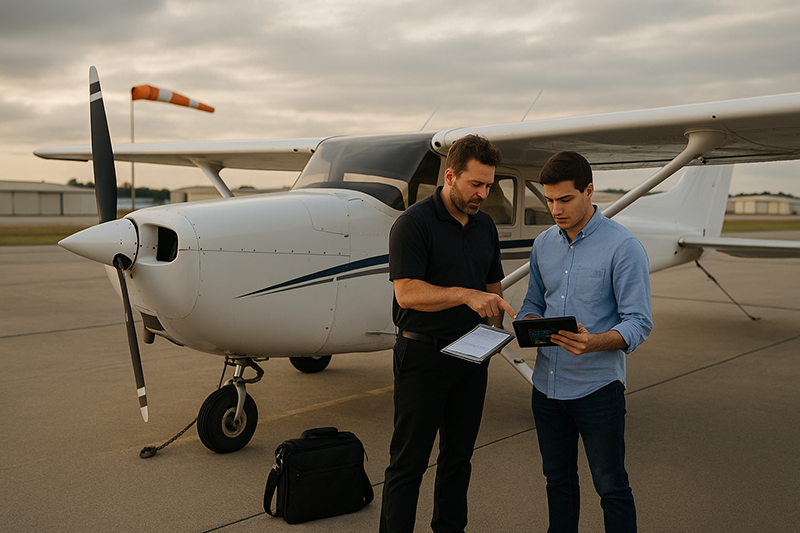
The PAVE checklist is one of the most useful aeronautical decision-making tools a pilot can carry into flight planning, cockpit briefings, and in-flight judgment. It helps pilots organize risk into four practical categories: Pilot, Aircraft, enVironment, and External pressures. Those categories are simple enough to remember under workload, but broad enough to expose the kinds of threats that often hide behind an otherwise routine flight.
For student pilots, the PAVE checklist provides structure when experience is still developing. For certificated pilots, flight instructors, and aviation professionals, it keeps decision-making disciplined when familiarity, schedule pressure, or confidence can make risk feel smaller than it really is. The value of PAVE is not that it produces an automatic go or no-go answer. Its value is that it slows the decision down long enough for the pilot to see the full picture before committing to a flight, continuing a flight, or changing the plan.
Real-world flight decisions rarely involve one dramatic hazard. More often, they involve several small pressures stacking together: a tired pilot, a marginal forecast, an aircraft with deferred convenience equipment, a passenger who needs to arrive on time, and a destination airport near the pilot's personal limits. PAVE gives pilots a common language for recognizing that stack before it turns into a trap.
What the PAVE Checklist Really Means
PAVE stands for Pilot, Aircraft, enVironment, and External pressures. It is commonly taught as part of aeronautical decision-making and risk management because it encourages pilots to look beyond weather alone. Many pilots are trained to ask, “Is the weather legal?” or “Is the airplane airworthy?” Those questions matter, but they do not fully answer whether the flight is wise for this pilot, in this aircraft, on this route, on this day, with these passengers and pressures.
The Pilot category focuses on the human being making the decisions and flying the aircraft. It includes fitness, proficiency, recent experience, fatigue, stress, medication, hydration, illness, emotional state, and honest comfort level. A pilot may be legally qualified and still not be the right pilot for a particular flight on a particular day. That distinction is central to good judgment.
The Aircraft category addresses whether the aircraft is appropriate for the mission. This includes airworthiness, equipment, performance, fuel planning, weight and balance, maintenance status, avionics capability, and the pilot's familiarity with that specific aircraft. An aircraft can be legally airworthy and still be a poor match for a flight involving night operations, high terrain, short runways, forecast icing, strong crosswinds, or complex airspace.
The enVironment category is broader than the weather briefing. It includes ceilings and visibility, wind, turbulence, convective activity, density altitude, terrain, runway conditions, airspace, lighting, time of day, traffic complexity, alternates, and airport services. It also includes the operational environment, such as flying into an unfamiliar airport, operating near busy terminal airspace, or navigating through restricted or special-use areas.
External pressures are the influences that push a pilot toward a decision for reasons other than safety and sound judgment. They can include passengers waiting, a business meeting, a vacation schedule, aircraft rental return time, maintenance appointments, pride, cost, social expectation, or the desire to complete a trip as planned. External pressure is often the most difficult PAVE category to admit because it can feel reasonable in the moment. Good pilots learn to identify it clearly and neutralize it early.
Why This Matters in Real-World Aviation
Most pilots do not struggle because they lack a checklist or cannot read a METAR. They struggle because the real world asks them to make decisions with incomplete information, changing conditions, and competing priorities. The PAVE checklist matters because it gives structure to that uncertainty.
Consider a local training flight. The airplane is available, the student has been preparing for a cross-country lesson, and the forecast shows marginal but legal VFR conditions. The instructor notices that the student arrived after a long work shift and seems unusually quiet. The airport winds are not excessive, but they are close to the student's current crosswind comfort level. There is no single obvious reason the flight must be canceled. Yet the combined picture suggests a better instructional decision may be to modify the lesson, stay in the pattern, conduct ground training, or postpone.
Now consider a private pilot flying family members to a weekend destination. The airplane is capable, the pilot is current, and the destination weather is forecast to improve. Along the route, however, ceilings are lower than expected, fuel options are limited at night, and the passengers are openly excited about arriving for an event. The pilot may feel pressure to continue because the plan was discussed for weeks. PAVE helps the pilot recognize that the decision is not just about ceiling and visibility. It is about the interaction of pilot workload, aircraft capability, environmental uncertainty, and social pressure.
In professional aviation, the same concept applies even when operations are supported by dispatch, standard operating procedures, and company systems. Crews still evaluate human factors, aircraft status, operational environment, and mission pressures. The terminology may differ, but the underlying risk management process is familiar: identify hazards, assess their significance, and make decisions that preserve margins.
How Pilots Should Understand the Pilot Category
The first letter in PAVE is often the most personal. Pilots are trained to evaluate aircraft, weather, and regulations, but self-assessment can be more uncomfortable. The Pilot category asks a direct question: am I genuinely ready for this flight?
Readiness is more than holding the appropriate certificate, rating, endorsements, and currency. Those are baseline considerations, not complete risk assessments. A pilot who has not flown in several weeks may be legal for the operation but less sharp than usual. A pilot who is recovering from illness may feel good enough to drive to the airport but not good enough to manage a complex flight. A pilot who is frustrated, rushed, dehydrated, or distracted may miss subtle cues during preflight planning or cockpit setup.
One practical way to use the Pilot category is to compare the planned flight to the pilot's recent experience, not just total experience. A pilot with many hours may still be rusty in night operations, instrument procedures, mountain flying, busy airspace, or short-field landings. A newer pilot may be fully capable of a local day VFR flight but not ready for a long cross-country with marginal weather and multiple airspace transitions. PAVE encourages that honest distinction.
Flight instructors can strengthen this habit by asking students to verbalize their personal risk factors before each lesson. Instead of simply asking, “Are you ready to fly?” an instructor might ask, “How did you sleep, what is your workload today, and what part of this flight do you expect to be most demanding?” That kind of discussion teaches students that judgment begins before engine start.
How Pilots Should Understand the Aircraft Category
The Aircraft category asks whether the airplane is legal, safe, properly equipped, and suitable for the mission. Airworthiness is essential, but the PAVE checklist pushes the analysis further. Suitability depends on what the flight requires.
For example, an aircraft used regularly for local VFR training may be perfectly appropriate for pattern work but less suitable for a night cross-country if cockpit lighting, navigation equipment, or pilot familiarity is limited. A high-performance aircraft may provide speed and capability, but it may also increase workload for a pilot who has not flown it recently. An aircraft with advanced avionics may reduce workload when used well, but increase workload if the pilot is programming, troubleshooting, or interpreting displays under pressure.
Performance planning also belongs in the Aircraft category. Pilots should think beyond book numbers and consider runway length, surface condition, obstacle environment, weight, temperature, pressure altitude, climb performance, fuel reserves, and alternates. The question is not merely whether the aircraft can complete the flight under ideal assumptions. The better question is whether the aircraft provides adequate margin for the conditions the pilot may actually encounter.
Maintenance status should also be reviewed in plain operational terms. A placarded or inoperative item may be properly handled under applicable rules and aircraft procedures, but it can still affect the wisdom of a specific flight. A nonessential item during a day local flight may become more significant at night, in instrument conditions, or on a long trip away from maintenance support. PAVE helps pilots avoid treating all legal dispatch decisions as equally prudent.
How Pilots Should Understand the enVironment Category
The enVironment category is where many pilots naturally begin, because weather is visible, measurable, and often central to the go or no-go decision. But in PAVE, environment means more than whether conditions meet legal minimums. It includes the complete operating context.
Weather should be evaluated in terms of trend, uncertainty, and pilot capability. A forecast that is improving may support one decision, while a forecast that is deteriorating may call for a much more conservative plan. Marginal VFR, gusty winds, convective potential, turbulence, low-level wind shear, icing potential, and reduced visibility all require more than a quick glance at current conditions. Pilots should ask what the weather could become, where escape options exist, and how much workload the conditions will add.
Terrain and airspace matter as well. Flying over flat, familiar terrain in good daylight conditions is not the same as flying near mountains, over water, across sparsely populated areas, or through complex controlled airspace. A route may be straightforward on a chart but demanding in practice if it includes frequency changes, altitude restrictions, traffic volume, terrain clearance considerations, or unfamiliar procedures.
Airport environment is another important part of PAVE. Runway length, runway width, lighting, slope, surface condition, obstacles, surrounding terrain, approach availability, pattern direction, traffic mix, and local procedures can all influence risk. A destination airport that looks simple in daylight can feel very different at night or in reduced visibility. The same is true for airports with limited services, nearby terrain, or limited diversion options.
Time of day should not be treated casually. Night flying can reduce visual cues, make weather harder to assess visually, increase the difficulty of off-airport landing decisions, and change a pilot's perception of terrain and clouds. These factors do not make night flying inherently unacceptable. They do mean the pilot should apply a different level of planning and personal minimums.
How Pilots Should Understand External Pressures
External pressures deserve special attention because they can distort every other category. A pilot under pressure may minimize fatigue, overestimate aircraft capability, accept weaker weather margins, or reinterpret a personal minimum as a flexible preference. The danger is not that pilots deliberately make unsafe choices. The danger is that pressure changes what feels reasonable.
External pressure often arrives in ordinary forms. A passenger took time off work. A rental aircraft is due back. A hotel is booked. A meeting starts in the morning. A pilot wants to prove competence. A student wants to avoid disappointing an instructor. An instructor wants to keep a training schedule moving. None of these pressures are unusual, and some are unavoidable. The key is to recognize that they are not safety reasons.
A practical defense is to make cancellation, delay, diversion, and alternate transportation normal parts of the plan before the day of flight. If passengers hear early that weather or pilot condition may change the plan, a delay feels less like failure. If the pilot has already identified a fuel stop, an intermediate overnight option, or a return strategy, changing the plan becomes easier. External pressure loses power when the safe alternative has been discussed and accepted in advance.
Instructors should teach students that a conservative decision is not a weak decision. It is a professional decision when the risk picture warrants it. Aviation culture is strongest when pilots can say, “Not today,” “Not in this airplane,” or “Not by this route,” without embarrassment.
Using PAVE Before, During, and After the Flight
Many pilots think of PAVE as a preflight tool, and it works well in that role. However, its real strength appears when pilots use it as a continuous decision framework. Risk is not frozen at engine start. Weather changes, equipment fails, fuel burn differs from expectation, passengers become uncomfortable, fatigue increases, and workload rises. A flight that began well within the pilot's comfort zone can become a different flight an hour later.
Before the flight, PAVE helps with the initial go or no-go decision. The pilot can review personal readiness, aircraft suitability, environmental conditions, and external pressures while there is still time to adjust the plan. This is the easiest time to make a good decision because the aircraft is still on the ground and options are plentiful.
During the flight, PAVE becomes a reassessment tool. If the weather is lower than forecast, the enVironment category changes. If the pilot becomes task saturated, the Pilot category changes. If an avionics issue develops, the Aircraft category changes. If passengers are urging continuation, External pressures become more prominent. The pilot should not wait for an emergency to reconsider the plan. Small changes deserve early attention.
After the flight, PAVE can guide debriefing. Pilots and instructors can ask which risks were identified correctly, which were underestimated, and which controls worked. This turns each flight into a learning event. The purpose is not to criticize every decision, but to improve the next one.
Common Mistakes and Misunderstandings
One common mistake is treating PAVE as a memory item rather than a thinking tool. A pilot can recite Pilot, Aircraft, enVironment, and External pressures without actually changing a decision. The checklist only works when it leads to honest assessment and action.
Another misunderstanding is assuming that legal means low risk. A flight can comply with applicable rules and still be unwise for a particular pilot or mission. Legal minimums are not the same as personal minimums, and personal minimums should reflect experience, proficiency, aircraft capability, terrain, weather, and operational complexity. Good pilots do not use the edge of legality as their normal operating target.
A third mistake is evaluating each PAVE category separately and missing the combined effect. A slightly tired pilot, a slightly stronger crosswind, a slightly unfamiliar airport, and a slightly rushed schedule may each seem manageable alone. Together, they may produce a risk level that deserves a delay, a different route, an instructor, a more capable aircraft, or a different plan.
Pilots also sometimes underweight external pressures because they are not technical. Weather appears objective. Aircraft performance appears numerical. Pressure feels emotional, so pilots may dismiss it. That is exactly why it deserves attention. Pressure influences interpretation, and interpretation drives action.
Finally, some pilots use PAVE only when the flight already looks challenging. The better habit is to use it on routine flights too. Routine use builds a decision-making pattern that is available when conditions become less routine. If a pilot only reaches for risk management tools on difficult days, the tool may feel artificial when it is needed most.
Practical Example: A Weekend Cross-Country Decision
Imagine a private pilot planning a Saturday morning VFR cross-country to take two passengers to a coastal airport for lunch. The flight is within the pilot's certificate privileges and the aircraft is one the pilot has flown before. At first glance, the trip looks manageable. The forecast calls for improving visibility later in the morning, winds are expected to increase in the afternoon, and the destination airport is reporting conditions above basic VFR minimums. The passengers are excited and have made restaurant reservations.
Using PAVE, the pilot starts with the Pilot category. The pilot slept poorly the night before and has not flown a cross-country in several weeks. Recent flying has been mostly local pattern work. That does not automatically cancel the flight, but it raises the importance of conservative margins and workload management.
Under Aircraft, the airplane is airworthy and fueled, but it is not equipped with an autopilot. The pilot is comfortable hand-flying, yet the route passes near busy airspace and requires careful navigation. The aircraft's performance is adequate for the planned runways under expected conditions, but the pilot still reviews weight and balance, takeoff performance, climb expectations, and fuel planning with a realistic alternate in mind.
Under enVironment, the pilot sees that the departure airport is clear, but the coastal destination has variable ceilings and the route includes a marine layer that may be slow to lift. Winds at the destination are forecast to become gusty later in the day. The pilot also notes that an inland alternate offers better weather and easier runway alignment if the coastal airport does not improve as expected.
External pressures are obvious. The passengers want the trip to happen, the reservation creates a target arrival time, and the pilot wants to deliver a smooth first passenger experience. Recognizing this pressure, the pilot briefs the passengers before departure: the flight may be delayed, shortened, diverted to the inland airport, or canceled if conditions are not comfortably within the plan.
The final decision might be to delay departure until the destination trend is clearly favorable, choose a closer destination, invite an instructor or more experienced pilot, or drive instead. If the pilot departs, the plan should include clear decision points, such as turning around before reaching lower ceilings, diverting before fuel becomes a concern, and avoiding scud running or continued VFR flight into deteriorating conditions. The important lesson is that PAVE does not simply produce a yes or no. It reveals where the risk lives and what can be changed to reduce it.
Best Practices for Pilots Using PAVE
The best use of PAVE is practical, brief, and honest. It should become part of normal flight planning rather than a paperwork exercise. A pilot does not need to write a long essay before every local flight, but the pilot should be able to articulate the major risks and the plan for managing them.
Personal minimums make PAVE more useful. If a pilot has already thought through minimum visibility, ceiling, wind, crosswind, fuel reserve, runway, terrain, and night comfort levels, it becomes easier to make calm decisions. Personal minimums should evolve with training and proficiency, but they should not be casually adjusted in the heat of a pressured departure.
Use PAVE to identify risk controls, not just hazards. If the pilot is tired, the control might be delaying the flight or reducing complexity. If the aircraft has limited equipment, the control might be choosing a simpler route or flying in better conditions. If the environment is challenging, the control might be selecting a better alternate, adding fuel, going earlier, waiting for improvement, or taking an instructor. If external pressure is strong, the control might be briefing passengers and making cancellation acceptable before boarding.
- Use PAVE early enough that changing the plan is still easy.
- Consider the combined effect of small risks, not just single hazards.
- Separate legal minimums from personal and operational minimums.
- Brief passengers that delay, diversion, or cancellation is normal aviation decision-making.
- Reassess PAVE in flight when conditions, aircraft status, or pilot workload changes.
- Debrief the decision afterward to improve future judgment.
Instructors can improve PAVE training by connecting it to actual flight decisions rather than presenting it as a rote acronym. Ask students what would change their decision. Ask what would make the flight safer. Ask where pressure might appear. Ask them to name a clear point where they would turn around, divert, or stop. These discussions build judgment in a way that memorization cannot.
PAVE and Aeronautical Decision-Making
PAVE fits naturally into aeronautical decision-making because it helps pilots identify hazards before choosing a course of action. A pilot cannot manage a risk that remains unnamed. Once a risk is identified, the pilot can reduce it, avoid it, transfer it, or accept it with appropriate margins. In aviation, accepting risk should be a deliberate choice, not an accidental result of incomplete planning.
PAVE also supports threat and error management. A threat is something outside the pilot or crew that increases operational complexity, such as weather, traffic, terrain, or equipment status. An error is an action or inaction that reduces safety margin. By identifying threats early, pilots reduce the chance that ordinary errors will compound into a serious situation.
The checklist also reinforces crew resource management, even in single-pilot operations. A single pilot can still use resources: flight service, ATC, onboard weather equipment where available, passengers, instructors, maintenance personnel, dispatch support, electronic flight bag tools, and airport staff. PAVE helps the pilot decide which resources are needed before workload rises.
Teaching PAVE to Student Pilots
Student pilots often learn PAVE early, but the concept becomes more meaningful when tied to specific lessons. Before a first solo, the Pilot category includes readiness, confidence, fatigue, and ability to handle normal variations in the traffic pattern. The Aircraft category includes familiarity with the training aircraft and any maintenance considerations. The enVironment category includes wind, traffic, runway, visibility, and local procedures. External pressures may include the student's desire to solo, family watching, or a training schedule.
For cross-country training, PAVE becomes even more valuable. Students must evaluate route selection, fuel planning, weather trends, alternates, airspace, aircraft performance, and personal workload. Instructors should resist giving only the answer. Instead, they should guide students through the reasoning. The goal is to produce pilots who can make sound decisions when the instructor is no longer in the right seat.
A useful instructional technique is to ask the student to make a preliminary decision, then change one variable. What if the ceiling drops? What if the crosswind increases? What if the destination fuel is unavailable? What if the passenger is anxious? What if the aircraft's preferred avionics display is unavailable? This teaches students that risk management is dynamic.
Frequently Asked Questions
Is the PAVE checklist required by regulation?
The PAVE checklist is a widely taught aviation risk management tool, but pilots should not treat it as a substitute for applicable regulations, aircraft limitations, operating procedures, or instructor guidance. It supports decision-making by organizing risk into practical categories.
When should a pilot use the PAVE checklist?
Pilots should use PAVE during preflight planning, before departure, when conditions change in flight, and during post-flight debriefing. It is most effective when used routinely, not only when a flight already appears difficult.
How is PAVE different from IMSAFE?
IMSAFE focuses specifically on pilot fitness factors such as illness, medication, stress, alcohol, fatigue, and emotion or eating. PAVE is broader. It includes the pilot, aircraft, operating environment, and external pressures. IMSAFE can be used inside the Pilot portion of PAVE.
Can PAVE help with go or no-go decisions?
Yes. PAVE is especially useful for go or no-go decisions because it prevents the pilot from focusing on only one factor, such as weather. It helps reveal whether several manageable risks are combining into an unacceptable overall risk picture.
Should instructors require students to verbalize PAVE before every flight?
Many instructors find it valuable to have students verbalize major PAVE factors during training, especially before solo and cross-country flights. The purpose is not to create a script. The purpose is to build a habit of structured, honest risk assessment.
What should a pilot do if one PAVE category raises concern?
A concern in one category does not always mean the flight must be canceled, but it does mean the pilot should manage the risk. That may involve delaying, changing the route, adding fuel, selecting a better alternate, taking another pilot, reducing workload, or choosing not to fly.
Key Takeaways
- The PAVE checklist helps pilots evaluate risk through Pilot, Aircraft, enVironment, and External pressures before and during flight.
- Its greatest value is recognizing how small risks combine, especially when weather, fatigue, unfamiliar operations, and schedule pressure overlap.
- PAVE supports better aeronautical decision-making when pilots use it honestly, connect it to personal minimums, and act on the risks they identify.