
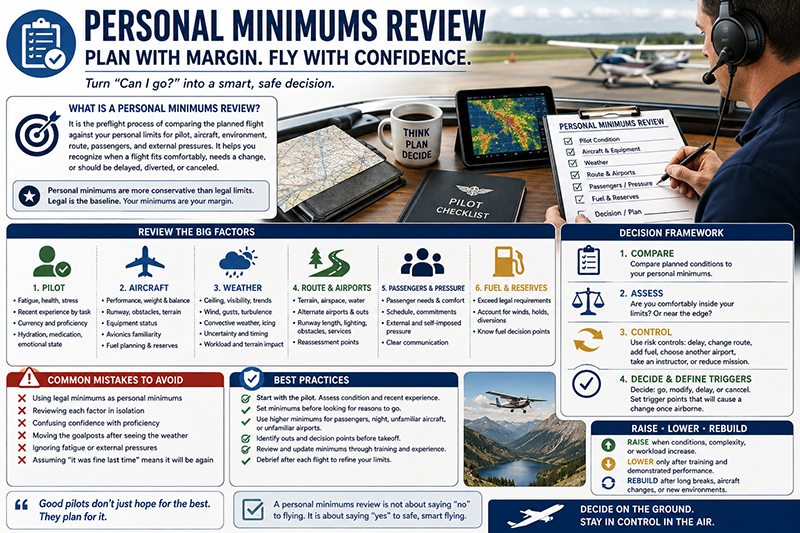
A personal minimums review is one of the most practical risk management habits a pilot can bring to every flight. It turns a general question, “Can I go?” into a disciplined evaluation of weather, aircraft, pilot condition, route, passengers, daylight, terrain, airspace, and operational pressure. The goal is not to make flying timid. The goal is to make the launch decision honest, repeatable, and appropriate for the pilot, aircraft, and mission on that specific day.
Many pilots create personal minimums during training, during a flight review, or after a challenging flight. Fewer pilots revisit them with enough regularity. Personal minimums are only useful when they are current, specific, and consulted before the emotional momentum of a trip takes over. A thoughtful review before every flight helps a pilot recognize when a planned flight is comfortably within capability, when it calls for a change of plan, and when the safest decision is to delay, divert, or cancel.
What a Personal Minimums Review Actually Does
Personal minimums are self-imposed limits that are more conservative than legal, aircraft, or operational limits. They reflect a pilot’s experience, proficiency, recency, training environment, aircraft familiarity, and tolerance for workload. They can address visibility, ceiling, wind, crosswind component, runway length, fuel reserves, night operations, terrain, convective weather, icing potential, passenger considerations, and many other variables.
A personal minimums review is the preflight process of comparing the planned flight against those limits. It is not simply reading a laminated card or repeating a familiar checklist from memory. It is a short but deliberate decision-making session that asks whether the flight still fits the pilot’s actual capability and conditions today. That final phrase matters. A pilot may be current but fatigued. A route may be familiar but affected by widespread weather. An aircraft may be airworthy but configured differently than the pilot usually flies. A passenger may be excited, anxious, or time-constrained. Each factor can change the risk picture.
Effective personal minimums are not designed to duplicate regulations. Regulations establish minimum legal requirements, but legal does not always mean wise for a particular pilot on a particular day. For example, a flight may be legally possible in marginal visibility, but a newer pilot who has not recently flown in reduced visibility may decide that the flight does not fit the minimums they set with an instructor. That is good judgment, not overcaution.
The best personal minimums are practical enough to use. If they are vague, they are easy to rationalize. If they are unrealistic, they are easy to ignore. A useful personal minimum might define a maximum demonstrated crosswind the pilot is comfortable accepting for normal operations, a minimum ceiling and visibility for a local VFR flight, or a minimum fuel reserve target that exceeds the legal requirement. The review before flight then becomes a comparison between known conditions and preselected decision points.
Why This Matters in Real-World Aviation
Risk in general aviation rarely arrives as one dramatic problem. It often develops as a series of small compromises. The ceiling is lower than forecast, but still legal. The pilot slept less than usual, but feels “good enough.” The passenger needs to arrive on time. The airport is unfamiliar. The wind is close to the pilot’s comfort zone. The airplane has a slightly different avionics setup. Each item alone may be manageable. Combined, they can create workload that exceeds the pilot’s capacity.
A preflight personal minimums review helps interrupt that chain before takeoff. It gives the pilot permission to make a conservative decision while still on the ground. That matters because once airborne, the pilot may have fewer options, more workload, and greater pressure to continue. Good aeronautical decision-making starts before the engine starts.
For student pilots, personal minimums are a bridge between instructor-supervised training and independent decision-making. The student learns that proficiency is not a certificate or endorsement by itself. It is a current, situation-specific capability. For certificated pilots, personal minimums help manage the gap between legal currency and actual proficiency. For flight instructors, they provide a teaching tool that makes risk management visible rather than abstract. For aircraft owners and aviation professionals, they support consistent operating discipline across flights that may look routine on paper but vary significantly in weather, terrain, passenger needs, or operational complexity.
The review also supports honest communication. A pilot who has clear personal minimums can explain a no-go decision professionally: “The forecast crosswind is above my current personal minimum for this aircraft,” or “The route is legal VFR, but the ceilings do not leave enough margin for my experience level today.” That language is easier to defend than a vague feeling of discomfort, although that feeling should never be ignored.
Start With the Pilot, Not the Airplane
Many pilots begin preflight planning with weather, fuel, and aircraft status. Those are essential, but an effective personal minimums review should start with the pilot. The pilot is part of the operating system. Fatigue, illness, medication, stress, hydration, nutrition, emotional state, and recent flying experience can all affect performance.
A pilot who is technically qualified but tired may process information more slowly, communicate less clearly, and tolerate distractions poorly. A pilot who has not flown cross-country recently may find that navigation, radio work, and traffic awareness consume more attention than expected. A pilot returning after a break may be legal to fly but still need more margin than usual. A personal minimums review should identify those realities before weather and route decisions are interpreted too optimistically.
One practical approach is to ask, “If I were advising another pilot in my exact condition today, what would I recommend?” That question reduces ego and helps reveal whether the flight plan depends on the pilot performing at their best. A strong plan should provide margin for normal human variability, not demand perfection.
Recent experience should be considered by task, not only by total hours. A pilot may have many hours overall but little recent night time, little recent actual or simulated instrument time, limited recent towered-airport work, or minimal experience with short-field operations in the current aircraft. Personal minimums should account for the specific skills the flight will require.
Review Weather as a Workload Factor
Weather minimums are often the first thing pilots think about when discussing personal minimums, but the most important question is not simply whether the weather is legal. The better question is how the weather will affect workload, options, and margins throughout the flight.
For VFR pilots, ceiling and visibility should be evaluated in relation to terrain, airspace, obstacles, traffic, route familiarity, and escape options. A ceiling that feels comfortable over flat terrain near familiar airports may feel very different over rising terrain, congested airspace, or an unfamiliar route. Visibility that is legally acceptable may still reduce the pilot’s ability to see weather buildups, traffic, towers, and landmarks early enough for comfortable decision-making.
Wind also deserves careful treatment. Pilots often focus on the crosswind component at departure and destination, but wind affects more than landing technique. It can change groundspeed, fuel planning, turbulence, climb performance expectations, passenger comfort, and the suitability of alternate airports. Gusts can be more demanding than steady wind. A direct crosswind near the pilot’s personal limit may be manageable on a wide, dry runway with clear approach paths, but less desirable at a narrow unfamiliar runway with mechanical turbulence or obstacles.
Instrument-rated pilots should review weather with equal discipline. An instrument rating expands capability, but it does not eliminate risk. Personal minimums for instrument flying may include ceiling and visibility for approach planning, convective weather avoidance, icing risk avoidance, alternates, fuel margins, autopilot considerations, approach recency, and fatigue management. A flight in actual instrument conditions after a long break may call for higher minimums, an instructor or experienced safety pilot on board, or a different plan.
Weather review should also include trend and uncertainty. A forecast that is improving presents a different risk picture than one that is deteriorating. Scattered convective activity, rapidly changing ceilings, frontal passage, strong surface winds, low-level turbulence, and temperature-dew point spread can all affect the suitability of a flight. Personal minimums should help a pilot decide not only whether the flight can begin, but whether it can be completed with reasonable alternatives available.
Match Minimums to the Aircraft and Equipment
A personal minimums review must account for the specific aircraft, not just the pilot. The same pilot may need different limits for a familiar trainer, a high-performance aircraft, a tailwheel aircraft, a technically advanced airplane, or a rental aircraft with unfamiliar avionics. Aircraft handling, performance, systems, cockpit layout, and equipment reliability all influence workload and decision-making.
Aircraft performance planning is especially important when the flight involves high density altitude, short runways, soft fields, obstacles, heavy loading, or reduced climb performance. Personal minimums can include extra runway margin, conservative weight and balance decisions, or a refusal to operate from certain runways unless conditions are favorable. These should be based on the aircraft’s approved performance data and the pilot’s proficiency, not on optimism or habit.
Equipment status also matters. An inoperative autopilot, a deferred navigation display issue, a weak radio, an unfamiliar GPS database setup, or a different cockpit than expected may not make a flight impossible. It may, however, raise workload enough to change the pilot’s personal minimums. The question is not only “Is the aircraft legal and airworthy for this flight?” It is also “Does the aircraft as equipped today support the plan I am about to fly?”
Fuel planning provides another example. Legal fuel requirements establish a baseline, but many pilots use more conservative personal fuel reserves to protect against wind error, routing changes, traffic delays, missed approaches, diversions, or unexpected holds. A personal minimums review should compare planned fuel not only to the regulation, but to the pilot’s own reserve target and realistic conditions.
Consider the Route, Airports, and Available Outs
A flight that looks simple on a direct line may be more complex when viewed operationally. Terrain, water crossings, restricted or special-use airspace, busy terminal areas, limited emergency landing options, sparse airports, and weather along the route all affect the risk profile. A personal minimums review should include the entire route, not just departure and destination conditions.
Experienced pilots often think in terms of “outs.” An out is a practical alternative available if the original plan changes. It might be a fuel stop, a divert airport, a turn-back point, a route around weather, a climb to smoother air, or the decision to remain local instead of continuing cross-country. Personal minimums are stronger when they are tied to these options. For example, a pilot may decide to depart only if at least two suitable alternates remain above their personal weather minimums along the first half of the route.
Airport review should consider runway length, surface condition, lighting, slope, obstacles, terrain, traffic pattern complexity, services, and approach options when applicable. The pilot’s familiarity with the airport also matters. A short runway at a familiar home airport may not carry the same workload as a similar runway at an unfamiliar field surrounded by terrain. Night operations add another layer because visual cues, emergency options, and fatigue considerations change significantly after dark.
Personal minimums should also include a reassessment point. Before takeoff, decide when you will evaluate whether the flight is still meeting the plan. That might be after climbing through a certain altitude, before crossing terrain, before leaving gliding distance of suitable fields, before entering a busy airspace area, or at a predetermined fuel state. A review that includes en route decision points is more useful than a simple go or no-go answer at the hangar.
Passengers and External Pressure Change the Equation
Passengers can be a joy to fly with, but they can also change the pilot’s workload and decision environment. A nervous passenger may need reassurance. A first-time passenger may not understand turbulence, sterile cockpit needs, or weather delays. A business passenger may create schedule pressure. A family member may unintentionally make the pilot feel obligated to complete the trip.
A personal minimums review should ask whether the presence of passengers reduces available margin. If so, the solution may be simple: raise the weather minimums, choose a shorter flight, schedule more daylight, add a fuel stop, take another pilot, or brief passengers clearly before the flight. Passenger comfort is not the only concern. A pilot distracted by passenger questions during taxi, departure, weather deviations, or landing may have less attention available for aircraft control, traffic, navigation, and communication.
External pressure can also come from hotel reservations, rental aircraft schedules, maintenance appointments, weather windows, workplace commitments, or the desire to avoid disappointing others. The most dangerous pressure is often the pressure the pilot creates internally. A written or well-established personal minimums review helps separate aviation judgment from social obligation. It gives the pilot a standard to return to when emotions rise.
How Pilots Should Conduct the Review Before Every Flight
An effective personal minimums review does not have to be lengthy. It should be structured enough to prevent wishful thinking and flexible enough to fit real operations. The best time to begin is during early planning, before the pilot has mentally committed to going. The review should then be repeated on the day of departure and again whenever conditions change.
Start by identifying the mission: local practice, solo training, passenger flight, night cross-country, instrument flight, aircraft relocation, or proficiency work. Different missions justify different minimums. A local flight in excellent weather may require less planning depth than a night cross-country with passengers and forecast weather changes, but both deserve a deliberate review.
Next, compare the flight against your established minimums in the major risk areas: pilot, aircraft, environment, and external pressures. The value is in the comparison. If the planned flight barely fits one minimum and is also close to another, the combined risk may be too high. For example, a pilot may be comfortable with a moderate crosswind when rested and flying solo, but not when tired, with passengers, into an unfamiliar airport, near sunset.
Then look for risk controls. A risk control is a practical adjustment that reduces exposure. Depart earlier, delay until weather improves, use a longer runway, add a fuel stop, take an instructor or experienced pilot, select a more familiar aircraft, avoid night arrival, file an instrument flight plan if qualified and appropriate, or convert the trip into local proficiency flying. The review should not be framed as “go or cancel” only. Often the safest and most professional answer is “go with a modified plan.”
Finally, define the trigger points that will cause a change of plan. If the ceiling drops below a certain level, if the crosswind exceeds your comfort level, if a passenger becomes ill, if fuel is lower than expected at a checkpoint, if the destination weather deteriorates, or if you feel behind the aircraft, the plan should already say what happens next. This prevents in-flight decision-making from being driven by surprise.
Common Mistakes and Misunderstandings
One common mistake is treating personal minimums as fixed forever. Minimums should evolve as proficiency changes, but they should not be relaxed casually. A pilot who has completed recent dual instruction, practiced specific maneuvers, and demonstrated consistent performance may decide with good reason to adjust certain limits. A pilot who has simply accumulated calendar time since the last review has not necessarily earned lower minimums.
Another mistake is using legal minimums as personal minimums by default. Legal minimums are not tailored to a specific pilot’s experience, recency, aircraft, mission, or workload. A prudent pilot may set limits that are significantly more conservative, especially in early solo operations, unfamiliar aircraft, night flying, marginal VFR, actual instrument conditions, or challenging wind.
A third mistake is reviewing each factor in isolation. Weather, fuel, aircraft, fatigue, and passenger pressure interact. A flight may be acceptable with any one concern present, but unacceptable when several concerns appear together. Good risk management considers the total picture.
Pilots also sometimes confuse confidence with proficiency. Confidence is useful only when it is supported by recent, relevant performance. A pilot who felt comfortable in crosswinds last season may not have the same skill today if they have not practiced. A pilot who passed an instrument checkride may not be equally ready for a long day of actual instrument flying after months of limited use. Personal minimums should be based on demonstrated capability, not memory of capability.
Finally, pilots can fall into the trap of moving the goalposts after seeing the weather. If a pilot sets a minimum visibility of five miles for a particular VFR cross-country, then sees four miles reported and decides it is “probably fine,” the minimum has lost its purpose. Changing minimums should be a deliberate training and proficiency decision, not a last-minute negotiation with conditions.
Practical Example: A Weekend Cross-Country Decision
Consider a private pilot planning a Saturday morning VFR cross-country in a familiar four-seat training aircraft. The flight is about two hours each way with one passenger. The pilot is current, has flown several local flights recently, and knows the departure airport well. The destination is unfamiliar, has a single runway, and the forecast includes a moderate surface wind with occasional gusts. Ceilings are expected to remain VFR, but the route includes areas of lower terrain visibility due to haze. Sunset is not a factor for the outbound leg, but the return could arrive near dusk if lunch runs long.
A weak personal minimums review might focus only on legality: the weather is VFR, the aircraft is available, and the pilot is current. A stronger review asks more useful questions. Is the forecast crosswind below the pilot’s current comfort level for an unfamiliar airport? Is the passenger comfortable with turbulence? Is there enough fuel margin to divert if winds slow the return? Are there alternate airports along the route with better runway alignment? What is the latest departure time that keeps the return in full daylight? Would adding a planned fuel stop reduce pressure?
After reviewing the flight, the pilot modifies the plan. The departure remains on schedule, but the pilot briefs the passenger that the trip may turn into a shorter lunch stop or a diversion if the destination wind is stronger than expected. The pilot selects two alternate airports with more favorable runway alignment, sets a latest return departure time, and adds extra fuel margin. The pilot also decides that if destination winds exceed the personal crosswind limit on arrival, the flight will divert rather than attempt a landing to satisfy the original plan.
This is the value of personal minimums. The review did not automatically cancel the flight. It improved the plan, reduced pressure, and created clear decision points before the pilot was close to the runway environment with a passenger expecting arrival.
Best Practices for Pilots
Personal minimums work best when they are written, reviewed, and tied to specific decisions. A pilot does not need an elaborate spreadsheet for every local flight, but the standards should be clear enough to prevent reinterpretation under pressure. Many pilots keep a personal minimums worksheet, a note in an electronic flight bag, or a printed card in the flight bag. The format is less important than the habit of using it.
Work with an instructor when creating or revising personal minimums. A good instructor can help separate appropriate conservatism from unnecessary restriction, and can connect minimums to training goals. For example, rather than simply lowering a crosswind limit, the pilot can schedule dual practice in gradually increasing crosswinds and adjust the minimum only after consistent performance. Rather than accepting lower ceilings for VFR cross-country flying, the pilot can practice weather diversion, navigation, and decision-making with an instructor.
Keep minimums mission-specific. A pilot might use different minimums for solo local practice, passenger sightseeing, night cross-country, instrument operations, mountain flying, or unfamiliar aircraft. A single set of numbers cannot capture every situation. The review should allow the pilot to raise the bar when complexity increases.
Use conservative planning when several factors are close to limits. If weather is near your minimum, make everything else easier: fly earlier, reduce distance, avoid passengers, choose familiar airports, add fuel, or take an instructor. If the aircraft is unfamiliar, make the weather easier. If the route is unfamiliar, make the schedule less demanding. This balancing mindset is often more useful than a single go or no-go line.
After the flight, debrief the decision. Did the conditions match the forecast? Were the minimums appropriate? Did the pilot feel rushed, overloaded, or surprised? Did the passenger add distraction? Did the fuel plan provide enough comfort? This post-flight reflection turns personal minimums into a living training tool rather than a static document.
The following habits make a personal minimums review more effective without turning it into paperwork:
- Review pilot condition before reviewing weather so fatigue or stress does not get overlooked.
- Set minimums before looking for reasons to complete a specific trip.
- Use higher minimums when carrying passengers, flying at night, using an unfamiliar aircraft, or operating into unfamiliar airports.
- Identify divert options and trigger points before takeoff.
- Update minimums after training, proficiency work, or meaningful operational experience, not simply because a flight is inconvenient to cancel.
Using Personal Minimums in Flight Training
Flight instructors can make personal minimums more meaningful by connecting them to actual performance. Instead of asking a student to memorize a number, the instructor can ask why that number is appropriate and what would cause it to change. This encourages judgment, not rote compliance.
For student pilots, minimums should be conservative and clearly aligned with the student’s stage of training. A pre-solo student, solo student, checkride candidate, and newly certificated private pilot may all have different needs. The instructor’s role is to help the student understand that personal minimums are not a sign of weakness. They are a professional habit used by pilots who respect the difference between permission and prudence.
Scenario-based training is especially useful. An instructor might present a flight that is technically legal but includes gusty winds, lowering ceilings, an unfamiliar airport, and a passenger commitment. The student then practices identifying the pressure points and modifying the plan. These exercises prepare pilots for real-world decisions where there is rarely a perfect answer.
Instructors should also model the behavior. When an instructor delays a lesson for wind, changes a route because of weather, or cancels a flight due to fatigue, explaining the decision reinforces safety culture. Students learn not only how to fly, but how a professional pilot thinks.
When to Raise, Lower, or Rebuild Personal Minimums
Personal minimums should become more refined over time. They may become less restrictive in some areas as proficiency improves, but they may also become more conservative for certain operations after a pilot gains experience and better understands the risks. Maturity in aviation often means recognizing more variables, not fewer.
Consider reviewing your minimums after a flight review, instrument proficiency check, aircraft checkout, transition training, significant time away from flying, change in aircraft type, move to a new geographic area, or any flight that felt closer to the edge than expected. These moments provide useful evidence. The question is not whether the flight ended safely. The question is whether the margin was appropriate and repeatable.
Lowering a minimum should usually follow training and demonstrated performance. If a pilot wants to accept stronger crosswinds, fly in lower VFR ceilings, conduct more demanding night operations, or use shorter runways, the better path is to train for that environment. Build experience deliberately with an instructor or mentor pilot, then adjust the minimums based on performance and comfort.
Raising minimums is equally professional. If a pilot has been away from flying, is transitioning to a different aircraft, is carrying passengers after a long solo-only period, or is operating in an unfamiliar region, higher minimums are appropriate. Personal minimums are not a permanent judgment of skill. They are a current expression of margin.
Frequently Asked Questions
Are personal minimums required by regulation?
Personal minimums are a risk management practice, not a substitute for regulatory requirements. Pilots must always comply with applicable regulations, aircraft limitations, and operating rules. Personal minimums add an additional safety margin based on the pilot’s experience, proficiency, aircraft, environment, and mission.
How often should I review my personal minimums?
Review them before every flight in relation to the planned operation, and conduct a deeper update after training events, long breaks from flying, aircraft transitions, flight reviews, instrument proficiency work, or any flight that exposed a gap in comfort or skill.
Should student pilots set their own personal minimums?
Student pilots should develop personal minimums with their instructor. The instructor can help ensure the limits are appropriate for the student’s stage of training, local conditions, solo endorsements, aircraft, and demonstrated performance.
Can experienced pilots use lower personal minimums?
Experienced pilots may use different minimums when they have current, relevant proficiency and the aircraft and mission support the operation. Experience alone is not enough. The key is recent demonstrated capability in the conditions the pilot intends to accept.
What should I do if one item is outside my personal minimums?
Treat it as a decision point, not an inconvenience. The best response may be to delay, change the route, choose another airport, add fuel, fly with an instructor or qualified pilot, reduce the mission, or cancel. Avoid simply adjusting the number to fit the trip.
How do personal minimums apply to instrument-rated pilots?
Instrument-rated pilots can use personal minimums for approach planning, weather trends, alternates, fuel reserves, icing avoidance, convective weather avoidance, night operations, equipment status, and recent instrument proficiency. The rating expands capability, but it does not remove the need for margin.
Key Takeaways
- A personal minimums review should compare the planned flight against the pilot’s current proficiency, aircraft, weather, route, passengers, and external pressures before takeoff.
- Legal does not always mean prudent. Personal minimums provide an added safety margin tailored to the pilot and the specific flight.
- Use personal minimums as a living decision-making tool. Update them through training, recent experience, instructor feedback, and honest post-flight debriefing.