
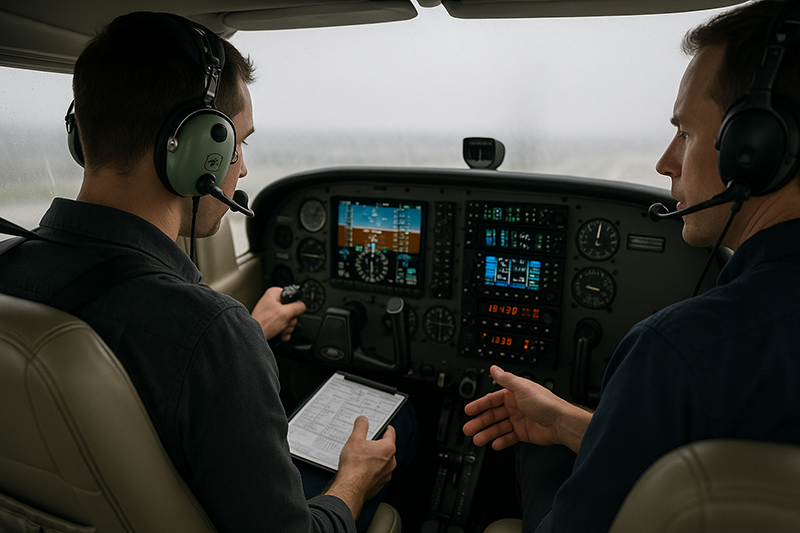
Cognitive overload in pilots is one of the most important human factors to recognize early because it often develops quietly. A pilot can be current, qualified, and well intentioned, yet still reach a point where the amount of information, workload, uncertainty, and time pressure exceeds the brain’s ability to process it effectively. When that happens, decision quality drops, situational awareness narrows, and basic flying tasks can become harder than they should be.
The practical challenge is that cognitive overload rarely announces itself as a dramatic event. It may begin as a missed radio call, a delayed checklist item, confusion over an ATC instruction, or an uncomfortable feeling that the airplane is getting ahead of the pilot. For student pilots, instructors, instrument pilots, crew members, and aviation professionals, learning to identify these early signs is a core safety skill. The goal is not to become a perfect multitasker. The goal is to recognize task saturation early enough to simplify, prioritize, and regain control before the situation becomes dangerous.
What Cognitive Overload Means in Aviation
Cognitive overload occurs when the mental demands of a situation exceed a pilot’s available attention, working memory, and decision-making capacity. In aviation, those demands can come from many directions at once: aircraft control, navigation, communication, weather interpretation, traffic avoidance, automation management, checklists, passenger concerns, abnormal indications, and time-sensitive decisions.
Working memory is limited. Pilots can hold and manipulate only a small amount of information at one time, especially when the situation is dynamic. In calm conditions, a pilot may easily manage headings, altitudes, frequencies, chart references, and aircraft configuration. Add turbulence, a reroute, unfamiliar airspace, a minor equipment issue, and a passenger question, and the same pilot may suddenly struggle to maintain a complete mental picture.
This is why cognitive overload is often discussed alongside task saturation. Task saturation is the point where the pilot has more tasks than can be managed safely in the available time. A pilot may still be physically controlling the aircraft, but the mental bandwidth needed for judgment, planning, and cross-checking is reduced. The result is not always an immediate loss of control. More often, it is a gradual decline in performance: slower responses, narrower attention, fixation on one problem, missed cues, and an increasing reliance on habit rather than deliberate decision-making.
Importantly, cognitive overload is not a character flaw. It is a human limitation. Good pilots respect that limitation and build habits that prevent overload from progressing unchecked.
Why This Matters in Real-World Aviation
Aviation is unforgiving of unmanaged workload because flight conditions can change faster than a pilot’s ability to recover mentally. A routine flight can become complex through weather, air traffic control changes, equipment anomalies, terrain, night operations, unfamiliar airports, or passenger pressure. Even a relatively simple aircraft can create high workload when flown in demanding conditions.
For student pilots, cognitive overload often appears during the transition from isolated maneuvers to integrated operations. A student may be able to fly steep turns, tune radios, and read a sectional chart separately, but combining those tasks in busy airspace can expose the limits of attention. This is normal in training, and it is one reason instructors carefully sequence lesson complexity.
For instrument pilots, overload can develop when the aircraft, avionics, ATC instructions, and weather require continuous management. An approach change close to the destination, an unexpected hold, a frequency change during a high-workload phase, or confusion about automation modes can quickly consume mental capacity. The aircraft may be stable one minute and poorly managed the next, not because the pilot forgot how to fly, but because attention became overloaded.
For instructors, recognizing cognitive overload in a learner is just as important as recognizing it in oneself. A student who stops talking, stares inside the cockpit, repeats the same error, or misses obvious cues may not need a longer explanation in that moment. They may need the instructor to reduce task demand, stabilize the situation, and rebuild capacity before continuing the lesson.
For professional crews and aviation teams, workload management is part of crew resource management. Good crews communicate workload, redistribute tasks, verify critical actions, and avoid letting one person become isolated with too much to manage. The same principle applies to single-pilot operations, but the resources may be different: autopilot, ATC, checklists, passengers briefed to stay quiet, or a decision to delay, divert, or discontinue an approach.
How Pilots Should Understand Cognitive Overload
Pilots should understand cognitive overload as a predictable human performance issue rather than a rare emergency. The brain is excellent at pattern recognition and decision-making when information is organized and workload is reasonable. It performs much less reliably when it is forced to process too many changing inputs under time pressure.
A useful way to think about overload is to separate flying demands into three layers. The first layer is aircraft control: attitude, airspeed, altitude, heading, configuration, and power. The second layer is flight path management: navigation, terrain and obstacle awareness, airspace, weather avoidance, and approach or departure planning. The third layer is communication and administration: radio calls, clearances, checklists, passenger coordination, avionics programming, and documentation where applicable.
When workload rises, the pilot must protect the first layer. Aviate remains the foundation because the aircraft must stay under control while everything else is sorted out. That does not mean navigation and communication are unimportant. It means they must be prioritized in a way that preserves flight safety. If the pilot is trying to answer ATC, reprogram the GPS, brief passengers, troubleshoot an indication, and maintain altitude in turbulence, something has to be simplified.
Cognitive overload also affects perception. A pilot under heavy workload may look at an instrument without truly processing what it means. They may hear a clearance but fail to retain a key restriction. They may continue with a plan after conditions have changed because changing the plan feels mentally expensive. This is one reason externalizing information is so valuable. Writing down clearances, using checklists, verbalizing intentions, briefing the next step, and setting up avionics early all reduce the amount of information that must be held in memory.
Automation can help, but it can also add workload if the pilot is unsure what the system is doing. Autopilots, flight directors, moving maps, and flight management systems are useful tools when understood and managed deliberately. They are not substitutes for situational awareness. If automation confusion becomes part of the overload problem, the safest response may be to simplify the automation, select a more basic mode, or hand fly if conditions and proficiency support that choice.
Early Warning Signs Pilots Should Not Ignore
The earliest signs of cognitive overload are often behavioral rather than technical. The airplane may still be within tolerances, but the pilot’s mental performance is beginning to degrade. Recognizing those signs early gives the pilot more options.
One common sign is narrowing attention. The pilot becomes fixated on one instrument, one radio call, one chart detail, or one problem while other important cues fade into the background. Fixation is especially dangerous because it can feel productive. The pilot believes they are solving the problem, but the overall flight picture is deteriorating.
Another sign is a breakdown in communication. The pilot may miss calls, read back instructions incorrectly, ask for repeated transmissions, or stop making position reports and standard callouts. In a crew or instructional environment, speech may become shorter, sharper, or absent. Silence is not always a sign of calm. It can be a sign that mental capacity is nearly full.
Procedural errors are also warning signs. Skipping a checklist item, forgetting a frequency change, setting the wrong altitude bug, leaving the aircraft in an unexpected configuration, or failing to complete a planned briefing can indicate that workload is exceeding capacity. The error itself may be small, but it should prompt the question: what else am I missing?
Physical sensations may appear as well. Pilots may notice increased heart rate, shallow breathing, muscle tension, tunnel vision, or a feeling of urgency. These reactions are normal under stress, but they can reduce fine motor performance and make deliberate thinking harder. A pilot who notices these sensations should treat them as useful information, not as something to hide or ignore.
A subtle but important sign is loss of future thinking. The pilot becomes absorbed in the immediate task and stops anticipating what comes next. In aviation, this is a major degradation in situational awareness. Good flight management requires the pilot to think ahead: next altitude, next heading, next frequency, next configuration, next weather decision, next escape option. When that forward-looking picture disappears, workload has likely become too high.
Common Mistakes and Misunderstandings
A common misunderstanding is that cognitive overload only affects inexperienced pilots. Experience helps because it builds pattern recognition, procedural fluency, and judgment, but it does not remove human limits. Experienced pilots can become overloaded when multiple threats combine, especially if they are tired, rushed, distracted, or operating outside their recent experience.
Another mistake is treating overload as something to power through. Aviation culture values competence and composure, but pushing harder is not always the safest response. When the brain is saturated, adding effort may increase fixation rather than improve performance. A better response is to reduce demand: slow down if appropriate, ask ATC for delay vectors or clarification, level off, use available automation correctly, delegate tasks, or discontinue a maneuver, approach, or plan that is no longer well managed.
Pilots also sometimes confuse busyness with safety. A cockpit can be busy because the pilot is doing too much too late. Briefing earlier, setting up avionics before the high-workload phase, reviewing airport information in cruise, and making conservative decisions sooner often reduce the need for hurried cockpit activity later.
Overreliance on memory is another trap. Pilots may try to remember a complex clearance, a taxi route, a runway crossing instruction, an approach change, or a sequence of abnormal tasks without writing anything down or verifying. Memory is vulnerable under stress. Using notes, checklists, and readbacks is not a sign of weakness. It is a professional method for protecting accuracy.
Some pilots underestimate the workload created by unfamiliarity. A new avionics suite, a new airport, a new aircraft, a new route, or a new instructor can make ordinary tasks more demanding. The same is true after a break from flying. Recent experience matters. A pilot who has not recently flown at night, in busy controlled airspace, or in actual instrument conditions should plan extra margin and avoid stacking challenges unnecessarily.
Finally, pilots may fail to communicate workload. A single-pilot operator may hesitate to tell ATC they need a moment. A student may not tell the instructor they are saturated. A crew member may assume the other pilot sees the same problem. Clear workload communication can prevent minor confusion from becoming a serious threat.
Practical Example: When a Simple Flight Gets Complicated
Consider a private pilot flying a familiar single-engine airplane on a day VFR cross-country. The flight begins normally. The pilot has planned the route, checked the weather, and briefed the destination. About 25 miles from the airport, visibility begins to lower slightly in haze, traffic increases, and ATC issues a new frequency and a modified arrival instruction. At the same time, the passenger asks whether the turbulence is normal, and the pilot notices the tablet map has stopped updating.
None of these items is necessarily an emergency. Together, they create a workload spike. The pilot is now trying to maintain altitude, scan for traffic, interpret the modified instruction, reassure the passenger, troubleshoot the tablet, and update the mental picture of the arrival. If the pilot continues treating all tasks as equally urgent, cognitive overload can develop quickly.
The early warning signs might be subtle. The pilot reads back the frequency correctly but delays switching. The airplane drifts 150 feet. The pilot looks down at the tablet longer than intended. The passenger asks another question, and the pilot responds sharply. The airport is now closer, but the pilot has not reviewed pattern entry, runway, or winds.
A safer response begins with prioritization. The pilot maintains aircraft control and outside scan, tells the passenger they need a quiet cockpit for the arrival, and stops troubleshooting the tablet because it is not essential to safe VFR flight at that moment. If needed, the pilot asks ATC to repeat or clarify the instruction. If the arrival no longer feels orderly, the pilot can request vectors, orbit in an appropriate area if approved and safe, or divert to a less busy airport. The key is not heroic multitasking. The key is recognizing that the situation is becoming overloaded and taking action while there is still time and airspace to manage it.
Best Practices for Preventing Cognitive Overload
The best defense against cognitive overload is preparation that reduces workload before the busiest phase of flight. Pilots should brief likely high-workload moments in advance: departure, airspace transitions, weather decisions, arrival, approach, landing, and taxi. A good briefing does not need to be long. It should answer the practical questions: what will happen next, what could change, what will I do if it does, and what is my out?
Workload management also depends on pacing. When possible, complete nonessential tasks early. Set frequencies, review charts, load and verify routes, brief approaches, organize cockpit materials, and confirm performance planning before workload peaks. A pilot who waits until descent to solve every arrival question is creating unnecessary pressure.
Use standard operating habits even in simple aircraft. Consistent flows, checklists, callouts, and cockpit organization reduce mental effort because the pilot is not reinventing the process every time. In training, instructors should emphasize why these habits matter, not just whether the student can recite them.
Another best practice is to verbalize. Saying “airspeed, altitude, heading, next frequency” or “I am task saturated, maintain aircraft control first” may feel artificial at first, but it helps organize attention. In crew operations, verbalizing workload and intentions keeps the other pilot in the loop. In single-pilot operations, self-briefing can serve a similar organizing function.
Pilots should also make conservative use of time. If a clearance, approach, or airport change arrives too late to manage comfortably, say so. If weather is trending worse, make the decision earlier rather than waiting until every option is compressed. If the aircraft is not configured and stabilized at the appropriate point for the operation, consider going around or discontinuing the approach. The safest pilots are not the ones who never experience high workload. They are the ones who recognize it early and respond decisively.
When workload rises, a short reset can be powerful. The following actions are not a substitute for aircraft-specific procedures or instructor guidance, but they reflect sound workload management principles:
- Fly the aircraft first, using attitude, power, trim, and a disciplined instrument or visual scan.
- Reduce unnecessary inputs, conversations, troubleshooting, or avionics changes.
- Clarify the most important next task and complete it before adding another.
- Use checklists, written notes, and standard callouts to protect memory.
- Ask for help, delay, vectors, clarification, or a different plan when appropriate.
These actions work because they reduce the number of competing demands. They restore order, which is exactly what an overloaded pilot needs.
Training Cognitive Overload Recognition
Flight training should include more than maneuver proficiency. It should help pilots recognize how their performance changes under workload. This requires thoughtful scenario design. Instructors can gradually add complexity after the learner has a stable foundation, then pause to debrief what happened to scan, communication, checklist use, and decision-making.
The purpose is not to overwhelm students for entertainment or to create a stressful cockpit without learning value. The purpose is to help learners identify their personal warning signs. One student may become quiet. Another may rush. Another may fixate on instruments. Another may abandon checklists. When students learn their own patterns, they can intervene earlier.
Scenario-based training is especially useful because overload often comes from combinations rather than single tasks. A diversion exercise that includes weather interpretation, fuel planning, passenger management, and ATC communication can reveal how a pilot organizes priorities. An instrument lesson with an approach change, automation mode awareness, and missed approach briefing can teach workload control in a realistic way.
Instructors should model calm workload management. If an instructor constantly talks during critical phases, changes tasks too quickly, or allows the cockpit to become disorganized, the student may learn that saturation is normal. A better instructional style is deliberate: introduce complexity, observe performance, intervene before safety margins erode, and debrief the decision process.
Single-Pilot Resource Management and Crew Resource Management
Single-pilot resource management is the practical use of all available resources by a pilot operating without another required crew member. Those resources include planning, automation, ATC, passengers, checklists, weather information, onboard equipment, and personal minimums. The single pilot must be especially disciplined because there is no second pilot to catch every missed item or challenge every assumption.
Crew resource management applies similar principles in a multi-person environment. The advantage of a crew is that tasks can be shared and cross-checked. The risk is that poor communication can allow both pilots to assume the other has the situation under control. Effective crews state workload, confirm responsibilities, and speak up when something does not look right.
Both single-pilot and crew environments depend on the same foundation: manage attention deliberately. Decide what matters most now, what can wait, and what can be eliminated. In many cases, the safest action is not adding another task. It is removing one.
Frequently Asked Questions
What is the difference between stress and cognitive overload?
Stress is the body and mind’s response to pressure or demand. Cognitive overload is the point where mental processing capacity is exceeded by the tasks and information competing for attention. Stress can contribute to overload, but a pilot can be busy and overloaded even without feeling panic.
Can experienced pilots still become task saturated?
Yes. Experience improves judgment, pattern recognition, and cockpit efficiency, but it does not eliminate human limits. Fatigue, unfamiliar equipment, weather, time pressure, abnormal indications, or several small problems occurring together can overload any pilot.
What should a pilot do first when feeling overloaded?
The first priority is to maintain aircraft control and preserve a safe flight path. After that, the pilot should reduce unnecessary tasks, clarify the next essential action, use checklists or notes, and ask for assistance or delay when appropriate.
How can instructors tell when a student is cognitively overloaded?
Common signs include silence, fixation, repeated mistakes, missed radio calls, checklist breakdowns, rushed control inputs, or loss of situational awareness. The instructor should reduce task demand, stabilize the flight, and debrief the pattern after the student has capacity to learn.
Does automation prevent cognitive overload?
Automation can reduce workload when the pilot understands it and monitors it properly. It can increase workload if the pilot is uncertain about modes, programming, or system behavior. Pilots should use automation as a resource, not as a replacement for understanding the flight path.
Is going around a good response to overload during landing?
When an approach or landing is no longer stable, understood, or comfortably managed, a go-around can be an appropriate risk-management decision. Pilots should be proficient in go-arounds and view them as a normal maneuver rather than a failure.
Key Takeaways
- Cognitive overload in pilots usually begins with small warning signs such as fixation, missed communications, procedural slips, or loss of forward planning.
- The safest response is to reduce workload early: fly the aircraft, simplify tasks, use checklists and notes, communicate clearly, and ask for help or delay when needed.
- Training should help pilots recognize their personal overload patterns and practice workload management before real-world pressure compresses their options.