
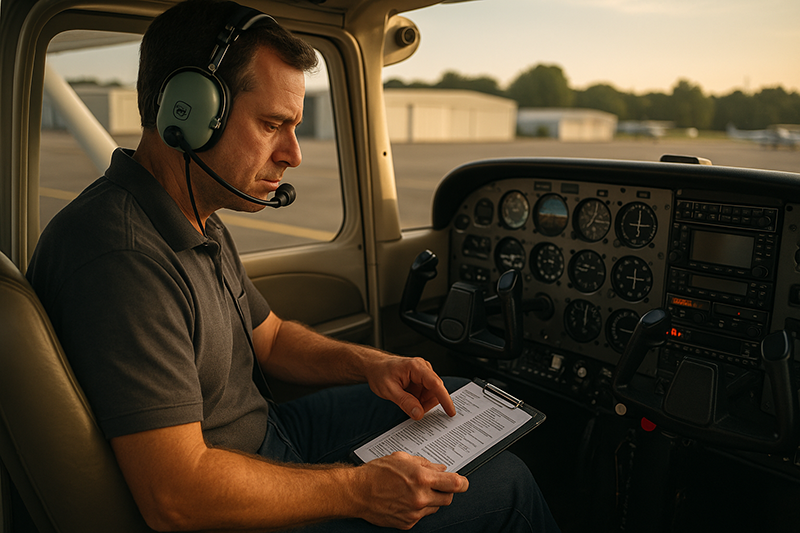
Pilot complacency is one of the more subtle threats in aviation because it often develops inside a pilot who is competent, current, and genuinely committed to safety. It does not usually appear as laziness or disregard for procedures. More often, it begins when repeated success makes a familiar flight feel less demanding than it really is. The experienced pilot has seen the route, flown the approach, managed the airplane, talked to the same controllers, and solved similar problems before. That experience is valuable, but it can also create a quiet expectation that today will unfold like yesterday.
For student pilots, complacency may sound like a problem reserved for high-time aviators. For flight instructors, charter pilots, airline crews, aircraft owners, and aviation professionals, it may sound uncomfortably familiar. The purpose of this article is not to criticize experience. Experience is one of aviation’s best teachers. The goal is to understand how experience can gradually reduce vigilance, weaken checklist discipline, and narrow a pilot’s attention at exactly the moment good judgment is needed most.
What Pilot Complacency Really Means
In practical aviation terms, complacency is a reduction in alertness, curiosity, or disciplined verification caused by familiarity, routine, confidence, or repeated uneventful outcomes. It is not the same as confidence. Confidence helps a pilot operate decisively and calmly. Complacency is different because it reduces the pilot’s willingness to question assumptions.
An experienced pilot may know the aircraft systems well, understand the local airspace, and have strong hands-on flying skill. None of that prevents complacency if the pilot starts treating a flight as predictable before the flight is complete. Aviation does not reward assumptions for very long. Weather changes, aircraft systems degrade, traffic conflicts appear, passengers create distractions, and operational pressure can shape decisions without being obvious.
Complacency can show up in small behaviors. A pilot may skim a checklist instead of using it deliberately. A preflight inspection may become a quick walkaround based on memory rather than observation. A weather briefing may become a glance at familiar apps rather than a real evaluation of trends, ceilings, visibility, winds, alternates, terrain, and personal minimums. A pilot may hear an unusual engine sound but mentally dismiss it because the engine has always run fine. These are not dramatic failures. They are small erosions in the safety margin.
The dangerous part is that complacency often feels like efficiency. The pilot may believe he or she is simply being smooth, experienced, and practical. In some cases, that may be true. Experienced pilots do learn how to manage workload and avoid unnecessary complexity. The challenge is distinguishing healthy efficiency from skipped verification.
Why Experienced Pilots Are Vulnerable
New pilots tend to know they are new. They often feel the weight of every task because so much of flying still requires conscious thought. They may be slow, cautious, and occasionally overwhelmed, but they usually recognize that they are operating near the edge of their experience. Experienced pilots face a different risk. They may be operating with enough skill that the flight feels easy, even when the underlying risk has increased.
Experience creates pattern recognition. That is a major advantage. A pilot who has flown many cross-country flights may quickly recognize developing weather concerns, aircraft performance changes, radio congestion, and approach instability. However, pattern recognition can also become pattern expectation. Instead of observing what is actually happening, the pilot begins seeing what normally happens.
This is especially relevant in familiar operations. A pilot who has flown the same aircraft from the same airport hundreds of times may begin to compress the preflight process. A pilot who regularly flies a short business route may stop studying diversion options with the same seriousness. A flight instructor who teaches the same maneuver every day may miss a student’s subtle misunderstanding because the lesson has become routine. A professional crew operating a familiar schedule may become vulnerable to automation monitoring lapses because the aircraft usually behaves as expected.
Complacency also develops when a pilot has repeatedly accepted small deviations without consequence. For example, a pilot who has occasionally launched with marginal fuel planning and still arrived safely may become more tolerant of thin margins. A pilot who has flown through slightly worse weather than planned and landed without difficulty may slowly redefine what seems acceptable. The problem is that uneventful outcomes are not always proof of good decisions. Sometimes they are simply outcomes in which the system had enough remaining margin.
How Complacency Develops Over Time
Complacency is rarely a single decision. It is usually a progression. The first stage is familiarity. The pilot becomes comfortable with the aircraft, airport, route, airspace, and normal procedures. Comfort is not bad. In fact, it allows the pilot to operate more smoothly and devote attention to higher-level decision-making. The risk begins when comfort turns into expectation.
The second stage is procedural compression. The pilot still completes the basic tasks, but with less deliberate attention. Checklists become reminders rather than confirmations. Weather planning becomes a quick look instead of a structured review. Performance planning may be based on past experience instead of current conditions. The pilot may not consciously decide to reduce discipline. It happens because the operation seems routine.
The third stage is assumption-based flying. The pilot assumes the runway will be available, the fuel burn will be normal, the avionics setup is correct, the passenger will not distract at a critical time, and the weather will remain close to forecast. Some assumptions are necessary in flight planning, but they must be tested and updated. Complacency prevents that update cycle from happening with enough rigor.
The fourth stage is reduced sensitivity to warning signs. A pilot who is mentally anchored to a normal outcome may downplay cues that contradict the plan. A rising workload may be interpreted as temporary. A weather trend may be minimized. An unstable approach may be rationalized because the pilot has salvaged similar approaches before. A maintenance concern may be postponed because the aircraft has been reliable. The pilot is not trying to be unsafe. The pilot is trying to continue a story that already feels familiar.
The final stage is normalization. Behaviors that once felt like exceptions become part of the pilot’s routine. This may include incomplete briefings, rushed taxi checks, late configuration changes, casual fuel planning, weak sterile-cockpit discipline, or poor monitoring of automation. Once a degraded habit becomes normal, the pilot may no longer recognize it as a risk.
Why This Matters in Real-World Aviation
Complacency matters because aviation safety depends on layers of defense. Training, procedures, checklists, aircraft design, maintenance, air traffic control, weather services, and pilot judgment all contribute to the safety margin. A complacent pilot does not remove every layer at once. Instead, complacency weakens several layers slightly. The flight may continue safely for a long time until a new threat appears and the remaining margin is no longer enough.
In flight training, complacency affects both students and instructors. A student may become overconfident after solo endorsement, after passing a checkride, or after completing a few successful cross-country flights. The student may begin to believe that basic skills are permanent rather than perishable. Instructors can become complacent when repeated exposure to training risk makes unusual student behavior seem predictable. A good instructor stays alert because students can surprise even a highly experienced CFI.
In general aviation, complacency often appears in personal flights. The pilot may know the airplane intimately and may fly without the external structure found in larger operations. That freedom is one of the strengths of general aviation, but it also places more responsibility on personal discipline. The owner-pilot who flies the same airplane frequently may be tempted to rely on memory rather than printed or electronic procedures. The weekend pilot who visits the same destinations may underestimate changes in temporary flight restrictions, runway closures, NOTAMs, weather, or local traffic patterns.
In professional aviation, complacency can develop in highly standardized environments as well. Standard operating procedures and crew resource management are designed to reduce variability, but routine operations can still dull monitoring. A crew that has completed many uneventful flights may become vulnerable to expectation bias, especially during low-workload cruise segments or familiar approach procedures. Professionalism is not the absence of complacency risk. It is the active management of that risk.
Complacency also matters in maintenance awareness and aircraft condition monitoring. Pilots are not mechanics unless separately qualified, but they are responsible for noticing changes in aircraft behavior and condition. A familiar aircraft can lull a pilot into overlooking tires, control surfaces, fluid leaks, cowling security, avionics anomalies, or abnormal indications. The more familiar the aircraft feels, the more important it is to inspect it as an aircraft rather than as a trusted possession.
How Pilots Should Understand Complacency
The most useful way to understand complacency is as a human factors issue. It is not simply a personality flaw. It is connected to attention, workload, memory, expectation, and decision-making. Human beings are efficient thinkers. We conserve mental energy by creating routines and recognizing patterns. In aviation, that efficiency helps us manage complex tasks. It also creates blind spots when routine replaces active verification.
One helpful distinction is the difference between automatic skill and automatic judgment. Automatic skill can be beneficial. A proficient pilot does not need to consciously think through every small control input in normal flight. That frees mental capacity for navigation, communication, weather evaluation, and risk management. Automatic judgment is more dangerous. When a pilot automatically decides that the weather is acceptable, the fuel is enough, the approach is stable, or the aircraft is airworthy without verifying the facts, experience has begun to work against safety.
Another important concept is confirmation bias. Pilots naturally notice information that supports the plan and may discount information that challenges it. If the plan is to depart on schedule, a pilot may focus on the parts of the weather picture that look manageable and minimize the parts that suggest delay. If the pilot expects a normal landing, an unstable airspeed or excessive sink rate may be interpreted as fixable until the window for a safe correction has narrowed.
Complacency also interacts with automation. Modern avionics and autopilots can reduce workload and improve situational awareness when used properly. They can also create passive monitoring if the pilot stops actively verifying modes, navigation sources, altitude constraints, or lateral guidance. The question is not whether automation is good or bad. The question is whether the pilot remains engaged enough to detect when the system is not doing what the pilot intends.
Experienced pilots should also understand that complacency can be situational. A pilot may be highly disciplined in instrument conditions but casual in day VFR. Another may be vigilant in unfamiliar airspace but relaxed at home base. A flight instructor may be sharp during checkride preparation but less attentive during repetitive pattern work. Recognizing these personal patterns is more useful than making a vague promise to be careful.
Common Mistakes and Misunderstandings
One common misunderstanding is the belief that complacency only affects careless pilots. In reality, it can affect conscientious pilots precisely because they have had many successful outcomes. A pilot can be safety-minded and still become vulnerable to shortcuts that feel reasonable at the time.
Another mistake is confusing currency with proficiency. A pilot may meet recent experience requirements for a type of operation and still be rusty in workload management, abnormal procedures, instrument scan, crosswind landings, night operations, or weather decision-making. Currency is a legal and operational concept. Proficiency is a practical performance concept. They overlap, but they are not identical.
Pilots also sometimes misunderstand the role of checklists. A checklist is not an insult to memory or experience. It is a defense against interruption, expectation, and task saturation. The more experienced a pilot becomes, the more tempting it can be to treat checklists as optional backup. That reverses their purpose. Checklists are most valuable when the pilot thinks everything is normal.
A related error is allowing local knowledge to replace planning. Local knowledge is useful. It helps pilots anticipate traffic flows, terrain considerations, preferred runways, noise-sensitive areas, and common weather patterns. But local knowledge cannot guarantee today’s runway condition, airspace status, NOTAM environment, aircraft performance, or weather trend. Familiarity should make planning more intelligent, not less necessary.
Another common mistake is dismissing small deviations because the overall flight still feels under control. A slightly rushed preflight, a slightly late departure, a slightly lower fuel reserve than preferred, a slightly higher workload, and a slightly worse weather picture can combine into a much more serious risk profile. Complacency often operates through accumulation rather than one obvious hazard.
Finally, experienced pilots may underestimate the effect of passengers and social pressure. A pilot who would normally delay for weather may feel pressure when passengers are waiting, an event is scheduled, or a business commitment is involved. The pilot may not call it pressure. It may feel like practicality. Good aeronautical decision-making requires noticing when external expectations are influencing risk acceptance.
Practical Example: The Familiar Weekend Cross-Country
Consider an experienced private pilot who owns a well-maintained single-engine airplane and often flies a two-hour route to visit family. The pilot has flown the route many times. The departure airport, fuel stop options, destination pattern, and local landmarks are familiar. The forecast looks generally acceptable, and the airplane flew normally the previous weekend.
Because the trip feels routine, the pilot arrives at the airport slightly behind schedule and completes a faster-than-usual preflight. The fuel level appears adequate based on past trips, so the pilot does not take time to recalculate fuel burn with the forecast winds. A passenger asks questions during engine start and taxi, and the pilot responds while also setting avionics and copying a clearance. The run-up is completed from memory. Nothing feels wrong.
In cruise, the headwind is stronger than expected. The pilot notices the groundspeed but initially treats it as an inconvenience rather than a planning issue. The destination weather remains VFR, but the ceiling is trending lower than expected. The pilot continues because the airport is familiar and the flight has been uneventful many times before. Near the destination, traffic is busy, the passenger is asking about arrival time, and the pilot is now managing fuel concern, weather concern, and approach planning at the same time.
No single decision in this example is extreme. That is exactly why it is useful. The risk came from routine familiarity, incomplete planning, distraction, and delayed reassessment. A more disciplined version of the same flight might include a full fuel calculation, a sterile cockpit expectation during critical phases, a deliberate checklist flow, earlier recognition of the headwind impact, and a firm diversion trigger before workload increased.
The lesson is not that experienced pilots should be fearful of familiar flights. The lesson is that familiar flights deserve the same safety structure as unfamiliar ones. Familiarity may reduce some workload, but it should not reduce verification.
How Instructors Can Teach Against Complacency
Flight instructors play a central role in shaping how pilots think about complacency. Students learn not only from what instructors say, but also from what instructors consistently do. If an instructor treats checklists, weather analysis, taxi briefings, runway verification, and go-around decisions as serious habits, the student learns that professionalism is normal. If the instructor casually skips steps because the lesson is routine, the student may absorb that message as well.
Good instructors teach students to value disciplined repetition. A maneuver practiced for the tenth time still deserves clearing turns, altitude awareness, traffic scanning, and a plan for recovery. A normal landing still deserves stabilized approach thinking and go-around readiness. A local training flight still deserves weather, fuel, airspace, and aircraft status review appropriate to the operation.
Instructors can also help advanced students and certificated pilots recognize the emotional side of complacency. Many pilots do not like admitting that they have become too comfortable. It can feel like a challenge to identity. A skilled instructor frames the issue professionally: complacency is a known human performance risk, and managing it is part of airmanship.
Scenario-based training is especially useful. Rather than simply telling a pilot to avoid complacency, an instructor can build realistic scenarios involving routine flights with subtle changes: an unexpected runway closure, a stronger-than-forecast wind, a passenger distraction, an avionics setup error, or a late weather deterioration. The training objective is not to trap the pilot. It is to practice noticing when the routine has stopped being routine.
Best Practices for Pilots
Preventing complacency begins with humility, but humility alone is not enough. Pilots need practical habits that make disciplined behavior easier, especially when a flight seems ordinary. The best defenses are simple, repeatable, and built into normal operations.
One strong habit is to treat every flight as familiar but not identical. The aircraft may be the same, but the day is not. Temperature, wind, runway condition, aircraft loading, pilot fatigue, traffic, maintenance status, passenger behavior, and airspace activity can all change. A pilot who asks, “What is different today?” is already resisting complacency.
Another best practice is deliberate checklist use. Flows can be efficient, but the checklist should confirm that critical items were completed. A flow is a memory-based sequence of actions. A checklist is a verification tool. Experienced pilots often use both well, but the verification step should not disappear.
Briefings also help. A takeoff briefing, approach briefing, passenger briefing, and personal risk briefing do not need to be theatrical or lengthy in every operation. They do need to be clear enough to focus attention. A short statement such as, “If we are not airborne by this point, we will reject,” or “If the approach is not stable by this altitude, we will go around,” can turn a vague intention into a usable decision point.
Pilots should build personal triggers for reassessment. These triggers might include stronger-than-expected winds, fuel below a planned amount at a checkpoint, lowering ceilings, unexpected turbulence, passenger illness, avionics anomalies, or rising workload. The purpose is to interrupt continuation bias before the pilot becomes committed to a weakening plan.
It is also helpful to seek periodic outside evaluation. A flight review, instrument proficiency session, aircraft transition lesson, or recurrent training event can reveal habits the pilot no longer notices. Even highly experienced pilots benefit from another qualified person observing their procedures, decision-making, and workload management.
The following practices are especially useful because they are easy to apply across many types of flying:
- Ask what is different about today’s aircraft, weather, runway, route, passengers, and pilot condition.
- Use checklists as verification tools, not as decorations or memory tests.
- Set decision points before takeoff, before continuing into deteriorating weather, and before attempting an approach.
- Protect attention during taxi, takeoff, approach, landing, and abnormal situations.
- Review personal minimums periodically and adjust them based on proficiency, not ego.
- Invite critique from instructors, safety pilots, mentors, and qualified peers.
The Role of Personal Minimums and Risk Management
Personal minimums are one of the most practical tools for resisting complacency. They help pilots make decisions before pressure, fatigue, or optimism becomes too influential. A pilot’s personal minimums may address weather, wind, visibility, ceiling, runway length comfort, night operations, fuel planning, crosswind experience, terrain, and recency of practice. These minimums should be more conservative when proficiency is lower, the aircraft is unfamiliar, the environment is challenging, or the consequences of delay are emotionally difficult.
The key is to treat personal minimums as living decision tools. They should not be copied once and forgotten. A pilot who has not flown instruments recently should not rely on the same weather comfort level used during a period of frequent instrument practice. A pilot transitioning to a new aircraft should recognize that workload may be higher until cockpit flows, sight picture, systems, and performance planning become familiar.
Risk management also requires looking at combinations. A strong crosswind might be acceptable on a long, dry, familiar runway in daylight. The same crosswind may deserve a different decision at night, after a long duty day, with passengers, on a shorter runway, or after a period away from flying. Complacency often evaluates risks one at a time. Good decision-making evaluates the whole picture.
Automation, Monitoring, and the Complacency Trap
Automation deserves special attention because it can make pilots both safer and more vulnerable, depending on how it is used. GPS navigators, flight directors, autopilots, engine monitors, traffic displays, terrain awareness tools, and electronic flight bags can dramatically improve information management. They can also tempt the pilot to become a passenger in the decision loop.
The complacency trap occurs when the pilot assumes the system is correct without confirming the setup and output. Is the correct procedure loaded? Is the navigation source appropriate? Is the altitude preselect correct? Is the autopilot mode doing what the pilot expects? Is the displayed fuel information based on accurate inputs? Is the traffic display supplementing visual scanning rather than replacing it? These questions are part of active monitoring.
Automation should not reduce a pilot’s responsibility to understand the aircraft’s energy state, position, configuration, and clearance limits. A pilot who cannot explain what the automation is doing should consider reducing the level of automation until situational awareness is restored. Hand flying, when appropriate and safe, remains a valuable proficiency tool. So does practicing automation management with an instructor rather than learning it only during busy operational moments.
Recognizing Early Warning Signs in Yourself
One of the most valuable skills an experienced pilot can develop is the ability to notice personal warning signs. Complacency often announces itself quietly. You may find yourself irritated by a checklist because it seems to slow you down. You may feel tempted to skip a weather detail because you already know the route. You may dismiss a concern because it has never been a problem before. You may catch yourself saying, “It will be fine,” without being able to explain why.
Other warning signs include rushing when there is no operational need, accepting distractions during critical phases, delaying a diversion decision, continuing an unstable approach because the runway is close, or relying on memory for items that should be verified. Another sign is defensiveness when another pilot, instructor, mechanic, passenger, or controller raises a concern. A professional pilot does not have to accept every outside comment as correct, but should be willing to evaluate it seriously.
Fatigue and stress can make complacency worse. A tired pilot may prefer the familiar plan because changing the plan requires effort. A stressed pilot may narrow attention to completion rather than evaluation. A pilot under time pressure may treat disciplined procedures as obstacles. Recognizing these conditions allows the pilot to slow down, simplify, delay, divert, or ask for help.
Building a Culture That Resists Complacency
Complacency is easier to manage when the surrounding culture supports disciplined behavior. In a flight school, that culture includes instructors who model checklist use, encourage go-arounds, discuss decision-making openly, and avoid mocking conservative choices. In an aircraft partnership, it includes honest communication about squawks, maintenance concerns, fuel status, and operating habits. In a professional operation, it includes standard procedures, recurrent training, crew communication, and leadership that values safety over schedule completion.
Culture also includes the stories pilots tell. If pilots only celebrate bold saves, tight arrivals, and “I made it work” flights, they may unintentionally reward risk tolerance. If they also discuss delays, diversions, go-arounds, canceled flights, and lessons learned, they normalize good judgment. A pilot who diverts early or cancels a questionable flight should not be treated as less skilled. Often, that pilot is demonstrating the kind of discipline that prevents emergencies from developing.
Mentorship is another powerful tool. Experienced pilots can help newer pilots understand that confidence must remain connected to verification. Newer pilots can also help experienced pilots by asking fresh questions that challenge routine assumptions. In healthy aviation communities, questions are not treated as weakness. They are treated as part of a safety system.
Frequently Asked Questions
Can experienced pilots become complacent even if they fly often?
Yes. Frequent flying can improve proficiency, but it can also make certain operations feel routine. The issue is not how often a pilot flies, but whether the pilot continues to verify aircraft status, weather, performance, clearances, configuration, and risk factors with discipline.
Is complacency the same as overconfidence?
They are related, but not identical. Overconfidence is an inflated belief in one’s ability or judgment. Complacency is a reduction in vigilance or verification, often caused by familiarity and repeated success. A pilot may be calm and skilled without being overconfident, yet still become complacent during routine operations.
What is the best way to prevent checklist complacency?
Use checklists as verification tools rather than memory exercises. Many pilots use cockpit flows to complete actions efficiently, then use the checklist to confirm that critical items are complete. The important habit is to pause long enough to actually verify, not merely recite.
How can flight instructors address complacency without discouraging confidence?
Instructors should frame complacency as a normal human factors risk rather than a character flaw. Confidence is valuable when paired with disciplined procedures, sound judgment, and willingness to reassess. Scenario-based training can help pilots practice catching small deviations before they accumulate.
Does automation increase pilot complacency?
Automation can reduce workload and improve situational awareness, but it can also encourage passive monitoring if used poorly. Pilots should verify modes, navigation sources, altitude selections, route changes, and aircraft energy state. Automation should support the pilot’s awareness, not replace it.
What should I do if I recognize complacency in my own flying?
Treat that recognition as a positive safety signal. Recommit to deliberate checklist use, schedule recurrent training, review personal minimums, invite feedback from an instructor or qualified pilot, and identify the specific situations where you are most likely to relax your standards.
Key Takeaways
- Pilot complacency develops gradually when familiarity and repeated success reduce deliberate verification.
- Experienced pilots are not immune. Routine flights, familiar aircraft, automation, and external pressure can all weaken the safety margin.
- The strongest defenses are disciplined checklist use, active risk management, personal minimums, recurrent training, and a willingness to reassess the plan before conditions force the issue.