
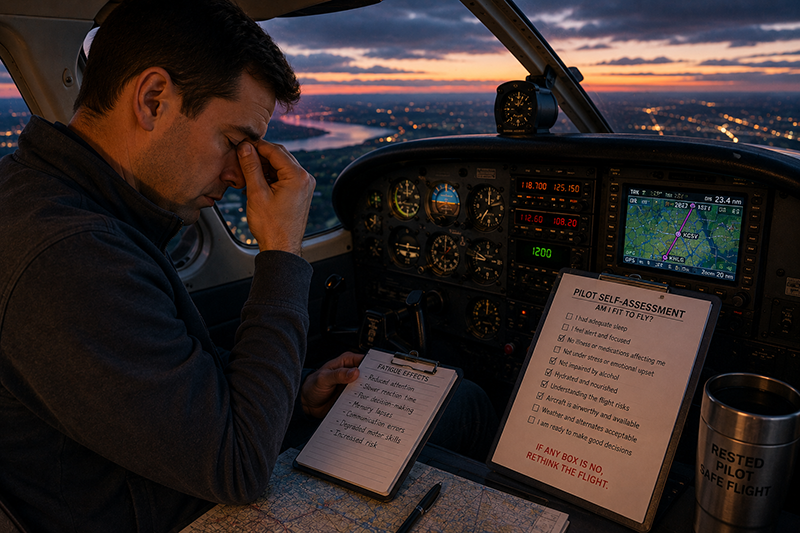
Pilot fatigue is one of the most practical human factors topics in aviation because it affects the very skills pilots rely on most: judgment, attention, communication, memory, hand flying, instrument interpretation, and decision-making. A tired pilot may still be legal, experienced, and highly motivated, yet still be less capable of managing a changing flight environment. That is why fatigue belongs in the same safety conversation as weather, aircraft performance, fuel planning, and risk management.
For student pilots, fatigue can slow learning and make normal training maneuvers feel harder than they should. For flight instructors, it can reduce the ability to monitor, teach, and intervene at the right moment. For professional crews, fatigue can erode crew coordination and increase the chance of small errors accumulating into a larger threat. This article explains how fatigue affects pilot performance, how to recognize it before it becomes a safety problem, and how to build practical fatigue management into everyday flight planning.
What Pilot Fatigue Really Means
Fatigue is more than feeling sleepy. In aviation, fatigue is a physiological and mental state that reduces a pilot’s ability to perform effectively. It can result from insufficient sleep, poor sleep quality, long periods awake, circadian disruption, workload, stress, illness, dehydration, poor nutrition, or a combination of these factors. Fatigue can be acute, such as after a short night of sleep before an early lesson, or cumulative, such as after several demanding days of flying, studying, commuting, and poor recovery.
One reason fatigue is challenging is that pilots often adapt to feeling tired. A pilot may say, “I’m used to it,” or “I’ll be fine once we get going.” The problem is that the body does not negotiate with sleep debt. Motivation can mask fatigue for a time, but it does not restore alertness, working memory, or reaction time. Aviation tasks require continuous monitoring, anticipation, and disciplined decision-making. Fatigue quietly reduces the margin available for all three.
Fatigue also differs from simple boredom. A long cruise segment on a quiet frequency may feel uneventful, but a fatigued pilot is less prepared for a sudden reroute, unexpected weather deviation, abnormal indication, passenger issue, or runway change. Fatigue does not always announce itself with yawning. It may appear as irritability, fixation, slow checklist use, missed radio calls, sloppy altitude control, or an unusual willingness to accept a plan that would normally deserve more analysis.
How Fatigue Affects Pilot Performance
Flying an aircraft demands a blend of cognitive, physical, and social skills. A pilot must plan, brief, aviate, navigate, communicate, manage systems, monitor aircraft energy, assess threats, and maintain situational awareness. Fatigue can degrade each of these areas in subtle ways before the pilot recognizes a serious problem.
Attention is often the first performance area to suffer. A rested pilot can scan instruments, traffic, weather, engine indications, and navigation information in a deliberate flow. A fatigued pilot may look without truly processing, linger on one instrument, miss a trend, or stop scanning outside as effectively. In visual flight, this can reduce traffic awareness and terrain awareness. In instrument flight, it can allow small heading, altitude, or airspeed deviations to persist longer than they should.
Working memory is another vulnerable area. Working memory is the short-term mental workspace used to remember an assigned heading, clearance limit, altitude restriction, frequency, taxi instruction, or checklist item while simultaneously flying the aircraft. Fatigue reduces the reliability of that mental workspace. A tired pilot is more likely to ask for repeats, mis-sequence tasks, forget a clearance detail, or believe something has been completed when it has not.
Decision-making also changes under fatigue. Tired pilots may become more conservative in some situations, but they may also become more impulsive, less flexible, or more vulnerable to plan continuation bias. Plan continuation bias is the tendency to continue with an original plan even when changing conditions suggest a different decision would be safer. Fatigue can make it harder to step back and ask, “Is this still the best option?”
Communication can become shorter, less precise, or less assertive. A fatigued pilot may accept unclear instructions instead of requesting clarification. A fatigued instructor may delay a correction. A fatigued crew member may be less likely to challenge an assumption or verbalize a concern. In aviation, where many safeguards depend on timely communication, that matters.
Motor skills may degrade as well. The aircraft may still be flyable, but control inputs can become less smooth and less anticipatory. In landing, fatigue may show up as unstable energy management, delayed flare timing, late crosswind correction, or weak go-around decision-making. In helicopter, tailwheel, seaplane, or high-performance operations, where control coordination and anticipation are especially important, the practical effect can be even more noticeable.
Why This Matters in Real-World Aviation
Fatigue rarely acts alone. It usually combines with other operational threats. Weather is more demanding when the pilot is tired. Airspace is more complex when the pilot is tired. A minor maintenance issue, unexpected passenger delay, late fuel truck, unfamiliar airport, or last-minute clearance change can become more difficult to manage when fatigue has already narrowed attention and reduced patience.
In flight training, fatigue can create misleading lessons. A student may struggle with landings, steep turns, instrument scan, or radio communication not because the concept is beyond reach, but because the brain is not in a good state for learning. Instructors should be alert to this distinction. Repeating a maneuver over and over when the student is mentally saturated and tired may not produce learning. It may simply build frustration and reinforce poor technique.
For instructors, fatigue deserves special attention because the instructor is both teacher and safety monitor. A tired instructor may be less effective at detecting trend errors early, especially during repetitive pattern work or instrument training. The instructor may also become less patient, which can change the learning environment. Professional instruction requires energy, attentiveness, and emotional discipline, not just technical knowledge.
In professional operations, fatigue management becomes part of operational risk control. Duty time, rest periods, scheduling practices, commuting, time zone changes, and company procedures can all affect alertness. Requirements vary by type of operation, certificate, location, and company policy, so pilots should understand the rules and fatigue reporting processes that apply to their operation. Even where rules exist, compliance with a limit is not the same thing as being well rested. A schedule may be allowable while still requiring careful personal assessment.
In personal flying, fatigue can be even more deceptive because there may be no dispatcher, crew scheduler, chief pilot, or second pilot to challenge the plan. A pilot who has worked all week, slept poorly, driven to the airport, preflighted in heat, and launched for a long cross-country may be accepting a level of fatigue that would be treated more formally in a structured operation. General aviation pilots must build their own barriers.
How Pilots Should Understand Fatigue
Pilots should think of fatigue as a performance limiter, not a character flaw. It is not about toughness. It is about physiology. A strong safety culture allows a pilot to acknowledge fatigue without embarrassment and make a better operational decision. The question is not, “Can I push through?” The better question is, “How much performance margin do I need for this flight, and do I have it today?”
A useful way to think about fatigue is to connect it to the specific demands of the flight. A short local flight in daylight with calm winds and familiar airspace may require less cognitive reserve than a night instrument flight into an unfamiliar airport with convective weather nearby. The same pilot, with the same amount of sleep, may be acceptable for one mission and poorly prepared for the other. Fatigue risk depends on the pilot, the operation, the environment, and the timing.
Circadian rhythm is also important. The circadian rhythm is the body’s internal timing system that influences alertness and sleep tendency across the day. Pilots may experience reduced alertness during normal sleep hours, after crossing time zones, or during early morning starts that require waking far earlier than usual. A pilot who slept a reasonable number of hours may still feel impaired if that sleep was poorly timed, interrupted, or not aligned with the body’s normal rhythm.
Sleep quality matters as much as sleep quantity. A pilot who spent eight hours in bed but woke repeatedly may not be well rested. Stress, alcohol, illness, certain medications, pain, noise, light, uncomfortable lodging, and irregular schedules can all reduce sleep quality. Pilots should be careful about assuming that time in bed equals restorative sleep.
Fatigue should also be considered alongside other personal readiness factors. Many pilots use personal minimums and preflight self-assessment tools to evaluate illness, medication, stress, alcohol, fatigue, emotion, hydration, nutrition, and workload. The purpose is not to create paperwork. The purpose is to force an honest pause before the aircraft is moving and before external pressure becomes stronger.
Signs of Fatigue Pilots Should Not Ignore
Fatigue can be difficult to self-diagnose because one of its effects is reduced self-awareness. That makes it important to identify early warning signs. A pilot who notices several of these signs before flight should reconsider the plan. A pilot who notices them during flight should reduce workload, use available resources, and consider diverting, delaying, or discontinuing the operation when appropriate.
Common signs include repeated yawning, heavy eyelids, difficulty focusing, slower responses, irritability, forgetfulness, and reduced motivation to perform normal planning tasks. In the cockpit, fatigue may show up as missed radio calls, incorrect readbacks, skipped checklist items, difficulty maintaining altitude or heading, confusion over navigation entries, fixation on a single problem, or a tendency to rush.
Another warning sign is unusual tolerance for risk. A fatigued pilot may become tempted to accept marginal weather, continue into deteriorating conditions, shorten a fuel stop, or avoid a diversion because the inconvenience feels overwhelming. This is especially dangerous because fatigue can make the safest option feel like the most annoying option. When tired, the pilot may choose the option that ends the task sooner instead of the option that manages risk best.
Emotional changes matter too. Frustration, impatience, and reduced communication are not just personality issues in the cockpit. They can be fatigue symptoms. A pilot who becomes annoyed by routine ATC instructions, passenger questions, student errors, or checklist discipline may be experiencing reduced cognitive capacity. Recognizing that pattern early can prevent poor decisions later.
Common Mistakes and Misunderstandings
One of the most common mistakes is treating fatigue as a binary condition: either the pilot is exhausted or the pilot is fine. In reality, fatigue exists on a spectrum. A pilot can be impaired enough to reduce safety margin without feeling dramatically sleepy. That middle zone is where many practical risks live.
Another misunderstanding is believing that caffeine fully solves fatigue. Caffeine can improve alertness for some people for a limited time, but it does not replace sleep. It may also affect sleep later, especially if used late in the day. Pilots should treat caffeine as a short-term alertness aid, not a fatigue management plan. If a flight is only possible because the pilot is heavily relying on stimulants to stay functional, the flight deserves a serious risk review.
A related mistake is assuming that experience cancels fatigue. Experience helps a pilot recognize threats and manage workload, but it does not make the brain immune to sleep loss. In fact, experienced pilots may be at risk of overconfidence because they have successfully completed difficult flights while tired in the past. Past success does not prove the margin was adequate. It may only prove that the system had enough luck and reserve on that day.
Student pilots sometimes misread fatigue as lack of ability. A tired student may think, “I’m not good at this,” when the real issue is that the lesson occurred after a demanding workday or during a period of poor sleep. Training quality improves when lessons are scheduled at times when the student can be mentally present. This is not always easy, but it is worth considering when progress stalls.
Flight instructors can make the opposite mistake by pushing through a lesson because the aircraft is booked, the weather is good, or the student drove a long distance. Those are real pressures, but they do not change the human factors risk. A shorter lesson, ground discussion, simulator session, or rescheduled flight may be a better training decision than flying when either person is not ready.
Another common error is ignoring post-flight fatigue. A pilot may focus entirely on whether they can complete the flight, while forgetting the drive home, aircraft securing tasks, logbook entries, fueling, debriefing, or next-day schedule. Fatigue risk does not end when the engine stops. The entire duty period and recovery plan matter.
Practical Example: A Tired Pilot on a Night Cross-Country
Consider a private pilot planning a night cross-country after a full workday. The weather is legal and the aircraft is familiar. The route includes controlled airspace, several frequency changes, and an arrival at an airport the pilot has visited only once. The pilot slept poorly the night before but believes the flight is manageable because the forecast is good and the airplane has modern avionics.
During preflight, the pilot notices small signs of reduced sharpness: needing to reread the weather briefing, forgetting where the fuel receipt was placed, and taking longer than usual to load the route. None of these errors is dramatic. In isolation, each looks harmless. Together, they suggest reduced mental capacity before engine start.
After departure, the pilot initially feels better because workload and adrenaline increase alertness. In cruise, however, fatigue returns. The pilot misses one radio call and then spends extra time correcting a minor navigation setup error. Approaching the destination, ATC assigns a runway change. The pilot accepts the clearance but does not fully brief the new pattern entry, lighting, terrain, and missed approach options. The aircraft arrives high and fast on final. Because the pilot wants to be done, the go-around decision is delayed.
This example does not require a dramatic emergency to illustrate the risk. The problem is not one single mistake. The problem is reduced capacity at every stage: planning, communication, setup, briefing, energy management, and decision-making. A safer decision might have been to delay the flight until morning, bring a qualified second pilot, choose a simpler destination, shorten the mission, or cancel when the early signs appeared.
Fatigue, Automation, and Modern Cockpits
Modern avionics and autopilots can reduce workload, but they do not eliminate fatigue risk. Automation is most helpful when the pilot understands it, monitors it, and uses it deliberately. A fatigued pilot may be more likely to make data entry errors, select the wrong mode, miss an unexpected mode change, or become too passive in monitoring.
Automation can also create a false sense of security. A pilot may think, “The airplane can fly the route, so I can handle being tired.” That logic is incomplete. Automation requires management. If weather changes, a clearance is amended, a system behaves unexpectedly, or the approach setup becomes confusing, the pilot still needs alertness and judgment. Fatigue can reduce the very oversight that automation depends on.
Good fatigue management in automated aircraft includes slowing down when workload rises, confirming mode selections, verbalizing changes when appropriate, cross-checking flight plan entries, and being willing to simplify. Simplifying may mean using basic heading and altitude modes instead of complex lateral navigation, delaying a nonessential programming task, asking ATC for vectors, or choosing a more familiar approach if available and appropriate.
Fatigue in Flight Training
Flight training adds another dimension because the goal is not only to complete a flight safely, but also to learn. Learning requires attention, repetition, feedback, and memory consolidation. Fatigue interferes with all of these. A student who is tired may make the same error repeatedly because the brain is not effectively processing the correction.
Instructors should discuss fatigue openly during preflight briefings, especially with students who train around school, shift work, family responsibilities, or long commutes. A simple question such as “How rested are you today?” can reveal important information. The answer should influence the lesson plan. A tired student may still benefit from a focused ground lesson, chair flying, cockpit flows, weather planning, or a short flight with limited objectives. Not every training day has to include a high-workload flight.
Students should also learn to distinguish normal training challenge from fatigue-related overload. It is normal for aviation to feel demanding. It is not ideal to practice complex tasks when concentration is failing and frustration is rising. A good training culture allows a student to say, “I’m not absorbing this well today,” without feeling like they have failed.
For checkride preparation, fatigue management becomes part of performance readiness. Applicants often study intensely in the days before a practical test, but excessive last-minute preparation can backfire if it reduces sleep and increases stress. A rested applicant is generally better positioned to demonstrate judgment, communicate clearly, and recover from minor errors than one who arrives mentally depleted.
Fatigue and Aeronautical Decision-Making
Aeronautical decision-making depends on recognizing hazards, assessing risk, considering alternatives, and taking timely action. Fatigue weakens each step. A tired pilot may identify fewer hazards, underestimate the significance of a changing condition, generate fewer alternatives, or delay the decision because choosing feels mentally expensive.
This is where preplanned decision points help. Before departure, the pilot can establish personal triggers: minimum rest expectations, latest acceptable departure time, maximum planned flight duration for the day, fuel stop criteria, weather diversion points, and a clear rule for discontinuing if alertness declines. These are not universal regulatory limits. They are personal risk controls tailored to the pilot and mission.
Fatigue should also be included in threat and error management. A pilot who begins a flight tired should treat that as an active threat, not background information. That may mean reducing other risks: selecting a simpler route, avoiding night operations, choosing better weather margins, briefing more thoroughly, using a second pilot when appropriate, or postponing the flight.
Good decision-making also recognizes external pressure. Fatigue often combines with get-there pressure, passenger expectations, business commitments, aircraft scheduling, or fear of inconvenience. The more pressure a pilot feels to continue, the more deliberately fatigue should be assessed. A safe pilot learns to separate inconvenience from unacceptable risk.
Best Practices for Pilots
Effective fatigue management begins before the day of flight. Pilots should plan rest with the same seriousness they apply to fuel, weather, and aircraft performance. That means looking ahead at wake-up time, commute time, flight duration, expected workload, time of day, recovery time, and the consequences of delays. If the plan leaves no room for rest, food, hydration, or schedule changes, the risk is already increasing.
Preflight self-assessment should be honest and specific. Instead of asking, “Am I okay?” ask more useful questions: How many hours did I sleep? Was the sleep good quality? How long have I been awake? Am I relying on caffeine to compensate? Is this flight during a normal low-alertness period for me? What is the most demanding part of today’s operation? What will I do if I feel worse en route?
During flight, workload management is fatigue management. Use checklists deliberately. Brief before high-workload phases. Slow down when possible. Ask ATC for clarification, delay vectors, or a simpler clearance when needed. Use automation appropriately, but monitor it actively. If flying with another qualified pilot, communicate openly about alertness and workload.
Nutrition and hydration also matter, although they are not substitutes for sleep. Dehydration, skipped meals, and excessive reliance on sugar or caffeine can make fatigue feel worse. Pilots should plan practical cockpit-friendly food and water, especially on long training days, ferry flights, or multi-leg trips. Comfort matters as well. Heat, cold, noise, vibration, and poor seating can contribute to fatigue over time.
After flight, recovery should be part of the plan. Long duty days followed by short sleep opportunities can create cumulative fatigue. Pilots who fly multiple days in a row should pay attention to whether small errors are increasing, whether motivation is dropping, and whether sleep is truly restorative. If the answer is no, the schedule may need adjustment.
- Build rest planning into the flight plan, not as an afterthought.
- Use personal minimums that include sleep, time awake, and workload factors.
- Treat fatigue as a threat that should reduce other accepted risks.
- Speak up early when alertness is declining, especially in training or crew environments.
- Be willing to delay, divert, shorten, or cancel when fatigue reduces safety margin.
What Instructors and Operators Can Do
Fatigue management is not only an individual responsibility. Instructors, flight schools, and operators influence fatigue risk through scheduling, culture, briefing habits, and the way they respond when a pilot raises a concern. A healthy safety culture makes it acceptable to discuss fatigue before the aircraft moves.
Flight schools can help by encouraging realistic lesson scheduling, especially for students who train after work or school. Instructors can avoid turning every good-weather window into a maximum-intensity training event. Operators can support clear fatigue reporting processes, realistic turnaround expectations, and schedule reviews when patterns of fatigue appear. The specific requirements and policies vary, but the safety principle is consistent: a pilot who is not fit to perform should have a practical way to stop and reassess.
Instructors should model fatigue awareness. Students notice whether instructors rush, skip briefings, fly while clearly exhausted, or dismiss personal readiness concerns. They also notice when instructors make conservative decisions and explain the reasoning. Teaching fatigue management is part of teaching professionalism.
Frequently Asked Questions
How does fatigue affect pilot performance?
Fatigue can reduce attention, working memory, reaction time, communication quality, aircraft control, and decision-making. In practical terms, a fatigued pilot may miss radio calls, make more checklist or navigation errors, fixate on one task, or delay a necessary go-around, diversion, or cancellation decision.
Can a pilot be legal to fly but still too fatigued?
Yes. Legal eligibility and personal fitness are related but not identical. A pilot should comply with all applicable rules and also make an honest personal assessment of alertness, sleep quality, workload, and flight demands. If fatigue reduces safety margin, delaying or changing the plan may be the safer choice.
Is caffeine a good solution for pilot fatigue?
Caffeine may temporarily improve alertness for some pilots, but it does not replace sleep or eliminate fatigue risk. It can also interfere with later sleep. Pilots should avoid treating caffeine as the primary safety strategy for a demanding flight.
What are early warning signs of fatigue in the cockpit?
Early signs can include repeated yawning, heavy eyelids, missed communications, slower checklist use, irritability, fixation, confusion with avionics, altitude or heading deviations, and reduced willingness to brief or plan carefully. Small errors that begin to cluster deserve attention.
How should student pilots manage fatigue during training?
Student pilots should schedule lessons when they can be mentally present, tell their instructor when they are tired, and be willing to adjust the lesson. A ground session, shorter flight, or focused review may be more productive than forcing a complex maneuver lesson when fatigue is limiting learning.
What should a pilot do if fatigue becomes noticeable in flight?
The pilot should reduce workload, use available resources, communicate clearly, and consider safer options such as delaying a task, requesting assistance from ATC, diverting, landing sooner, or discontinuing the operation when appropriate. The right response depends on the flight, but ignoring worsening fatigue is not a sound strategy.
Key Takeaways
- Pilot fatigue is a real performance limiter that can affect attention, memory, communication, aircraft control, and aeronautical decision-making.
- Fatigue risk increases when tiredness combines with night flying, weather, unfamiliar airports, complex airspace, training pressure, or get-there pressure.
- Professional fatigue management means planning rest, assessing personal fitness honestly, reducing other risks when tired, and being willing to delay, divert, or cancel when safety margin is no longer adequate.