
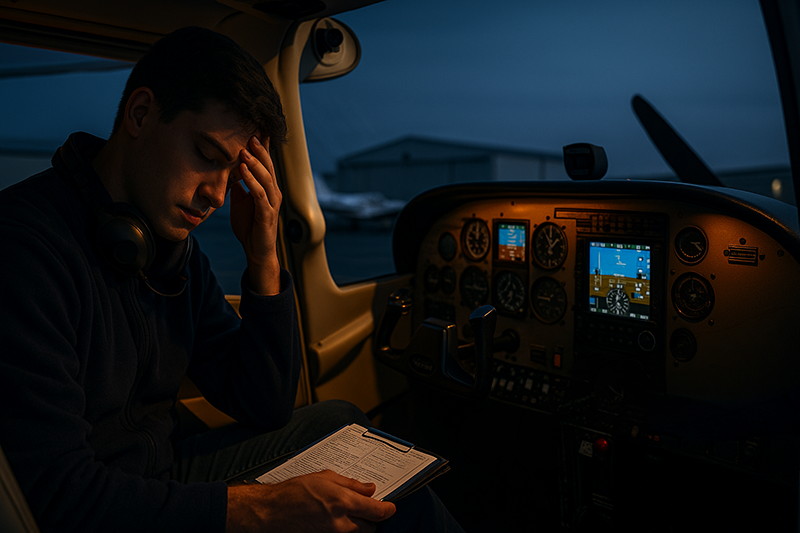
Pilot fatigue is one of the most practical human factors issues in aviation because it directly affects attention, judgment, communication, reaction time, and the quality of decisions made in the cockpit. A tired pilot may still be legal, current, experienced, and well intentioned, yet still operate below normal capability. That is what makes fatigue difficult to manage. It does not always announce itself with obvious warning signs, and it can degrade performance gradually enough that the pilot may not notice the change.
For student pilots, fatigue can interfere with learning, coordination, and confidence. For flight instructors, it can reduce the ability to monitor, teach, and intervene. For professional pilots and aviation operators, fatigue management is a core safety concern because operations often involve early departures, late arrivals, schedule pressure, weather decisions, high workload, and time-zone changes. This article explains how fatigue affects pilot performance, why it matters in real-world flying, how pilots can recognize it, and what practical habits can reduce fatigue-related risk.
What Pilot Fatigue Means in Aviation
Fatigue is more than ordinary tiredness. In aviation, fatigue can be understood as a state of reduced mental or physical performance caused by factors such as insufficient sleep, extended wakefulness, disrupted circadian rhythm, workload, stress, illness, dehydration, poor nutrition, or cumulative sleep debt. A fatigued pilot may be awake and functioning, but not functioning at the level required for safe, precise, and adaptable flight operations.
The cockpit is an unforgiving place for subtle impairment. Flying requires continuous information processing: monitoring instruments, interpreting weather, managing automation, communicating with air traffic control, navigating, anticipating aircraft energy state, and making decisions under changing conditions. Fatigue weakens many of those same abilities. It may not prevent a pilot from completing routine tasks, but it can reduce the margin available when the flight becomes abnormal, rushed, confusing, or unexpectedly demanding.
One of the most important points for pilots to understand is that fatigue is not simply a matter of willpower. Motivation and professionalism help, but they do not fully overcome the biological need for sleep and recovery. A pilot can be highly disciplined and still experience degraded performance after inadequate rest. Treating fatigue as a normal human limitation, rather than a character flaw, makes it easier to manage honestly.
How Fatigue Affects Pilot Performance
Fatigue affects pilot performance in several connected ways. The first is attention. A well-rested pilot can scan instruments, listen to radio calls, watch for traffic, track aircraft configuration, and remain aware of changing weather. A fatigued pilot is more likely to narrow attention, miss small cues, or spend too long on one task while neglecting another. In flight training, this may show up as fixation on altitude while airspeed drifts, or concentration on radio phraseology while heading control weakens.
Fatigue also affects working memory. Working memory is the mental workspace used to hold and manipulate information for a short period of time. Pilots use it constantly. A clearance, a runway assignment, an altitude restriction, a checklist item, and a mental calculation all rely on working memory. When fatigue reduces working memory, the pilot may need more time to process information, may ask for repeats more often, or may forget a step that would normally be automatic.
Decision-making is another major area of concern. Fatigued pilots may be more vulnerable to accepting a plan simply because it is already in motion. They may delay diverting, continue an unstable approach longer than they should, underestimate weather complexity, or accept a high workload rather than simplifying the situation. Fatigue can make conservative choices feel inconvenient and optimistic assumptions feel attractive.
Reaction time and motor coordination can also be affected. A fatigued pilot may be slower to respond to deviations, less smooth on the controls, or less precise during maneuvering. In normal cruise flight, that change may be barely noticeable. During a gusty crosswind landing, a go-around, an instrument approach, or a simulated emergency, the effect can be much more significant.
Communication quality often declines as well. Fatigue can lead to shorter, less precise, or more irritable communication. Crew resource management depends on clear callouts, active listening, and willingness to speak up. In single-pilot operations, communication still matters because the pilot must interact with controllers, passengers, maintenance personnel, instructors, dispatchers, or line staff. A tired pilot is more likely to misunderstand instructions, read back incorrectly, or fail to clarify uncertainty.
Why This Matters in Real-World Aviation
Fatigue matters because aviation safety depends on consistent performance, not just peak performance. Many flights begin with a routine plan and later require flexible thinking. A short training flight may encounter unexpected turbulence, a busy traffic pattern, a runway change, or a systems issue. A cross-country flight may involve deteriorating weather, airspace reroutes, fuel planning decisions, and passenger pressure. A professional trip may involve early report times, multiple legs, delays, and late-night operations.
Real-world aviation rarely presents fatigue as a single dramatic event. More often, it appears as a chain of small performance losses. A pilot skips a full weather briefing because the route is familiar. A checklist is rushed because the aircraft is behind schedule. A radio call is missed because the pilot is mentally saturated. A landing is continued despite being slightly unstable because going around feels like extra work. None of these behaviors require recklessness. They can happen to conscientious pilots when fatigue reduces available mental bandwidth.
Flight instructors see this clearly during training. A student who flew well in the morning may struggle in the late afternoon after school, work, poor sleep, or several lessons in a week. The student may not lack ability. The issue may be fatigue interfering with task management and learning. Instructors also need to monitor their own fatigue. Teaching from the right seat requires constant risk assessment, anticipation, and intervention readiness. An instructor who is tired may allow a deviation to develop longer than usual or may miss the early signs that a student is overloaded.
For aviation professionals, fatigue management is also an operational discipline. Some operations have formal scheduling, duty, and rest frameworks, while others rely more heavily on personal judgment and organizational culture. In every setting, the principle is the same: a pilot’s physical and cognitive readiness is part of the safety system. Aircraft performance, weather minimums, fuel reserves, maintenance condition, and pilot fitness all interact. Fatigue should be evaluated with the same seriousness as any other risk factor.
How Pilots Should Understand Fatigue Practically
Pilots should understand fatigue as a performance risk that changes with timing, workload, and recovery. It is not enough to ask, “Am I awake?” A better question is, “Do I have enough alertness, patience, judgment, and spare capacity for this flight if conditions change?” That question moves fatigue assessment from a vague feeling to an operational decision.
Many pilots use personal readiness tools as part of aeronautical decision-making. The IMSAFE concept is one widely taught method that encourages pilots to consider illness, medication, stress, alcohol, fatigue, and emotion before flying. Its value is not in memorizing the acronym. Its value is in creating a deliberate pause before the flight begins. Fatigue deserves that pause because it can make a pilot more likely to rationalize risk.
Fatigue is also highly individual. Some pilots function well early in the morning, while others are noticeably slower before their normal wake time. Some handle time-zone changes better than others. Some recover quickly after a long day, while others accumulate sleep debt across several days. The point is not to compare yourself with another pilot. The point is to know your own patterns and set personal limits before fatigue begins influencing your judgment.
Another practical concept is workload timing. A pilot may feel adequate during preflight and cruise, then become overloaded during descent and approach. Fatigue often becomes most noticeable when workload rises. That is why a pilot should not judge fitness only by how they feel at the start of a flight. Consider the most demanding part of the planned operation: night arrival, marginal weather, unfamiliar airport, complex airspace, short runway, high density altitude, or a training maneuver that requires precision. If fatigue is already present, those demands matter.
Sleep quantity is important, but sleep quality matters too. A pilot who spent eight hours in bed may still be fatigued after fragmented sleep, illness, stress, or an uncomfortable environment. Likewise, rest opportunities do not always equal actual recovery. For pilots working irregular schedules, early departures, or long training days, the difference between time available for sleep and sleep actually obtained is operationally important.
Fatigue, Circadian Rhythm, and Time of Day
The human body follows a circadian rhythm, which is an internal timing system that influences alertness, sleep tendency, body temperature, and many other functions. Pilots do not need to be sleep scientists to understand the aviation relevance: performance is not the same at all hours of the day. Early morning operations, late-night flights, and rapid schedule changes can place a pilot at a biological low point even if the flight itself appears simple.
Night flying offers a useful example. A pilot may complete a daytime cross-country comfortably, but the same route at night can feel more demanding. Visual references are reduced, cockpit lighting and chart management require more attention, weather recognition may be harder, and fatigue may be increasing as the body expects sleep. If the flight also includes an unfamiliar airport or an instrument approach, the margin can shrink quickly.
Time-zone changes add another layer. A pilot’s local clock and body clock may not agree. This is especially relevant for pilots operating across multiple time zones, but even general aviation pilots can experience the effect during long cross-country travel or aviation events. The key safety lesson is that scheduled clock time does not fully describe alertness. A flight planned for a reasonable local hour may still occur when the pilot’s body expects rest.
Fatigue in Single-Pilot Operations
Single-pilot operations deserve special attention because there is no second pilot to cross-check decisions, catch missed radio calls, challenge assumptions, or take over tasks. The single pilot must serve as pilot flying, pilot monitoring, navigator, systems manager, communicator, and risk manager. When fatigue reduces spare capacity, the single-pilot workload can become unforgiving.
Automation can help, but it does not eliminate fatigue risk. Autopilots, moving maps, flight management systems, and electronic checklists can reduce workload when used correctly. However, automation also requires monitoring and mode awareness. A tired pilot may be more likely to select the wrong mode, miss an unexpected automation behavior, or become complacent during a quiet cruise segment. The goal is not to avoid automation. The goal is to use it deliberately and remain actively engaged.
For single-pilot instrument flight, fatigue management is especially important. IFR flying requires sustained attention to clearances, altitude assignments, approach procedures, weather, and aircraft control. A fatigued instrument pilot may still fly within tolerances in smooth air, but workload can rise sharply during reroutes, holds, missed approaches, equipment issues, or busy terminal operations. Good preflight planning and conservative personal minimums become even more important when fatigue is a factor.
Fatigue in Flight Training
Fatigue has a direct effect on training quality. A tired student may need more repetitions to learn a maneuver, may become frustrated faster, and may have difficulty transferring ground knowledge into cockpit action. This is not a failure of motivation. Learning to fly requires attention, memory, motor coordination, and emotional regulation, all of which can suffer when the student is not rested.
Instructors should watch for fatigue patterns rather than treating every weak lesson as a skill problem. If a student consistently struggles after work, during late evening lessons, or after multiple demanding training days, schedule design may be part of the solution. A shorter lesson at the right time can sometimes produce better learning than a long lesson when the student is mentally drained.
Fatigue can also affect checkride preparation. As a practical matter, pushing hard in the final days before a practical test can become counterproductive if it reduces sleep and increases stress. A pilot preparing for evaluation needs proficiency, but also rest, clarity, and confidence. The final stage of training should include deliberate recovery time, not just more tasks.
Common Mistakes and Misunderstandings About Pilot Fatigue
One common mistake is assuming that caffeine solves fatigue. Caffeine can improve alertness temporarily for many people, but it is not a substitute for sleep. It may also create a false sense of readiness. A pilot who uses caffeine to push through fatigue still needs to consider the underlying sleep deficit, the timing of the flight, and the possibility of alertness declining later.
Another misunderstanding is believing that experience makes a pilot immune. Experience can improve judgment and workload management, but it does not remove human physiological limits. In fact, experienced pilots may be at risk of normalizing fatigue because they have successfully completed many flights while tired. Past success does not prove that the risk is acceptable on the next flight.
A third mistake is equating legality with fitness. A pilot may meet applicable currency or scheduling requirements and still be too fatigued for a particular operation. Fitness for flight is broader than paperwork. The real question is whether the pilot can safely perform the duties required for the planned flight and the likely alternatives if conditions change.
Some pilots also underestimate cumulative fatigue. One short night of sleep may be manageable for a low-workload day, but several short nights can add up. Fatigue can accumulate gradually, especially during intensive training, aircraft ferry trips, aviation events, or professional schedules with repeated early starts. By the time the pilot recognizes the problem, performance may already be degraded.
Another risky assumption is that a short, familiar flight does not require fatigue assessment. Familiarity can reduce workload, but it can also encourage complacency. Many mistakes occur during routine operations because the pilot expects the flight to be easy. A tired pilot on a familiar route may be less likely to notice that weather, traffic, fuel, or personal condition has changed the risk picture.
Practical Example: A Tired Pilot on a Familiar Cross-Country
Consider a private pilot planning a late afternoon return flight after a weekend aviation event. The route is familiar, the weather is visual, and the aircraft is operating normally. The pilot slept poorly the night before, spent the day walking around the airport, and had a light lunch. The flight home is expected to take a little over an hour.
During preflight, nothing feels obviously unsafe. The pilot is tired but motivated to get home. After departure, the first part of the flight is uneventful. In cruise, the pilot notices that radio calls require more effort than usual and that scanning outside for traffic feels less consistent. A minor headwind means the arrival will be later than expected. The sun is lowering, and the destination pattern is busy.
On descent, workload increases. The pilot needs to listen to traffic, manage altitude, review airport information, and prepare for landing. Because of fatigue, the pilot is slower to configure and does not notice an excessive descent rate as early as usual. Turning final, the aircraft is slightly high and fast. The pilot is tempted to continue because the runway is familiar and there is no obvious emergency.
A safer decision is to recognize the fatigue-related chain before it becomes a landing problem. The pilot can level off earlier, extend the pattern if appropriate, request assistance if operating in controlled airspace, or go around if the approach is not stabilized. Better yet, the pilot could have adjusted the plan before departure by resting longer, departing earlier, hydrating, eating properly, inviting another qualified pilot if appropriate, or choosing to remain overnight.
This scenario is intentionally ordinary. That is the point. Fatigue risk often appears in normal flights, not just extreme operations. The operational skill is noticing when normal tasks are taking abnormal effort and responding before the margin disappears.
Best Practices for Managing Fatigue Before Flight
The most effective fatigue management usually happens before the engine starts. Once airborne, options are more limited. Pilots should build fatigue assessment into their preflight routine just as naturally as checking weather, fuel, maintenance status, and aircraft documents. The goal is not to create a rigid checklist for every personal condition. The goal is to make fatigue visible before it affects decisions.
Start with honest self-assessment. Ask whether you slept enough, whether your sleep was restful, how long you have been awake, whether you are operating at an unusual time, and whether the flight contains high-workload elements. Then compare your condition to the demands of the flight. A local day VFR proficiency flight in calm weather is not the same as a night IFR arrival at an unfamiliar airport. Fatigue that might be manageable for one operation may be unacceptable for another.
Plan flights to protect the most demanding phase. If fatigue is a concern, avoid stacking multiple challenges into one operation. For example, a tired pilot should be cautious about combining night, marginal weather, unfamiliar terrain, complex airspace, passenger pressure, and a tight schedule. Reducing one or more of those variables can significantly improve the overall risk picture.
Use practical countermeasures without pretending they are cures. Hydration, nutrition, movement, light exposure, rest breaks, and strategic caffeine use may help maintain alertness in some situations, but none of them replace adequate sleep. If fatigue is significant, the best countermeasure may be delaying, canceling, shortening, or changing the flight.
For instructors and flight schools, scheduling is a safety tool. Training quality often improves when lessons are planned at times when the student and instructor are mentally available. Debriefs should also account for fatigue. If a student’s performance drops late in a lesson, the answer may not be more repetitions. The answer may be to stop, debrief, rest, and return when learning capacity is better.
- Evaluate fatigue before every flight, especially before night, IFR, long cross-country, or high-workload operations.
- Set personal limits that consider sleep, time awake, time of day, workload, and recovery, not just legal eligibility.
- Use conservative decision-making when fatigue is present, including delaying, diverting, or simplifying the flight.
- Recognize that caffeine and motivation may help temporarily but do not restore full performance like sleep can.
- Encourage a cockpit and training culture where saying “I am too tired to fly” is treated as sound judgment.
In-Flight Signs That Fatigue May Be Affecting You
Once in flight, fatigue may appear as subtle changes in behavior. You might notice that you are rereading the same chart segment, missing radio calls, making small altitude or heading deviations, delaying checklist use, or feeling unusually irritated by normal workload. You may also find yourself staring at one instrument or display instead of maintaining a balanced scan.
Another sign is reduced anticipation. A rested pilot usually thinks ahead: next frequency, next altitude, next configuration, next weather decision. A fatigued pilot may become reactive, dealing only with what is immediately in front of them. That can be dangerous because safe flying depends heavily on staying ahead of the airplane.
If fatigue becomes apparent in flight, the best response is to reduce workload and increase margins. Use available automation appropriately, slow the pace when safe, ask ATC for clarification or assistance if needed, review checklists deliberately, and consider diverting to a more suitable airport. If flying with another qualified pilot, communicate clearly and share tasks. If carrying passengers, do not let embarrassment prevent a conservative decision.
Building a Fatigue-Aware Safety Culture
Fatigue management is not only an individual responsibility. Aviation organizations, flight schools, flying clubs, and professional teams influence how pilots make fatigue decisions. If the culture rewards pushing through exhaustion or treats cancellation as weakness, pilots may hide fatigue until it becomes unsafe. If the culture supports honest risk assessment, pilots are more likely to speak up early.
In a training environment, instructors can model good behavior by discussing fatigue openly during preflight and postflight briefings. Students should learn that fitness for flight is part of being pilot in command, not an afterthought. A canceled lesson due to fatigue can be a valuable safety lesson if the instructor explains the reasoning professionally.
In professional environments, fatigue reporting and scheduling practices should encourage realistic communication. Specific regulatory requirements vary by operation and jurisdiction, so pilots and operators must know the rules that apply to them. Beyond compliance, however, the operational objective is the same: ensure that pilots have enough rest and alertness to perform safely.
Frequently Asked Questions
How does fatigue affect pilot decision-making?
Fatigue can reduce attention, working memory, patience, and the ability to evaluate risk clearly. A fatigued pilot may be more likely to continue with an original plan, delay a go-around or diversion, overlook small cues, or underestimate how quickly workload can increase.
Can a pilot be legal to fly but still too fatigued?
Yes. Legal eligibility and actual fitness are not always the same thing. A pilot may satisfy applicable requirements yet still lack the alertness or mental capacity needed for a specific flight. Pilots should assess fatigue as part of overall readiness before acting as pilot in command.
Is caffeine an effective solution for pilot fatigue?
Caffeine may temporarily improve alertness for some pilots, but it is not a replacement for sleep. It should not be used to justify accepting a flight when fatigue is significant. If rest is needed, delaying or changing the flight is usually the safer solution.
What are common signs of fatigue during flight?
Common signs include missed radio calls, fixation, slower checklist use, difficulty maintaining altitude or heading, irritability, confusion, reduced scan quality, and a feeling that normal tasks require unusual effort. These signs should prompt workload reduction and conservative decision-making.
How should student pilots handle fatigue before a lesson?
Student pilots should tell their instructor if they are tired, poorly rested, sick, stressed, or mentally overloaded. A good instructor can adjust the lesson, shorten it, focus on ground training, or reschedule. Training while fatigued often produces poor learning and unnecessary frustration.
What is the best way to prevent fatigue-related errors?
The best prevention is adequate sleep and realistic scheduling. Pilots should also use personal minimums, assess fatigue before flight, avoid combining fatigue with high-workload conditions, and make conservative decisions early when alertness is declining.
Key Takeaways
- Pilot fatigue reduces attention, memory, communication, reaction time, and judgment, even when the pilot is motivated and experienced.
- Fatigue risk increases when tiredness is combined with night operations, weather, unfamiliar airports, single-pilot workload, or schedule pressure.
- Good aeronautical decision-making includes honest fatigue assessment before flight and a willingness to delay, divert, shorten, or cancel when needed.