
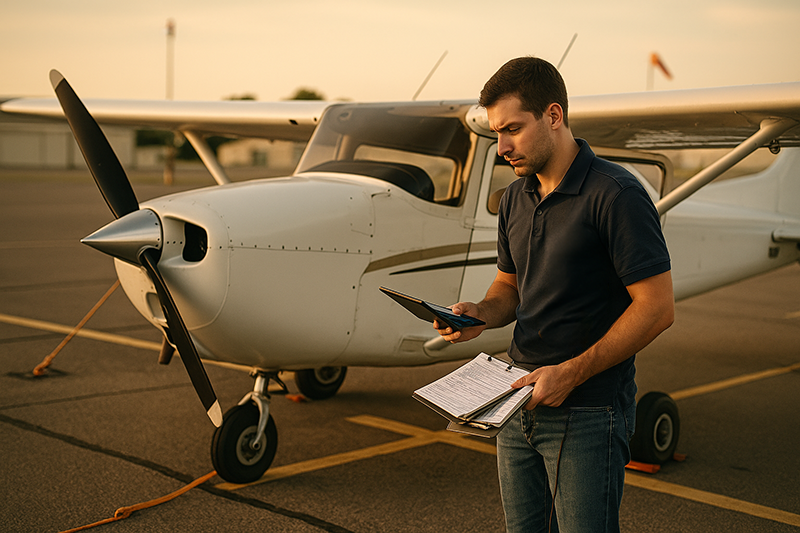
Pilot self-debriefs are one of the most practical ways to turn ordinary flying into deliberate aviation training. A flight does not stop teaching when the engine is shut down, the aircraft is secured, or the logbook entry is complete. The minutes immediately after a flight often contain the clearest evidence of how well a pilot planned, managed workload, communicated, flew the aircraft, and made decisions under real operating conditions.
An effective self-debrief is not a ritual of self-criticism. It is a disciplined learning habit. It helps pilots separate what actually happened from what they hoped happened, identify why performance varied, and choose a specific improvement for the next flight. For student pilots, it accelerates skill development between lessons. For certificated pilots, it helps prevent skill drift and reinforces thoughtful aeronautical decision-making. For instructors, it strengthens reflective learning and gives students a model they can continue using long after formal training.
The value of a self-debrief is simple: pilots improve faster when they observe their own performance with honesty, structure, and a plan for what comes next. A good debrief does not need to be long, complicated, or formal. It needs to be accurate, specific, and tied to future action.
What an Effective Pilot Self-Debrief Really Is
A self-debrief is a structured review of a flight conducted by the pilot who flew it. It looks at the complete operation, not just stick-and-rudder technique. That includes preflight planning, weather decisions, aircraft handling, checklist discipline, radio communication, traffic awareness, risk management, task management, and postflight judgment.
The word “structured” matters. Many pilots replay a flight informally on the drive home, but informal reflection can drift toward emotion, selective memory, or a single obvious mistake. A structured self-debrief keeps the review balanced. It asks what went well, what did not go as expected, why it happened, and what should be done differently next time.
Effective self-debriefs are also evidence-based. Evidence can include your memory, written notes, aircraft performance observations, flight track data, weather products reviewed before and after the flight, ATC communication recollections, fuel burn, approach profiles, landing performance, and instructor feedback when available. Not every flight needs a deep data review, but the best debriefs are grounded in observable facts instead of vague impressions.
The goal is not to create a perfect flight on paper. The goal is to create a better pilot over time. A pilot who debriefs consistently is more likely to notice recurring patterns, such as rushing checklists when behind schedule, accepting unstable approaches too long, becoming task-saturated in busy airspace, or underestimating crosswind correction during the flare. Patterns are where the real training value lives.
Why Self-Debriefs Matter in Real-World Aviation
In real-world aviation, performance is affected by more than technical knowledge. Weather, fatigue, passenger expectations, schedule pressure, unfamiliar airports, maintenance concerns, airspace complexity, and cockpit distractions can all influence how a flight unfolds. A self-debrief gives pilots a way to examine those influences after the workload has decreased.
Flight training often includes instructor-led critique, but pilots eventually operate without an instructor beside them. That transition makes self-assessment a core professional skill. A private pilot flying a weekend cross-country, a commercial pilot repositioning an aircraft, and an instructor conducting multiple lessons in a day all benefit from the ability to review performance objectively.
Self-debriefing also supports risk management. Many operational risks develop gradually. A pilot might begin accepting smaller fuel margins, flying approaches that are not well stabilized, launching into marginal weather with less planning than usual, or allowing passengers to influence decisions. None of these habits may feel dramatic in the moment. A written or spoken debrief makes those trends more visible before they become normalized.
The process also improves training efficiency. A student pilot who arrives at the next lesson knowing exactly what was challenging on the last flight gives the instructor better information. Instead of spending the first part of the lesson rediscovering old issues, the instructor and student can target them immediately. The same principle applies to instrument proficiency, aircraft transition training, recurrent training, and simulator sessions.
For instructors, teaching students how to self-debrief is as important as providing feedback. A student who can describe what happened, assess why it happened, and propose a correction is developing judgment. That judgment is not limited to maneuver standards. It applies to go/no-go decisions, traffic pattern discipline, approach management, cockpit resource management, and safe personal minimums.
The Mindset: Curious, Honest, and Action-Oriented
The best self-debriefs begin with the right mindset. A pilot should approach the review with curiosity instead of defensiveness. The question is not “Was I a good pilot today?” The better question is “What did today’s flight reveal?”
This distinction matters because aviation performance is variable. A strong pilot can have a weak flight. A student can fly one excellent landing followed by a poor one. A certificated pilot can make a sound weather decision and still find areas to improve in cockpit organization or communication. A single flight should not become a verdict on personal ability. It should become information.
Honesty is equally important. A self-debrief loses value when a pilot explains away every problem. It also loses value when a pilot focuses only on shortcomings and ignores what worked. Balanced review improves confidence and competence. Pilots need to know which habits to preserve as well as which habits to change.
An action-oriented debrief ends with a next step. “My landings were inconsistent” is an observation. “On the next flight, I will verbalize airspeed and aim point on final, initiate a go-around if the approach becomes unstable, and ask my instructor to focus on flare timing” is a plan. The difference between those two statements is the difference between reflection and improvement.
A Practical Framework for Conducting a Self-Debrief
A useful self-debrief can be completed in ten to twenty minutes for a routine flight, or longer after a complex training event. The key is to follow a consistent flow. One practical framework is to move through four questions: What happened? Why did it happen? What does it mean? What will I do next?
Start with the facts
Begin by recording the basic facts while the flight is fresh. Note the aircraft, route or training area, weather conditions, runway used, type of operation, maneuvers practiced, approaches flown, and any abnormal events or surprises. This is not the place for judgment yet. It is a factual reconstruction of the flight.
For example, a student might write: “Pattern work at a towered airport, winds 210 at 11 knots with gusts, runway 18, six landings, one go-around, instructor demonstrated one short-field landing.” A certificated pilot might write: “Day VFR cross-country, two passengers, scattered clouds, moderate headwind, fuel stop added after reassessing groundspeed.” These details create context for the rest of the debrief.
Compare performance against expectations
Next, compare what happened with what you expected or intended. Did the preflight plan match the actual conditions? Were the takeoff and climb consistent with anticipated aircraft performance? Did the traffic pattern feel organized? Were radio calls timely and clear? Did the approach remain stable? Did workload increase at a predictable point?
Expectations should be realistic and tied to the operation. A student pilot early in training should not expect airline-level precision, but should still evaluate preparation, checklist use, traffic awareness, and responsiveness to instruction. A more experienced pilot should evaluate higher-level skills such as energy management, anticipation, automation use if applicable, and decision-making under changing conditions.
Identify causes, not just symptoms
Many debriefs stop at the symptom. “I was high on final.” “I missed a radio call.” “I forgot a checklist item.” “I felt rushed.” Those statements are useful, but they do not explain enough. A stronger self-debrief asks why.
Being high on final might have resulted from turning base too close, carrying excess airspeed, delaying configuration, misunderstanding the wind, or failing to notice the visual picture early enough. Missing a radio call might have resulted from task saturation, poor audio setup, frequency congestion, or trying to brief an approach at the wrong time. Forgetting a checklist item might reflect interruption management rather than lack of knowledge.
Root-cause thinking helps avoid superficial fixes. If the real issue is workload management, simply telling yourself to “try harder” will not help. You may need to brief earlier, slow the aircraft sooner, use a flow followed by a checklist, reduce cockpit distractions, or ask for vectors or delaying action when appropriate.
Choose one or two improvements
A common mistake is leaving a debrief with too many goals. Pilots are often tempted to fix everything at once. That usually produces frustration rather than progress. A more effective approach is to choose one or two specific improvements for the next flight.
Good improvement items are observable. “Be more precise” is too vague. “Maintain assigned altitude within a tighter personal target during cruise by trimming after each power change” is more useful. “Improve radios” is broad. “Write down the next frequency before reading it back and pause before transmitting in busy airspace” is more actionable.
When a flight includes a serious concern, such as confusion about an ATC clearance, aircraft control difficulty, or a decision that felt uncomfortably close to personal limits, the improvement plan should include additional training, instructor discussion, or a more conservative operating choice before repeating a similar flight.
What Pilots Should Review After Each Flight
A complete self-debrief looks beyond the most memorable moment. The landing often dominates a pilot’s memory, but the safest and most effective pilots review the entire operation. A beautiful landing does not erase weak planning, and a firm landing does not mean the flight was poorly managed.
Start with planning and readiness. Ask whether the weather briefing, fuel planning, route selection, aircraft performance review, and personal fitness were appropriate for the flight. Consider whether you felt rushed before departure. Many cockpit problems begin before engine start because the pilot accepted time pressure, skipped mental rehearsal, or did not fully organize charts, frequencies, performance data, or cockpit materials.
Review aircraft handling from takeoff through landing. Look at directional control, pitch and power coordination, trim use, airspeed management, altitude control, bank control, and energy management. In training, connect these observations to specific maneuvers. In normal operations, connect them to phases of flight, such as climb, cruise, descent, arrival, and traffic pattern.
Review communication and cockpit management. Were calls made at the right time? Did you understand clearances and instructions before acting? Did you manage avionics without letting your attention stay inside too long? If another pilot, instructor, or passenger was on board, did you communicate intentions clearly?
Review decision-making. This is often the most important part. Did you notice changes early? Did you update the plan when conditions changed? Did you continue because the plan was still sound, or because changing the plan felt inconvenient? Did you respect your personal minimums? Did you give yourself enough time and space to make decisions without rushing?
Finally, review emotional and physiological factors. Fatigue, dehydration, stress, frustration, overconfidence, and embarrassment can all influence performance. A pilot who learns to notice those factors gains a valuable safety advantage. The point is not to overanalyze every feeling. The point is to recognize when human factors affected the flight.
Common Mistakes and Misunderstandings
One common misunderstanding is believing that self-debriefs are only for student pilots. In reality, self-assessment is a lifelong aviation skill. Experience does not eliminate the need for review. It changes the level of review. More experienced pilots may spend less time on basic aircraft control and more time on judgment, planning, automation management, crew coordination, and risk tolerance.
Another mistake is treating the debrief as a confession of errors. If the process feels punitive, pilots will avoid it or distort it. A productive debrief includes positive performance. What went well? What decision protected the margin? What preparation paid off? Identifying effective habits is not self-congratulation. It is reinforcement of safe behavior.
Some pilots focus almost entirely on the landing. Landings are visible, memorable, and emotionally satisfying when they go well. However, they are only one part of flight performance. A pilot can make a smooth landing after a poorly planned arrival, and a pilot can make a firm landing after a well-managed flight. The debrief should include the landing, but it should not be limited to it.
Another frequent error is using vague language. “Bad approach,” “poor radios,” or “not my best flight” may express frustration, but they do not guide improvement. Specific language creates useful training. Instead of “bad approach,” write, “I intercepted final high, delayed reducing power, and did not decide early enough whether to go around.” That statement identifies several teachable points.
Overreliance on flight tracking data can also be misleading. Data is valuable, but it does not always explain context. A ground track may show altitude deviations, speed changes, or course corrections, but it may not reveal cockpit workload, ATC instructions, traffic avoidance, turbulence, or instructional objectives. Use data to support reflection, not replace judgment.
A final mistake is failing to close the loop. A debrief that produces no action becomes a diary. The most useful self-debriefs create a bridge to the next flight. That bridge might be a training objective, a question for an instructor, a change to personal minimums, a revised cockpit setup, or a decision to practice a specific skill before carrying passengers.
Practical Example: Debriefing a Pattern Work Lesson
Consider a student pilot who completes a local lesson focused on traffic patterns and landings. The flight included normal takeoffs, rectangular pattern work, several landings, and one go-around. The wind was a moderate crosswind with occasional gusts. The student leaves the aircraft feeling disappointed because two landings were firm and one approach required instructor prompting.
A weak self-debrief might sound like this: “My landings were bad. I need to flare better.” That reaction is understandable, but it is too broad to guide training.
A stronger self-debrief begins with facts. The student notes the wind direction and runway, the number of landings, the go-around, and the instructor’s comments. Then the student compares each pattern with the intended performance. The first two patterns were stable until short final, but the student allowed airspeed to vary during the last 200 feet. The third approach was high because the base turn was delayed. The go-around was safe but slow to initiate because the student waited for the instructor to call it.
Next, the student looks for causes. The firm touchdowns were not simply flare problems. They were connected to inconsistent airspeed control and a late transition from approach attitude to landing attitude. The high approach came from pattern spacing and delayed descent planning. The hesitation on the go-around came from uncertainty about when the approach was no longer acceptable.
The student’s improvement plan becomes specific: “On the next pattern lesson, I will call out target airspeed on downwind, base, and final. I will decide by short final whether the approach is stable enough to continue. If I am high, fast, not aligned, or unsure, I will initiate the go-around promptly and then discuss it after the aircraft is climbing safely.”
This debrief does not pretend the flight was perfect. It also does not reduce the lesson to “bad landings.” It identifies the chain of performance factors that led to the outcome and turns the next flight into a focused training opportunity.
Using Self-Debriefs for Cross-Country and IFR Operations
Self-debriefs are especially valuable after cross-country flights because the pilot must integrate planning, navigation, weather, communication, fuel management, and passenger considerations. After a cross-country, review whether the route and alternates made sense, whether actual groundspeed and fuel burn matched planning assumptions, and whether any point in the flight felt rushed or uncertain.
For VFR pilots, a debrief should include visibility, cloud clearance awareness, terrain considerations, airspace planning, and diversion thinking. If weather was better or worse than expected, ask how that affected confidence and decision-making. If you continued toward deteriorating conditions before turning around or diverting, examine what cues were available earlier.
For instrument pilots, the debrief should include clearance understanding, briefing quality, descent planning, approach setup, altitude awareness, mode awareness if using automation, and missed approach readiness. Instrument flying places a premium on staying ahead of the aircraft. A good self-debrief asks where you were ahead, where you were behind, and what cockpit habits influenced that result.
Instrument and cross-country debriefs should also include workload management. Did you brief the arrival early enough? Did you program avionics during a low-workload phase? Did you ask ATC for clarification when needed? Did you verify navigation sources before relying on them? These questions build habits that matter when conditions become less forgiving.
How Instructors Can Teach Better Self-Debriefing
Flight instructors can strengthen student learning by gradually shifting part of the debrief from instructor evaluation to student self-assessment. Instead of beginning every postflight discussion with a list of corrections, an instructor can ask the student to reconstruct the flight first. What were the objectives? What went well? Where did performance begin to change? What would the student do differently next time?
This approach does not mean the instructor withholds important feedback. Safety-critical issues should be addressed clearly. But when students learn to identify their own performance patterns, they become more independent and more prepared for solo flight, checkride preparation, and future flying without an instructor in the aircraft.
Instructors can also model balanced language. Instead of saying, “That was wrong,” they can say, “Let’s look at what led to that outcome.” This keeps the discussion focused on causes and corrections. It also helps students separate personal identity from performance. A student who feels attacked may become defensive. A student who feels coached is more likely to learn.
Another useful instructor technique is to end each lesson with a written next step. The student should leave knowing the highest-priority item for the next flight. That item should be specific enough to practice and observe. Over time, the student’s own self-debrief notes should begin to look more like an instructor’s analysis: factual, specific, and forward-looking.
Best Practices for Pilots
Effective self-debriefing is a habit, not a paperwork exercise. The best system is the one a pilot will actually use consistently. Some pilots prefer a notebook. Others use a digital note app, an electronic logbook note, a kneeboard form, or a voice memo recorded after shutdown. The tool matters less than the quality of thinking.
Keep the process close to the flight. Debrief as soon as practical, while details are fresh and before memory becomes reshaped by emotion or distraction. Even a brief note taken before leaving the airport can preserve important details for a deeper review later.
Use consistent categories. A simple structure might include planning, aircraft control, communication, navigation, decision-making, workload, and next action. Repeating the same categories over time makes trends easier to see. If every debrief is written differently, recurring issues may remain hidden.
Include both strengths and improvements. A pilot who only records mistakes may develop an inaccurate view of progress. A pilot who only records successes may miss risk. Balanced notes support better confidence and better safety.
When appropriate, invite outside input. An instructor, safety pilot, mentor, or experienced flying partner can help identify blind spots. Self-debriefing does not mean learning alone. It means taking ownership of the first review and being prepared to discuss it intelligently.
Most importantly, make the next action realistic. A pilot should not leave a routine flight with ten improvement items. Choose the one or two that matter most. If a concern involves safety, confusion, or repeated difficulty, make the next action more substantial, such as scheduling instruction, reviewing aircraft procedures, practicing in a lower-workload environment, or setting a more conservative personal minimum.
- Write the debrief soon after the flight, even if it is brief.
- Separate facts from opinions before drawing conclusions.
- Look for causes behind performance issues.
- Identify what went well so good habits are reinforced.
- End with one or two concrete actions for the next flight.
A Simple Self-Debrief Template Pilots Can Adapt
A template can help pilots stay organized without turning the process into a rigid checklist. The following structure works well for many training and personal flying situations. It can be spoken aloud, written in a notebook, or adapted into a digital form.
First, summarize the flight in two or three sentences. Include the mission, conditions, and major events. Second, identify the strongest part of the flight. This might be a conservative weather decision, improved altitude control, better radio discipline, or a well-executed go-around. Third, identify the most important area for improvement. Be specific about the phase of flight and the observable behavior.
Fourth, identify the likely cause. Was the issue related to knowledge, skill, planning, workload, distraction, aircraft configuration, weather, or decision-making? Fifth, decide what you will do next. The next action should be something you can actually perform, brief, study, or discuss before or during the next flight.
This kind of template is short enough to use regularly but deep enough to create learning. It avoids the trap of turning every flight into an exhaustive report while still preserving the important lessons.
When a Self-Debrief Should Lead to More Training
Not every debrief finding requires formal instruction. Many small improvements can be handled through awareness, practice, and preparation. However, some findings should prompt a pilot to seek additional training or experienced feedback.
If a pilot repeatedly feels behind the aircraft, becomes confused by procedures, has difficulty maintaining control within safe margins, misunderstands clearances, struggles with landings in ordinary conditions, or feels uncertain about weather decisions, additional instruction is a prudent next step. The same is true after a flight that involved an abnormal situation, a significant startle response, or a decision that felt uncomfortably close to the pilot’s limits.
Seeking instruction is not a sign of failure. It is a normal part of professional aviation behavior. Skilled pilots use training to build margin. A good self-debrief helps identify when that margin needs reinforcement.
Frequently Asked Questions
How long should a pilot self-debrief take?
For a routine local flight, ten to twenty minutes is often enough to capture the important lessons. A complex cross-country, instrument flight, simulator session, or training event may deserve a longer review. The debrief should be long enough to identify facts, causes, and next actions, but not so burdensome that the pilot stops doing it.
Should student pilots write down every mistake?
No. Student pilots should record the most important learning points, not every imperfection. Training flights contain many small variations, and trying to document all of them can become overwhelming. Focus on recurring patterns, safety-related issues, instructor priorities, and one or two improvements for the next lesson.
Can flight tracking apps replace a self-debrief?
No. Flight tracking data can support a self-debrief, but it cannot fully replace pilot judgment. Track data may show altitude, speed, or route trends, but it does not always explain cockpit workload, ATC instructions, visual cues, training objectives, or decision-making context.
What should I do if my self-debrief reveals a serious concern?
If the concern involves safety, aircraft control, procedural confusion, weather judgment, or repeated uncertainty, discuss it with a qualified instructor or experienced aviation mentor before repeating a similar operation. A self-debrief is most valuable when it leads to appropriate action.
Should instructors let students debrief themselves first?
Often, yes. Allowing students to assess their own performance first can build judgment and ownership. The instructor should still correct misunderstandings and address safety issues, but student-led reflection helps develop independent pilot decision-making.
How can experienced pilots avoid complacency in self-debriefs?
Experienced pilots can focus on patterns, margins, and decisions rather than only technical execution. Questions about weather judgment, personal minimums, cockpit workload, passenger pressure, and plan changes help keep the debrief meaningful even when the flight was routine.
Key Takeaways
- Effective pilot self-debriefs turn each flight into a learning cycle by connecting facts, causes, and specific next actions.
- The safest debriefs review the whole operation, including planning, workload, communication, decision-making, and aircraft handling.
- A good self-debrief is balanced, evidence-based, and forward-looking, and it should lead to instruction or more conservative choices when safety concerns appear.