
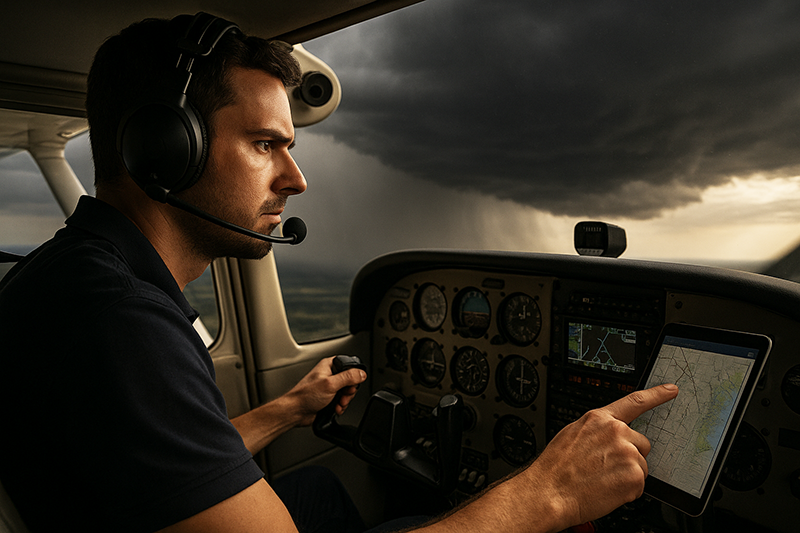
Plan continuation bias is one of the most important human factors for pilots to recognize because it often feels like disciplined follow-through rather than risk-taking. A pilot launches with a reasonable plan, receives new information along the way, and continues toward the original goal even though the situation has changed. The danger is not that the pilot is careless. The danger is that the pilot is committed, organized, and trying to complete a flight that seemed acceptable when it began.
For student pilots, flight instructors, experienced aviators, dispatchers, and aviation professionals, understanding plan continuation bias is a practical safety skill. It helps explain why smart, trained people sometimes continue into deteriorating weather, unstable approaches, fuel concerns, schedule pressure, runway changes, or operational complexity that deserved a pause. This article explains how the bias develops, how to spot it before it becomes a problem, and how pilots can build habits that make changing the plan feel normal, professional, and expected.
What Plan Continuation Bias Means in Aviation
Plan continuation bias is the tendency to continue with an original course of action after conditions have changed enough that the plan should be reconsidered. In aviation, the original plan may include the intended route, fuel stop, destination airport, approach, runway, passenger pickup, training lesson, departure time, or completion of a mission. The bias is strongest when the pilot has already invested time, effort, money, or reputation in that plan.
The key word is not continuation. Continuing a plan is not automatically unsafe. Aviation depends on planning and disciplined execution. The concern is bias, which means the pilot’s thinking has become tilted toward completion even when new information should trigger reassessment. A healthy plan is flexible. A biased plan becomes sticky.
Plan continuation bias can appear in small general aviation operations, airline crews, corporate flight departments, helicopter missions, flight training, maintenance ferry flights, and personal travel. It can affect a solo student on a local cross-country just as easily as a professional crew managing a complex arrival. The details change, but the mental pattern is similar: the pilot sees warning signs, explains them away, and keeps moving toward the original objective.
In practical terms, the bias often sounds like an internal conversation. The weather is not quite what was forecast, but it should improve after the next checkpoint. The fuel situation is still legal, but the headwind is stronger than expected. The approach is not as stable as it should be, but the runway is right there. The passenger is late for an appointment, but there is probably enough margin. Each individual thought may sound reasonable. The risk grows when those thoughts are used to protect the plan instead of evaluate it.
Why This Matters in Real-World Aviation
Aviation is a changing environment. Weather develops, winds shift, traffic changes, passengers add pressure, maintenance issues appear, and pilot workload rises. Good preflight planning is essential, but it is only the first part of decision-making. The pilot must also compare the plan against reality as the flight unfolds.
Plan continuation bias matters because it can quietly reduce the pilot’s willingness to divert, delay, discontinue an approach, return to the airport, ask for help, or cancel a flight. Those actions are normal tools of professional airmanship. Yet under pressure, they can start to feel like failures. A pilot who sees diversion as defeat is more vulnerable to continuing into an avoidable problem.
The bias is especially relevant during weather decision-making. A pilot may depart with a forecast that supports the flight, then encounter lowering ceilings, reduced visibility, stronger winds, turbulence, icing potential, convective activity, or unforecast conditions. The decision point may arrive gradually rather than dramatically. Because each mile has already been flown, continuing one more mile can seem easier than turning around or landing short of the destination.
It also matters during approach and landing. Many pilots have been taught to recognize an unstable approach, but recognizing is not the same as acting. When the runway is visible and the aircraft is close to the ground, the desire to complete the landing can overpower a disciplined go-around decision. A go-around is a normal maneuver. Plan continuation bias can make it feel like an interruption of success rather than an appropriate response to an unsatisfactory approach.
Flight training is another environment where the bias shows up. A lesson may be planned around crosswind landings, short-field technique, or a cross-country. If conditions are not suitable, the instructor and student may feel pressure to proceed because the schedule is tight or the student has been waiting for that lesson. The safer and more educational response may be to modify the lesson, choose a different airport, practice ground-based decision-making, or postpone the flight.
For aviation organizations, plan continuation bias affects culture. If pilots believe they will be criticized for delaying, diverting, or discontinuing a flight, they may become more completion-oriented. If leaders consistently support conservative decisions, pilots are more likely to speak up early. Safety culture is not only about written procedures. It is also about how the organization reacts when a pilot says, “The plan no longer fits the conditions.”
How Pilots Should Understand This Topic
The most useful way to understand plan continuation bias is to see it as a normal human tendency, not a character flaw. Pilots are trained to plan carefully, brief the flight, anticipate contingencies, and complete tasks. Those traits are valuable. The problem appears when commitment to the plan becomes stronger than commitment to the objective of safe flight.
A good pilot is not someone who never changes the plan. A good pilot is someone who changes the plan early enough, clearly enough, and calmly enough that the change remains manageable. That may mean diverting while there is still plenty of fuel, requesting vectors before workload peaks, discontinuing an approach before the aircraft is low and fast, or canceling before passengers are loaded.
One practical method is to separate the mission from the method. The mission might be to transport people safely, complete a training objective, reposition an aircraft, or conduct a business trip. The method is the specific route, departure time, fuel plan, approach, or airport selection. Plan continuation bias often causes the pilot to confuse the method with the mission. If the method becomes unsuitable, changing it may actually protect the mission.
Pilots can also understand the bias through “decision gates.” A decision gate is a planned point at which the pilot deliberately reassesses conditions. It can be based on time, fuel, location, weather, approach stability, passenger condition, crew workload, or aircraft status. The value of a decision gate is that it gives the pilot permission to reconsider before the situation becomes urgent.
Examples of useful decision gates include reviewing weather before crossing a mountain range, verifying fuel remaining at a midpoint, reassessing ceilings and visibility before leaving the practice area, evaluating aircraft configuration and energy state before continuing an approach, or deciding in advance what conditions would trigger a diversion. These gates are not regulatory substitutes, and they do not replace aircraft manuals, procedures, or pilot judgment. They are mental tools for staying honest.
It is also important to recognize that plan continuation bias becomes stronger under workload. When a pilot is busy communicating, navigating, managing systems, interpreting weather, and flying the aircraft, there is less mental capacity available for strategic thinking. Under high workload, the brain tends to favor the familiar path. Continuing may feel simpler than building a new plan, even when the new plan is safer.
That is why simple prompts matter. “What has changed?” “What would make me stop?” “Where is my best out?” “If I were advising another pilot, what would I recommend?” These questions interrupt the automatic push toward completion and help the pilot regain perspective.
Warning Signs That the Original Plan Is Taking Over
Plan continuation bias rarely announces itself. It usually appears as rationalization, narrowing attention, or reluctance to use available alternatives. Pilots can improve their judgment by learning the warning signs that their thinking is becoming too attached to the original plan.
One warning sign is repeated justification. If a pilot keeps explaining why the flight can still be completed, rather than evaluating whether it should be completed, the plan may be driving the decision. A single new fact may be manageable. Several small changes, such as lower ceilings, stronger winds, passenger pressure, and higher fuel burn, can combine into a substantially different risk picture.
Another warning sign is discomfort with simple alternatives. If diverting to a nearby airport, delaying departure, adding fuel, requesting assistance, or going around feels embarrassing rather than prudent, the pilot should pause. Good aviation decisions often look conservative in the moment and wise afterward.
A third warning sign is the phrase “almost there.” Being close to the destination can create a strong pull to continue. Proximity is not the same as safety. Some of the highest workload phases of flight occur near the destination, including arrival, approach, landing, taxi, and changing weather decisions. The fact that the flight is nearly complete does not remove the need for disciplined judgment.
Watch also for narrowing options. Early in a flight, a pilot may have many airports, altitudes, routes, fuel choices, and timing options. As the flight continues, some options disappear. A pilot caught in plan continuation bias may fail to notice that the number of good outs is shrinking. A professional mindset asks, “Am I preserving options or spending them?”
Another subtle warning sign is silence. In a two-pilot cockpit, with an instructor and student, or with experienced passengers, people may notice concerns but hesitate to speak. The flying pilot may be focused on execution. The non-flying pilot or instructor may assume the other person has it handled. A clear invitation for challenge, such as “Tell me if you see the plan getting too tight,” can reduce that silence.
Why Smart Pilots Continue Bad Plans
It is tempting to believe that poor outcomes happen only to careless pilots. That belief is comforting, but it is not a useful safety strategy. Plan continuation bias affects capable people because it is tied to normal mental shortcuts and social pressures.
One factor is sunk cost. Once time, money, fuel, and effort have been invested in a flight, changing the plan can feel wasteful. In reality, past investment cannot make a risky future decision safer. The fuel already burned, the time already spent, and the passengers already briefed are not reasons to continue into unacceptable conditions.
Another factor is goal pressure. Pilots often have legitimate reasons to complete a flight: work obligations, family events, maintenance appointments, student progress, business schedules, or operational commitments. These goals matter, but they are not flight safety criteria. When a goal becomes emotionally important, the pilot may unconsciously raise the threshold for calling off the plan.
Normalization also plays a role. If a pilot has previously completed flights in marginal conditions, that experience can create confidence. Experience is valuable, but it can also teach the wrong lesson if the pilot interprets luck or thin margins as proof of skill. A flight that ended without incident is not automatically evidence that the decision was sound.
Social identity is another influence. Pilots often take pride in being capable, prepared, and reliable. That identity can make it difficult to say, “I am not comfortable with this anymore.” In a healthy aviation culture, the opposite should be true. The pilot who changes the plan based on changing conditions is demonstrating command judgment.
Finally, there is cognitive workload. When pilots are saturated, they may cling to the plan because building a new one requires mental effort. This is why early decisions are usually better. Diverting before fuel is tight, asking for help before becoming overloaded, and going around before the approach becomes unrecoverable all preserve mental bandwidth.
How Plan Continuation Bias Shows Up During Flight Planning
Plan continuation bias can begin before engine start. It may show up during preflight planning when a pilot becomes attached to a preferred departure time, destination, or route before fully evaluating the conditions. The pilot may check the weather with the hope of confirming the plan rather than the intention of testing it.
A more disciplined approach is to plan with disconfirmation in mind. Instead of asking, “Can I make this work?” ask, “What would tell me this is not a good plan?” That shift changes the quality of the preflight review. It encourages the pilot to look for fuel margin issues, weather trends, terrain concerns, alternates, daylight, fatigue, aircraft status, passenger needs, and escape options.
For student pilots, this is an excellent training opportunity. Instructors can ask students to present both a go plan and a no-go threshold. The goal is not to make students timid. The goal is to help them think like pilots in command. A student who can explain why a flight should be delayed may be demonstrating more maturity than one who simply wants to complete the lesson.
Flight planning should also include personal minimums. Personal minimums are not a replacement for regulations, aircraft limitations, or operating procedures. They are self-imposed margins that reflect pilot experience, proficiency, aircraft equipment, terrain, weather, and mission demands. The value of personal minimums is greatest when they are written or briefed before pressure builds.
When the pilot revises personal minimums in the direction of less margin during the flight, that change deserves scrutiny. There may be legitimate reasons to adjust a plan, but lowering standards in response to schedule pressure is a classic path into plan continuation bias.
How Plan Continuation Bias Appears in Weather Decisions
Weather is one of the clearest environments for plan continuation bias because it changes over time and distance. A flight may begin with acceptable conditions and later encounter unexpected developments. The decision to continue may not feel like one big decision. It may feel like a series of small, reasonable steps.
For VFR pilots, the bias can appear as scud running, pressing toward lowering visibility, or continuing over terrain with fewer landing options. The pilot may reason that the next area will be better, the destination is close, or there is still room underneath the ceiling. The safer question is not only whether the aircraft can physically continue. The better question is whether the pilot still has comfortable, legal, and practical options if conditions worsen.
For IFR pilots, the bias can appear as overconfidence in the clearance or the avionics. An instrument rating and properly equipped aircraft can provide valuable capability, but they do not remove the need for judgment. Workload, icing potential, convective weather, turbulence, alternates, fuel, approach availability, and pilot proficiency still matter. Continuing IFR because the airplane and pilot are technically capable may not be the same as making the best operational decision.
Weather decisions should be made early and revisited often. Pilots should be alert when the actual conditions differ from the forecast, when reports along the route are trending worse, when terrain limits escape routes, or when fuel reserve is being consumed faster than planned. These are not automatic emergencies. They are prompts to reassess before the choices become narrow.
Approach and Landing: The Bias at Low Altitude
Approach and landing deserve special attention because the aircraft is close to the ground, workload is high, and the runway can create powerful visual temptation. The closer the aircraft gets to touchdown, the more emotionally difficult it can be to discontinue the landing, even when the approach is not meeting the pilot’s expectations.
An unstable approach may involve excessive speed, poor glidepath control, late configuration, high sink rate, runway misalignment, inadequate spacing, distraction, or a rushed descent. The exact stabilization criteria depend on the aircraft, operation, and procedures being used. The principle is simple: if the approach is not where it needs to be in enough time to land safely, going around is the professional choice.
Plan continuation bias can distort this decision by making the landing feel inevitable. The pilot sees the runway, expects to finish the flight, and may try to salvage the approach. That word, salvage, should get a pilot’s attention. If an approach needs to be salvaged, it may need to be discontinued.
In training, instructors should normalize go-arounds early. A go-around should not be treated as a dramatic event or a sign of poor performance. It is a normal maneuver that preserves options. When pilots practice go-arounds from different points in the pattern and approach, they become less reluctant to use them when needed.
Common Mistakes and Misunderstandings
One common misunderstanding is that plan continuation bias only applies to reckless pilots. In reality, it can affect disciplined pilots precisely because they value completion and consistency. The pilot who carefully planned the flight may feel a stronger need to execute that plan.
Another mistake is treating a legal minimum as the same thing as a wise minimum. Regulations establish requirements, but they do not evaluate every personal, aircraft, weather, terrain, and workload factor in a specific flight. A flight can be legal and still be a poor choice for a particular pilot on a particular day.
Pilots also sometimes underestimate passenger pressure. Passengers may not intentionally pressure the pilot, but their expectations can still matter. A pilot who wants to avoid disappointing family, clients, friends, or students may continue a plan longer than is prudent. Clear passenger briefings help. Telling passengers before departure that delays, diversions, and cancellations are normal safety decisions reduces the surprise if the plan changes later.
A related mistake is waiting for certainty. Pilots may delay changing the plan because they want definite proof that conditions are unsafe. That standard is too high. Aviation decisions often must be made with incomplete information. If the trend is unfavorable and margins are shrinking, waiting for certainty may mean waiting too long.
Another misunderstanding is believing that technology will solve the problem. Weather displays, moving maps, autopilots, terrain awareness, traffic information, and electronic flight bags can improve situational awareness when used properly. They can also create confidence that encourages continuation. Technology is a decision aid, not a substitute for judgment.
Finally, pilots may think that changing the plan creates more risk than continuing. Sometimes a diversion, delay, or go-around does add workload. But the comparison should be between the risks of changing early and the risks of continuing until the situation deteriorates. Early changes are usually easier to manage than late ones.
Practical Example: The Cross-Country That Keeps Getting Tighter
Consider a private pilot planning a daytime VFR cross-country to meet friends for an evening event. The weather briefing shows acceptable conditions, but a front is expected later. The pilot plans a direct route, identifies several airports along the way, and tells the passengers that the return may be delayed if conditions change.
After departure, the flight begins smoothly. One hour later, the groundspeed is lower than expected because of stronger headwinds. The pilot still has adequate fuel, but the planned reserve is shrinking. A weather check shows ceilings near the destination are lower than forecast and visibility is trending down. The passengers are relaxed and looking forward to arriving.
This is the moment when plan continuation bias can start. The pilot has already completed much of the trip. The destination is not far away. The event matters. The airplane is operating normally. It is easy to think, “We can probably make it.”
A pilot actively guarding against the bias would pause and compare the current flight to the original plan. The flight now has stronger headwinds, lower weather, reduced fuel margin, and increasing time pressure. None of those factors alone may require an immediate landing, but together they show that the plan has changed. The pilot chooses a nearby airport with fuel and good weather, lands, updates the weather, and calls the passengers’ friends. The event may be delayed, but the decision is made while options are abundant.
The key lesson is that the diversion was not a failure. It was the successful use of command authority. The pilot recognized that the original plan no longer matched the conditions and acted before the situation became urgent.
Best Practices for Pilots
The best defense against plan continuation bias is not one clever phrase. It is a collection of habits that make reassessment normal. These habits should be practiced in flight training, reinforced during recurrent training, and used on everyday flights.
First, brief the conditions that would cause you to change the plan. Before departure, identify the weather, fuel, aircraft, time, passenger, or workload triggers that would lead to a delay, diversion, return, or cancellation. A trigger does not remove judgment, but it gives the pilot a reference point when pressure rises.
Second, protect your outs. An “out” is a practical alternative, such as a suitable airport, safe altitude, fuel stop, delay option, approach choice, or go-around. If the flight is consuming options faster than expected, treat that as important information. Pilots should value options the same way they value fuel, because options are a form of safety margin.
Third, use verbal decision-making. Saying the situation out loud can expose weak reasoning. In a crew environment, verbalize changes and invite challenge. In single-pilot operations, a brief self-talk statement can help: “The plan was based on better weather and more fuel margin than I have now. I need a new plan.”
Fourth, make conservative decisions early. Early changes are usually calmer, more flexible, and less expensive than late changes. A diversion with comfortable fuel and daylight is very different from a diversion made after the weather has deteriorated and the pilot is tired.
Fifth, train for plan changes. Instructors can build realistic scenario-based training in which the correct answer is not always to complete the original lesson. Students should practice diverting, delaying, changing airports, discontinuing approaches, and explaining decisions to passengers. The goal is to make flexibility part of normal airmanship.
Sixth, be careful with external pressure. If a passenger, employer, customer, instructor, or personal schedule is influencing the decision, name that pressure directly. Pressure loses some of its power when it is acknowledged. A simple statement such as “The schedule is pushing me, but the weather is making the decision” can reset priorities.
The following practical prompts can help pilots interrupt plan continuation bias without turning the cockpit into a checklist exercise:
- What has changed since I made the original plan?
- Would I launch now if I were still on the ground with this information?
- What is my best alternative while I still have good options?
- Am I continuing because it is safe, or because changing the plan is inconvenient?
- What would I advise a student or another pilot to do in this situation?
Instructor Techniques for Teaching Plan Continuation Bias
Flight instructors play an important role in helping pilots recognize plan continuation bias before it becomes ingrained. The most effective instruction is not a lecture about poor judgment. It is scenario-based training that lets the learner experience the pressure of changing a plan.
For example, an instructor might assign a cross-country plan and then introduce realistic changes: a stronger headwind, an unexpected runway closure, a sick passenger, a lower-than-expected ceiling, or a maintenance discrepancy discovered before departure. The student must decide whether to continue, modify, delay, or cancel. The instructor’s debrief should focus on the reasoning process, not simply the outcome.
Instructors should be careful not to reward completion at the expense of judgment. If every lesson is considered successful only when the planned maneuver or destination is completed, students learn the wrong message. A lesson in which the student makes a sound no-go decision can be highly successful.
Another useful technique is the “fresh pilot” question. Ask the student, “If another qualified pilot walked up right now with no emotional investment in this flight, what would that pilot see?” This question helps separate current conditions from personal commitment.
Instructors can also model humility. Saying, “I do not like how this is developing, so we are going to change the plan,” teaches more than a lecture. Students remember calm, conservative decisions made by instructors they respect.
Using Crew Resource Management in Single-Pilot Flying
Crew resource management is often associated with multi-pilot operations, but the principles are useful for single-pilot flying as well. The core idea is to use all available resources to manage risk, including equipment, air traffic services, passengers, instructors, dispatchers, maintenance personnel, and other pilots.
A single pilot can reduce plan continuation bias by involving resources early. That might mean asking air traffic control for updated weather or vectors, calling flight service or an operations contact while on the ground, consulting another instructor before departure, or using passengers appropriately for non-flying tasks such as looking for traffic or reading a frequency. The pilot remains responsible for the decision, but does not have to think in isolation.
Passenger communication is part of resource management. Before departure, explain that the flight may change if weather, fuel, aircraft condition, or pilot workload changes. This is not alarming. It is professional. When passengers understand that flexibility is normal, the pilot is less likely to feel trapped by expectations.
Building a Personal Anti-Bias Routine
A personal anti-bias routine should be simple enough to use on every flight. Complicated systems tend to disappear under pressure. A useful routine might include a preflight trigger briefing, midpoint reassessment, destination reassessment, and approach gate.
During preflight, identify the conditions that would change the plan. During the flight, compare actual conditions to expected conditions at logical points. Before committing to the destination area, verify that weather, fuel, aircraft status, daylight, and pilot condition still support the plan. During approach, decide whether the aircraft is stable enough to continue.
The routine should also include a personal permission statement. Pilots benefit from deciding in advance that they are allowed to be conservative. For example: “I will not let embarrassment, cost, or schedule pressure make this decision for me.” That may sound simple, but it can be powerful when the pressure is real.
After the flight, review the decision points. Did you notice changes early? Did you preserve options? Did you feel pressure to continue? Did passengers or schedule influence your thinking? This kind of debrief builds judgment over time.
Frequently Asked Questions
Is plan continuation bias the same as get-there-itis?
They are closely related, but not identical. Get-there-itis is a common aviation phrase for the pressure to reach a destination. Plan continuation bias is broader. It includes the tendency to continue any original plan, such as a route, approach, lesson, fuel stop, or operational decision, even after conditions suggest reassessment.
Can experienced pilots still be affected by plan continuation bias?
Yes. Experience can improve judgment, but it does not eliminate human factors. Experienced pilots may be especially confident in their ability to manage changing conditions, which can be helpful or harmful depending on how objectively they reassess the situation.
What is the best way to recognize plan continuation bias in the cockpit?
Look for changes from the original plan and listen for rationalizations. If you are repeatedly explaining why continuing is still possible, pause and ask whether continuing is still the best choice. Compare current conditions to the assumptions you used before departure.
How can student pilots practice avoiding this bias?
Student pilots can practice by using scenario-based planning, setting personal minimums with an instructor, identifying diversion airports, and debriefing no-go decisions. Training should make changing the plan feel like normal pilot-in-command behavior, not a failure.
Does going around help prevent plan continuation bias?
A go-around is one important tool for resisting plan continuation bias during approach and landing. If the approach is not stable, the runway environment is not developing as expected, or the pilot feels rushed, a go-around preserves options and creates time to reassess.
Should pilots always divert when conditions change?
No. Conditions can change without making the flight unsafe or unsuitable. The point is not to divert automatically. The point is to reassess honestly, compare the new situation to the original assumptions, and choose the safest practical option with adequate margins.
Key Takeaways
- Plan continuation bias occurs when commitment to the original plan becomes stronger than the pilot’s willingness to reassess changing conditions.
- Early changes such as delaying, diverting, returning, requesting help, or going around usually preserve more options than late changes made under pressure.
- Training, personal minimums, decision gates, passenger briefings, and honest debriefs help pilots make flexible decision-making a normal part of airmanship.