
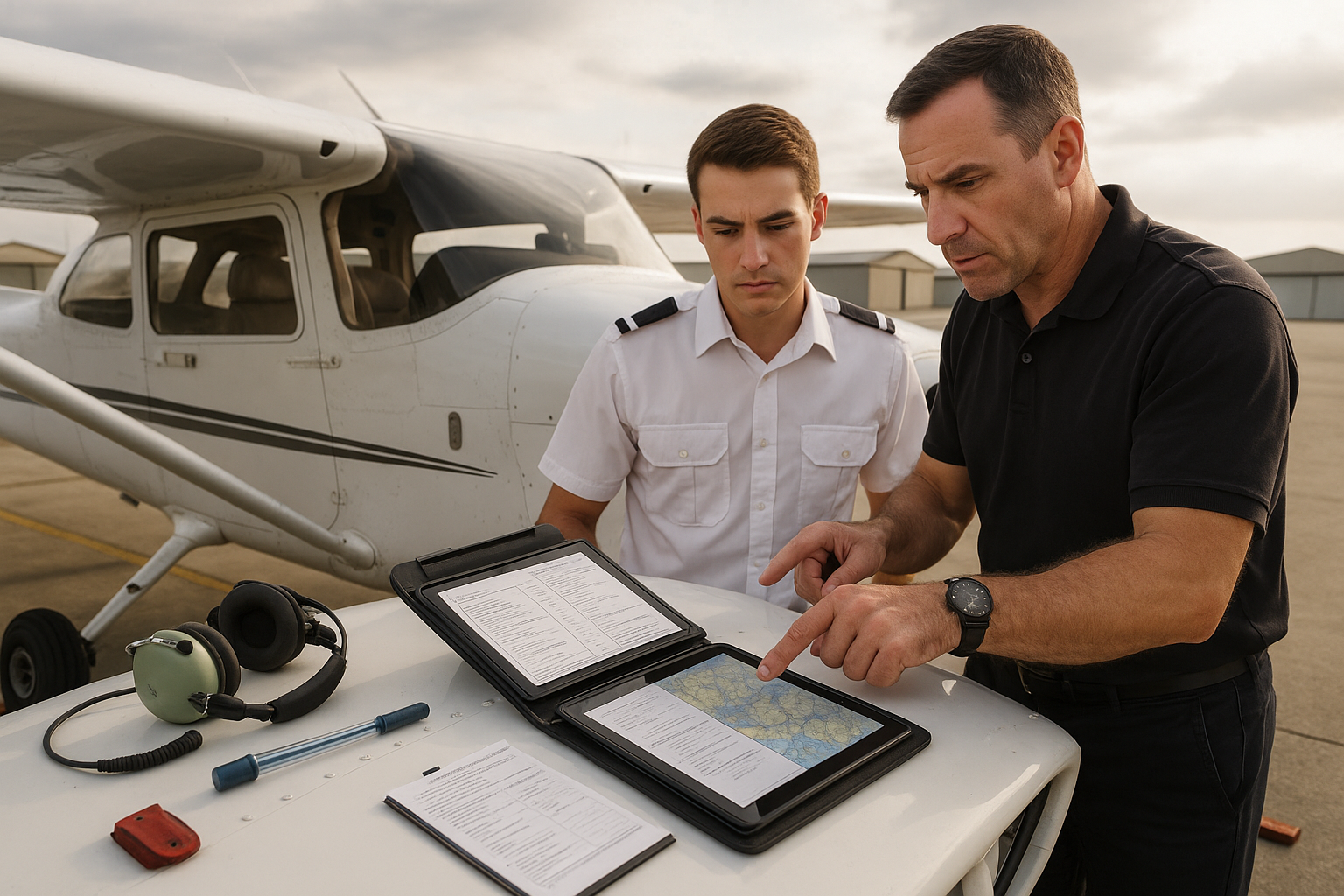
Poor flight preparation rarely announces itself as a major safety problem at the beginning of a trip. It usually starts quietly: a weather briefing skimmed too quickly, a performance calculation assumed from memory, a fuel stop left vague, a NOTAM overlooked, or a training flight launched without a clear lesson objective. The airplane may start normally, the taxi may feel routine, and the first few minutes of flight may look completely ordinary. The real cost appears later, when the pilot has fewer options, less time, and more workload than expected.
For pilots, student pilots, flight instructors, aircraft owners, and aviation professionals, flight preparation is not simply paperwork before the enjoyable part of flying begins. It is the process that turns uncertainty into usable decisions. Good preparation helps a pilot understand the aircraft, the weather, the route, the airspace, the airport environment, the fuel picture, the passengers, and personal readiness before the airplane is committed to flight. This article looks at the hidden costs of weak preflight planning, including safety margins, money, training efficiency, aircraft care, passenger confidence, and pilot judgment.
What Poor Flight Preparation Really Costs
The obvious cost of poor flight preparation is delay. A pilot arrives at the airport, discovers a maintenance discrepancy, realizes the winds are stronger than expected, or finds that a destination runway is not available. The flight is delayed, rescheduled, or canceled. That is inconvenient, but it is often the least expensive outcome.
The deeper costs are operational. Poor preparation can reduce the quality of decisions made before and during flight. A pilot who has not studied the route may be slower to recognize deteriorating weather options. A student who has not reviewed maneuvers may spend valuable lesson time relearning basics instead of improving skill. An aircraft owner who has not evaluated weight and balance may find that a planned loading arrangement is not practical. A flight instructor who has not confirmed airport conditions may need to redesign the lesson after engine start. Each example creates friction, workload, and unnecessary risk.
Flight preparation is also a risk management tool. It does not remove all risk, and it cannot predict every variable. Aviation will always include weather changes, mechanical surprises, air traffic delays, and human factors. Preparation matters because it gives the pilot a mental model before the flight begins. When something changes, the prepared pilot recognizes the change faster and compares it against a plan that already exists. The unprepared pilot must build that plan while also flying the aircraft, communicating, navigating, managing passengers, and evaluating conditions.
In practical terms, poor preparation often costs pilots three things they cannot easily recover in flight: time, attention, and options. Time is lost when a pilot must look up information that should already be understood. Attention is lost when the pilot’s mental bandwidth is spent catching up. Options are lost when fuel, daylight, weather, airspace, or aircraft performance margins become tighter than expected. These costs compound quickly.
Why This Matters in Real-World Aviation
Real-world aviation is full of small changes. Surface winds shift. Temperatures rise. A runway closes. A training area becomes busy. A fuel pump is unavailable. A passenger arrives with more baggage than expected. A cloud layer forms earlier than forecast. A pilot who prepared carefully may still need to adjust, but the adjustment is made from a position of awareness rather than surprise.
Flight preparation matters in training because learning depends on structured attention. A student pilot who arrives prepared can use the lesson for refinement, decision-making, and new skill development. A student who arrives without reviewing procedures, airspeeds, callouts, or lesson objectives may spend much of the flight simply trying to remember what was previously covered. That can be frustrating for the student, inefficient for the instructor, and expensive for whoever is paying for the aircraft.
It matters in aircraft operation because performance is not a slogan. Takeoff distance, climb capability, landing distance, fuel endurance, and loading limits are practical considerations that vary with aircraft configuration, atmospheric conditions, runway condition, pilot technique, and other operational factors. Pilots should use the appropriate aircraft documentation and current conditions rather than relying on habit or a previous experience that may not apply.
It matters in weather decision-making because weather is not just a go or no-go item. A meaningful weather review includes the trend, timing, route, ceiling, visibility, wind, convective potential, icing concerns when applicable, turbulence, pressure systems, and available alternates. A pilot does not need to become a meteorologist to plan responsibly, but the pilot does need to understand how the forecast affects the specific flight being considered.
It matters in regulations and procedures because compliance is not separate from safety. Pilots are expected to operate within applicable rules, aircraft limitations, airspace requirements, and operational procedures. A rushed pilot is more likely to treat regulatory items as obstacles instead of decision-making information. A prepared pilot uses them as boundaries that help define a safe and legal flight.
The Hidden Financial Costs of Weak Planning
Many pilots think of preparation as a safety issue, but it is also a financial issue. In training aircraft, rental time is usually billed by aircraft use, and instructor time may be billed whether the lesson is highly productive or not. If a student arrives unprepared, the lesson may still occur, but the value of that lesson can decline. Instead of progressing toward proficiency, the student may repeat avoidable errors, miss briefing points, or need extra ground review that could have been completed before arrival.
Aircraft owners face a different version of the same problem. Poor route planning can lead to unnecessary fuel stops, inefficient cruise altitudes, avoidable delays, or operating decisions that increase wear. In piston aircraft, poor engine management habits, repeated short flights without thoughtful planning, or rushed operations can contribute to maintenance concerns over time. Specific maintenance effects depend on the aircraft, engine, environment, and operating practices, so pilots should follow the aircraft manufacturer’s guidance and maintenance professional advice rather than general assumptions.
Fuel planning is another financial and operational example. Carrying fuel is essential, but fuel has weight. A pilot who does not think through fuel needs, passenger loading, baggage, runway length, temperature, and route options may discover too late that the original plan does not fit the aircraft’s practical capabilities. That can mean offloading baggage, reducing passengers, adding an intermediate stop, or delaying until conditions improve. None of those outcomes is automatically unsafe, but they can become costly when discovered at the last minute.
There is also the cost of reputation. A professional pilot, instructor, or aviation business that repeatedly launches into avoidable confusion loses trust. Passengers may not know every detail of weather planning or aircraft performance, but they can sense disorganization. Students quickly recognize whether an instructor has a plan. Dispatchers, maintenance personnel, and airport staff notice whether pilots communicate clearly. Preparation is part of professional credibility.
The Safety Costs Are Often Indirect
Poor flight preparation does not always cause an immediate unsafe act. More often, it sets up a chain of indirect pressures. A pilot departs later than planned, then feels tempted to continue as daylight fades. A weather deviation adds time, then fuel becomes a more active concern. A student struggles with radio work because the airport diagram was not reviewed, then task saturation affects traffic scanning. A pilot realizes a chart, database, or route detail is not understood, then spends too much time heads-down in the cockpit.
These situations are not about blaming pilots for being imperfect. Every pilot has launched a flight and learned something that should have been considered earlier. The point is that aviation gives better outcomes to pilots who reduce preventable surprises. A cockpit is a poor classroom for learning basic facts that were available before engine start.
Workload is one of the most important hidden costs. High workload reduces a pilot’s ability to notice subtle changes and make calm decisions. When a pilot is behind the airplane, small tasks begin to compete with essential tasks. Radio calls, navigation changes, passenger questions, weather updates, checklist use, aircraft control, and traffic awareness all demand attention. Good preparation lowers baseline workload before the flight begins.
Another safety cost is normalization of shortcuts. If a pilot repeatedly skips parts of preparation and nothing bad happens, the shortcut can begin to feel validated. That is a dangerous training effect. The absence of a bad outcome does not prove the quality of the decision. It may only mean that conditions were forgiving. Strong pilots resist the temptation to measure preparation by whether the last shortcut appeared to work.
How Pilots Should Understand Flight Preparation
Flight preparation is best understood as a complete picture rather than a stack of unrelated tasks. Weather, aircraft performance, fuel, route, airspace, passenger needs, maintenance status, and pilot readiness all interact. A forecast headwind affects fuel and arrival time. Temperature affects aircraft performance. Passenger baggage affects loading. Loading affects takeoff and climb performance. Airport elevation and runway length affect departure planning. Airspace affects routing and communication workload. Personal fatigue affects the pilot’s ability to manage all of it.
A good way to think about preparation is to ask, “What do I expect, what will I do if that expectation is wrong, and where are my margins?” This question turns planning into decision-making. If the ceiling is lower than forecast, what is the plan? If the headwind is stronger than expected, where is the fuel stop? If the passenger becomes uncomfortable, what airport is suitable? If the training area is busy, what is the alternate lesson plan? If the runway is shorter than the pilot normally uses, what does the aircraft performance information indicate?
Preparation should not become ritual without understanding. A pilot can complete a form, print a briefing, or tap through a digital planning app without truly understanding the flight. The goal is not to collect information. The goal is to interpret information. For example, seeing a wind forecast is not enough. The pilot should consider crosswind component, runway selection, turbulence potential, fuel burn, groundspeed, and passenger comfort. Seeing a NOTAM is not enough. The pilot should determine whether it affects the planned operation.
Instructors can help by teaching students how to brief decisions, not just facts. Instead of asking only for the weather, the instructor might ask, “What part of today’s weather most affects our lesson?” Instead of asking only for takeoff distance, the instructor might ask, “What conditions would make this runway unacceptable for us today?” That style of teaching develops judgment, not just compliance.
Common Mistakes and Misunderstandings
One common mistake is treating familiar flights as automatically low risk. Familiarity is useful, but it can also create complacency. A local training flight may still involve temporary flight restrictions, runway closures, changed traffic patterns, strong winds, maintenance issues, density altitude concerns, or student readiness problems. A short flight deserves preparation proportional to its risk, not its distance.
Another mistake is planning from memory. Experienced pilots build useful mental models, but memory can become stale. Frequencies change, procedures change, airport conditions change, and aircraft equipment status can change. Current information matters. When pilots use memory, it should be supported by current charts, aircraft documents, briefings, and operational data appropriate to the flight.
A third mistake is focusing on departure while neglecting arrival. Many pilots prepare carefully for takeoff and cruise but give less attention to the destination environment. Arrival workload can be high, especially when approaching unfamiliar airports, busy airspace, mountainous terrain, marginal weather, or night operations. A pilot should understand airport layout, runway options, lighting, pattern procedures when applicable, terrain considerations, expected communications, and possible alternates before getting close to the destination.
A fourth misunderstanding is assuming technology replaces preparation. Electronic flight bags, moving maps, datalink weather, GPS navigators, and performance tools are valuable when used properly. They do not eliminate the need for pilot understanding. Technology can fail, lag, display information that needs interpretation, or distract the pilot if used at the wrong time. A prepared pilot uses technology to support decisions, not to outsource judgment.
Another common issue is leaving passenger planning until the last minute. Passengers influence the flight in practical ways. Their weight and baggage affect loading. Their comfort affects route and altitude decisions. Their schedule can create pressure. Their anxiety can increase cockpit distraction. A short passenger briefing, realistic expectations, and a willingness to delay or cancel help prevent passenger needs from becoming operational pressure.
Finally, pilots sometimes confuse confidence with readiness. Confidence is helpful only when it is connected to evidence. A pilot may feel comfortable because the route is familiar or because similar flights have gone well before. Readiness asks better questions: Have the conditions been checked? Is the aircraft suitable today? Is the pilot rested and current for the operation? Are there practical alternates? Are the margins acceptable?
Practical Example: A Simple Cross-Country That Gets Expensive
Consider a private pilot planning a weekend daytime VFR cross-country in a familiar single-engine training aircraft. The route is about two hours each way, the destination has a restaurant on the field, and the pilot has flown there before. Because the trip feels routine, the pilot gives the plan only a quick review the night before.
On the morning of the flight, the passengers arrive with extra baggage. The pilot had not calculated weight and balance using the actual loading, so the group spends time rearranging bags and discussing what to leave behind. The temperature is warmer than expected, and the departure runway available that morning has a light tailwind unless the pilot requests the opposite direction. The pilot had not reviewed takeoff performance for the current conditions, so the decision takes longer than it should.
During cruise, the headwind is stronger than expected. The pilot had planned fuel based on a familiar groundspeed rather than updated winds. Fuel is still adequate, but the margin is smaller than expected, and the passengers are now asking whether they will arrive on time. Near the destination, the pilot discovers that one runway is closed and the preferred arrival route is not practical. None of these items alone creates an emergency. Together, they create pressure, delay, distraction, and a less professional flight.
The hidden costs are clear. The pilot burns extra time on the ground, increases passenger concern, works harder in the cockpit, and gives up some flexibility. If the pilot chooses to continue without adjusting the plan, the risk can increase. If the pilot makes conservative decisions, such as adding a fuel stop or delaying the return, the flight may remain safe but becomes more expensive and less efficient. Better preparation would not guarantee a perfect day, but it would make the day more predictable and easier to manage.
Best Practices for Better Flight Preparation
Strong preparation begins with the mindset that every flight deserves a deliberate plan. The plan does not need to be complicated, but it should be appropriate. A local pattern lesson, a night cross-country, a mountain route, an instrument training flight, and a passenger trip do not require the same level of detail in every area. They do require the same seriousness about identifying risk before the aircraft moves.
Pilots should build a planning habit that connects information to action. It is not enough to know that winds are strong. The pilot should decide what crosswind limit is appropriate for the aircraft, runway, pilot proficiency, and training objective. It is not enough to know that convective weather is possible later. The pilot should decide when the flight must be completed, delayed, rerouted, or canceled. It is not enough to know that the aircraft can carry a certain useful load. The pilot should evaluate the actual loading and performance needs for that day.
A practical preparation flow includes several connected areas:
- Define the mission, including purpose, passengers, schedule, route, and acceptable alternatives.
- Review the aircraft status, required documents, inspections, equipment, fuel, oil, and known discrepancies as applicable.
- Evaluate weather for departure, route, destination, alternates, timing, and trends.
- Calculate performance, fuel, weight and balance, and runway suitability using appropriate aircraft information.
- Review airspace, airport diagrams, NOTAMs, communications, terrain, and special-use or temporary restrictions that may apply.
- Assess pilot readiness, including recent experience, fatigue, stress, proficiency, and comfort with the planned conditions.
- Brief passengers and set expectations for delays, route changes, turbulence, airsickness, sterile cockpit periods, and cancellation decisions.
For flight instructors, preparation should also include lesson architecture. The instructor should know the objective, completion standards appropriate to the stage of training, likely student errors, risk controls, and a backup plan. A well-prepared instructor can adapt without losing the learning objective. A poorly prepared instructor may fill the flight with activity but deliver limited progress.
For student pilots, preparation does not mean arriving with perfect answers. It means arriving ready to learn. Reviewing the lesson, chair-flying procedures, studying airport diagrams, preparing questions, and understanding the weather picture all make the instructor’s feedback more valuable. A prepared student learns faster because the lesson starts at a higher level.
The Instructor’s Role in Preventing Preparation Drift
Flight instructors are in a strong position to shape how pilots think about preparation. Students often copy what instructors emphasize. If an instructor treats preflight planning as a rushed administrative task, students may do the same. If an instructor connects planning to real decisions in the cockpit, students learn that preparation is part of airmanship.
Instructors can prevent preparation drift by asking students to explain the “why” behind their plan. Why is this runway acceptable today? Why is this fuel stop reasonable? Why is this weather trend important? Why is this maneuver appropriate in this training area? These questions reveal whether the student understands the operation or is simply repeating information.
Preparation should also be scaled as students progress. Early in training, the instructor may guide most of the planning. Later, the student should take greater responsibility for weather interpretation, performance planning, route selection, and risk assessment. By the time a pilot is preparing for practical test standards or real passenger operations, planning should feel like an integrated part of command decision-making.
For certificated pilots returning for recurrent training, instructors can use scenario-based discussions to uncover weak habits. A pilot may be proficient at controlling the airplane but rusty at evaluating alternates, briefing passengers, or interpreting weather impacts. Recurrent training is an opportunity to rebuild preparation discipline before a real flight exposes the gap.
Preparation, Judgment, and Personal Minimums
Personal minimums are pilot-selected operating boundaries that may be more conservative than legal minimums or aircraft capability. They are useful because they help pilots make decisions before external pressure builds. Examples may include crosswind comfort levels, ceiling and visibility preferences, fuel reserve goals, maximum passenger workload, runway length preferences, or night and terrain limitations. The exact values should be based on training, proficiency, aircraft type, environment, and instructor guidance where appropriate.
Poor preparation weakens personal minimums because the pilot may not recognize when those boundaries are being approached. If the pilot has not reviewed winds, runway conditions, fuel requirements, or weather timing, the decision may happen late. Late decisions are more vulnerable to pressure. A pilot who discovers a problem during planning can cancel with a cup of coffee in hand. A pilot who discovers it after departure must manage the aircraft while making the same decision under higher workload.
Good judgment is not the absence of risk. It is the ability to recognize risk early, compare it against capability and mission value, and choose a course of action with adequate margins. Preparation gives judgment the raw material it needs.
Frequently Asked Questions
What is considered poor flight preparation?
Poor flight preparation means the pilot has not adequately evaluated the conditions, aircraft, route, weather, fuel, performance, airspace, passenger factors, or personal readiness needed for the planned operation. It can also mean the pilot gathered information but did not interpret how it affects the flight.
Can a familiar local flight still require detailed preparation?
Yes. A local flight may require less route planning than a long cross-country, but it still deserves a review of weather, aircraft status, airport conditions, airspace, training objectives, fuel, and pilot readiness. Familiarity should reduce confusion, not replace planning.
How does poor preparation affect flight training costs?
Unprepared students often spend more lesson time reviewing material that could have been studied before arrival. That can slow progress, increase aircraft and instructor time, and make training feel less efficient. Preparation helps convert paid flight time into meaningful skill development.
Does using an electronic flight bag solve preparation problems?
No. Electronic flight bags and planning apps are excellent tools, but they do not replace pilot judgment. The pilot still needs to understand weather, performance, fuel, airspace, aircraft limitations, and operational risk. Technology supports preparation when the pilot uses it thoughtfully.
What is the most important habit for better preflight planning?
The most important habit is connecting each planning item to a decision. Do not only ask what the weather, fuel, runway, or route information is. Ask what it means for this aircraft, this pilot, this mission, and today’s conditions.
Key Takeaways
- Poor flight preparation costs more than time. It reduces attention, options, efficiency, passenger confidence, and safety margins.
- Good preparation connects weather, aircraft performance, fuel, route, airspace, passengers, and pilot readiness into one practical decision-making picture.
- Flight instructors and pilots should treat preparation as an airmanship skill, not a paperwork exercise or a last-minute administrative task.