
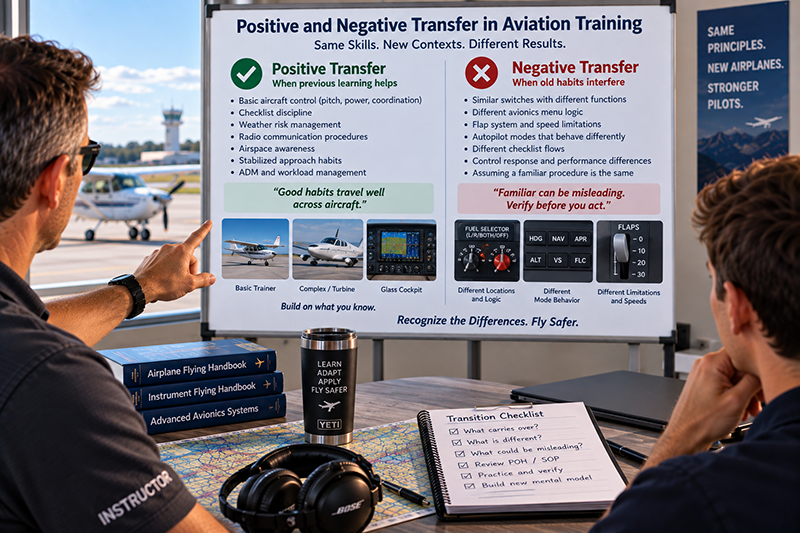
Positive and negative transfer are two of the most important learning concepts in aviation training, especially when pilots move between aircraft, avionics suites, cockpit layouts, automation systems, or operating procedures. A skill that helps in one airplane can make the next airplane easier to learn. That is positive transfer. A habit that worked well in one cockpit but creates confusion, delay, or an incorrect action in another cockpit is negative transfer.
For pilots, this topic is not academic. It shows up during aircraft checkouts, instrument training, avionics transitions, technically advanced aircraft training, tailwheel training, multi-engine training, turbine transitions, and even a simple move from one GPS navigator to another. Understanding transfer of learning helps pilots train more efficiently, avoid overconfidence, and recognize when a familiar habit may no longer be safe or appropriate.
This article explains how positive and negative transfer affect aircraft handling, checklist use, avionics operation, automation management, emergency response, and pilot decision-making. It is written for student pilots, certificated pilots, flight instructors, and aviation professionals who want to make transitions between aircraft and systems safer, more deliberate, and more effective.
What Positive and Negative Transfer Mean in Aviation
Transfer of learning is the way previously learned knowledge, skills, or habits affect new learning or performance. In aviation, pilots rarely learn each aircraft or system in isolation. Every new cockpit is interpreted through the pilot’s previous experience. That experience can be an advantage, but it can also create blind spots.
Positive transfer occurs when an existing skill supports correct performance in a new situation. A pilot who has learned disciplined pitch and power flying in a basic trainer will usually have a useful foundation when moving to instrument flying, complex aircraft, or heavier airplanes. The exact power settings and control pressures will change, but the underlying relationship between attitude, power, configuration, and performance remains valuable.
Negative transfer occurs when an old habit interferes with the correct action in a new environment. This can happen when switches look similar but operate differently, when avionics use different menu logic, when aircraft have different flap limitations, when checklist flows change, or when an autopilot mode behaves differently than expected. The risk is not simply that the pilot lacks knowledge. The risk is that the pilot feels familiar enough to act quickly, but the familiar action is wrong for the new context.
Transfer can affect physical aircraft control, cognitive decision-making, procedural memory, visual scanning, callouts, crew coordination, and automation management. It can be helpful, harmful, or neutral depending on how closely the old and new tasks match.
Why This Matters in Real-World Aviation
Modern aviation training often involves transitions. A student pilot may train in one make and model, rent a different aircraft after certification, and later add an instrument rating using a different avionics package. A private pilot may move from analog instruments to a glass cockpit. A flight instructor may teach in multiple aircraft with different fuel selectors, flap systems, trim locations, autopilot interfaces, and emergency checklist formats. A professional pilot may transition from one aircraft type or avionics philosophy to another under a formal training program.
Each transition creates an opportunity for positive transfer. Good checklist discipline, strong aircraft control, weather risk management, airspace awareness, radio procedures, and stabilized approach habits are broadly useful. They travel well across aircraft. These skills reduce workload because the pilot does not have to rebuild every habit from the beginning.
At the same time, transitions create opportunities for negative transfer. A pilot accustomed to one cockpit may reach for a control that is not there, expect a warning system to behave a certain way, arm an autopilot mode based on a previous interface, or assume a performance response that does not match the new aircraft. In a low-workload training environment, the error may be easy to catch. Under time pressure, turbulence, weather, traffic, or an abnormal situation, the same error can become more consequential.
Negative transfer is especially important because it can hide behind competence. A new pilot often moves cautiously because everything feels unfamiliar. An experienced pilot may move quickly because the task feels familiar. That confidence is valuable when it is matched to correct understanding. It becomes a risk when the pilot has not identified what is different.
How Pilots Should Understand Transfer of Learning
Pilots should think of transfer as a comparison between the old task and the new task. The more similar the tasks are in structure, cues, control response, and desired outcome, the more likely positive transfer becomes. The more similar they look while requiring different actions, the more likely negative transfer becomes.
For example, an attitude instrument scan developed in one airplane can transfer positively to another because the basic need remains the same: control pitch, bank, power, and trim while cross-checking performance. However, if the new airplane has significantly different pitch attitudes for common phases of flight, the pilot must recalibrate expectations. The scanning habit transfers, but the specific visual picture does not transfer perfectly.
The same concept applies to avionics. A pilot who understands flight plan structure, navigation source selection, direct-to navigation, approach loading, approach activation, course guidance, and autopilot coupling has a strong foundation. That understanding can transfer across multiple systems. But button sequences, touchscreen menus, soft keys, mode labels, and failure indications may differ. The concept transfers positively. The muscle memory may transfer negatively.
A useful way to frame the issue is to separate principles from procedures. Principles are the broader ideas that often transfer well. Procedures are the exact steps that may or may not transfer. A pilot who understands that automation must be monitored, verified, and managed retains a valuable principle. A pilot who assumes the same button sequence will always produce the same result may be setting up a negative transfer error.
Positive Transfer Between Aircraft
Positive transfer is one reason flight training works. Pilots build layers of skill. Basic aircraft control supports takeoffs and landings. Takeoff and landing judgment supports crosswind operations. Crosswind awareness supports short-field and soft-field technique. Navigation skills support cross-country operations. Aeronautical decision-making supports every phase of flight.
Many core aviation skills transfer well because they are based on aerodynamic principles and disciplined cockpit behavior. Examples include maintaining coordinated flight, trimming to reduce workload, using outside visual references in visual conditions, making smooth control inputs, managing energy on approach, cross-checking instruments, using checklists, planning fuel and alternates, and recognizing when workload is increasing.
Positive transfer can also occur within aircraft families or similar avionics ecosystems. A pilot moving from one aircraft to another with a similar cockpit philosophy may already understand the location of primary information, the relationship between screens and standby instruments, or the logic of the navigation system. That familiarity can speed learning, provided the pilot still verifies differences.
Instructors can use positive transfer intentionally. During transition training, an instructor might say, “Your stabilized approach habit from the previous airplane is useful here, but the sight picture and power response will be different.” That statement validates the useful skill while preparing the pilot to adjust the details. This is better than treating the transition as completely new or assuming everything carries over unchanged.
Negative Transfer Between Aircraft
Negative transfer becomes a concern when familiar cues lead to inappropriate action. In aircraft transitions, this often involves cockpit layout, configuration changes, aircraft performance, emergency procedures, and operating limitations. Because aircraft differ by make, model, equipment, modifications, and operating procedures, pilots should avoid assuming that a control, system, or limitation is the same as another aircraft they have flown.
One common example is configuration management. A pilot moving between aircraft may be accustomed to a particular flap handle design, flap speed habit, or final approach configuration. If the new aircraft has different flap positions, different extension speeds, different pitch changes, or different drag characteristics, old timing can create an unstable approach or unnecessary workload. The pilot’s general understanding of flap use transfers positively, but the specific habit must be relearned.
Another example is fuel system management. Some training aircraft have simple fuel selector logic. Others require more deliberate tank selection, fuel pump use, crossfeed knowledge, or fuel balance awareness. The broad principle that fuel configuration must be verified transfers well. The exact selector position, timing, and checklist sequence must come from the aircraft’s approved information and the operator’s procedures.
Control feel can also create transfer issues. A pilot accustomed to light control forces may overcontrol a heavier aircraft. A pilot accustomed to heavier control forces may make insufficient inputs in a lighter aircraft. Trim technique, rudder pressure, flare sight picture, and go-around pitch attitude all require recalibration. This does not mean the pilot is starting over. It means previous skill must be adjusted to the new aircraft’s response.
Positive and Negative Transfer in Avionics
Avionics transitions deserve special attention because modern systems can look intuitive while hiding complex mode logic. Moving from round-dial instruments to an integrated flight deck, from one GPS navigator to another, or from one autopilot interface to another requires more than learning where the buttons are. It requires understanding what the system is doing, what it is not doing, and how the pilot will verify the result.
Positive transfer in avionics includes understanding navigation concepts such as waypoint sequencing, desired track, course deviation, vertical guidance, communication frequency management, transponder use, and instrument approach structure. A pilot who already understands the operational meaning of those concepts can learn a new interface more efficiently.
Negative transfer appears when the pilot relies on memorized button pushes without confirming mode status or system output. For example, two avionics systems may both allow a pilot to load an instrument approach, but the method for activating the approach, selecting the transition, managing vectors-to-final, or coupling the autopilot may be different. If the pilot performs the old sequence and assumes the system is configured, the aircraft may not provide the guidance expected.
Mode awareness is central. Pilots should know which lateral and vertical modes are armed, which modes are active, what navigation source is driving the display, and whether the autopilot or flight director is following the intended guidance. The words on the annunciation line matter more than the pilot’s expectation. A new avionics suite should be treated as a new operating environment until the pilot can confidently predict, command, and verify its behavior.
Automation Management and the Transfer Trap
Automation can magnify both positive and negative transfer. A disciplined pilot who monitors automation, verbalizes mode changes, verifies navigation sources, and maintains manual flying proficiency can carry those habits into many cockpits. That is strong positive transfer. A pilot who views automation as a universal black box may be vulnerable to negative transfer when the system behaves differently than expected.
The transfer trap occurs when a pilot says, in effect, “I know how autopilots work,” and stops studying the specific system. In reality, autopilots differ in engagement logic, disconnect behavior, altitude capture, vertical speed operation, navigation coupling, approach mode sequencing, trim requirements, and failure annunciations. Even within the same broad category of avionics, software versions and installations can affect available features and operating details.
Good automation management begins with humility. The pilot should ask: What mode is active? What mode is armed? What is the system using as its navigation source? What altitude, course, speed, or vertical path does the system think I want? What will happen next? How will I know if it does not happen?
Those questions are not only for instrument pilots. VFR pilots using GPS navigation, flight directors, altitude hold, or coupled navigation also need automation awareness. Automation can reduce workload when understood. It can increase workload when the pilot is surprised by it.
Why Instructors Should Teach Transfer Explicitly
Flight instructors play a major role in shaping how pilots handle transfer. Many transition problems are not caused by lack of intelligence or lack of effort. They occur because the pilot is using a previous pattern in a new environment without realizing that the pattern no longer fits.
Instructors can improve training by naming the issue directly. Instead of saying only, “Do it this way,” an instructor can explain, “In your previous airplane, that habit made sense because the switch and system logic were different. In this airplane, the same motion does not produce the same result.” That type of instruction helps the pilot understand the cause of the error rather than simply correcting the symptom.
Instructors should also identify skills that transfer positively. This is important because transition training should not make pilots feel that all previous experience is invalid. A pilot’s scan, checklist discipline, radio phraseology, weather judgment, and stabilized approach mindset may be strong. The training task is to preserve what works, modify what partially works, and replace what does not apply.
A helpful instructional technique is contrast training. The instructor deliberately compares the old and new aircraft or avionics system. The comparison should be specific: control locations, checklist flows, power settings, configuration timing, abnormal procedures, avionics mode selection, and common error traps. The goal is not to overload the pilot with differences. The goal is to direct attention to the differences most likely to affect safety and performance.
Common Mistakes or Misunderstandings
One common misunderstanding is that more experience automatically prevents negative transfer. Experience helps when it brings discipline, pattern recognition, and judgment. It can hurt when it creates assumptions. A high-time pilot transitioning into an unfamiliar cockpit still needs structured training, aircraft-specific study, and deliberate practice.
Another mistake is treating avionics familiarity as aircraft proficiency. A pilot may be very comfortable with a GPS navigator or glass display but still be new to the aircraft’s handling, performance, emergency procedures, and limitations. The reverse is also true. A pilot may handle the airplane well but be behind the aircraft because the avionics workflow is unfamiliar.
Pilots also sometimes confuse checklist flow with checklist completion. A flow can be useful when it follows the cockpit layout and is verified by a checklist. But carrying a flow from one aircraft to another can be risky if the control locations or system logic differ. A memorized motion is not a substitute for aircraft-specific verification.
Another risk is practicing only in calm, low-workload conditions. Negative transfer may not reveal itself until the pilot is distracted. A pilot might operate a new avionics system correctly on the ground or in cruise but struggle when receiving a late runway change, a reroute, a hold, or a revised approach clearance. Training should include realistic workload, but only in a safe and controlled manner appropriate to the pilot’s level and the operating environment.
A final misunderstanding is thinking that negative transfer is a personal failure. It is a normal human learning effect. The right response is not embarrassment. The right response is to identify the interfering habit, understand the difference, and practice the correct behavior until it becomes reliable.
Practical Example: Moving from a Basic Trainer to a Glass Cockpit Aircraft
Consider a private pilot who trained in a conventional instrument-panel trainer and later begins flying a newer aircraft equipped with an integrated glass cockpit and autopilot. The pilot already has many skills that transfer positively. They understand traffic pattern procedures, pitch and power relationships, radio communication, basic navigation, checklist use, and the importance of maintaining aircraft control.
During early transition flights, the pilot notices that the glass cockpit provides more information than the previous panel. Airspeed, altitude, vertical speed, navigation data, engine information, and alerts are all presented in a different visual format. The pilot’s instrument scan transfers, but the scan must be reorganized. The pilot must learn where to find essential information quickly without staring at the display.
The autopilot introduces another transfer issue. In the previous aircraft, the pilot may have used a simple wing-leveler or no autopilot at all. In the new aircraft, the autopilot can follow navigation guidance, hold altitude, capture selected altitudes, or provide vertical modes depending on installation and configuration. The pilot learns that pressing a button is only half the task. The other half is confirming the active and armed modes, verifying the navigation source, and staying ready to hand-fly.
On one training flight, the pilot loads a practice instrument approach for situational awareness during a VFR flight with an instructor. The pilot expects the system to sequence exactly like a different navigator they used in a simulator. It does not. The displayed course and autopilot mode do not match what the pilot expected. Because the instructor has emphasized mode verification, the pilot catches the mismatch before it becomes a problem. The event becomes a useful lesson in negative transfer: the concept of approach loading transferred positively, but the button sequence and assumptions did not.
By the end of transition training, the pilot is not simply “checked out” in the new airplane. The pilot has learned which old habits remain useful, which habits need adjustment, and which avionics actions must be verified every time. That is the practical goal of understanding transfer.
Best Practices for Pilots
Pilots can manage transfer of learning by approaching every transition with structured curiosity. The question is not, “Is this like what I flew before?” The better question is, “Which parts are the same, which parts are different, and which differences matter most when workload is high?”
Before flying a new aircraft or avionics system, study the aircraft-specific information, cockpit layout, normal procedures, abnormal procedures, and limitations that apply to that aircraft. Use an instructor or qualified mentor when appropriate. Chair-fly the cockpit flows, but do not let chair-flying become rote button pushing without understanding.
During training, verbalize important differences. Saying them aloud can help interrupt old habits. For example, a pilot might brief the location and operation of the fuel selector, flap control, trim system, autopilot disconnect, go-around procedure, and avionics source selection before flight. The point is not to recite trivia. The point is to make the critical differences mentally available before they are needed.
Use slow, deliberate practice at first. Speed should come after accuracy. In aviation, a fast wrong action can be worse than a slightly slower correct one. This is especially true for avionics, where incorrect mode selection can remain hidden until the aircraft does something unexpected.
Several habits are especially valuable during aircraft and avionics transitions:
- Separate aerodynamic principles from aircraft-specific procedures.
- Verify cockpit controls visually before moving them, especially in unfamiliar aircraft.
- Confirm avionics mode annunciations instead of relying on memory of button sequences.
- Use the approved checklist and aircraft-specific procedures rather than a habit from another cockpit.
- Practice manual flying and automation use so neither skill is neglected.
- Debrief errors as transfer issues when old habits interfere with new procedures.
For instructors, the best practice is to build transfer awareness into the lesson plan. Ask the pilot what they have flown before, what avionics they know, and what procedures feel automatic. Then identify which of those habits will help and which require caution. This makes transition training more efficient and more honest.
How to Debrief Transfer Errors
A transfer-related error should be debriefed in a way that improves future performance. The debrief should identify the previous habit, the new requirement, the cue that triggered the old response, and the practice needed to replace it. This is more useful than simply saying, “Don’t do that again.”
For example, if a pilot reaches for the wrong switch during an after-landing flow, the instructor can ask what aircraft or habit that motion came from. If the pilot identifies the source, the instructor can help create a new cockpit-specific cue. The pilot might slow down the flow, touch each control only after naming it, or use the checklist more deliberately until the new pattern is stable.
When the issue involves avionics, the debrief should focus on system state. What did the pilot expect? What did the display show? Which annunciation or navigation indication confirmed the actual state? What should the pilot look for next time? This reinforces the idea that avionics operation is not complete until the result is verified.
Good debriefing also preserves confidence. The message should be: your previous experience is useful, but it must be sorted. Keep the transferable skills. Update the aircraft-specific habits. Verify the high-risk items. That approach develops safer and more adaptable pilots.
Frequently Asked Questions
What is positive transfer in flight training?
Positive transfer occurs when a skill or concept learned in one aviation setting improves performance in another. For example, a disciplined instrument scan, good checklist habits, and understanding pitch and power relationships can help a pilot transition to a different aircraft or avionics system.
What is negative transfer in aviation?
Negative transfer occurs when a previous habit interferes with correct performance in a new aircraft, cockpit, procedure, or avionics system. It can happen when a pilot assumes that a switch, checklist flow, autopilot mode, or aircraft response is the same as one they have used before.
Why is negative transfer common during avionics transitions?
Avionics systems often share similar concepts but use different menus, buttons, mode logic, and annunciations. A pilot may understand the navigation concept but still make an error if they rely on a memorized sequence from another system without verifying the result.
How can pilots reduce negative transfer when changing aircraft?
Pilots can reduce negative transfer by studying aircraft-specific procedures, receiving appropriate transition training, using checklists carefully, verbalizing key differences, practicing deliberately, and confirming system status before relying on memory or habit.
Should experienced pilots worry about transfer errors?
Yes. Experience can provide valuable positive transfer, but it can also create strong habits that do not fit a new cockpit. Experienced pilots should be especially alert to assumptions during aircraft, avionics, and automation transitions.
How should flight instructors teach transfer of learning?
Instructors should identify what the pilot already knows, explain which skills transfer well, and point out specific areas where old habits may conflict with the new aircraft or system. Comparing the old and new environments helps pilots adapt more safely.
Key Takeaways
- Positive transfer helps pilots carry useful skills such as aircraft control, checklist discipline, scan technique, and decision-making into new aircraft and avionics environments.
- Negative transfer occurs when a familiar habit produces the wrong action in a different cockpit, especially under workload, time pressure, or automation complexity.
- Safe transition training should preserve what works, identify what changes, and require pilots to verify aircraft-specific procedures, limitations, and avionics modes.