
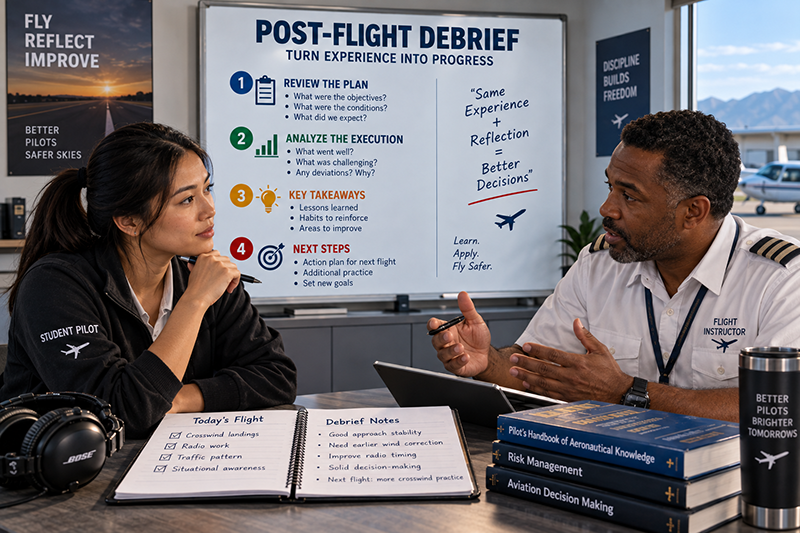
A post-flight debrief is one of the most valuable learning tools in aviation because it turns a completed flight into usable pilot judgment. The airplane may be parked, the engine may be shut down, and the logbook may be ready for an entry, but the learning is not finished until the pilot has made sense of what happened. For student pilots, a good debrief connects the lesson objective to actual performance. For certificated pilots, it sharpens decision-making, reveals habit patterns, and keeps routine flights from becoming mindless repetitions.
A meaningful debrief is not a lecture, a fault-finding session, or a casual comment such as, “That landing was fine.” It is a disciplined conversation about planning, execution, aeronautical decision-making, aircraft control, communication, risk management, and next steps. When conducted well, it helps pilots preserve what worked, correct what did not, and build a more accurate mental picture for the next flight. This article explains how pilots and instructors can conduct post-flight debriefs that are practical, professional, and genuinely useful.
What Makes a Post-Flight Debrief Meaningful?
A meaningful post-flight debrief does more than review events in chronological order. It connects three things: the objective of the flight, the decisions made during the flight, and the lessons that should influence future performance. The goal is not simply to remember what happened. The goal is to understand why it happened and what should change because of it.
In flight training, this means comparing the intended lesson outcomes with the actual results. If the objective was to improve crosswind landings, the debrief should not drift into an unfocused discussion of every small imperfection. It should focus on the pilot’s crosswind correction, approach stability, control inputs, touchdown alignment, go-around judgment, and awareness of changing wind conditions. Other issues may be noted, but the debrief should not lose sight of the lesson purpose.
For an experienced pilot, the objective may be self-defined. A personal flight might include goals such as smoother radio work in busy airspace, better fuel planning discipline, more precise altitude control, or improved weather decision-making. The debrief then becomes a professional self-review. It asks, “Did I operate the aircraft the way I intended to operate it?” and “What did this flight reveal about my habits?”
A strong debrief also separates observable facts from interpretation. “The airplane drifted left of centerline during the flare” is an observation. “You are bad at crosswind landings” is a judgment and not a useful training statement. The first statement gives the pilot something specific to analyze. The second can create defensiveness and reduce learning. The best instructors and safety-minded pilots describe what happened in a way that invites accurate correction.
Timing matters as well. A debrief should occur while the flight is still fresh, but not while the pilot is rushed, distracted, overheated, or still mentally saturated. A short pause after shutdown can help. Secure the aircraft, complete any required post-flight actions, collect notes or data if available, and then begin the debrief in a calm setting where the pilot can think clearly.
Why This Matters in Real-World Aviation
Aviation skill is built through repeated experience, but experience alone is not enough. A pilot can repeat the same weak habit for years if no one helps identify it and if the pilot never reflects on it honestly. A post-flight debrief closes the loop between action and learning. It helps convert flight time into improved judgment.
Real-world flying includes changing weather, aircraft performance considerations, traffic, runway conditions, workload, fatigue, passenger expectations, and operational pressure. Many of the most important lessons from a flight are not limited to stick-and-rudder performance. They involve how the pilot managed information, prioritized tasks, communicated, and adapted when conditions differed from the plan.
For example, a pilot may fly a technically acceptable approach but become so focused on correcting airspeed that radio calls, traffic awareness, and runway environment monitoring become secondary. A simple landing grade would miss the deeper issue. A good debrief would ask how the workload developed, what cues the pilot noticed late, and what could be done earlier on the next approach to prevent task saturation.
Post-flight debriefing also supports safety culture. Instructors, flight schools, flying clubs, and aviation departments benefit when pilots can discuss errors without shame and without minimizing them. A safe learning environment does not excuse poor performance. It makes improvement possible by treating errors as information. When pilots learn to examine small deviations honestly, they are more likely to catch bigger risk patterns before they become serious operational problems.
In multi-pilot, instructional, and crew environments, the debrief also improves communication. It gives each participant a chance to compare perceptions. One pilot may have believed the approach was stabilized; another may have noticed that the aircraft configuration, descent rate, or runway alignment required more attention than expected. Discussing those differences develops shared understanding and better crew coordination.
How Pilots Should Understand the Debrief Process
The best way to understand a post-flight debrief is to see it as a guided learning conversation. It has structure, but it should not feel like an interrogation. A pilot should leave the debrief knowing what went well, what needs attention, why it matters, and what to do next.
A useful starting point is the flight objective. Before discussing individual maneuvers or decisions, identify the purpose of the flight. Was it a primary training lesson, a proficiency flight, a cross-country operation, a checkride preparation session, an instrument practice flight, a checkout, or a personal proficiency review? The purpose determines what evidence matters most.
Next, reconstruct the flight briefly. This does not require replaying every minute. Focus on decision points, workload peaks, and moments where performance either met expectations or drifted away from them. For a training flight, that might include the preflight planning, taxi and run-up habits, takeoff, climb, maneuver setup, traffic pattern entry, approach, landing, and post-landing actions. For an instrument practice flight, it might include briefing quality, avionics setup, clearance understanding, scan discipline, altitude control, approach management, missed approach readiness, and workload management.
After the reconstruction, evaluate performance against a useful standard. In training, the standard may be the lesson objective, the school’s syllabus, instructor expectations, or the proficiency level appropriate to the pilot’s stage of training. In personal flying, the standard may be the pilot’s own operating expectations, aircraft operating procedures, risk management habits, and conservative decision-making criteria. The point is to avoid vague impressions. “Pretty good” is not a learning standard. “Maintained altitude within a reasonable training tolerance during the steep turn but lost scan discipline during the rollout” is far more useful.
A good debrief also balances strengths and corrections. Pilots need to know what to repeat, not just what to fix. If a student made a smart go-around decision, verbalized wind correction clearly, or briefed an emergency procedure effectively, that behavior should be identified and reinforced. Positive reinforcement is not praise for its own sake. It tells the pilot, “This is the type of thinking and performance you should carry forward.”
The correction phase should be specific and actionable. Instead of saying, “Work on landings,” identify the actual issue. Was the problem airspeed control, aiming point discipline, runway alignment, flare timing, overcontrolling, crosswind correction, sight picture, or go-around hesitation? Each problem has a different training solution. Meaningful debriefing avoids broad labels and points toward the next practical action.
Finally, the debrief should end with a plan. The next flight should not begin with a vague hope that things will improve. It should begin with a clear training focus, such as improving stabilized approach discipline, practicing better trim use, verbalizing missed approach instructions earlier, reviewing short-field landing technique, or conducting a weather decision-making exercise before departure. The plan is where the debrief becomes future performance.
The Instructor’s Role in a Productive Debrief
For flight instructors, the post-flight debrief is an instructional skill equal in importance to in-flight demonstration and coaching. Many students can remember what an instructor says immediately after an error, but they often learn more deeply when the instructor helps them analyze the situation after the flight.
A strong instructor does not dominate the entire discussion. The instructor guides the student toward accurate self-assessment. Asking, “How did that last approach compare with the one before it?” can reveal whether the student is developing perception. Asking, “What did you notice about your airspeed on short final?” encourages the student to connect instrument indications, outside visual cues, and aircraft feel. This is more effective than simply announcing the answer.
However, self-assessment should not become guesswork. If a student did not recognize a deviation, the instructor should state it clearly and professionally. The key is to combine student reflection with instructor expertise. The instructor can say, “You felt that approach was stable because the runway picture looked comfortable, but our airspeed was trending high and the descent rate increased late. Let’s talk about the cues that would help you catch that earlier.”
Instructors should also manage emotional tone. Students often judge themselves harshly after a difficult flight. Others may minimize errors because they do not yet understand their significance. The instructor’s job is to keep the debrief accurate, calm, and forward-looking. A flight can be disappointing without being wasted. In fact, difficult flights often produce the best learning when the debrief is handled well.
Documentation can support the process when used thoughtfully. Lesson notes, maneuver grades, cockpit observations, and agreed-upon next steps can help maintain continuity between flights. The written record should reflect useful training information, not just a collection of generic comments. If a school or instructor uses a specific syllabus or recordkeeping system, the debrief should align with that system while still preserving meaningful conversation.
The Pilot’s Role in Self-Debriefing
Not every flight includes an instructor. Private pilots, instrument-rated pilots, commercial pilots, and aircraft owners need a practical method for self-debriefing. The habit does not need to be complicated. It only needs to be honest and consistent.
A useful self-debrief starts with three questions: What did I plan? What actually happened? What will I do differently next time? These questions apply to almost every type of flight. On a short local flight, the answers may take two minutes. On a challenging cross-country, they may deserve a longer review.
Self-debriefing is especially valuable after flights that feel routine. Routine can hide weak habits. A pilot may consistently accept rushed preflight planning, imprecise fuel calculations, late configuration changes, casual checklist usage, or unstable traffic pattern habits simply because the flights have ended safely. A debrief is a chance to identify whether the safe outcome was the result of good technique or good fortune.
Modern tools can help, but they should not replace judgment. GPS tracks, avionics data, tablet logs, and video recordings can reveal altitude deviations, ground track, airspeed trends, or procedural timing. These tools can be excellent learning aids when used carefully. They can also distract pilots into analyzing the wrong thing. A perfect ground track does not prove good decision-making. A slightly imperfect maneuver may still represent excellent risk management if the pilot recognized a problem and corrected it promptly.
For personal flying, it is wise to keep a small record of recurring themes. If three recent flights all included rushed descent planning, that is a trend worth addressing. If radio communication becomes weaker in busy terminal areas, that may point to workload management. If crosswind correction deteriorates when landing at unfamiliar airports, that suggests a specific proficiency item. A self-debrief becomes powerful when it reveals patterns across multiple flights.
Common Mistakes and Misunderstandings
One common mistake is treating the debrief as a grade instead of a learning process. Grades and endorsements may matter in training programs, but the debrief itself should be more than a pass-or-fail statement. If the only message is “acceptable” or “not acceptable,” the pilot may not understand what produced the result.
Another mistake is focusing only on the landing. Landings are memorable because they happen at the end of the flight and are easy to judge visually, but they are not the whole flight. A firm landing after excellent planning, safe decision-making, and a stable approach may be less concerning than a smooth touchdown that followed a rushed, unstable, or poorly managed approach. The debrief should examine the complete chain of events, not just the final impression.
A third misunderstanding is assuming that more talking equals better debriefing. Long debriefs can become unfocused. The most effective debriefs are often concise but precise. They identify the highest-value learning points and make sure the pilot understands them. If everything is treated as equally important, the pilot may remember nothing clearly.
Some pilots also make the mistake of defending every action. Aviation confidence is valuable, but defensiveness blocks learning. A professional pilot can explain the reasoning behind a decision while still being open to critique. The question is not, “Can I justify what I did?” The better question is, “Was there a safer, more efficient, or more disciplined way to manage that situation?”
Instructors can make mistakes too. A debrief that is sarcastic, vague, rushed, or overly negative can damage learning. So can a debrief that avoids necessary correction because the instructor wants to be encouraging. The right balance is honest and respectful. Pilots deserve accurate feedback delivered in a way that helps them improve.
Another safety risk is failing to debrief near-misses, surprises, or moments of confusion. If the pilot was uncertain about a clearance, misread an airport layout, lost situational awareness briefly, or felt behind the aircraft, that deserves discussion even if no violation, incident, or damage occurred. The debrief is the best time to examine why the margin narrowed and how to restore margin earlier next time.
Practical Example: Debriefing a Crosswind Landing Lesson
Consider a student pilot and instructor returning from a local training flight focused on crosswind takeoffs and landings. The winds were within the instructor’s comfort level for the lesson, but they varied enough to create a realistic challenge. The student completed several patterns. Two approaches were reasonably stable, one required a go-around, and the final landing touched down slightly side-loaded before the student corrected with rudder and aileron.
A weak debrief would sound like this: “Your landings need work. Keep practicing crosswinds.” That statement may be true, but it does not teach much. The student leaves with a general feeling of failure and no clear plan.
A meaningful debrief would begin with the objective: controlling drift and maintaining runway alignment in a crosswind. The instructor might ask the student which approach felt best and why. The student may say the second approach felt best because the airplane was lined up earlier and the airspeed was more stable. The instructor can then reinforce that observation and connect it to earlier rudder and aileron inputs.
Next, the instructor can review the go-around. Instead of treating it as a failed landing, the debrief can frame it as a good decision if the aircraft was not positioned for a safe touchdown. The instructor might discuss the cues that indicated the approach was deteriorating, such as increasing drift, late alignment correction, or excessive workload in the flare. The lesson becomes not only crosswind control, but also judgment about when to discontinue an approach.
For the final landing, the instructor can describe the side-load risk in practical terms. The issue is not simply that the touchdown looked imperfect. The issue is that touching down without proper alignment can place unnecessary stress on the landing gear and reduce directional control margin. The correction is specific: maintain crosswind aileron input, use rudder to align the longitudinal axis with the runway, and be willing to go around if the correction is not stabilized in time.
The debrief ends with a next-step plan. Before the next flight, the student will review crosswind control principles and chair-fly the transition from final approach to flare. During the next lesson, the instructor will emphasize earlier drift correction, verbal callouts of wind correction, and go-around decision points. The student now has a clear path forward, not just a vague instruction to improve.
Best Practices for Pilots
A strong post-flight debrief is built on a few practical habits. These habits apply whether the flight involved a student and instructor, two experienced pilots, or a pilot conducting a personal self-review.
- Start with the objective. Identify what the flight was intended to accomplish before judging performance.
- Use specific observations. Discuss airspeed trends, altitude control, checklist discipline, communication, aircraft configuration, risk decisions, and workload instead of vague impressions.
- Discuss decisions, not only maneuvers. Include weather choices, fuel planning, traffic awareness, diversion thinking, go-around decisions, and personal minimums when relevant.
- Reinforce what worked. Pilots need to know which habits should be repeated, not only which errors should be corrected.
- Identify the next action. End with a practical plan for study, chair flying, simulator work, maneuver practice, or operational improvement.
One of the most useful best practices is to debrief the flight in phases. Begin with preflight planning, then move through ground operations, departure, enroute or maneuver work, arrival, landing, and post-flight actions. This keeps the discussion organized without turning it into a mechanical checklist. It also helps reveal where a later problem actually began. A rushed arrival may have started with late descent planning. A poor traffic pattern may have started with incomplete airport familiarization. A high-workload instrument approach may have started with incomplete avionics setup before the initial approach fix.
Another effective technique is the “two strengths, two improvements” method. The numbers are not sacred, but the concept is helpful. Identify a small number of strengths and a small number of improvements. This prevents the debrief from becoming either empty praise or an overwhelming list of faults. The highest-value lessons should receive the most attention.
Pilots should also debrief their workload. Workload management is often where good flights and weak flights separate. Ask when the pilot felt ahead of the aircraft and when the pilot felt behind. Discuss what created the workload. Was it late checklist use, unclear navigation setup, radio congestion, unexpected traffic, weather changes, or uncertainty about airport layout? Then identify what could have been done earlier.
For instructors, one of the best practices is to ask before telling when appropriate. A student who can accurately diagnose a deviation is developing judgment. But the instructor must still correct misunderstanding. If the student’s self-assessment is inaccurate, the instructor should refine it with clear explanation and practical examples.
For all pilots, the best debriefing habit is consistency. A two-minute reflection after every flight is more valuable than a long debrief only after a bad flight. Consistent debriefing normalizes learning. It sends the message that every flight contains useful information.
Using Questions That Improve Pilot Judgment
The quality of a debrief often depends on the quality of the questions. Good questions direct attention toward judgment, perception, and cause-and-effect relationships. They help the pilot connect actions with outcomes.
Useful debrief questions include: What was the most important decision on this flight? When did workload increase? What cue did you notice first? What cue did you miss? What would have made the approach more stable? What information did you wish you had earlier? Did the aircraft ever get ahead of your plan? Did you ever continue with a plan mainly because it was already in motion?
These questions are valuable because they move beyond surface performance. A pilot who understands why a problem developed is better prepared to prevent it. A pilot who only knows that something went wrong may simply hope to do better next time.
Questions should be adapted to the pilot’s experience level. A new student may need concrete questions about sight picture, pitch attitude, checklist use, and control coordination. An instrument student may need questions about scan, briefing, automation management, and missed approach planning. An experienced pilot may benefit from questions about risk tolerance, personal minimums, passenger pressure, fatigue, or complacency.
Debriefing Technology, Data, and Cockpit Recordings
Many pilots now have access to flight data that previous generations did not. GPS tracks, tablet applications, avionics logs, engine monitors, action cameras, and simulator playback tools can all support post-flight review. Used properly, these tools can make a debrief more objective.
Data can reveal trends that the pilot did not notice in real time. A pattern altitude may have gradually crept high. A final approach may have become unstable earlier than remembered. A taxi route may show confusion at a complex airport. Engine monitor data may support a discussion about leaning technique or engine management, provided the pilot understands the equipment and aircraft guidance that applies.
However, data should be interpreted carefully. A flight track is not the entire story. It may show what happened, but it may not show why the pilot made a decision, what traffic or weather was present, or what instruction was being given at the time. Video can be helpful, but it can also make pilots focus on appearance rather than learning. The goal is not to create a courtroom record. The goal is to improve future performance.
When using technology in a training environment, pilots and instructors should respect privacy, school policy, aircraft owner preferences, and any applicable operational rules. The debrief should remain professional and focused on learning.
How to End a Debrief Well
The final minutes of a debrief are important because they shape what the pilot remembers. A good ending summarizes the main learning points, confirms the next step, and leaves the pilot with a realistic sense of progress.
The summary should be short and specific. For example: “Today’s strongest improvement was your earlier recognition of drift on final. The main item for next time is maintaining rudder alignment through touchdown instead of relaxing it in the flare. We will brief crosswind correction again and plan more repetitions if the conditions are appropriate.” That is far more useful than, “Good job, we’ll keep working on it.”
The next step should be manageable. Assigning too many corrections at once can dilute learning. If the flight revealed several issues, prioritize the one or two that affect safety, learning progression, or operational discipline most directly. Additional items can be noted for later.
The debrief should also preserve motivation. This does not mean pretending the flight was better than it was. It means showing the pilot that improvement is possible and that the path is clear. Aviation training is demanding. Pilots are more likely to improve when feedback is honest, specific, and connected to action.
Frequently Asked Questions
How long should a post-flight debrief take?
The length depends on the flight. A routine proficiency flight may need only a few focused minutes, while a complex training lesson or challenging cross-country may justify a longer discussion. The debrief should be long enough to identify meaningful lessons and short enough to remain focused.
Should every flight include a debrief?
Yes, at least informally. Even experienced pilots benefit from a brief review of what went well, what could be improved, and what should be remembered for the next flight. The habit is more important than the length.
What should a student pilot do if the debrief feels vague?
The student should ask for specific examples and next steps. Good questions include, “What cue should I have noticed earlier?” “What should I practice before the next lesson?” and “Which item is most important for safety or progress?”
Can pilots debrief without an instructor?
Yes. Self-debriefing is an important habit for certificated pilots. Reviewing the plan, actual performance, decision points, workload, and recurring trends can improve proficiency and reduce complacency.
Should the debrief focus more on mistakes or strengths?
It should include both. Mistakes identify what must change, while strengths identify what should be repeated. A debrief that ignores strengths may miss valuable habits, and a debrief that avoids mistakes may fail to improve safety.
Is flight data useful in a post-flight debrief?
Flight data can be very useful when interpreted in context. Tracks, altitude profiles, and cockpit recordings may reveal trends, but they should support judgment rather than replace it. The most important question remains what the pilot learned and how future performance will improve.
Key Takeaways
- A meaningful post-flight debrief connects the flight objective, actual performance, pilot decisions, and a clear plan for improvement.
- The most valuable debriefs examine workload, judgment, aircraft control, communication, and risk management, not just the landing.
- Pilots and instructors should use specific observations, honest self-assessment, and practical next steps to turn each flight into better future performance.