
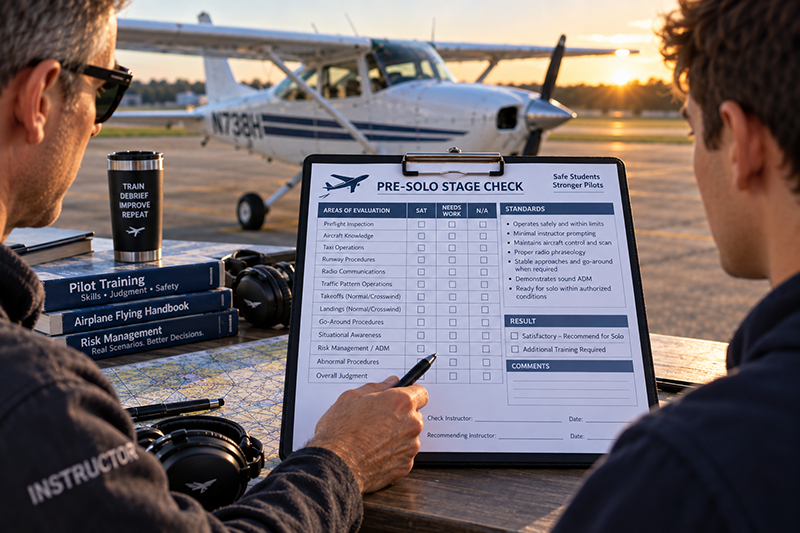
Pre-solo stage checks are one of the most important quality-control points in primary flight training. A student pilot may be able to take off, fly a traffic pattern, and land with the instructor onboard, but solo readiness requires more than repeating a maneuver successfully on a calm day. An independent review should measure whether the student can recognize problems early, manage normal workload, make conservative decisions, communicate clearly, and fly the aircraft within safe margins without being coached through each step.
For flight schools, instructors, and student pilots, the pre-solo review is not just a formality before an endorsement. It is a structured opportunity to identify gaps while there is still time to correct them. A well-designed stage check protects the student, supports the recommending instructor, and strengthens the training program. A poorly designed one can create false confidence by treating solo readiness as a checklist of maneuvers rather than a complete assessment of judgment, aircraft control, traffic pattern discipline, and risk management.
What a Pre-Solo Stage Check Is Really For
A pre-solo stage check is an independent training review conducted before a student pilot is authorized to fly alone. The term may mean different things depending on the school, training program, aircraft category, and local procedures. In some environments it is a formal stage check with a chief instructor, assistant chief instructor, or check instructor. In others it may be an informal second-instructor review. Regardless of the format, the purpose should be the same: determine whether the student is prepared to operate safely as the sole occupant of the aircraft within the limits established by the instructor and training organization.
The word independent matters. The recommending instructor has spent many hours with the student and understands the student’s progress, habits, and weak areas. That familiarity is valuable, but it can also make it easier to overlook patterns that have become normal in daily training. A fresh instructor can observe how the student performs without the usual rhythm, prompts, and expectations that develop between a student and a primary instructor.
An effective review does not try to replace the primary instructor’s judgment. Instead, it adds a second professional perspective. The stage check should confirm that the student has the required foundation, expose any hidden dependence on instructor coaching, and provide practical feedback to both the student and the recommending instructor. When done well, it becomes a training tool rather than a gatekeeping ritual.
The review should answer a simple but demanding question: if the instructor stepped out of the airplane today, would this student have the skill, awareness, and judgment to complete the planned solo safely under approved conditions? That question includes more than landing ability. It includes preflight preparation, airspace awareness, radio communication, taxi discipline, runway selection, traffic pattern spacing, go-around judgment, abnormal-situation response, and the ability to say no when conditions are not right.
Why This Matters in Real-World Aviation
The first solo is a milestone, but it is also the first time a student pilot must manage the complete flight task without an instructor acting as a safety net. Even when the flight is local and limited to the traffic pattern, the student is responsible for aircraft control, configuration, collision avoidance, radio work, checklist usage, wind correction, runway alignment, and decision-making. That is a meaningful workload shift.
In dual instruction, students sometimes perform well because the instructor is silently shaping the flight. The instructor may choose the runway, prompt the radio call, point out traffic, remind the student to correct for crosswind, or ask a timely question that leads to a go-around. The student may not realize how much structure is being provided. A stage check is valuable because it can reveal whether the student is truly managing the flight or simply responding to cues.
Real-world aviation rarely fails in neat categories. A student does not usually struggle because one isolated skill is missing. Problems often combine. A slightly high approach leads to a late power reduction. A late radio call distracts from airspeed control. A gust changes the sight picture. Another aircraft extends downwind. The student becomes task saturated and continues an approach that should have been discontinued. A pre-solo review should look for the ability to manage these combinations, not just the ability to demonstrate a maneuver when nothing else is happening.
This is also why the independent reviewer should pay attention to trends. One slightly late checklist item may not be a major concern. Repeated checklist drift during high workload may indicate that the student does not yet have a reliable cockpit flow. One firm landing may be a teaching point. A pattern of unstable approaches followed by attempts to salvage the landing may be a solo-readiness problem. The check instructor’s job is to separate normal student variation from risk-significant behavior.
What an Independent Review Should Actually Measure
A useful pre-solo stage check should measure three broad areas: technical aircraft control, operational management, and aeronautical decision-making. These areas overlap constantly in flight. A student who can hold altitude but cannot maintain situational awareness in the pattern is not ready. A student who can explain a go-around but hesitates to initiate one when the approach becomes unstable is not ready. A student who lands well only after repeated instructor reminders has not yet demonstrated independent control.
Technical aircraft control includes the expected pre-solo skills: normal takeoffs, climbs, level flight, turns, descents, traffic pattern operations, approaches, landings, and go-arounds. Depending on the aircraft and training syllabus, the review may also include emergency procedures, slow flight concepts, stall recognition and recovery, ground reference maneuvers, or other tasks that support safe solo operations. The point is not to create a miniature practical test. The point is to verify that the student can control the aircraft predictably and safely in the environment where solo flight will occur.
Operational management includes all the tasks that surround aircraft control. The student should be able to complete a preflight inspection appropriate to their training level, brief the intended flight, use checklists correctly, understand local airport procedures, comply with assigned taxi routes and hold-short instructions, make appropriate radio calls, manage aircraft configuration, and maintain awareness of wind, traffic, runway status, and airport surface movement. These are not secondary skills. They are part of flying the aircraft.
Aeronautical decision-making is the area most likely to be under-measured. The independent reviewer should look for whether the student can identify when conditions exceed the planned solo limitations, when spacing is poor, when an approach is unstable, when a radio instruction is unclear, or when a go-around is the safer option. At the pre-solo level, the student is not expected to think like a seasoned airline captain, but the student must show conservative, timely, and understandable decisions within the scope of the operation.
The reviewer should also measure independence. Independence does not mean the student never asks a question or never makes a small correction. It means the student is not dependent on instructor prompting for critical actions. A student ready for solo should not need to be reminded to maintain directional control during takeoff roll, correct for wind on final, clear the approach path before turning base, or initiate a go-around when the landing cannot be completed safely.
How Pilots Should Understand This Topic
Student pilots often think of the pre-solo stage check as a pass-fail event. That mindset is understandable, but it is not the most useful way to view it. The review is better understood as a safety calibration. It compares the student’s current performance against the level of consistency and judgment needed for limited solo flight. If the result is additional training, that is not a failure. It is the system working as intended.
Instructors should explain the purpose early. A student who knows the stage check is coming may be tempted to rehearse specific maneuvers without understanding the broader standard. Instead, the primary instructor should teach the student to manage complete flights. That means asking the student to verbalize plans, notice deviations, choose corrections, and evaluate whether an approach should continue. The more the instructor gradually removes prompts during dual lessons, the more meaningful the stage check becomes.
Check instructors should resist turning the review into a surprise exam. The student should understand the general scope, local expectations, and aircraft or weather limitations. The reviewer can still observe independent performance without creating unnecessary stress. In aviation training, realism and fairness are not opposites. A fair review can be demanding, and a demanding review can still be supportive.
For school leaders, pre-solo stage checks can reveal training-system issues. If many students arrive with weak radio technique, inconsistent checklist use, or poor go-around judgment, the problem may not be individual students. It may be lesson sequencing, instructor standardization, local operating procedures, or unclear expectations. Stage check results should feed back into instructor meetings and syllabus improvements.
The Difference Between Maneuver Proficiency and Solo Readiness
Maneuver proficiency is necessary, but it is not the whole measure. A student may demonstrate a normal landing within acceptable parameters during one circuit and still not be ready for solo if the approach required repeated coaching. Similarly, a student may recover from a simulated abnormal situation in the practice area but freeze when a spacing problem develops in the traffic pattern. Solo readiness depends on performance in context.
Consider airspeed control. On a training flight, an instructor may say, raise the nose slightly, add a little power, or watch your speed on final. The student responds and the maneuver looks acceptable. During solo, there is no such prompt. The student must notice the trend, understand why it matters, and correct it. The stage check should therefore look for trend recognition, not just final outcomes.
The same principle applies to landings. A safe solo student does not need every landing to be perfect. No pilot meets that standard. But the student does need stable approach habits, runway alignment discipline, the ability to transition to landing without excessive drift or side load, and the judgment to go around when the landing is not developing safely. The go-around is not an admission of failure. At the pre-solo stage, it is one of the strongest indicators of sound judgment.
Another important distinction is between memorized knowledge and usable knowledge. A student may recite local pattern altitude, runway numbers, traffic pattern direction, or basic aircraft speeds. The reviewer should determine whether the student can apply that information while taxiing, flying, communicating, and making decisions. Knowledge that cannot be used under normal cockpit workload is not yet operational knowledge.
Elements a Strong Pre-Solo Review Should Include
Although every training organization should tailor its process to its aircraft, airport, syllabus, and regulatory environment, several elements belong in most pre-solo stage checks. The review should begin before engine start. The student should brief the intended flight, discuss weather and winds, confirm the planned runway and pattern, identify any limitations set by the instructor or school, and describe what would cause the flight to be delayed, changed, or discontinued.
The preflight portion should show that the student has developed disciplined habits. The reviewer is not looking for a mechanic-level inspection. The reviewer is looking for methodical aircraft handling, checklist use, fuel and oil awareness appropriate to the aircraft, control-surface checks, tire and brake awareness, document and equipment awareness as taught by the school, and the willingness to stop when something does not look right. A student who rushes preflight because the stage check feels stressful is demonstrating a risk-management issue worth addressing.
Taxi and run-up are equally important. Many training risks begin before takeoff. The student should maintain directional control, manage speed, avoid distractions, comply with airport signs and markings, use checklists at appropriate times, and demonstrate clear radio or non-towered communication habits. If the student is operating at a towered airport, readback discipline and hold-short awareness matter. If the student is operating at a non-towered airport, traffic awareness and position reporting become especially important.
In the air, the review should include enough normal flight to observe control coordination, altitude and heading management, trim use, visual scanning, and workload management. The traffic pattern should receive significant attention because many first solos are limited to pattern work. The reviewer should evaluate entries, spacing, wind correction, configuration timing, checklist discipline, stabilized approach habits, landing judgment, runway alignment, and go-around decisions.
The review should also include discussion of abnormal and emergency thinking. Whether simulated in flight, discussed on the ground, or practiced according to the school’s procedures, the student should be able to explain immediate priorities: maintain aircraft control, choose a safe course of action, communicate when appropriate, and use checklists when time permits. The student should understand that an abnormal situation during solo may require landing, going around, returning to the airport, or discontinuing the flight depending on the circumstances and training received.
What Should Not Be Overweighted
A pre-solo stage check can lose value when it overweights the wrong things. One common example is treating the smoothness of a landing as the primary measure. A smooth touchdown is satisfying, but it is not the best single predictor of solo readiness. A slightly firm landing following a stable approach and good runway alignment may be less concerning than a soft landing salvaged from a low, drifting, unstable approach.
Another mistake is overemphasizing trivia. Aircraft systems knowledge and local procedures matter, but the review should focus on knowledge that supports safe operation. A student should understand the practical meaning of engine indications, fuel selection procedures if applicable, flap operation, electrical limitations at a basic level, and the consequences of abnormal indications. The goal is not to impress the reviewer with memorized detail. The goal is to ensure the student can operate the aircraft intelligently and recognize when something is wrong.
Reviewers should also be careful about introducing complexity that is not appropriate to the student’s training stage. The pre-solo check is not a private pilot practical test, instrument proficiency check, or advanced emergency drill. It should be challenging enough to reveal independence, but not so broad that it measures tasks the student has not been trained to perform. Fairness matters because unfair checks produce anxiety rather than useful safety information.
Common Mistakes or Misunderstandings
One misunderstanding is that a stage check is primarily about protecting the school from liability. Safety and documentation are important, but a review designed only for paperwork will miss the deeper training value. The best stage checks improve the student’s readiness and give instructors better information.
Another common mistake is allowing the primary instructor to over-prepare the student for a scripted event. If the student knows exactly what will happen and in what order, the review may measure rehearsal more than readiness. A better approach is to define the scope clearly while allowing the reviewer to observe natural decision-making within that scope.
Students sometimes believe that asking for clarification during a stage check shows weakness. In reality, appropriate clarification can be a sign of good cockpit management. If an instruction is unclear, a radio transmission is missed, or a planned maneuver needs explanation, a safe pilot asks before acting on assumptions. The concern is not a student who asks a reasonable question. The concern is a student who proceeds while confused.
Another risk is normalization of instructor rescue. If the instructor frequently takes over mentally while the student continues physically manipulating the controls, the student may appear more capable than they are. Examples include the instructor prompting every radio call, choosing every correction, calling out all traffic, or deciding every go-around. Before a stage check, instructors should gradually shift these responsibilities to the student in a controlled way.
Finally, some schools treat a delayed solo as a negative event. That attitude can pressure students and instructors into rushing. Additional training before solo is normal in aviation. Weather interruptions, airport complexity, aircraft availability, student confidence, and individual learning pace all affect readiness. The right question is not how quickly the student solos. The right question is whether the student is prepared to solo safely within defined limits.
Practical Example
Imagine a student pilot arriving for a pre-solo review at a moderately busy training airport. The weather is visual, the wind is within the limitations set by the instructor, and the planned flight is local pattern work. During the ground briefing, the student identifies the active runway, discusses the wind, reviews the traffic pattern, and explains that a go-around will be used if the approach becomes unstable, spacing is poor, or the aircraft is not aligned for a safe touchdown.
During taxi, the student maintains good speed control and uses the checklist without rushing. At the run-up area, the student notices that another aircraft is waiting behind and begins to hurry. The reviewer watches closely. The student pauses, completes the checklist properly, and tells the reviewer that checklist discipline is more important than rushing for traffic behind them. That moment says a great deal about readiness.
On the first circuit, the student turns base slightly late because of traffic spacing and ends up high on final. The aircraft is aligned, but the descent path is not developing normally. Instead of forcing the landing, the student announces and initiates a go-around using the procedure taught by the instructor. The second approach is stable and results in an acceptable landing. The touchdown is not perfectly smooth, but the approach planning, correction, and go-around judgment are strong.
In the debrief, the reviewer may discuss pattern planning, earlier spacing decisions, and how to avoid getting high on final. But the student demonstrated something more important than one polished landing. The student recognized a developing problem, managed workload, and chose the safer option without being told. That is exactly the kind of behavior an independent pre-solo stage check should measure.
Best Practices for Pilots and Instructors
For student pilots, the best preparation is not cramming. It is learning to fly each dual lesson as if the instructor is gradually becoming less necessary. That means verbalizing your plan, noticing deviations early, making decisions instead of waiting for prompts, and developing the habit of discontinuing an approach when it no longer meets safe conditions. Confidence should come from repeatable process, not from hoping the check instructor sees your best landing of the week.
For primary instructors, the key is to teach independence deliberately. Early in training, close prompting is normal. As the student progresses, the instructor should shift from giving answers to asking questions, then from asking questions to observing. If the first time a student must manage the entire pattern independently is the stage check, the training progression has waited too long.
For check instructors, consistency and calibration are essential. Different reviewers may have different personalities, but the school’s standard should be stable. A student should not pass or fail based primarily on which instructor happened to conduct the review. Schools can improve consistency through standardization meetings, shared debrief formats, and periodic review of stage check outcomes.
Several practical habits improve the value of pre-solo reviews:
- Define the expected solo environment, including airport, aircraft, weather, wind, runway, and traffic limitations established by the training program or instructor.
- Observe the complete flight process, not only the landing phase.
- Evaluate whether the student recognizes and corrects trends without coaching.
- Use the debrief to identify specific next steps rather than vague comments such as more practice needed.
- Feed repeated findings back into instructor standardization and syllabus improvement.
The best reviews are specific. Telling a student to improve landings is not as helpful as explaining that the student is carrying excess speed on final, delaying power reduction, and trying to correct drift too late in the flare. Specific observations lead to targeted training. Targeted training produces safer solo decisions.
Documentation and Debriefing
Documentation should support training, not replace it. A pre-solo stage check record should capture the areas reviewed, the conditions, the aircraft, the result, and the key strengths and weaknesses observed. If additional training is required, the record should describe the issue in operational terms. For example, needs more practice maintaining stable final approach speed and initiating timely go-arounds is more useful than landings unsatisfactory.
The debrief should be direct but constructive. Student pilots often attach major emotional significance to the pre-solo stage check, and a poorly delivered debrief can damage confidence. The reviewer should separate safety-critical items from refinement items. If the student is not ready, the reviewer should explain why in plain language and describe what improvement would demonstrate readiness. If the student is ready, the reviewer should still reinforce limits, conservative decision-making, and the expectation that solo flight is not a license to improvise beyond the approved plan.
The primary instructor should be part of the feedback loop. A stage check that identifies a weakness but does not inform the instructor clearly is incomplete. The recommending instructor needs enough detail to build an effective follow-up lesson. This is especially important when the issue involves judgment or workload rather than a simple maneuver deficiency.
Regulatory and Training Context
Solo authorization is tied to instructor judgment, required training, and appropriate endorsements under the applicable rules for the operation. The exact requirements depend on aircraft category, training program, jurisdiction, and local procedures. A pre-solo stage check may be required by a particular school syllabus or training course, but it should not be described as a universal stand-alone requirement unless that is true for the specific program being discussed.
In practical terms, the stage check helps the authorized instructor make a better-informed decision. It does not remove the instructor’s responsibility to ensure the student has received the necessary training and is prepared for the intended solo operation. It also does not authorize the student to exceed limitations placed by the instructor, school, aircraft documentation, airport procedures, or weather conditions.
Training organizations should be careful with language. If a school advertises that every student must pass a pre-solo stage check, that statement should match the school’s approved or adopted syllabus. If a school uses stage checks as an internal safety practice, it should explain that clearly. Precision matters because pilots and students often interpret training policies as regulatory requirements.
Building a Better Pre-Solo Review Culture
The strongest training programs treat stage checks as part of a safety culture. That means students are encouraged to be honest about uncertainty, instructors welcome second opinions, and check instructors view their role as both evaluator and educator. The goal is not to delay solo unnecessarily. The goal is to make solo timing defensible, consistent, and safe.
A healthy culture also recognizes that solo readiness includes confidence, but confidence must be earned through demonstrated competence. A nervous student may still be ready if performance is consistent and judgment is sound. An overconfident student may need additional training if decisions are rushed or margins are thin. The reviewer should look beyond personality and focus on observable behavior.
Pre-solo checks can also reduce instructor isolation. Flight instructors, especially newer instructors, benefit from feedback on their students’ performance. If several students from one instructor show the same weakness, that instructor may need mentoring or a change in teaching technique. If students from across the school show the same weakness, the syllabus may need revision. Used properly, stage checks improve the entire instructional system.
Frequently Asked Questions
Is a pre-solo stage check required for every student pilot?
Not necessarily as a universal stand-alone requirement. Many flight schools require a pre-solo stage check through their syllabus or internal procedures, while others use a second-instructor review as a best practice. Solo authorization still depends on the applicable rules, required training, instructor endorsement, and the instructor’s judgment for the intended operation.
Who should conduct an independent pre-solo review?
The review is usually most valuable when conducted by an experienced instructor who is not the student’s primary instructor. In a structured school, that may be a chief instructor, assistant chief instructor, check instructor, or another instructor designated by the school. The reviewer should understand the local syllabus, aircraft, airport environment, and solo limitations.
What is the most important skill to measure before solo?
No single skill is enough. Safe solo readiness combines aircraft control, traffic pattern discipline, checklist use, communication, situational awareness, and judgment. If one skill deserves special emphasis, it is the student’s ability to recognize when a plan is no longer safe and take timely corrective action, including a go-around when appropriate.
Does one bad landing mean the student is not ready?
Not automatically. The reviewer should consider the entire approach, aircraft control, wind correction, alignment, and decision-making. A firm landing after a stable approach may be a refinement issue. Repeated unstable approaches, poor directional control, or reluctance to go around are more significant concerns.
How should a student prepare for a pre-solo stage check?
The best preparation is to manage complete flights during dual instruction with less prompting from the instructor. Students should know local procedures, use checklists correctly, communicate clearly, maintain situational awareness, and practice making conservative decisions. The goal is not to perform a memorized script, but to demonstrate safe independent operation.
What should happen if the student does not pass the review?
The reviewer should identify specific areas needing improvement, and the primary instructor should provide targeted follow-up training. A delayed solo should be treated as a normal safety decision, not a personal failure. Once the weaknesses are corrected and readiness is demonstrated, the student can be reconsidered for solo within the school’s process.
Key Takeaways
- A strong pre-solo stage check measures independent aircraft control, operational management, and conservative decision-making, not just the smoothness of landings.
- The most useful review looks for trend recognition, timely go-around judgment, checklist discipline, traffic awareness, and the ability to operate without instructor prompting.
- Training organizations should use pre-solo reviews as a safety and standardization tool while avoiding unsupported claims about universal regulatory requirements.