
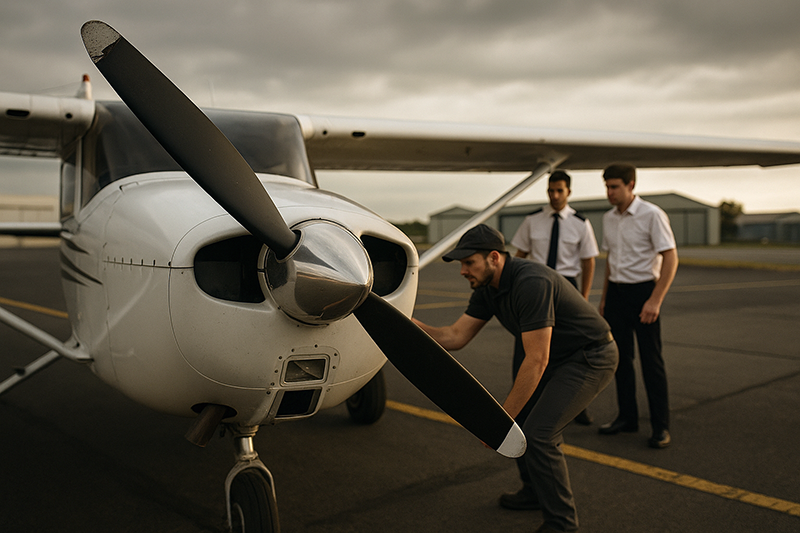
A propeller strike is one of those aviation events that can look deceptively simple from the cockpit. The airplane may still be upright, the engine may have stopped only briefly, and the visible damage may appear limited to a nicked blade tip or a scuffed spinner. Yet a propeller strike and sudden engine stoppage can transfer severe torsional and bending loads through the propeller flange, crankshaft, gear train, bearings, accessories, and engine mounts. For pilots, the most important question is not whether the airplane can be coaxed into running again. The question is what should happen next to protect people, preserve aircraft airworthiness, and avoid turning a maintenance event into a larger safety problem.
This article explains how pilots should think through a propeller strike, sudden engine stoppage, or suspected prop contact after a ground event, runway excursion, hard landing, gear-up landing, wildlife strike, or foreign object impact. It is written for pilots, student pilots, instructors, aircraft owners, flight schools, and aviation professionals who need a practical, safety-focused understanding of the right next steps. It does not replace the aircraft flight manual, engine and propeller manufacturer instructions, operator procedures, or the judgment of qualified maintenance personnel. It is designed to help pilots make the right initial decisions before maintenance takes over.
What Counts as a Propeller Strike?
In practical pilot language, a propeller strike is any event in which the propeller contacts something it was not designed to contact while the engine is installed on the aircraft. That may include pavement, turf, gravel, a runway light, a tie-down chain, a towbar, a hangar door, a snowbank, standing water, or foreign object debris. It can occur at takeoff power, idle power, during taxi, during landing rollout, or even when the engine is not producing power but the propeller is windmilling or being moved by inertia.
Pilots sometimes picture a propeller strike as a dramatic event with a bent blade and an obvious engine failure. Some are dramatic. Others are subtle. A momentary nose-over in soft field conditions, a porpoised landing that compresses the nose gear, a tailwheel airplane that tips forward during braking, or a propeller blade that clips a loose object on the ramp can all raise serious airworthiness questions. A sudden engine stoppage may also occur without a classic ground strike, such as when the propeller is abruptly stopped by an obstruction or when the engine experiences an internal stoppage.
The key pilot takeaway is simple: if there is credible reason to believe the propeller contacted an object or the engine stopped suddenly under abnormal load, treat the aircraft as potentially unairworthy until it has been evaluated by qualified maintenance personnel using the applicable aircraft, engine, and propeller guidance.
Why Sudden Engine Stoppage Is a Big Deal
A piston aircraft engine and propeller system is designed to transmit power smoothly. During normal operation, the crankshaft turns the propeller through predictable loads. A sudden stoppage is different. When a rotating propeller stops abruptly, the rotating mass of the engine and propeller system can create sharp torsional loads. Those loads may exceed what some components experience in normal service, even if the engine later starts and appears to run normally.
The danger is that some damage may be hidden. A propeller blade can be repaired or replaced, but the event may also affect the crankshaft, crankshaft flange, bearings, gears, accessory drives, counterweights if installed, engine mounts, and related components. In some engines, the inspection required after a propeller strike may be extensive. In others, the evaluation may depend on the specific event, the engine model, and the manufacturer’s criteria. Pilots should not attempt to make that technical determination from the cockpit.
A smooth run-up after a propeller strike does not prove that the engine is airworthy. A normal oil pressure indication does not prove that internal components are undamaged. A propeller that still looks straight from the pilot seat does not prove that the crankshaft flange has not been stressed. This is why the post-event decision should be conservative: stop operating the aircraft and involve maintenance.
Immediate Pilot Priorities After a Propeller Strike
The pilot’s first responsibility is to manage the aircraft and occupants safely. The exact actions depend on whether the event occurs in flight, during takeoff or landing, while taxiing, or while parked. The airplane’s approved operating procedures always matter, but the general priorities are consistent: maintain control, reduce further risk, secure the engine when appropriate, protect people, and prevent additional damage.
If the aircraft is still moving on the runway or taxiway, directional control comes first. Maintain aircraft control, avoid abrupt inputs that could worsen the situation, and bring the aircraft to a safe stop if runway remaining and conditions allow. If the propeller has struck the ground or an object, do not continue taxiing simply to clear the area unless safety requires it. If the aircraft is blocking an active runway, coordinate with air traffic control, airport operations, or other pilots as appropriate. Safety of people and traffic separation should guide the immediate decision.
Once stopped, secure the aircraft using the applicable cockpit procedures. In many piston aircraft this will involve bringing the engine to idle if it is still running, then shutting it down with the mixture, magnetos, fuel selector, and electrical switches as appropriate for the aircraft. If there is a fire risk, fuel leak, smoke, or structural damage, evacuate promptly and move occupants upwind and away from the aircraft. If there is no immediate danger, remain deliberate and avoid rushing around a damaged aircraft with a hot engine, spinning propeller, or leaking fuel.
After a suspected propeller strike, pilots should not restart the engine for a test run unless directed by qualified maintenance personnel under controlled conditions. They should also avoid hand-moving the propeller except when maintenance personnel determine it is necessary and safe. Rotating the propeller can move damaged parts, disturb evidence, and create injury risk if the ignition system is not properly secured.
If the Event Happens in Flight
A propeller strike in flight is uncommon, but pilots may encounter bird strikes, debris strikes, severe vibration, partial propeller damage, or an abrupt loss of engine power. If the propeller is damaged or the engine stops suddenly in flight, the event becomes an aircraft control and emergency landing problem. The pilot should fly the airplane first. Establish the appropriate glide or controllable airspeed, choose a landing area, and use the emergency procedures in the aircraft flight manual or pilot operating handbook.
If the engine is producing severe vibration after a propeller or engine event, reducing power may be necessary to maintain control and reduce the risk of further damage. In some cases, shutting the engine down may be the safest option if the vibration is extreme or if continued operation threatens structural control. The exact action depends on aircraft type, altitude, terrain, weather, and cockpit workload. This is a training point worth discussing with a flight instructor because the correct decision may be time critical.
After landing, the same post-event principle applies: do not assume the engine is serviceable because it made partial power or because the aircraft landed safely. A precautionary landing that ends well can still leave the aircraft grounded until inspection.
Why This Matters in Real-World Aviation
Propeller strikes happen in the kinds of ordinary operating environments pilots use every day. Soft fields, sloped ramps, uneven turf, contaminated runways, poorly marked obstacles, aggressive braking, hard landings, porpoising recoveries, and ramp distractions all create opportunities for propeller contact. Flight training aircraft are especially exposed because they operate frequently, cycle through many landings, and are often flown by pilots developing judgment and aircraft handling skills.
From a safety standpoint, the problem is not only the strike itself. The bigger hazard can be the pilot’s reaction afterward. A pilot who feels embarrassed may want to minimize the event. An owner may worry about cost or downtime. A renter may fear consequences with the flight school. An instructor may be tempted to treat a minor blade nick as a simple maintenance write-up. These human factors are real, and they are exactly why pilots need a clear mental model before an event occurs.
The correct response protects everyone involved. It protects the next pilot from inheriting an unknown mechanical condition. It protects maintenance personnel by giving them accurate information. It protects the owner or operator by preserving the opportunity for a proper inspection and documentation. Most importantly, it protects the public and occupants by preventing continued operation of an aircraft that may not be airworthy.
How Pilots Should Understand Airworthiness After a Strike
Airworthiness is not just the absence of obvious damage. For a civil aircraft to be flown, it must be in a condition for safe operation and must conform to its approved design. After a propeller strike or sudden engine stoppage, a pilot generally does not have enough information to determine that condition alone. The aircraft may need inspection in accordance with maintenance manuals, engine manufacturer service instructions, propeller manufacturer guidance, and applicable regulatory maintenance rules.
This is where pilot and mechanic roles intersect. The pilot reports what happened, secures the aircraft, and ensures the event is not hidden or normalized. Maintenance personnel determine the required inspection, repair, replacement, return-to-service documentation, and any test procedures. The pilot should resist the temptation to convert a maintenance question into a cockpit opinion.
Good reporting matters. Maintenance personnel need to know the power setting, aircraft attitude, surface, object contacted, whether the engine stopped suddenly, whether the propeller continued rotating, whether there was vibration, whether the aircraft taxied afterward, and what cockpit indications were observed. A short, honest description is far more useful than a vague report such as, ‘the prop may have touched something.’
Ground Operations and the Hidden Risk of Minor Events
Many propeller strike risks develop before the airplane ever reaches takeoff power. During preflight, pilots should note propeller condition, nose gear or tailwheel strut condition, tire inflation, ramp surface, chocks, tie-down ropes, towbar placement, and nearby obstacles. A nose strut that sits unusually low, a soft patch of turf, or a rut near a tiedown spot can reduce propeller clearance more than expected.
During taxi, propeller clearance can change with braking, bumps, and surface slope. Nosewheel aircraft can pitch forward under braking. Tailwheel aircraft can be vulnerable to nose-over tendencies if braking is mishandled or if the surface is soft. Floatplanes, ski-equipped aircraft, and aircraft operating on unimproved surfaces add their own considerations. Pilots should not assume that published propeller clearance, if known, remains available under every loading and surface condition.
Ramp discipline is equally important. Towbars left attached, cones placed too close, luggage staged near the propeller arc, and loose hardware on the ramp are preventable hazards. During start, run-up, and taxi, the propeller becomes both a safety hazard to people and a debris hazard to the aircraft. Propeller strikes are not limited to runway accidents; they can begin with a small ramp oversight.
Common Mistakes or Misunderstandings
One of the most common mistakes is assuming that visible damage tells the whole story. A blade that looks only slightly damaged may have transmitted significant load into the engine. Conversely, even if the propeller damage seems repairable, the engine and accessories may still require evaluation. Pilots are trained to inspect what they can see, but a propeller strike is partly about what cannot be seen.
Another misunderstanding is believing that a successful engine restart clears the aircraft. It does not. Restarting the engine after a strike can create additional risk, including further mechanical damage or injury to personnel nearby. A ground run may be part of a maintenance process, but it should not be a pilot’s improvised diagnostic step immediately after the event.
Pilots may also underestimate a sudden engine stoppage if it happens at low power. While the severity of the event can vary, the pilot should not decide that low rpm automatically means no inspection is needed. Manufacturer guidance and maintenance judgment are what matter. If the engine stopped abruptly or the propeller contacted an object, treat it seriously.
A fourth error is failing to document the event accurately. A vague logbook discrepancy can leave the mechanic guessing. A complete report helps determine the correct inspection path. Include the circumstances without dramatizing or minimizing them. If you are unsure whether contact occurred, say that. If witnesses heard a strike or saw debris, include that information.
Finally, some pilots continue taxiing after a suspected strike because they want to move the airplane out of the way. In some circumstances, moving the aircraft may be necessary for immediate safety. But routine taxi back to parking after a propeller strike can worsen damage and complicate the maintenance evaluation. If the aircraft must be moved, coordinate with airport operations or maintenance and consider towing when safe and practical.
Practical Example: A Training Aircraft on a Soft Field
Consider a realistic flight training scenario. A student pilot and instructor are practicing short-field and soft-field operations at a quiet airport with a turf runway. On rollout after a firm landing, the nosewheel enters a soft patch. The nose dips more than expected, the instructor applies aft elevator and reduces braking, and the airplane slows to a stop. Neither pilot is certain the propeller contacted the turf, but they felt a sharp jolt and noticed a small vibration before the engine was shut down.
In this situation, the safest response is not to taxi back to the hangar and debate whether anything happened. The crew should secure the aircraft, advise other traffic or airport personnel if the runway is affected, and arrange for the aircraft to be inspected before further operation. They should report the exact sequence: runway surface, landing attitude, braking, nosewheel dip, engine behavior, vibration, and whether the propeller continued turning. Maintenance can then determine the required inspection based on the aircraft and engine.
This example is useful because it shows how uncertainty should be handled. Pilots are not expected to become forensic engineers on the runway. They are expected to make conservative operational decisions when airworthiness is in doubt. If the event turns out not to be a propeller strike, the airplane can be returned to service through proper channels. If it was a strike, the conservative decision may prevent a far more serious failure later.
Best Practices for Pilots
The best time to prepare for a propeller strike is before one happens. Aircraft owners, renters, flight schools, and instructors should discuss the expected response during checkout and recurrent training. Pilots should know whom to call, how to secure the aircraft, how to document the discrepancy, and how the organization handles aircraft recovery from a runway or remote field.
A practical pilot approach includes several habits:
- Brief abnormal ground events as seriously as airborne emergencies, especially during training on soft fields, short fields, and crosswind landings.
- Know the shutdown and evacuation procedures for the specific aircraft you fly.
- Treat suspected propeller contact or abrupt engine stoppage as an airworthiness concern until maintenance determines otherwise.
- Do not restart, run up, or continue taxiing after a suspected strike unless immediate safety or qualified maintenance direction requires it.
- Give maintenance personnel a clear, factual description of the event, including uncertainty where uncertainty exists.
- Use conservative judgment when embarrassment, schedule pressure, or cost concerns tempt you to minimize the event.
For instructors, the teaching opportunity is significant. Students should understand that good airmanship includes admitting uncertainty and grounding an aircraft when appropriate. A pilot who says, ‘I am not comfortable flying this until maintenance looks at it,’ is demonstrating judgment, not weakness.
Maintenance Coordination and Documentation
After the aircraft is secured, the next step is coordinated maintenance action. For a rented aircraft or flight school airplane, notify the operator immediately. For an owned aircraft, contact the mechanic or maintenance provider responsible for the aircraft. If the event occurs away from home base, the aircraft may need to remain at the airport until a mechanic can evaluate it or until it can be moved safely by towing or other approved means.
Documentation should be factual. A pilot discrepancy report might describe the event as suspected propeller contact with turf during landing rollout, abrupt engine stoppage after propeller contact with runway surface, or severe propeller vibration after debris impact, depending on what actually occurred. Avoid vague wording that conceals the nature of the event. Avoid exaggeration as well. Maintenance decisions depend on accurate facts.
Insurance, operator policy, and rental agreements may add reporting requirements. Those details vary and should be verified for the aircraft and organization involved. From a safety perspective, however, the operational principle remains the same: no further flight until the aircraft has been properly inspected and returned to service.
Training Value for Student Pilots and Instructors
Student pilots often learn emergency procedures as airborne flows and memory items, but propeller strike response is just as much a judgment exercise. The event may occur when adrenaline is high and the consequences are embarrassing. A student may not want to tell the instructor that the propeller might have hit something. An instructor may be balancing traffic, radio calls, aircraft recovery, and student reassurance. Clear expectations reduce confusion.
Instructors can use scenario-based training to ask: What would you do if the nosewheel dropped into a rut and you were not sure whether the prop hit? What if you clipped a runway light during a crosswind landing? What if a towbar was discovered near the propeller after start? What if a bird strike created severe vibration on climbout? These discussions help pilots build decision-making patterns before stress narrows their thinking.
The most important training lesson is that aircraft damage assessment is not a pride issue. It is a system safety issue. A pilot who grounds an aircraft after a suspected propeller strike may inconvenience a schedule, but that decision supports the integrity of the entire aviation operation.
Frequently Asked Questions
Can I fly the aircraft if the propeller strike looked minor?
No pilot should assume the aircraft is safe to fly based only on visual appearance. Even a seemingly minor strike can require inspection under the applicable aircraft, engine, and propeller guidance. The aircraft should remain out of service until qualified maintenance personnel determine the required actions and return it to service.
Should I restart the engine after a propeller strike to see if it runs smoothly?
As a general safety practice, do not restart or run the engine after a suspected propeller strike unless qualified maintenance personnel direct that action under controlled conditions. A smooth restart does not prove internal components are undamaged, and running the engine may increase risk.
What information should I give the mechanic?
Provide a clear description of what happened, including power setting, aircraft movement, surface or object contacted, whether the engine stopped abruptly, vibration, cockpit indications, and whether the aircraft was moved afterward. If you are unsure whether the propeller made contact, state that clearly.
Does every propeller strike require an engine teardown?
The required inspection or repair depends on the specific engine, propeller, aircraft, and circumstances of the event, as well as manufacturer and maintenance guidance. Pilots should not make that determination themselves. Some events may require extensive inspection, while others may follow a different approved maintenance path.
What if the aircraft is blocking a runway after the strike?
Keep people safe first. Coordinate with air traffic control, airport operations, or other traffic as appropriate. If the aircraft must be moved for safety, use the safest practical method and involve maintenance or airport personnel when possible. Avoid routine taxiing after a suspected strike unless immediate safety requires movement.
Is a sudden engine stoppage the same concern as a propeller strike?
It can be. A sudden stoppage can impose abnormal loads on the engine and propeller system, even if there is no obvious external blade damage. Treat an abrupt abnormal stoppage as a maintenance and airworthiness issue until evaluated by qualified personnel.
Key Takeaways
- A propeller strike or sudden engine stoppage should be treated as a serious airworthiness concern, even when visible damage appears minor.
- Pilots should secure the aircraft, protect occupants, avoid unnecessary engine operation, and involve qualified maintenance personnel before further flight.
- Accurate reporting, conservative judgment, and aircraft-specific maintenance guidance are essential to safe decision-making after any suspected propeller contact.