
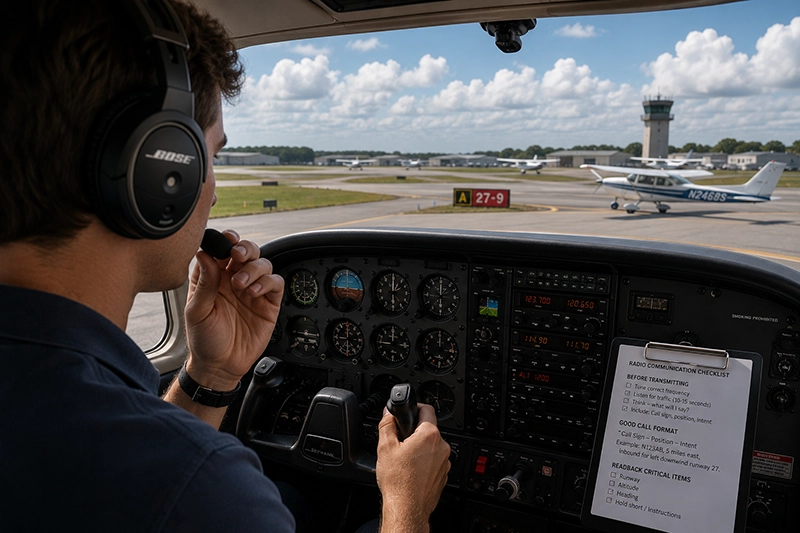
Radio communication mistakes are one of the most common and consequential training gaps for student pilots. Early in training, students focus on stick-and-rudder skills while radio work can feel like an afterthought. That imbalance builds habits that persist into solo flights and beyond. This article explains typical errors, why they matter, and practical ways to become clear, concise, and confident on the radio.
Whether you fly from uncontrolled fields, train in busy traffic environments, or work toward an instrument rating, strong radio skills improve safety, reduce workload, and make you a better pilot. Read on for concrete examples, common misunderstandings, a realistic training scenario, and best practices you can apply on your next flight.
What "Radio Communication Mistakes" Really Means
Radio communication mistakes cover a spectrum from technical problems to procedural and human factors errors. Technical problems include poor microphone technique, incorrect radio frequency selection, and improperly tuned radios. Procedural errors include using nonstandard phraseology, failing to listen before transmitting, providing incomplete information, or not reading back critical clearances. Human factors such as anxiety, rushed mental checklists, or multitasking during high workload moments cause many of these mistakes.
Good radio communication is not just about sounding professional. It is a tool for maintaining traffic awareness, obtaining ATC services, coordinating with other traffic at uncontrolled airports, and managing risk in deteriorating weather or emergencies. A clear, timely transmission prevents ambiguity and reduces the chance of missed sequencing, runway incursions, or lost communications.
Why This Matters in Real-World Aviation
In real operations, the consequences of poor radio work vary from small annoyances to safety-critical events. At uncontrolled fields, misstates of position or intent can lead to conflicting traffic in the pattern. In terminal areas, missed readbacks or incorrect readbacks of altitudes and runway assignments can disrupt ATC flow and increase controller workload. Under instrument flight rules, incorrect readbacks of vectors or altimeter settings have led to navigational errors and runway excursions in some investigations.
Beyond obvious safety concerns, poor radio habits create extra work for instructors, controllers, and fellow pilots. Repeatedly asking for clarification, correcting misunderstood transmissions, or resolving stepped-on calls divert attention from primary tasks. Developing precise radio habits early reduces frequency congestion and helps build trust with controllers and other pilots.
How Pilots Should Understand Radio Communication
Approach radio communication as an integrated part of flying, not a separate skill practiced only in a simulator or classroom. Radio calls belong in your cockpit flow: tune and identify the frequency early, listen for the last transmission before you speak, formulate what you will say, then transmit crisply. Include only the information that is relevant to the recipient: call sign, position, request or intent, and any necessary clarifying data such as altitude, runway, or direction of flight.
Learn standard phraseology and when to be concise versus when to expand. Standard phraseology reduces ambiguity because controllers and other pilots expect certain formats. When a situation requires more nuance, such as declaring an emergency or reporting a mechanical problem, add the necessary detail but remain orderly: state your call sign, location, the nature of the problem, and your intentions.
Common Mistakes or Misunderstandings
Below are recurring mistakes student pilots make, why they happen, and the operational risk each mistake presents.
1. Failing to Listen Before Transmitting
Students often transmit immediately after tuning a frequency without first listening. This leads to stepping on other calls. The result can be an unintelligible transmission, delayed responses from controllers, or missed instructions. Listening gives you situational awareness and allows you to time your transmission to avoid interference.
2. Using Nonstandard or Wordy Phraseology
Using conversational English instead of standard aviation phraseology creates ambiguity. For example, saying "I think I'll enter left base" instead of "Cessna 123AB left base runway 27" makes it harder for other pilots to identify your position and intent quickly. Wordy calls also clog the frequency and increase controller workload.
3. Poor Readback Technique
Students sometimes paraphrase critical clearances instead of reading back key elements exactly. Readbacks should include critical numbers such as runway, altitude, heading, or hold-short instructions. Failure to read back accurately can allow an instruction to go unverified and lead to misunderstandings about runway assignments or vectors.
4. Omitting Important Details
Too little information is as problematic as too much. A pilot who states only "traffic in the pattern" without position, altitude, or direction leaves other pilots guessing. Conversely, providing your full flight plan when a short position call would suffice wastes time. The skill is to include the right details for the situation.
5. Poor Microphone Technique and Audio Problems
Microphone technique issues include holding the mic too far from the mouth, speaking directly into it (causing popping), or having an open headset mic that transmits ambient cockpit noise. Static, squeaks, and inconsistent audio make your calls unintelligible. Check your headset microphone position and radio audio levels during preflight and before critical transmissions.
6. Frequency Management Errors
Students sometimes forget to change to the correct frequency for ground, tower, or departure, or they fail to set the standby frequency properly. Landing at a towered field and remaining on approach frequency, or transmitting on the wrong CTAF, leads to missed instructions and possible conflicts.
7. Transmitting During High Workload Without Prioritization
Radio transmissions during critical flight phases such as takeoff or immediate post-takeoff should be minimized unless necessary for safety. Novice pilots often try to handle nonessential communications while trimming and scanning, increasing workload and risk of missed items. Prioritize flying the airplane; delay noncritical radio work until workload allows.
8. Mispronouncing or Misreading Numbers
Numbers are important. Students often say figures quickly, slur digits, or use casual wording that can be misheard. Using clear enunciation and standard number pronunciation helps ensure altitudes, headings, and frequencies are correctly understood.
9. Not Confirming Lost Communications Procedures
Many students do not familiarize themselves with the actions required if communications fail in controlled airspace or on an instrument flight. Prebriefing expected ATC routing and clearance elements reduces ambiguity if radio failure occurs and helps you follow published procedures or controller expectations.
10. Overreliance on Automation for Frequency Changes
Relying solely on autopilot or integrated avionics to manage frequencies without manual verification can cause missed handoffs or wrong-frequency transmissions. Always verify that radios are set and active when an ATC frequency change is expected.
Practical Example: Single-Engine Student at a Busy Uncontrolled Airport
Imagine a student pilot flying a single-engine training airplane to a busy uncontrolled airport for solo practice. The student is approaching with the idea of entering the left downwind for runway 24. They tune the CTAF and immediately announce "Student N123AB inbound." Two other aircraft are already flying the pattern. One aircraft is on base for runway 24 and another is on final for runway 06.
What went wrong? The student provided inadequate positional information and did not listen to the traffic flow before transmitting. They also failed to state intentions. A clearer transmission would be: "Cessna one two three alpha bravo, five miles southeast, inbound for left downwind runway two four, full stop." This statement includes aircraft identification, position, intent, and planned landing. Listening first would have revealed that runway 06 traffic conflicted with their inbound routing and allowed the student to choose an alternate entry or delay arrival until a safe spacing was available.
In training, use this kind of scenario to practice three radio actions: tune and listen, craft a concise call with intent and position, and transmit with clear enunciation. Run the scenario from both pilot and instructor perspectives so that the instructor can simulate other traffic and controller responses.
Best Practices for Pilots
Adopt habits that reduce error and support clear communication. Here are actionable practices that fit into normal cockpit flows:
- Listen first, then speak. After changing a frequency, wait for a natural pause and listen for the last transmission before calling in.
- Include call sign, position, and intention. Make it easy for others to identify you and your plan.
- Use standard phraseology for common situations. Learn when to shorten calls and when to expand them.
- Read back critical clearances exactly. Focus on runway, altitude, heading, and hold-short instructions when applicable.
- Practice microphone technique. Position the boom about one finger-width from the corner of your mouth, not directly in front of it, and speak at normal conversational volume.
- Tune and identify frequencies before approaching critical phases. Preselect expected frequencies during descent planning.
- Manage workload. Delay nonessential comms during takeoff, landing, or other high work phases.
- Prebrief expected clearances. For IFR flights or busy terminal areas, brief possible routing and altitudes so you can recognize and read back critical elements quickly.
- Practice simulated failures. Work lost communications and diversion scenarios with an instructor to build confidence.
Training Exercises to Improve Radio Skills
Practice is the best cure for radio anxiety and mistakes. Here are a few training exercises you can run with an instructor or a safety pilot.
- Frequency Tuning Drill: During preflight planning, pick anticipated frequencies and set them in the radio stack. During taxi and takeoff, verify each frequency immediately before switching.
- Pattern Position Calls: Fly a series of touch-and-goes and focus on making consistent position reports with call sign, position in pattern, and landing intentions.
- Controller Readback Practice: Have the instructor read simulated ATC clearances, including vectors and altitude changes. Practice accurate readbacks under increasing workload.
- Silent Listening Drill: Fly with an instructor who talks on the radio while you only listen for three minutes, then write down all call signs, positions, and instructions you heard. This strengthens auditory situational awareness.
Common Misunderstandings and Safety Risks
One common misunderstanding is that "brief" calls are always better. While concise calls are generally good, being too brief at the wrong time creates ambiguity. Another misconception is that repeating only part of a clearance is always sufficient. Controllers expect readbacks of the critical elements and may assume compliance if you paraphrase, which can lead to dangerous situations if misinterpretation occurs.
Students sometimes assume that radio silence equals permission. Silence from ATC is rarely a clearance. If you do not receive an expected clearance or acknowledgment, act conservatively, clarify your position and request, or remain in a safe holding action until instructions are explicit.
Practical Tips for Listening and Speaking
Improve both reception and transmission by making small adjustments. When listening, cup the ear opposite your headset volume control to reduce cockpit noise, and identify the last speaker’s call sign before you speak. When transmitting, speak clearly, enunciate digits individually, and pause briefly between important elements so the receiver can parse the message.
Avoid filler words and unnecessary apologies. For example, instead of saying "Sorry to bother you, but Cessna 123AB downwind," say "Cessna 123AB downwind runway 24." Be assertive yet polite; professional radio communication is efficient and calm.
Handling Stepped-On Calls and Miscommunications
If you step on another transmission or get stepped on, the remedy is simple: stop transmitting, listen to the remainder of the exchange, and then repeat your call when the frequency becomes clear. If you realize that your previous transmission may have been unintelligible, repeat the essential information. Controllers appreciate concise corrections, for example: "N123AB, correction, five miles southeast inbound, left downwind runway two four."
When a controller issues a clearance that appears conflicting or unsafe, request clarification immediately. Use short, direct language to explain the conflict, such as "Unable due traffic on final, request delay" or "Confirm turn to heading 030, N123AB." Controllers will respond with revised instructions when necessary.
When to Use Plain Language Versus Phraseology
Standard phraseology improves clarity and is recommended for routine exchanges. However, plain language is appropriate for nonstandard situations such as mechanical issues, weather deviations, or emergencies, where more detailed explanation helps the controller understand your needs. The key is to be structured: start with call sign and location, state the problem, and state your intentions or request.
Frequently Asked Questions
How do I know which details are essential to include in a position report?
Essential details are those that answer who you are, where you are, and what you intend to do. At uncontrolled fields, that usually means call sign, position relative to the airport, direction of flight or pattern entry, and landing intentions. In controlled environments, include your call sign and the exact clearance elements requested or acknowledged.
What should I do if I miss a clearance or don't understand it?
Ask for clarification immediately. Use short, specific language such as "Say again runway assignment, N123AB" or "Unable to copy altitude, request repeat." Do not guess the instruction. Controllers expect readbacks and clarification requests when necessary.
Is it a problem to be nervous on the radio as a student?
Nervousness is normal. The most effective remedy is practice. Start with low-traffic airports, run scripted radio exchanges with your instructor, and increase complexity gradually. Over time, predictable radio flows become automatic and anxiety decreases.
How can I practice radio calls outside the cockpit?
Record yourself making standard calls and listen for clarity and pacing. Role-play common scenarios with an instructor or fellow student. Many flight schools and apps provide sample communications to rehearse. Listening to live ATC recordings can also help you internalize typical phraseology and cadence.
When should I go beyond standard phraseology and explain more?
When you have an abnormal situation: partial panel, mechanical problem, unexpected weather, or an emergency. Start with the essentials, then add brief, structured details that help ATC or other pilots understand your problem and intentions.
Key Takeaways
- Practical takeaway: Always listen before transmitting and include call sign, position, and intention to make your calls unambiguous.
- Safety takeaway: Accurate readbacks and clear mic technique reduce the risk of runway incursions and traffic conflicts.
- Training takeaway: Practice scripted scenarios and build radio flow into your cockpit routine so communications become habit rather than add-on tasks.