
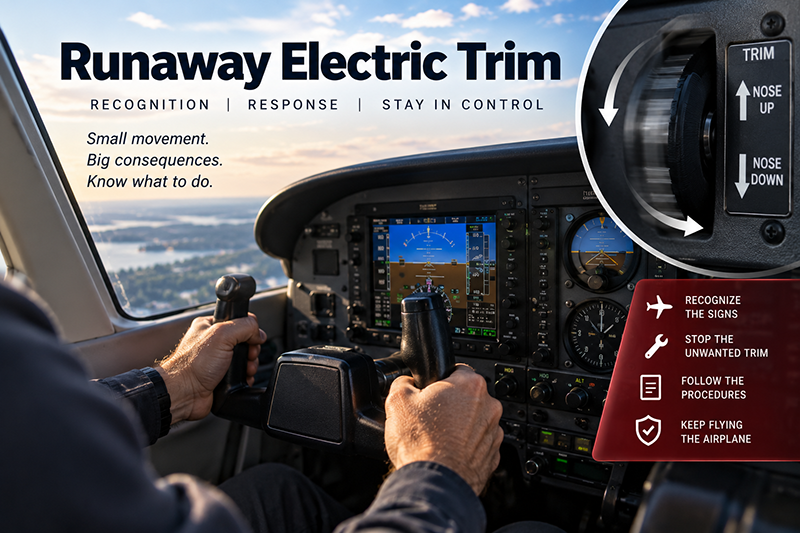
Runaway electric trim is an abnormal condition in which an aircraft’s electrically powered trim system moves without the pilot’s intended command, or continues moving after the intended command has stopped. It matters because trim is not just a comfort feature. Trim changes the control forces required to hold an attitude, and in some aircraft a significant trim displacement can quickly create heavy pitch forces, distracting cockpit workload, and an urgent aircraft control problem.
For pilots, student pilots, flight instructors, and aviation operators, the most important point is simple: recognize the runaway early, stop the unwanted trim input using the aircraft’s approved method, and keep flying the airplane. This article explains how runaway electric trim typically presents itself, why control forces can build so quickly, and how pilots should think about disconnection, manual trim recovery, and training for this event without relying on memorized slogans alone.
What Runaway Electric Trim Means
Trim systems reduce the continuous control force a pilot must hold to maintain a desired aircraft attitude, airspeed, or configuration. In many airplanes, the most familiar trim system is pitch trim, which may move a trim tab, adjust a stabilizer, or reposition another surface depending on aircraft design. Electric trim lets the pilot command trim movement through switches, commonly located on the control yoke, control stick, pedestal, or autopilot control system.
A runaway electric trim event occurs when that electrically powered system drives in a direction the pilot did not intend. The runaway may be obvious, such as a trim wheel spinning rapidly with no pilot input. It may also be subtle at first, especially if the aircraft is on autopilot, the cockpit is noisy, or the trim indication is outside the pilot’s normal scan.
The consequences depend on aircraft type, airspeed, configuration, trim authority, autopilot design, and how quickly the pilot intervenes. In a light training airplane, the pilot may feel steadily increasing pressure on the control wheel or stick. In a faster or more complex aircraft, the forces may build faster and the upset potential may be more significant. The correct response is always aircraft-specific, but the underlying priorities are consistent: maintain control, stop the unwanted trim movement, re-trim as appropriate, and use the emergency or abnormal procedure published for that aircraft.
How Electric Trim and Autopilot Trim Interact
Electric trim may be a stand-alone convenience system, an integrated part of the autopilot, or both. A pilot-operated electric trim switch usually commands trim movement directly. An autopilot may also command trim to reduce servo loads and keep the airplane in trim while it holds altitude, vertical speed, approach path, or pitch attitude.
This relationship is important because some trim problems first appear while the autopilot is engaged. A pilot may notice that the airplane is holding altitude but the trim wheel is moving more than expected, or that the autopilot is working unusually hard. If the autopilot disconnects after trimming the airplane far from neutral, the pilot may suddenly inherit large control forces. Conversely, what feels like a trim runaway may sometimes be an autopilot or servo issue rather than a trim motor problem. The pilot does not need to diagnose the electrical pathway in the moment. The immediate task is to stop unintended automation and preserve aircraft control.
Modern installations may include trim interrupt switches, autopilot disconnect buttons, split trim switches, clutches, circuit protection, or annunciations. Older or simpler installations may provide fewer layers of protection. Because cockpit designs vary widely, every pilot should know the exact disconnect methods in the aircraft being flown, including what each switch does, whether it disconnects the autopilot, whether it removes power from electric trim, and how manual trim is restored after the event.
Recognition: What Pilots Usually Notice First
Runaway electric trim recognition begins with attitude awareness and control feel. The airplane may begin pitching up or down without a corresponding pilot input. The pilot may need increasing forward or aft pressure to maintain the same attitude. The trim wheel or trim indicator may move unexpectedly. There may be a trim motor sound, a change in autopilot behavior, a caution message in equipped aircraft, or an unexplained change in airspeed or vertical speed.
Nose-down trim runaway often presents as a growing need to pull aft on the yoke or stick to maintain pitch attitude. If not corrected, the airplane may accelerate, descend, or require substantial back pressure. Nose-up trim runaway can require increasing forward pressure. If not corrected, it may lead to an increasing pitch attitude, decaying airspeed, or an approach toward stall conditions. Neither direction should be treated casually, particularly close to the ground.
A common recognition challenge is that trim runaway can mimic other problems. A pitch change after flap extension, power change, or configuration change may be normal. Turbulence can mask small changes in attitude. An autopilot mode change can surprise the pilot. A control pressure change after a missed approach or go-around may be expected. The distinction is persistence and lack of pilot command. If the aircraft continues to trim or the required control force continues to build without a known reason, treat it as an abnormal trim event until proven otherwise.
Why Control Forces Can Become So Demanding
Trim changes the balance of aerodynamic forces. When trim is displaced in the wrong direction, the pilot must oppose the resulting pitching tendency with the primary flight controls. At low levels of mistrim, this may feel like an inconvenience. At higher levels, the force may become tiring or difficult to manage, especially at higher airspeeds where aerodynamic loads increase.
This is why runaway trim is not merely an electrical nuisance. It is a flight control issue. The longer the trim motor runs, the more the aircraft may depart from its properly trimmed state. If airspeed increases during a nose-down event, control forces can become even more challenging. If airspeed decreases during a nose-up event, the pilot may be managing both control pressure and energy state at the same time.
The exact forces are aircraft-specific. Some airplanes provide generous manual leverage and remain manageable with prompt pilot action. Others may produce substantial forces after significant trim displacement. Pilots should avoid broad assumptions such as “I can always overpower it” or “the autopilot will protect me.” The safer assumption is that early recognition and disconnection are essential because the event may become more difficult with time.
Immediate Priorities in a Runaway Trim Event
The first priority is aircraft control. A pilot who is startled by uncommanded pitch movement should focus outside, stabilize the attitude, and use appropriate control input to keep the airplane within a safe flight path. This may require a firm grip and decisive pressure. If another pilot is onboard, clear communication matters: one pilot flies, the other helps identify and stop the malfunction according to the aircraft procedure.
The next priority is stopping the unwanted trim movement. In many aircraft, this may involve pressing and holding a trim interrupt or autopilot disconnect switch, releasing a stuck trim switch, moving a guarded electric trim switch to off, or using another manufacturer-specified disconnect method. In some aircraft, pulling a circuit breaker may be part of the approved procedure or an option only after other steps. Pilots should not assume a universal circuit breaker technique applies to all aircraft. The correct action is the action published for that aircraft and installation.
After the runaway is stopped, the pilot may need to re-trim manually if manual trim remains available. This step should be done carefully. If the aircraft is significantly out of trim, sudden relaxation of control pressure while trimming can produce an abrupt pitch change. The pilot should maintain the desired attitude, use manual trim deliberately, and verify that the unwanted electric movement has stopped. If the electric trim system is disabled, the remainder of the flight should be conducted using the procedures and limitations applicable to that aircraft.
Why This Matters in Real-World Aviation
Runaway electric trim is important because it can occur during high-workload phases of flight. A pilot may be climbing after takeoff, intercepting an approach, configuring for landing, managing icing or turbulence, or communicating with air traffic control when the trim begins to move. The abnormal event competes with navigation, communication, traffic awareness, and aircraft performance management.
Training environments can unintentionally reduce the perceived seriousness of the problem. Many pilots learn trim primarily as a way to reduce workload. They practice trimming for hands-off stability, but may spend less time considering what happens when trim moves the wrong way. A pilot who has never felt significant mistrim may underestimate the physical force and distraction involved. This is especially true when transitioning from one aircraft to another, because trim rate, trim authority, switch design, and autopilot integration can be very different.
Runaway trim also matters in crew resource management. In two-pilot operations, the event requires immediate role clarity. The pilot flying should not become trapped in switch diagnosis while the flight path degrades. The pilot monitoring can silence distractions, identify trim movement, call out airspeed and attitude trends, and execute the relevant abnormal procedure. In single-pilot operations, the same principles apply internally: fly first, simplify the situation, and do not let troubleshooting replace control.
How Pilots Should Understand This Topic
Pilots should think of electric trim as a powerful secondary control system. It is secondary because it is not the primary control used to maneuver the airplane moment by moment. It is powerful because it changes the forces the pilot must overcome through those primary controls. A runaway trim condition can therefore turn a normally stable airplane into one that demands immediate physical and mental discipline.
The best mental model is “uncommanded trim equals automation to be stopped.” If the autopilot is engaged and the airplane begins doing something unexpected, disconnecting the autopilot is often an early step in regaining direct control. If electric trim continues after autopilot disconnection, the pilot must use the trim disconnect method for that aircraft. If the trim switch is stuck or the system remains powered, simply fighting the airplane is not enough.
Understanding the system before flight is essential. Pilots should know where the electric trim switches are, how the trim interrupt works, whether the autopilot disconnect also disables electric trim, where the manual trim control is located, and how to identify trim position. This knowledge should be aircraft-specific, not generic. A pilot who flies multiple aircraft should not assume that one cockpit’s logic applies to another.
Common Mistakes or Misunderstandings
One common mistake is delaying action because the pilot is unsure whether the event is truly a runaway. The airplane does not require a perfect diagnosis before the pilot stops an uncommanded motion. If trim is moving without a valid command or control forces are rapidly increasing, prompt intervention is appropriate.
Another misunderstanding is believing that trim is harmless because it moves slowly. Some trim systems do move at a controlled rate, but a few seconds of movement can still create a serious mistrim condition, particularly at higher airspeeds or during a critical phase of flight. The problem is not only the speed of movement. It is the accumulating displacement and the pilot workload it creates.
A third mistake is focusing inside the cockpit for too long. Pilots may stare at the trim wheel, search for a circuit breaker, or troubleshoot the autopilot while the airplane departs from altitude or attitude. The correct mindset is to keep the aircraft under control while using practiced, immediate disconnect actions. If a switch or breaker cannot be found instantly, the pilot must continue flying and use the most accessible approved means to stop the problem.
Some pilots also assume the autopilot is always helping. In many normal situations, it is. During abnormal trim or pitch behavior, however, the autopilot can obscure the developing problem or leave the aircraft in an undesirable trim state when it disconnects. Monitoring automation means watching not only the flight path but also what the system is doing to achieve that flight path.
Finally, pilots sometimes practice trim failures only as verbal questions during ground training. Discussion is useful, but it does not replace cockpit familiarization and supervised flight or simulator practice where appropriate. The pilot should be able to locate and use the correct disconnect controls by touch and habit, while still maintaining attitude and airspeed.
Practical Example
Consider a pilot in a high-performance single-engine airplane cruising in smooth air with the autopilot engaged. The aircraft is level at cruise power. The pilot notices a faint trim motor sound and then sees the trim wheel moving nose down. At first the airplane remains level because the autopilot is still holding altitude. A few seconds later, the autopilot disconnects and the pilot must apply increasing aft pressure to keep the nose from dropping.
The correct response is not to diagnose every possible electrical fault. The pilot grips the controls, maintains pitch attitude, and uses the aircraft’s autopilot and trim disconnect method. After confirming the trim has stopped, the pilot reduces workload, checks airspeed and attitude, and uses manual trim if available to relieve the heavy control force. The pilot then reviews the abnormal procedure, avoids re-engaging the affected system, and considers the safest destination based on aircraft condition, workload, weather, and available maintenance support.
This example highlights a key training point: the most surprising moment may occur when the autopilot stops masking the mistrim. Pilots who monitor trim movement and control forces are less likely to be startled when automation disengages. Instructors can use scenario-based training to reinforce this awareness, particularly during aircraft transitions and autopilot checkouts.
Best Practices for Pilots
Good runaway trim preparation begins before engine start. During cockpit setup, identify the trim controls, autopilot disconnect, trim interrupt, manual trim control, trim position indicator, and any relevant switches or circuit protection called out by the aircraft documents. This does not need to become a lengthy ritual, but it should be deliberate enough that the pilot can find the controls under stress.
During flight, include trim behavior in the automation scan. If the autopilot is engaged, periodically notice whether the airplane remains reasonably in trim and whether the trim is moving in a way that makes sense for the mode and conditions. During hand flying, be alert for control pressures that change without an obvious cause. The airplane communicates through attitude, airspeed, sound, and feel.
Training should include the physical reality of mistrim when it can be demonstrated safely and in accordance with the aircraft’s limitations and instructor judgment. A student who has felt moderate mistrim at altitude is more likely to respond decisively later. The purpose is not to create surprise or fear. It is to build recognition, confidence, and respect for control forces.
- Know the aircraft-specific trim disconnect and autopilot disconnect methods before flight.
- Keep flying the aircraft first, especially if control forces are increasing.
- Do not re-engage a malfunctioning trim or autopilot system unless the aircraft procedure clearly permits it and the problem has been resolved.
- Use manual trim carefully after the runaway stops, while maintaining attitude and airspeed.
- Brief trim and automation concerns during aircraft checkouts, avionics transitions, and recurrent training.
Instructor Considerations for Teaching Runaway Trim
Flight instructors should teach runaway electric trim as both a systems topic and an aircraft control topic. Ground instruction should cover how the trim system works in the specific airplane, what switches control it, how the autopilot uses trim, and how the published abnormal procedure is organized. Flight instruction should emphasize recognition and prioritization rather than rote switch throwing.
Instructors must be careful when demonstrating mistrim. The demonstration should be conducted at a safe altitude, in suitable weather, with clear transfer of controls, and within the aircraft’s operating limitations. The goal is to let the learner experience changing control force, not to create an extreme out-of-trim condition. For many training situations, a simulator, aviation training device, or carefully managed discussion may be more appropriate than an aggressive in-flight demonstration.
Scenario-based instruction can be especially effective. For example, an instructor might ask a pilot during a preflight briefing, “If the trim runs nose down after autopilot disconnect, what will you feel first, what will you push, and where is the manual trim?” This simple question encourages aircraft-specific thinking. It also reveals whether the pilot has only memorized a procedure or truly understands the cockpit layout.
Operational Considerations After the Event
Once the airplane is under control and the runaway has stopped, the event is not necessarily over. The pilot must decide how to continue safely. If electric trim is disabled, manual control may be more demanding. If the autopilot is unavailable, workload may increase during instrument flight, busy airspace, or deteriorating weather. If the cause is unknown, the pilot should avoid unnecessary use of the affected system.
The safest course may be to divert, return, or continue to a suitable airport depending on conditions. Factors include control forces, remaining flight time, weather, airspace complexity, pilot fatigue, passenger condition, runway length, maintenance availability, and whether the aircraft can be safely configured and landed. These decisions should be made conservatively. A pilot who has just managed a control system abnormality should reduce workload, communicate as needed, and avoid pressing into a more demanding situation without a clear reason.
After landing, the aircraft should receive appropriate maintenance attention before the electric trim system is used again. Possible causes can include switch faults, wiring issues, relay or servo problems, autopilot integration faults, or mechanical issues, but the pilot should not assume the cause. A write-up should describe the symptoms clearly, including direction of trim movement, phase of flight, autopilot status, annunciations, disconnect actions, and whether the trim stopped.
Electric Trim During Takeoff, Go-Around, and Landing
Runaway trim during takeoff, go-around, or landing is particularly serious because altitude, time, and margin may be limited. During these phases, the pilot may already be managing power changes, configuration changes, pitch targets, runway alignment, obstacles, and traffic. A trim problem can quickly become a flight path problem.
Before takeoff, proper trim setting should be verified using the aircraft’s normal checklist. This is not only about takeoff performance. It also gives the pilot a known starting point. If the aircraft behaves abnormally after liftoff, the pilot can compare the behavior against the expected trim condition and configuration. However, a correct takeoff trim setting does not prevent an in-flight electric trim malfunction, so pilots must remain alert.
During a go-around, trim may need to be adjusted as power, flaps, gear, and pitch attitude change. An electric trim runaway at that moment can be confusing because normal control forces are also changing. The pilot should maintain the correct attitude and airspeed, stop uncommanded trim movement, and avoid letting the airplane drift into an unsafe climb or descent profile while troubleshooting.
Single-Pilot Workload and Startle Management
Single-pilot operations demand disciplined prioritization. When the aircraft suddenly requires heavy control pressure, the natural human response may be surprise, tunnel vision, or an urge to immediately identify the fault. Training should prepare pilots to replace startle with a short sequence of priorities: attitude, control pressure, disconnect, verify, re-trim, communicate.
This does not mean the pilot becomes robotic. It means the pilot has a mental path that prevents confusion from consuming valuable seconds. A practiced pilot is more likely to hold the correct attitude while pressing the known disconnect switch. An unprepared pilot may search the panel, let airspeed change significantly, or engage in unnecessary radio communication before stabilizing the airplane.
Workload reduction is also important after the initial recovery. If appropriate, ask air traffic control for vectors, altitude changes, delaying action, or a less demanding clearance. If workload is high, declare the nature of the problem plainly. Pilots should never hesitate to use available resources when aircraft control or system reliability is in question.
Frequently Asked Questions
What is the first sign of runaway electric trim?
The first sign is often an unexplained change in control pressure or aircraft pitch tendency. Pilots may also notice trim wheel movement, trim motor noise, unexpected autopilot behavior, a trim indication change, or an alert in equipped aircraft.
Should I disconnect the autopilot during a suspected trim runaway?
If the autopilot is engaged and the aircraft is not behaving as expected, disconnecting the autopilot is commonly an early step in regaining direct control. The pilot should then determine whether electric trim has stopped or whether the aircraft-specific trim disconnect procedure is also required.
Can a pilot overpower runaway trim?
A pilot may be able to oppose the control forces, especially early in the event, but overpowering the airplane is not the solution. The unwanted trim movement must be stopped using the approved aircraft-specific method, and control forces may become substantial if the trim continues to run.
Is pulling a circuit breaker always the correct response?
No. Circuit breaker use is aircraft-specific. Some procedures may include it, while others provide a trim interrupt switch, guarded switch, autopilot disconnect, or another method. Pilots should follow the aircraft’s published procedure and avoid assuming a generic response applies to every cockpit.
How should instructors teach runaway trim safely?
Instructors should combine systems knowledge, cockpit familiarization, and controlled scenario training. Any in-flight demonstration should be conservative, conducted at a safe altitude, and kept within the aircraft’s limitations. The emphasis should be recognition, aircraft control, and correct use of the specific disconnect method.
Can runaway trim happen with the autopilot off?
Yes. Depending on the aircraft and system design, electric trim can malfunction independently of the autopilot. A stuck trim switch, electrical fault, or trim motor command problem may occur during hand flying. Pilots should monitor trim behavior even when no automation is engaged.
Key Takeaways
- Runaway electric trim is a flight control problem, not just an electrical abnormality. Recognize uncommanded trim movement and increasing control forces early.
- The immediate safety priority is to maintain attitude and airspeed while stopping the unwanted trim input using the aircraft’s approved disconnect method.
- Effective training should be aircraft-specific, including autopilot interaction, trim interrupt location, manual trim use, and conservative decision-making after the event.