
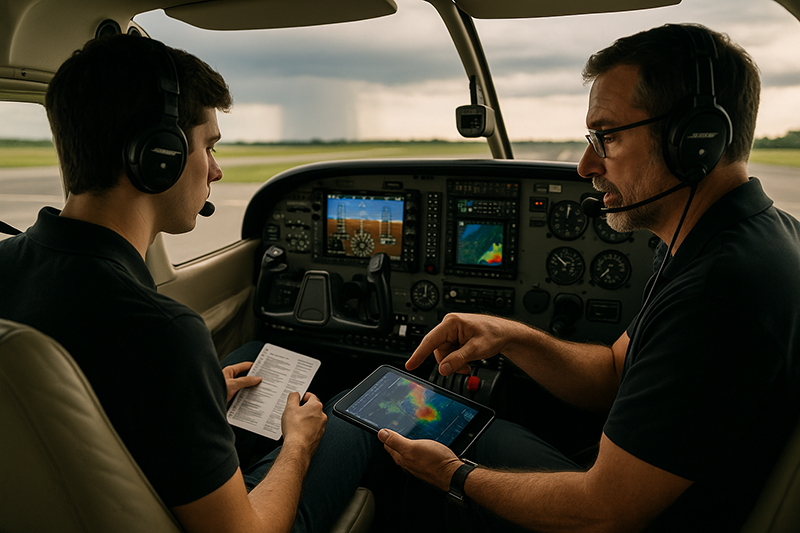
Scenario-based training techniques help pilots move beyond memorized answers and practice the kind of judgment they need in real flight operations. Instead of treating each maneuver, regulation, weather concept, or cockpit task as an isolated event, scenario-based training places those skills inside a realistic aviation decision. The student is not simply asked to demonstrate a steep turn or explain fuel reserves. The student is asked to plan, brief, fly, monitor, adapt, and decide as a pilot in command would.
For student pilots, flight instructors, recurrent training providers, and aviation professionals, this approach can make training more practical and more honest. Real flights rarely unfold as a perfect sequence from a lesson plan. Weather changes, passengers ask questions, avionics behave differently than expected, air traffic control instructions create workload, and the pilot must manage the aircraft while thinking ahead. Well-designed scenarios allow those realities to appear in training at an appropriate level, with enough structure to support learning and enough realism to develop judgment.
Scenario-based training is not a replacement for fundamentals. A pilot still needs sound stick-and-rudder skill, checklist discipline, aircraft systems knowledge, weather understanding, airspace awareness, and regulatory knowledge. The value of scenario-based training is that it connects those fundamentals. It helps pilots answer the question that matters most in the cockpit: what should I do now, and why?
What Scenario-Based Training Means in Aviation
Scenario-based training is an instructional method that uses realistic flight situations to teach and evaluate pilot decision-making, risk management, and task integration. A scenario may be as simple as a pre-solo student deciding whether to continue a local flight with lowering ceilings, or as complex as an instrument pilot managing an unexpected route change, equipment issue, and passenger pressure during a cross-country flight.
The key difference between scenario-based training and traditional maneuver-based training is context. A maneuver-based lesson might focus on short-field landings by repeating a procedure until the pilot can perform it to the desired standard. A scenario-based lesson might require the pilot to select an appropriate landing technique after evaluating runway length, wind, aircraft weight, obstacles, density altitude, runway surface, and go-around options. The short-field landing still matters, but the scenario adds the decision-making that determines whether that landing should even be attempted.
Good scenario-based training does not mean surprising the pilot with random failures or creating stress for its own sake. It means designing a realistic learning environment around clear objectives. The instructor knows what skill or judgment area is being developed. The pilot understands the purpose of the exercise. The scenario then allows the pilot to practice making decisions, communicating priorities, using available resources, and learning from the outcome.
A scenario can be used before, during, or after a flight. On the ground, it may appear as a planning discussion, weather briefing exercise, aircraft performance review, or go/no-go decision. In the airplane or simulator, it may appear as a route change, system abnormality, traffic conflict, deteriorating weather, unexpected runway assignment, or passenger-management problem. After the flight, it becomes a debriefing tool: what did you notice, what options did you consider, what risks changed, and what would you do differently next time?
Why This Matters in Real-World Aviation
Aviation safety depends on more than knowing procedures. Procedures are essential, but pilots operate in a changing environment. Weather forecasts are imperfect, workload rises and falls, aircraft performance varies with conditions, and human factors affect attention, memory, and judgment. Scenario-based training helps pilots practice operating in that dynamic environment while an instructor can still pause, coach, or redirect the learning.
In real-world flying, many important decisions happen before the airplane moves. Should the pilot launch with marginal weather along the route? Is the fuel plan conservative enough for the conditions? Does the planned runway provide acceptable performance margin? Is the pilot rested, current, and proficient for this flight? These questions are difficult to train if every lesson begins with the assumption that the flight will proceed as planned. A scenario allows the instructor to place those questions at the center of the lesson.
Scenario-based training also supports transfer of learning. A student who memorizes a single answer for a single condition may struggle when the situation changes. A student who has practiced evaluating conditions, identifying hazards, developing alternatives, and explaining decisions is more likely to apply the underlying concept in a new situation. The objective is not to teach one perfect answer for every possible flight. The objective is to build a thinking process that works across many flights.
This is especially important during transitions. A pilot moving from a training aircraft to a more capable airplane may face greater speed, more automation, more systems, and more complex airspace. A pilot beginning instrument training must learn to manage aircraft control, navigation, communication, weather interpretation, and procedure compliance under higher workload. A flight instructor candidate must learn not only to fly, but to observe, teach, intervene, and debrief. In each case, realistic scenarios help connect technical knowledge to operational judgment.
The Core Elements of an Effective Training Scenario
A useful aviation scenario has four basic elements: a clear objective, realistic conditions, meaningful decisions, and a structured debrief. If any of these elements is missing, the scenario can become either a vague discussion or an unfair test.
The objective should be specific. For example, an instructor may want a private pilot student to practice diversion planning, fuel awareness, and communication with air traffic control. Another lesson may focus on crosswind decision-making, automation management, or weather avoidance. The objective gives the instructor a reason for choosing the scenario and gives the pilot a basis for measuring progress.
The conditions should feel plausible. Scenarios are most powerful when they resemble problems pilots actually face: a forecast that is legal but not comfortable, a passenger who is late and pressuring the schedule, a runway closure, an alternator warning, a stronger-than-expected headwind, a low fuel state created by poor planning, or a confusing clearance in busy airspace. Extreme or theatrical situations may be memorable, but they can distract from the learning objective if used too often or too early.
The decisions should matter. A scenario is not just a story wrapped around a maneuver. The pilot should have options, and those options should have consequences. Continue, divert, delay, climb, descend, request help, return to the airport, change the plan, or stop the flight before departure. The instructor should resist the urge to steer every choice immediately. The pilot needs enough room to think, explain, and learn.
The debrief is where much of the learning becomes durable. A good debrief asks the pilot to reconstruct the decision process rather than simply defend the final answer. What cues did you notice? What information did you miss? What assumptions did you make? What risk controls were available? At what point would you change the plan? This reflective process helps pilots build judgment without relying only on instructor correction.
How Pilots Should Understand This Topic
Pilots should understand scenario-based training as practice for the whole flight, not just practice for emergencies. Emergencies are important, but most aviation decision-making occurs in less dramatic conditions. A flight may be legal but unwise for a pilot's experience level. A runway may be long enough on paper but leave little comfort after considering wind, surface, temperature, and aircraft loading. A route may be familiar but become demanding when airspace, weather, and cockpit workload combine.
Scenario-based training teaches pilots to integrate three broad areas: aircraft control, operational knowledge, and risk management. Aircraft control includes the ability to maintain attitude, airspeed, altitude, heading, and configuration. Operational knowledge includes regulations, procedures, aircraft systems, performance, weather, navigation, communications, and airport operations. Risk management is the pilot's ability to identify hazards, assess their significance, choose controls, and adjust when conditions change.
A practical way to view scenario-based training is to ask, “What is the pilot trying to accomplish, and what could interfere with that outcome?” For a cross-country flight, the goal might be to transport passengers safely to a destination. Interference could come from weather, fuel, fatigue, terrain, airspace, aircraft equipment, time pressure, or pilot proficiency. The scenario brings those factors into the training environment so the pilot can practice recognizing and managing them.
This approach also encourages pilots to verbalize their thinking. Instructors often learn more from a student's explanation than from the final action alone. A student may make the correct radio call but misunderstand the airspace. Another may choose a safe diversion but for the wrong reason. When pilots explain their decision-making, instructors can identify gaps in understanding, not just errors in performance.
Building Scenarios Around Pilot Experience Level
Effective scenario-based training must match the pilot's stage of learning. A new student pilot should not be overloaded with a complex instrument-style abnormal situation while still learning basic aircraft control. Likewise, an advanced pilot should not spend all scenario time on simple choices that do not challenge planning, workload management, or judgment.
For early student pilots, scenarios should be short, concrete, and closely connected to the lesson. During pattern work, an instructor might ask what the student would do if the crosswind increased or if another aircraft extended downwind. During a local practice flight, the instructor might introduce a simple decision about returning to the airport because visibility is not as good as expected. The goal is not to create pressure. The goal is to begin building the habit of noticing changes and making safe decisions.
For pre-solo and cross-country students, scenarios can expand into weather interpretation, fuel planning, airport selection, airspace entry, and diversion decisions. A student might plan a cross-country flight, then be given a realistic change such as a headwind that reduces groundspeed, a temporary runway closure at the destination, or a passenger who wants to continue despite worsening weather. These scenarios help the student see that planning is not a paperwork exercise. It is the first stage of risk management.
For instrument students, scenario-based training can focus on workload, automation, clearance changes, approach selection, missed approach planning, and weather decision-making. The instructor can present situations that require the pilot to brief an approach, manage avionics, communicate clearly, and decide when the plan is no longer appropriate. The emphasis should remain on safe instrument habits, not on tricking the pilot into mistakes.
For certificated pilots, scenarios are valuable during flight reviews, instrument proficiency checks, aircraft checkouts, transition training, and recurrent training. A pilot who has flown for years may not need a lecture on basic aerodynamics, but may benefit greatly from a realistic discussion of personal minimums, automation dependency, passenger pressure, night operations, or diversion planning. Scenario-based recurrent training can expose complacency in a constructive way.
Instructor Techniques That Make Scenarios Work
The instructor's role in scenario-based training is not to act as a scriptwriter who controls every move. The instructor is a facilitator, safety monitor, evaluator, and coach. The best scenarios allow the learner to make decisions while the instructor maintains appropriate boundaries and ensures the lesson remains safe and productive.
Before the lesson, the instructor should define the training objective and decide what information the pilot will receive. Too much information can remove the need for decision-making. Too little information can turn the scenario into a guessing game. For example, if the objective is weather decision-making, the pilot should have enough weather data to make a reasoned choice, but may also need to deal with uncertainty, changing conditions, or conflicting indications.
During the scenario, instructors should use questions carefully. A well-timed question can prompt thinking without taking control. Questions such as “What are your options?” “What information would help you decide?” or “What would make you discontinue this approach?” encourage the pilot to assess the situation. In contrast, a leading question may give away the expected answer and reduce the scenario to a quiz.
Instructors also need to manage workload. Scenario-based training can become counterproductive if the pilot is saturated beyond the learning objective. A student who is still struggling to hold altitude may not learn much from a layered abnormal situation that requires navigation, communications, and systems diagnosis at the same time. The instructor should adjust complexity so the scenario remains challenging but teachable.
Finally, instructors should debrief with discipline. It is easy to spend the entire debrief reviewing every minor error. A more effective approach is to focus on the decisions that mattered, the cues that were recognized or missed, and the habits that should carry forward. The debrief should leave the pilot with practical insight, not simply a list of mistakes.
Common Mistakes or Misunderstandings
One common misunderstanding is that scenario-based training means every lesson must be complex. In reality, simple scenarios are often the most effective. A short discussion about whether to depart with a gusty crosswind can teach more than an elaborate scripted emergency if it is tied to aircraft capability, pilot proficiency, runway selection, and personal minimums.
Another mistake is using scenarios mainly as traps. If the instructor builds a situation where the student is almost certain to fail, the training may produce embarrassment rather than learning. There is value in allowing pilots to experience the consequences of poor decisions in a safe training environment, but the goal should be development, not humiliation. The best scenario challenges the pilot's thinking while preserving trust between instructor and learner.
Some pilots also confuse legal minimums with good decisions. Scenario-based training is an excellent way to explore that distinction without inventing rules. A flight may comply with applicable regulations and still be a poor choice for a particular pilot, aircraft, route, time of day, or weather pattern. Training scenarios can help pilots develop personal minimums and operational judgment that sit above the regulatory floor.
A related mistake is treating the debrief as a search for the one correct answer. Many aviation decisions involve judgment within a range of acceptable options. One pilot may choose to delay departure. Another may choose a different route. A third may launch but establish firm decision points and alternates. The instructor's job is to evaluate the quality of the reasoning, the risk awareness, and the safety margin, not merely whether the pilot chose the instructor's preferred option.
Another risk is neglecting basic skill proficiency. Scenario-based training should not become a substitute for precise aircraft control, checklist use, traffic scan, radio communication, or procedure knowledge. A realistic scenario becomes valuable only when the pilot has enough foundational skill to participate meaningfully. Fundamentals and scenarios should reinforce each other.
Practical Example: A Cross-Country Flight That Changes
Consider a private pilot student preparing for a day VFR cross-country flight with an instructor. The planned route is familiar, the aircraft is a typical training airplane, and the destination has a runway long enough for normal operations under expected conditions. The student completes the planning, checks weather, calculates fuel, reviews airspace, and briefs the route.
Before departure, the instructor updates the scenario: the destination wind has shifted and is now favoring a different runway. The forecast also suggests that ceilings along part of the route may be lower later in the afternoon. The instructor does not say whether the flight should continue. Instead, the student is asked to evaluate the new information.
A maneuver-based lesson might proceed directly to navigation practice. A scenario-based lesson pauses at the decision point. The student considers runway orientation, crosswind comfort, fuel margin, route options, nearby airports, terrain, time of day, and the possibility of returning early. The student may decide to continue with a revised plan, delay, choose a different destination, or cancel. Each option can be discussed in terms of risk, not pride.
During the flight, the instructor adds another realistic development. The groundspeed is lower than planned because of stronger headwinds. The student must compare actual progress with the fuel plan and estimated time en route. Later, a simulated passenger asks whether they can still make the original destination because of an appointment. This introduces external pressure, a common human factors issue in aviation decision-making.
The most important learning moment may not be the landing at all. It may be the point where the student says, “We are still safe, but the margin is getting smaller. I want to divert to the airport ahead, refuel, and reassess.” That is a pilot-in-command decision. The aircraft handling, navigation, communication, fuel awareness, and risk management all come together in one realistic training event.
Best Practices for Pilots
Pilots get the most from scenario-based training when they participate actively. That means preparing for lessons, explaining decisions, asking for feedback, and being willing to revise a plan. A scenario is not a performance stage where the pilot must appear perfect. It is a training environment where thoughtful mistakes can produce valuable learning.
One of the best habits is to verbalize risk before it becomes urgent. During planning, say what conditions would cause you to delay, divert, or return. In flight, identify changes early: lowering visibility, unexpected turbulence, higher fuel burn, rising workload, confusing avionics indications, or uncertainty about position. Speaking these observations helps prevent passive continuation into a narrowing set of options.
Pilots should also build scenarios into personal proficiency flying. Even without an instructor on board, a pilot can ask, “What would I do if the destination became unavailable?” “Where is my best diversion airport right now?” “What is my fuel state compared to the plan?” “What is the escape route if the weather ahead is worse than expected?” These mental exercises should never distract from flying the aircraft, but they can sharpen situational awareness during appropriate phases of flight.
For instructors and training organizations, scenario design should be intentional. The scenario should match the pilot's experience, the aircraft, the local operating environment, and the lesson objective. It should include realistic pressures, but not unnecessary theatrics. It should produce a debrief that connects performance to future behavior.
- Use scenarios to connect maneuvers, planning, weather, aircraft systems, and decision-making.
- Keep early scenarios simple and increase complexity as pilot proficiency improves.
- Debrief the decision process, not just the final action or maneuver outcome.
- Include normal operations, abnormal situations, and human factors such as time pressure or passenger expectations.
- Preserve foundational flying skills. Scenarios work best when basic aircraft control remains disciplined.
Using Scenarios for Risk Management
Risk management is often taught through models, acronyms, and worksheets. Those tools can be useful, but scenario-based training gives them life. Instead of asking a pilot to recite a risk model, the instructor can ask the pilot to apply it to a real-looking flight. What hazards exist? Which ones matter most? What can reduce the risk? What decision point will trigger a change in plan?
For example, imagine a night flight to a rural airport after a long workday. The weather is acceptable, but the pilot is tired, the destination has limited services, and the surrounding area has fewer visual references. A scenario like this encourages discussion of fatigue, night illusions, runway lighting, alternate planning, fuel reserves, and the difference between being legally current and being personally ready.
Risk management scenarios should include both hazards and controls. A hazard without a control can make the exercise feel fatalistic. A control might be delaying until daylight, taking another qualified pilot, choosing a better-equipped airport, carrying extra fuel, setting conservative weather limits, or canceling the flight. The lesson is not that every risk requires cancellation. The lesson is that risk should be recognized, evaluated, and managed before it manages the pilot.
Using Scenarios With Simulators and Aviation Training Devices
Simulators and aviation training devices can be excellent platforms for scenario-based training when used with clear objectives. They allow instructors to create weather, system abnormalities, navigation changes, and workload events that may not be practical or safe to introduce in the airplane. They also make it easier to pause, reset, replay, and debrief key moments.
The value of simulation is not limited to instrument training. VFR pilots can practice weather avoidance decisions, diversion planning, communication flow, cockpit organization, and abnormal procedures. Instrument pilots can practice approach briefings, missed approach decisions, avionics management, and workload prioritization. Instructors can observe where the pilot looks, what the pilot says, and how quickly the pilot recognizes that the plan must change.
Simulation should still be treated as training, not entertainment. The scenario should be plausible, the learning objective should be defined, and the debrief should connect simulator performance to real aircraft operations. Instructors should also be clear about the limits of any device, especially where control feel, visual cues, aircraft performance, or avionics behavior may differ from the airplane being flown.
How Scenario-Based Training Supports Flight Reviews and Recurrent Training
Flight reviews and recurrent training are natural opportunities for scenario-based instruction. A pilot who already holds a certificate may benefit more from realistic operational scenarios than from a disconnected review of topics. The instructor can tailor the session to the pilot's typical flying: local recreational flights, family cross-countries, night operations, instrument trips, mountain-area flying, complex aircraft, or technically advanced aircraft.
A productive recurrent training session might begin with a discussion of recent flying, aircraft type, usual routes, comfort level, and areas where the pilot wants improvement. The instructor can then build scenarios around the pilot's real operations. For example, a pilot who frequently flies with family may benefit from passenger pressure scenarios. A pilot returning after a long break may need workload management and airspace refreshers. A pilot using modern avionics may need practice reverting to basic navigation and raw data when automation becomes confusing.
The goal is to make recurrent training relevant. Pilots are more likely to change habits when the training resembles decisions they actually make. Scenario-based training also helps instructors identify subtle risks that may not appear during a simple maneuver review, such as weak preflight planning, overreliance on automation, poor fuel monitoring, or reluctance to ask for assistance.
Frequently Asked Questions
Is scenario-based training only for advanced pilots?
No. Scenario-based training can begin early, but the scenario must match the pilot's experience. A new student may work through simple weather, traffic pattern, or go/no-go decisions. More advanced pilots can handle layered scenarios involving route changes, systems, instrument procedures, passenger pressure, or automation management.
Does scenario-based training replace maneuver practice?
No. Maneuver proficiency remains essential. Scenario-based training gives those maneuvers operational context. A pilot still needs to practice stalls, takeoffs, landings, emergency procedures, navigation, and instrument skills as appropriate. Scenarios help the pilot decide when, why, and how those skills apply in real flight operations.
What makes a scenario realistic rather than artificial?
A realistic scenario is based on situations pilots could plausibly encounter in the aircraft and operating environment being trained. It includes enough information for the pilot to make a reasoned decision, allows more than one possible outcome when appropriate, and connects directly to the lesson objective.
How should instructors debrief a scenario?
Instructors should debrief both the outcome and the thinking process. Useful questions include what the pilot noticed, what risks were present, what alternatives were considered, what information was missing, and what decision points should be used next time. The goal is improved judgment, not simply identifying mistakes.
Can pilots use scenario-based thinking when flying alone?
Yes, within normal cockpit workload limits. Pilots can mentally rehearse diversions, fuel checks, weather escape plans, and abnormal procedures during appropriate phases of flight. The priority must always remain aircraft control, traffic awareness, navigation, and communication.
Bringing Scenario-Based Training Into Everyday Flying
The strongest pilots tend to think ahead. They do not wait until a problem becomes urgent before considering options. Scenario-based training develops that habit by making “what if” thinking a normal part of aviation practice. What if the runway changes? What if the weather lowers? What if the passenger becomes uncomfortable? What if the avionics fail to sequence correctly? What if the fuel plan no longer matches the actual groundspeed?
For student pilots, this kind of training builds confidence because it shows how decisions are made, not just what answers are expected. For certificated pilots, it keeps proficiency connected to actual operations. For instructors, it creates a richer learning environment where aircraft control, knowledge, and judgment are developed together.
Scenario-based training works best when it is practical, respectful, and specific. It should challenge the pilot without becoming a guessing game. It should include real aviation pressures without becoming theatrical. It should help the pilot leave the lesson with better habits, better awareness, and a clearer understanding of personal limits.
Ultimately, scenario-based training techniques are about preparing pilots for the flight that does not follow the script. That is where judgment matters most. The pilot who can recognize changing risk, manage workload, communicate clearly, and choose a conservative option before options disappear is practicing the kind of decision-making aviation demands.
Key Takeaways
- Scenario-based training connects aviation knowledge, aircraft control, and decision-making inside realistic flight situations.
- The best scenarios are purposeful, plausible, matched to pilot experience, and followed by a thoughtful debrief.
- Pilots and instructors should use scenarios to practice risk management, personal minimums, workload control, and safe changes of plan.