
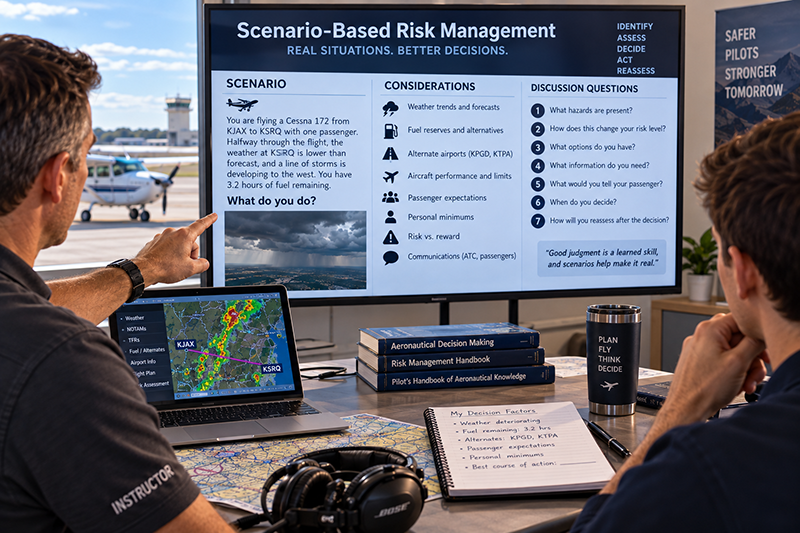
Scenario-based risk management gives pilots something a lecture rarely can: practice making decisions while a flight is still unfolding. Pilots do not encounter risk as a definition on a slide. They encounter it as a lowering ceiling, a passenger asking to continue, a runway that looks shorter than expected, a fuel stop that seems inconvenient, or a maintenance discrepancy that appears minor until the situation becomes more complex.
For flight instructors, chief instructors, safety managers, and serious pilots, the training question is not whether risk management matters. It clearly does. The more useful question is how to teach it so that pilots can recognize changing conditions, evaluate options, and take timely action before a situation narrows their choices. Scenario-based training is one of the most effective ways to move risk management from abstract knowledge into practical cockpit judgment.
This article explains how to teach aviation risk management through realistic scenarios instead of relying primarily on lectures. It is written for pilots and instructors who want risk management training to sound less like a classroom requirement and more like the way decisions actually happen in flight. The goal is not to eliminate briefings, models, or structured teaching. The goal is to use them in a way that supports thinking, discussion, and safer choices in real operations.
What Scenario-Based Risk Management Really Means
Scenario-based risk management is the practice of teaching pilots to identify hazards, assess risk, make decisions, and reassess conditions inside a realistic aviation situation. Instead of asking a student to define aeronautical decision-making, the instructor presents a flight context that requires judgment. The student must interpret the situation, prioritize information, and decide what to do next.
A strong scenario is not a trick question. It is a carefully designed learning environment. The instructor chooses a setting, aircraft, route, weather picture, operational pressure, passenger expectation, or aircraft condition that resembles a situation a pilot may actually face. The scenario then gives the learner enough information to make a reasonable decision, while still leaving room for uncertainty. That uncertainty is important because real flights rarely present every answer in a clean sequence.
In a lecture, a pilot may correctly say that external pressure is a risk factor. In a scenario, that same pilot may have to tell a waiting friend that the flight will be delayed because the forecast has deteriorated. In a lecture, a pilot may recite that fuel reserves should be protected. In a scenario, the pilot may have to choose between pressing on toward the original destination or diverting early while options are still favorable. The second form of training reveals how the pilot thinks under operational pressure.
Scenario-based risk management also helps connect several important aviation concepts that are sometimes taught separately. Hazard identification, personal minimums, weather interpretation, aircraft performance, workload management, situational awareness, and crew or passenger communication all interact during a flight. A well-built scenario allows those elements to appear together, which is much closer to actual flying.
Why Lectures Alone Often Miss the Point
Lectures are not the enemy. Pilots need ground instruction, technical explanations, regulatory knowledge, and exposure to established decision-making models. A lecture can introduce vocabulary, explain principles, and create a common foundation. The limitation is that a lecture usually asks the pilot to recognize the right answer after the problem has already been framed.
In real aviation, the hard part is often recognizing that a problem is forming at all. A pilot may not receive a dramatic warning that the situation is becoming unsafe. Instead, several small changes may accumulate. The wind is stronger than forecast. The arrival airport is reporting marginal visibility. The passenger is uncomfortable. The student is behind the airplane. The instructor is tempted to continue because the training objective has not been completed. Each detail may seem manageable alone, but together they alter the risk picture.
Lecture-based training can also unintentionally make risk management sound like a compliance topic rather than a flying skill. If students associate risk management only with written tests or verbal definitions, they may fail to use it when it matters most. Scenario-based training reframes risk management as active cockpit work. It asks, “What are you seeing, what is changing, what are your options, and when will you act?”
Another weakness of lecture-only training is that it can hide decision-making habits. A student may know the correct terminology but still be reluctant to divert, delay, discontinue a maneuver, or challenge an assumption. Instructors cannot coach those habits effectively until they see them. Scenarios make judgment visible.
Why This Matters in Real-World Aviation
Risk management is not limited to abnormal events or emergencies. Most risk management occurs during ordinary operations: planning a cross-country, evaluating a weather update, deciding whether to accept a runway, managing fatigue, briefing a passenger, or determining whether a training maneuver should continue. The quality of those routine decisions often determines whether a flight remains simple or becomes demanding.
For student pilots, scenario-based risk management builds judgment before experience has had time to accumulate. A new pilot may not yet have encountered marginal weather, unexpected maintenance delays, complex airspace, or passenger pressure. Scenarios allow the instructor to expose the student to those decision points in a controlled learning environment. That exposure helps the student build mental patterns that can be recalled later.
For certificated pilots, scenarios help prevent complacency. Experience is valuable, but it can also create confidence that exceeds current proficiency, aircraft familiarity, or environmental conditions. A pilot who has made many successful flights can still be surprised by a combination of fatigue, weather, aircraft loading, or operational pressure. Scenario-based training keeps the pilot engaged in active risk assessment rather than relying only on past success.
For instructors, scenarios improve the quality of teaching because they shift the focus from telling to discovering. The instructor can observe how the learner gathers information, whether the learner updates the plan when conditions change, and how the learner communicates a decision. Those observations are often more meaningful than whether the student can repeat a definition from memory.
For aviation organizations, realistic scenarios can support a stronger safety culture. When training consistently treats conservative decisions as professional decisions, pilots are more likely to speak up, delay, divert, or cancel when conditions warrant. The point is not to create timid pilots. The point is to create pilots who understand that disciplined decision-making is part of operational competence.
How Pilots Should Understand This Topic
Pilots should understand scenario-based risk management as a method for practicing judgment, not as a replacement for technical knowledge. A pilot still needs to understand weather, aircraft systems, performance, regulations, airspace, human factors, and normal procedures. Scenarios become effective when they require the pilot to apply that knowledge to a situation that contains tradeoffs.
A useful way to think about risk management is that hazards are conditions that can cause harm, while risk is the exposure created by those hazards in a specific context. A thunderstorm near the route is a hazard. The risk depends on the aircraft, pilot experience, fuel, alternate airports, route options, time of day, and willingness to delay or divert. Scenario-based training helps pilots avoid treating hazards as isolated facts. It teaches them to ask what the hazard means for this flight, in this airplane, with this pilot, at this time.
Many instructors use structured decision-making models to organize this thinking. Common aviation frameworks include evaluating the pilot, aircraft, environment, and external pressures, as well as periodically reassessing the plan during each phase of flight. These models are helpful because they give pilots a repeatable way to scan for changing risk. However, the model should not become the lesson by itself. The training value comes when the model is applied to a realistic decision.
For example, instead of asking a student to list the categories of a risk assessment model, the instructor might ask the student to plan a flight with a marginal forecast, a passenger who needs to arrive by a certain time, and an aircraft that is near maximum allowable loading. The instructor can then ask: What concerns you? What information do you need? What would make this a no-go decision? What would make you turn around after departure? How would you explain the decision to your passenger?
Those questions turn risk management into an operational habit. The student learns that a safe decision is not only a final answer. It is a process of noticing, questioning, setting limits, and acting before the margin is gone.
Designing Scenarios That Teach Instead of Test
The best training scenarios are built around clear learning objectives. An instructor should know what the scenario is intended to develop before presenting it. The objective might be weather decision-making, diversion planning, passenger management, fuel planning, night operations, runway selection, automation management, or recognizing personal limitations. Without an objective, a scenario can become a story instead of a lesson.
A good scenario also needs the right level of complexity. If it is too simple, the answer is obvious and little judgment is required. If it is too complicated, the student may become overloaded and stop learning. Early scenarios for student pilots should usually focus on one or two major decision points. As the pilot gains skill, the instructor can add ambiguity, time pressure, competing priorities, or changing conditions.
Realism matters, but realism does not mean recreating an accident chain or overwhelming the learner with drama. Many valuable scenarios are ordinary. A student discovers that the planned practice area is busier than expected. A crosswind is stronger than the student has personally practiced. The destination airport has a runway closure that changes the arrival plan. A passenger feels unwell. The airplane is legal to fly, but a nonessential system is inoperative and the pilot must think through the operational implications. These situations are believable, and that makes them powerful.
Instructors should also avoid designing scenarios with only one acceptable answer unless the situation truly demands it. Risk management often involves several reasonable choices, each with advantages and limitations. The learning comes from comparing those choices. If the instructor has already decided that only one answer is acceptable, the student may focus on guessing the instructor’s preference instead of developing sound judgment.
Debriefing is where much of the learning occurs. After the scenario, the instructor should ask the pilot to describe what they noticed, what assumptions they made, when the risk level changed, and what they would do differently next time. A good debrief does not merely declare the decision right or wrong. It examines the reasoning behind the decision and reinforces habits that can be used on future flights.
Common Mistakes or Misunderstandings
One common mistake is treating scenario-based training as an oral exam. If every scenario becomes a search for the textbook answer, the student may learn to perform for the instructor rather than think like pilot in command. The instructor’s role is to challenge reasoning, not to trap the learner. Scenarios should encourage honest discussion, including uncertainty.
Another misunderstanding is assuming that risk management scenarios must involve emergencies. Emergency training is essential, but most safety-critical decisions begin before an emergency exists. A pilot who delays a departure, lands before weather worsens, or discontinues an unstable approach has managed risk before it becomes an urgent problem. Scenario-based training should emphasize early recognition and timely action, not only last-minute recovery.
A third mistake is overloading the scenario with too many hazards. It can be tempting to combine low fuel, bad weather, passenger pressure, equipment issues, fatigue, and unfamiliar airspace into one dramatic exercise. That may create excitement, but it can reduce instructional value if the learner cannot identify which decisions mattered most. Better training often comes from a realistic progression where one or two factors change at a time and the pilot must reassess.
Instructors can also undermine learning by revealing the lesson too early. If the instructor immediately tells the student what to think, the student loses the chance to practice recognition. A more effective technique is to ask guiding questions: What has changed since your preflight plan? What information would reduce uncertainty? What are your outs? How much time do you have before this becomes harder?
Pilots sometimes misunderstand personal minimums as fixed numbers that guarantee safety. Personal minimums are useful decision aids, especially for less experienced pilots, but they do not replace judgment. A ceiling, visibility, wind, or fuel threshold must be considered along with route, terrain, aircraft performance, proficiency, fatigue, and alternatives. Scenarios help pilots see that minimums are part of a broader risk picture.
Another risk is normalizing continuation bias. Continuation bias is the tendency to keep going with the original plan even when conditions suggest a change would be wiser. A pilot may continue because the destination is close, the passengers are expecting arrival, the airplane is performing normally, or the pilot has already invested time and money in the flight. Scenario-based training can expose this tendency in a safe setting and help pilots practice changing the plan early.
Practical Example: A Cross-Country Decision Scenario
Consider a private pilot planning a daytime VFR cross-country flight in a familiar single-engine training aircraft. The route is within the pilot’s experience, the airplane is available, and the passengers are looking forward to the trip. The preflight weather briefing shows VFR conditions along the route, but the forecast also suggests the possibility of lowering ceilings later in the day near the destination. Surface winds are expected to increase, and the destination has one runway that may produce a moderate crosswind component for this pilot’s experience level.
In a lecture, the instructor might explain weather minimums, crosswind planning, passenger pressure, and diversion airports as separate topics. In a scenario, the pilot must combine them. The instructor asks the pilot to brief the flight as if it were real. The pilot reviews weather, fuel, aircraft performance, airport information, and passenger considerations. The instructor then introduces updated information: the destination ceiling is trending lower than forecast, a nearby alternate remains better, and one passenger has an appointment shortly after the planned arrival time.
The training value begins when the instructor asks the pilot to make and explain a decision. Would the pilot depart as planned, delay, choose a different destination, adjust the route, add a fuel stop, or cancel? What would be the trigger to divert? How would the pilot communicate the decision to passengers? What information would the pilot monitor after takeoff? If the destination wind increases, what runway and landing alternatives are available?
There may be more than one defensible answer depending on the exact conditions and pilot proficiency. The point is not to force a dramatic cancellation. The point is to make the pilot articulate risk, margins, alternatives, and decision triggers. If the pilot says, “We can probably make it,” the instructor can probe further. What does “probably” mean? What will you do if the ceiling drops another few hundred feet? At what point does the passenger’s schedule stop being relevant? Which airport gives you the best option before the route becomes constrained?
This example also teaches communication. Many pilots understand the safe choice but hesitate to disappoint passengers. A scenario allows the pilot to practice professional wording: “The forecast is changing, and I want to keep good options available. We are going to delay and reevaluate, or we will choose a different airport with better conditions.” That kind of rehearsal makes it easier to act decisively in real life.
Best Practices for Pilots and Instructors
Effective scenario-based risk management training should be deliberate, realistic, and repeatable. It should not depend on whether an unusual event happens during a lesson. Instructors can build scenarios into preflight briefings, simulator sessions, flight lessons, postflight debriefs, and recurrent training. Pilots can use the same approach for personal proficiency by mentally rehearsing decisions before and during a flight.
One best practice is to start with the flight the pilot is actually about to conduct. If the lesson is a local flight, the scenario can involve local weather, runway selection, traffic, fuel, or training area workload. If the lesson is a cross-country, the scenario can involve route changes, diversion planning, alternates, passenger expectations, or changing visibility. Real flights provide natural risk management opportunities.
Another best practice is to ask open-ended questions before giving answers. Questions such as “What concerns you most about today’s flight?” or “What would cause you to discontinue this plan?” reveal how the pilot is thinking. They also encourage ownership. A pilot who sets a decision trigger before departure is more likely to respect it when conditions change.
Instructors should normalize conservative decisions. If a student chooses to delay, divert, or discontinue based on sound reasoning, that decision should be treated as good airmanship, not as a failed training event. This is especially important because pilots learn from instructor reactions. If an instructor appears frustrated when a student makes a cautious decision, the student may receive the unintended message that completion matters more than judgment.
Short, repeated scenarios are often more effective than rare, elaborate ones. A five-minute discussion during preflight can be enough to strengthen decision-making. For example, the instructor might ask what the student would do if the practice area weather deteriorated, if the radio became unreliable, if the student felt task saturated, or if the destination runway changed. Regular exposure builds a habit of thinking ahead.
The following practices can help keep scenario-based training focused and useful:
- Define the learning objective before presenting the scenario.
- Use realistic conditions, aircraft, airports, and pilot experience levels.
- Let the learner make decisions before offering instructor judgment.
- Include changing information so the pilot must reassess the plan.
- Debrief the reasoning process, not only the final answer.
- Reinforce early action, communication, and preservation of options.
Pilots training on their own can also use scenario thinking. Before departure, ask: What are the top three risks today? What could change? Where are my best alternatives? What decision would I make now that might become harder later? During flight, periodically compare actual conditions to the plan. If the flight no longer matches the assumptions used to launch, reassess before options narrow.
Using Scenarios in Ground, Simulator, and Flight Training
Scenario-based risk management can be taught in several environments. Ground training is useful for slowing the decision down. The instructor can present weather reports, airport diagrams, aircraft loading information, and passenger factors, then allow discussion without the workload of flight. This is especially helpful for introducing new pilots to the reasoning process.
Simulator or aviation training device sessions can add time pressure and cockpit workload without exposing the aircraft to actual operational risk. A simulator can be useful for practicing diversions, systems management, weather avoidance decision-making, abnormal procedures, and workload prioritization. The instructor can pause, rewind, or repeat a scenario, which is difficult in the airplane.
Flight training adds realism because the pilot must manage the aircraft while making decisions. However, instructors should be careful not to create unsafe distractions or unrealistic surprises. A scenario in the airplane should fit the lesson, the airspace, the aircraft, and the student’s ability. Safety of flight always comes before instructional creativity.
The strongest programs often combine all three. The concept is introduced on the ground, practiced in a lower-risk environment, and then reinforced during actual flight operations. Over time, the pilot learns that risk management is not a separate training event. It is part of every preflight, taxi, takeoff, cruise, approach, landing, and postflight review.
How to Debrief Risk Management Decisions
A debrief should help the pilot understand both the decision and the decision-making process. Instructors can begin by asking the learner to self-assess. What did you notice first? What information mattered most? Did any pressure influence you? Did you consider alternatives early enough? What would you do differently if this happened on a solo flight or with passengers?
Self-assessment matters because the pilot needs to internalize the lesson. If the instructor simply states the correct answer, the learner may comply without changing future habits. When the learner explains the reasoning, the instructor can identify assumptions, gaps, or strengths. The conversation becomes coaching instead of grading.
Debriefs should also identify decision points. In many scenarios, the final outcome receives too much attention. The more valuable question is often, “When did the flight first begin to change?” If the pilot can recognize that point earlier next time, the response will likely be easier and safer. Early recognition preserves options.
Finally, the instructor should connect the scenario to future behavior. A good debrief ends with a practical commitment: a personal minimum to refine, a passenger briefing to improve, a weather review habit to strengthen, a diversion trigger to set, or a workload management technique to practice. The lesson should leave the pilot with something usable.
Frequently Asked Questions
Is scenario-based risk management only for student pilots?
No. Student pilots benefit because scenarios build judgment before they have extensive experience, but certificated pilots, instructors, and aviation organizations can use the same approach for recurrent training, proficiency checks, and safety discussions. The complexity should match the pilot’s experience and operation.
Do scenarios replace formal ground instruction?
No. Pilots still need formal instruction in weather, aircraft systems, performance, regulations, procedures, and human factors. Scenarios are most effective when they require the pilot to apply that knowledge to realistic decisions.
How realistic should a training scenario be?
A scenario should be realistic enough to resemble an actual decision a pilot may face, but not so complex that the training objective becomes lost. Ordinary situations, such as changing weather, passenger pressure, fuel planning, or runway selection, often create excellent learning opportunities.
What makes a risk management scenario effective?
An effective scenario has a clear learning objective, relevant context, enough uncertainty to require judgment, and a debrief that examines the pilot’s reasoning. It should encourage the pilot to identify hazards, assess options, communicate clearly, and act while options remain available.
How can pilots practice this without an instructor?
Pilots can practice by asking scenario-based questions during preflight planning and in cruise: What has changed? What are my alternatives? What decision would I make if conditions worsened? What pressure might influence me? This habit turns routine flights into opportunities for better judgment.
Key Takeaways
- Scenario-based risk management helps pilots turn aviation judgment concepts into practical decisions made in realistic flight contexts.
- The greatest safety value often comes from recognizing changing conditions early, preserving options, and acting before the situation becomes urgent.
- Instructors should use scenarios to coach reasoning, communication, and decision triggers, not merely to test whether a student can recite definitions.