
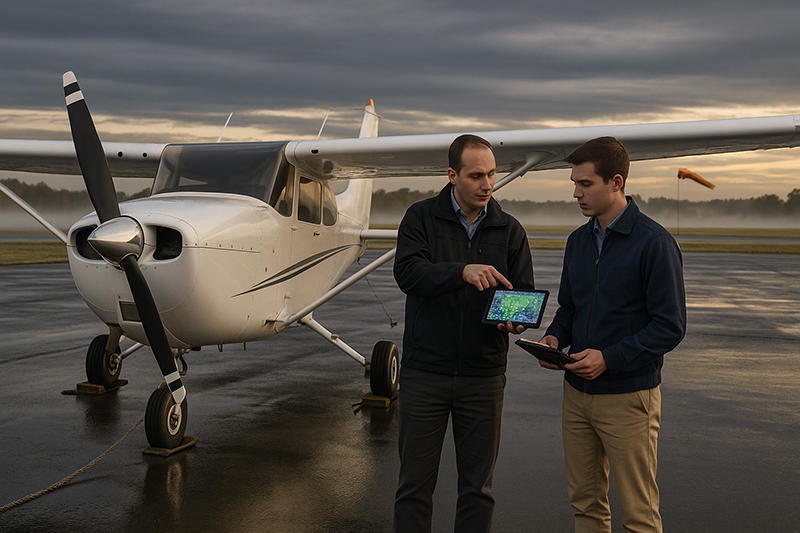
Weather risks during seasonal transitions deserve special attention because the atmosphere rarely changes seasons smoothly. For pilots, the weeks between winter and spring, spring and summer, summer and fall, and fall and winter can produce fast-moving fronts, shifting freezing levels, gusty winds, low ceilings, fog, convective activity, and rapidly changing runway conditions. These hazards are not unusual, but they can be easy to underestimate when the calendar suggests one season while the atmosphere is still behaving like another.
For student pilots, seasonal weather is a practical lesson in pattern recognition and humility. For flight instructors, it is an opportunity to teach beyond the METAR and TAF. For experienced pilots and aviation professionals, it is a reminder that safe decision-making depends on understanding the broader weather setup, not simply confirming that conditions meet a legal minimum. This article explains how transitional weather develops, why it matters in real-world flight operations, and how pilots can brief and manage the risk more effectively.
Why Seasonal Transitions Create Unique Aviation Weather Risks
Seasonal transition periods are aviation weather pressure cookers because air masses with different temperature, moisture, and stability characteristics frequently meet. A cold air mass may still be entrenched near the surface while warmer, moisture-laden air moves above it. A strong spring sun may heat the surface rapidly during the day, then clear skies may allow temperatures to fall quickly at night. In fall, dry and stable mornings can give way to widespread low visibility after sunset as cooling brings the temperature and dew point closer together.
The important point for pilots is that transitional weather often produces variability. Conditions may be excellent at departure and marginal at destination. A morning flight may be uneventful, while an afternoon return leg involves gusty crosswinds, convective buildups, or mechanical turbulence. A route that looks acceptable at lower elevations may be affected by cloud layers, precipitation, or icing potential over higher terrain. These are not exotic hazards. They are common operational problems that become more significant when pilots plan as though the weather will remain static.
Seasonal transition weather is also difficult because it can combine hazards. A single flight may involve marginal VFR ceilings, gusty winds, turbulence, embedded precipitation, and temperature conditions that require icing awareness. Pilots often train to identify hazards one at a time, but real weather rarely follows that format. The safe question is not simply, Can I fly through this? A better question is, What is the whole system doing, and what options will I still have if it changes faster than expected?
Major Weather Hazards During Seasonal Change
The specific risks vary by region, terrain, aircraft, route, time of day, and season, but several recurring hazards deserve attention during every seasonal change.
Frontal Weather and Rapid Ceiling Changes
Fronts are common during seasonal shifts because contrasting air masses are actively moving and replacing one another. A frontal passage can bring wind shifts, pressure changes, lowering ceilings, precipitation, turbulence, and temperature changes. The exact weather depends on the air masses involved and the type of front, but the practical flight planning concern is the same: conditions can change quickly over a relatively short distance or time period.
For VFR pilots, the greatest trap is launching into a route where the weather appears to meet basic visibility and cloud clearance needs at departure, while the destination or return window is deteriorating. For IFR pilots, the risk may shift toward approach minimums, alternate planning, convective activity, icing potential, or turbulence. In either case, the forecast trend matters as much as the current observation.
Low Ceilings, Fog, and Visibility Restrictions
Fog and low stratus are frequent concerns during seasonal transitions, especially when nighttime cooling is strong, moisture is present, and winds are light. Radiation fog can form in low-lying areas after clear nights. Advection fog can develop when moist air moves over a cooler surface. Upslope flow can contribute to low clouds near terrain. In fall and spring, these conditions may be localized enough to surprise a pilot who checks only a few reporting stations.
Visibility restrictions are particularly important in training operations because they can turn a simple local flight into a decision-making exercise. A student practicing in familiar airspace may look outside and see adequate visibility in one direction, while a nearby valley, shoreline, or river corridor is already filling with fog. Instructors should use these days to teach weather observation, escape planning, and the difference between legal conditions and useful training conditions.
Wind, Gusts, Turbulence, and Wind Shear
Seasonal transition periods often involve stronger pressure gradients and active mixing in the lower atmosphere. That can mean gusty surface winds, crosswind challenges, low-level turbulence, and mechanical turbulence near buildings, trees, ridges, and uneven terrain. When a front passes, the wind direction may change enough to alter runway selection, aircraft performance, and pilot workload.
Wind shear is another practical concern. It can occur with frontal passages, temperature inversions, convective outflows, and strong low-level winds. Pilots should treat significant changes in wind speed or direction with altitude as more than an academic weather topic. It can affect climb performance, approach stability, touchdown point, and go-around planning. A stabilized approach is harder to maintain when the wind is changing rapidly near the ground.
Convective Weather Outside the Middle of Summer
Many pilots associate thunderstorms mainly with hot summer afternoons, but convective weather can occur during other seasons when instability, moisture, and lift are present. Spring is well known for active convective setups in many regions, but fall and even winter can produce convective showers, isolated thunderstorms, small hail, strong gust fronts, or rapidly changing visibility in precipitation.
The practical mistake is assuming that cool surface temperatures eliminate convective risk. They do not. Convective potential is related to the vertical structure of the atmosphere, moisture, lift, and instability. Pilots do not need to become meteorologists to respect this. If forecasts, radar, satellite imagery, or aviation weather products indicate convective development, the risk should be treated seriously regardless of the month.
Icing Potential and Changing Freezing Levels
During transitional seasons, freezing levels can move significantly over time and distance. A route that appears free of icing concerns in the afternoon may become more concerning after sunset or at higher altitudes. Moisture above a cold surface layer can also support freezing precipitation in some setups. For aircraft not approved and equipped for flight in icing conditions, the operational takeaway is direct: avoid conditions where structural icing may occur, and maintain practical escape options if temperatures, clouds, and precipitation create concern.
Even without airborne icing, frost and contamination on the aircraft are critical preflight concerns. Any contamination on lifting surfaces should be taken seriously because it can degrade aerodynamic performance. Pilots should follow the aircraft manufacturer’s guidance, airport procedures, and sound preflight practice before flight. Seasonal change is when pilots may first encounter frost after months of warm-weather flying, and complacency can be a real threat.
Runway and Surface Condition Changes
Transition seasons can create runway and taxiway concerns that are not obvious from cruise altitude. Rain after a dry period, wet leaves, slush, frost, standing water, refreezing after sunset, or changing braking action reports can affect taxi, takeoff, landing, and rejected takeoff planning. At non-towered or lightly used airports, conditions may vary across the airport surface and may not be captured by a single report.
For pilots of light aircraft, this is not only a performance issue. It is also a workload issue. A gusty crosswind landing on a wet runway with falling temperatures requires more margin than the same landing on a dry runway in calm wind. Seasonal weather often asks pilots to manage multiple small risks at once. The combined risk is what matters.
Why This Matters in Real-World Aviation
Weather during seasonal transitions affects almost every part of a flight. It influences whether a lesson should be conducted, whether a cross-country should be delayed, whether an alternate plan is realistic, whether passengers should be briefed about turbulence, and whether a pilot should choose a different route or altitude. It also affects maintenance and ground operations through preheating needs, frost removal, tiedown security, hangar decisions, and protection from wind or precipitation.
In flight training, transitional weather is one of the best ways to develop aeronautical decision-making. A student can learn how a cold front appears in a forecast, how ceilings trend ahead of a warm front, how local terrain influences fog, and why a gusty day may be valuable for dual instruction but inappropriate for solo practice. The goal is not to make pilots afraid of weather. The goal is to teach them to recognize when the weather picture is becoming complex enough to require a different plan.
For instrument-rated pilots, seasonal transitions can create a different kind of temptation. An IFR clearance can provide structure and access to the system, but it does not remove weather hazards. Icing, convective activity, turbulence, low approaches, missed approach planning, and fuel reserves still require judgment. Legal capability and practical safety are related, but they are not the same thing.
Operators and aviation professionals also need to account for seasonal weather in scheduling and risk management. Dispatch reliability may change during fog-prone periods. Training syllabi may need flexibility during windy spring patterns or early winter icing setups. Maintenance teams may need to prepare for temperature swings, battery performance concerns, frost prevention, and aircraft storage considerations. Seasonal transition risk management is not only a cockpit issue. It is an operational discipline.
How Pilots Should Understand Seasonal Weather
A good seasonal weather briefing begins with the big picture. Before focusing on individual airport observations, pilots should understand the overall weather system. Where are the fronts? Which air mass is moving in? Is the pressure gradient tightening? Is moisture increasing? Are ceilings forecast to improve or deteriorate? Is the freezing level changing? Are there areas of precipitation, embedded convection, or mountain obscuration along the route?
After the big picture, the pilot can study the route in layers. Surface observations show what is happening now at reporting points. Terminal forecasts provide expected conditions at specific airports. Radar and satellite imagery help reveal precipitation, cloud structure, and movement. Pilot reports can add valuable real-world information about turbulence, cloud tops, icing, and visibility, when available. Area forecasts and aviation weather advisories can help pilots understand broader hazards that may not be obvious from one airport report.
The pilot should also think in terms of time windows. During seasonal transitions, the safest flight may be possible earlier or later than originally planned. Morning fog may burn off, but afternoon winds may increase. A front may arrive faster than expected. Temperatures may drop after sunset, changing both visibility and icing concerns. A forecast is not a guarantee. It is a planning tool that must be compared against actual trends before and during flight.
Another useful mental model is margin. Seasonal weather often erodes margin gradually. A ceiling lowers by a few hundred feet. A crosswind increases by a few knots. Visibility drops in precipitation. The destination remains technically available, but the return airport becomes less attractive. None of these changes alone may seem dramatic. Together, they can push a flight into a corner. Good pilots identify that trend early and act while options remain plentiful.
Seasonal Patterns Pilots Should Recognize
Every region has its own weather personality, so pilots should learn local patterns from instructors, experienced operators, meteorologists, and repeated observation. Still, several broad seasonal transition patterns are useful for aviation decision-making.
Winter to Spring
The transition from winter to spring often brings active frontal systems, strong winds, turbulence, changing freezing levels, and mixed precipitation concerns in colder regions. A warm surface temperature at the departure airport does not automatically mean the entire route is free of icing risk. Higher terrain, shaded valleys, and cloud layers aloft may tell a different story. Spring can also bring convective development as stronger sun angle and unstable air combine with frontal lift.
Spring to Summer
As spring turns to summer, pilots may see increasing convective activity, higher density altitude concerns, stronger thermal turbulence, and more pronounced afternoon weather cycles. Morning conditions may be smooth and favorable, while afternoon conditions may become bumpy or stormy. This transition is a good time to revisit aircraft performance planning and passenger comfort considerations, especially at high-elevation airports or on warm, humid days.
Summer to Fall
The move from summer to fall often introduces cooler nights, fog-prone mornings, lower sun angles, and more frequent stable layers. Pilots may encounter excellent flying weather after fog lifts, but early departures can be limited by low visibility and low ceilings. Fall can also bring stronger frontal passages after relatively quiet summer patterns. Crosswind planning and return-flight timing become especially important.
Fall to Winter
As fall turns to winter, pilots should become increasingly alert to freezing levels, frost, snow, ice, cold-soaked aircraft, slippery surfaces, and low ceilings. In some regions, the first winter weather events catch pilots and airports before routines are fully reset. Preflight inspections take longer. Deicing or frost removal may become necessary. Taxi and landing surfaces may require closer evaluation. The airplane may perform well in cold dense air, but that does not offset the hazards of contamination, braking limitations, and weather-related escape constraints.
Common Mistakes and Misunderstandings
One common mistake is planning from the calendar instead of the atmosphere. A pilot may think, It is spring now, so icing is not a concern, or it is fall now, so thunderstorms are over. The atmosphere does not follow calendar boundaries. Transitional periods are defined by conflict between air masses, not by the date.
Another mistake is relying too heavily on the departure airport observation. If the weather at home base is good, the pilot may mentally commit to the flight before fully evaluating the destination, route, terrain, alternates, and return window. This is especially risky when weather is moving quickly. A safe departure does not guarantee a safe arrival or a safe return.
A third mistake is treating marginal VFR as a stable category. Marginal conditions may be improving, deteriorating, or fluctuating. The trend is critical. A VFR pilot who launches into marginal conditions with lowering ceilings may have fewer options as terrain, airspace, and weather combine. An instrument pilot may be legal and capable, but still face unacceptable icing, convective, or approach risks depending on aircraft equipment, proficiency, and conditions.
Pilots also sometimes underestimate wind after a seasonal front passes. Clear skies behind a front may look inviting, but the pressure gradient and mixing can produce strong gusts, crosswinds, and turbulence. A flight that is safe for a proficient pilot receiving dual instruction may not be appropriate for a low-time solo student or a passenger-carrying trip.
Finally, pilots may brief the weather once and then stop learning. Seasonal weather rewards continuous updating. Before engine start, compare the forecast to current observations. Before departure, check whether conditions are moving faster than expected. En route, monitor weather information appropriate to the aircraft and operation. After landing, debrief what actually happened. That habit builds practical weather judgment over time.
Practical Example: A Spring Cross-Country Decision
Consider a private pilot planning a daytime VFR cross-country in early spring. The departure airport is reporting good visibility, a scattered cloud layer, and light winds. The destination is two hours away, near slightly higher terrain. A cold front is forecast to pass later in the day, with increasing winds and lowering ceilings behind it. Temperatures at the surface are above freezing, but cloud bases along part of the route are expected to lower, and the freezing level is not far above the planned cruise altitude.
A superficial briefing might conclude that the flight is legal and likely manageable. A deeper briefing raises better questions. What time is the front expected at the destination? Are ceilings trending down along the route? Is there precipitation ahead of or behind the front? Will the return flight be into stronger winds? Are there suitable airports along the way if the weather changes? If the pilot climbs for terrain or smoother air, does that increase exposure to cold cloud layers? If the flight is delayed by ground operations or passenger needs, does the risk profile change?
A conservative decision might be to depart earlier, shorten the route, fly with an instructor, file and fly IFR only if the pilot and aircraft are appropriate for the actual hazards, or postpone the trip. The important lesson is not that every spring front makes flight impossible. The lesson is that transition-season weather often requires time-based planning. The question is not only whether conditions are acceptable now. It is whether they are likely to remain acceptable for the whole operation, including realistic delays and alternatives.
Best Practices for Pilots
The most effective seasonal weather practice is to brief from broad to specific. Start with the weather system, then narrow the focus to route, airports, altitudes, timing, and aircraft capability. This helps prevent tunnel vision. A pilot who begins and ends with a single airport forecast may miss the larger pattern that controls the flight.
Personal minimums should also be seasonal and situational. A crosswind limit that feels reasonable on a dry runway in daylight may not be appropriate at night with gusts, wet pavement, and a passenger on board. A ceiling that works for local pattern practice may not be suitable for a cross-country over rising terrain. A comfortable IFR flight in smooth stratiform clouds may be very different from an IFR flight near convection or icing potential.
Good seasonal weather habits include:
- Compare forecast conditions with current trends before committing to the flight.
- Evaluate the route, destination, alternates, and return window, not just the departure airport.
- Pay close attention to freezing levels, cloud layers, and visible moisture during colder transition periods.
- Treat gusty winds, wind shifts, and post-frontal turbulence as operational risks, not inconveniences.
- Build decision points into the flight so diversion or cancellation happens early rather than late.
- Debrief flights afterward to improve recognition of local seasonal patterns.
Flight instructors should intentionally teach seasonal weather rather than waiting for it to surprise students. A lesson can include comparing morning and afternoon forecasts, reviewing why a flight was canceled, or flying dual in manageable gusty conditions to build crosswind judgment. Students learn more from a well-explained no-go decision than from a rushed launch into deteriorating weather.
Experienced pilots should resist the idea that familiarity eliminates risk. Familiar airports and routes can be deceptive because the pilot already has a mental picture of how the flight usually goes. Seasonal transition weather is exactly when usual patterns change. A disciplined briefing protects against the confidence that comes from repetition.
Frequently Asked Questions
Why is weather often more unpredictable during seasonal transitions?
Seasonal transitions bring competing air masses, changing sun angles, shifting moisture patterns, and active frontal systems. That combination can make ceilings, visibility, wind, precipitation, and temperatures change faster than pilots might expect from a routine forecast check.
What is the most important weather product for seasonal transition flying?
No single product is enough. Pilots should combine the big-picture weather analysis with airport observations, terminal forecasts, radar, satellite imagery, pilot reports when available, and applicable aviation weather advisories. The value comes from seeing how the products agree, disagree, and trend over time.
Can VFR pilots safely fly during seasonal transition periods?
Yes, when conditions, route, aircraft, pilot proficiency, and timing support a safe operation. The key is avoiding marginal thinking. VFR pilots should maintain strong weather margins, clear escape options, and a willingness to delay, divert, or cancel when ceilings, visibility, terrain, or wind reduce safety.
Are IFR pilots less affected by seasonal weather risks?
IFR training and equipment can help manage low ceilings and visibility, but they do not remove hazards such as icing, embedded convection, turbulence, wind shear, or runway contamination. IFR pilots still need careful weather analysis and conservative decision-making.
How should student pilots approach gusty seasonal winds?
Student pilots should follow instructor guidance, personal minimums, and aircraft procedures. Gusty winds can be excellent dual instruction opportunities, but they may be unsuitable for solo practice depending on the student’s experience, runway alignment, surface conditions, and traffic environment.
What should pilots watch after a front passes?
After frontal passage, pilots should watch for wind shifts, gusts, turbulence, changing ceilings, temperature drops, and runway condition changes. Clearer skies do not always mean easier flying, especially when strong winds and mechanical turbulence remain.
Key Takeaways
- Seasonal weather risks are driven by changing air masses, frontal activity, moisture, temperature swings, and shifting freezing levels, not simply by the date on the calendar.
- Safe flight planning requires evaluating the whole weather system, including route trends, destination conditions, alternates, return timing, winds, icing potential, and runway conditions.
- The best pilot response is disciplined decision-making: brief broadly, set realistic margins, update continuously, and choose delay, diversion, dual instruction, or cancellation before options narrow.