
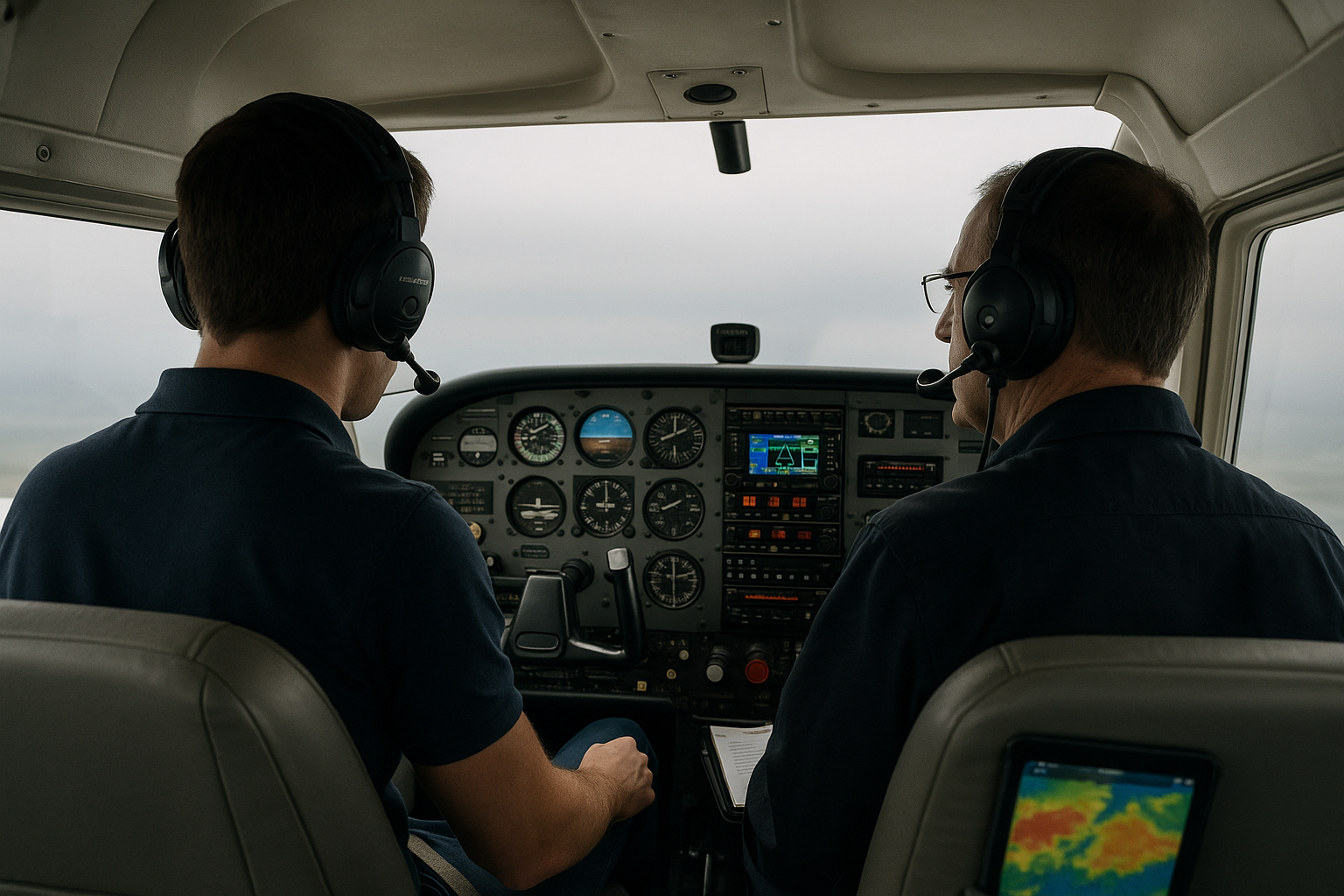
Spatial disorientation risk increases quickly when a pilot loses reliable outside visual references, which is why the best time to manage it is before entering instrument meteorological conditions. Once the airplane is in cloud, haze, precipitation, darkness, or any environment where the horizon is not usable, the pilot’s body can generate convincing but false sensations of bank, pitch, acceleration, or turning. Those sensations can be powerful enough to compete with training, experience, and cockpit instruments.
For pilots, student pilots, flight instructors, and aviation professionals, the practical lesson is straightforward: do not treat spatial disorientation as a problem to solve only after it begins. Treat it as a predictable human performance risk that should be addressed during preflight planning, weather evaluation, cockpit setup, departure briefing, and go or no-go decision-making. The safest pilots build a margin before IMC, not after they are already overloaded inside it.
What Spatial Disorientation Means Before IMC
Spatial disorientation occurs when a pilot’s perception of aircraft attitude, motion, or position does not match reality. In visual conditions, the natural horizon, ground references, and peripheral vision help the brain confirm which way is up, whether the aircraft is turning, and how the flight path is changing. In IMC, those outside references may disappear. The vestibular system in the inner ear, visual system, and proprioceptive cues from pressure on the body can then send misleading information.
The most important point for pilots is that spatial disorientation is not a character flaw or a lack of toughness. It is a normal human limitation. The inner ear is not designed to function as a flight instrument. It can sense acceleration and angular motion, but it can also adapt, fatigue, and misinterpret sustained movement. A steady-rate turn can begin to feel like straight-and-level flight. Leveling the wings after that turn can feel like a turn in the opposite direction. Acceleration can create a false sensation of pitch-up. Deceleration can feel like pitch-down. These sensations may feel real even when the attitude indicator, heading indicator, turn coordinator, and vertical speed indicator show something else.
Before entering IMC, a pilot should ask a different question than simply, “Am I legal?” A better operational question is, “Am I ready to transition immediately and confidently to instruments, manage the aircraft, communicate, navigate, and make decisions if the visual world disappears?” That question applies to instrument-rated pilots, pilots receiving instrument training, and VFR pilots evaluating deteriorating weather. The answer should consider proficiency, currency, aircraft equipment, autopilot capability if installed, weather complexity, terrain, workload, fatigue, and available escape options.
Why This Matters in Real-World Aviation
Spatial disorientation is especially dangerous because it often develops at the same time as other cockpit pressures. A pilot entering IMC may be climbing after takeoff, maneuvering near terrain, changing frequencies, copying a clearance, troubleshooting a system, or trying to decide whether to continue. The aircraft may be close to the ground, near traffic, or in busy airspace. The weather may be moving faster than expected. The workload is rarely ideal.
In flight training, the transition from visual to instrument reference is often introduced in a controlled manner. The instructor asks the student to lower a view-limiting device, the airplane is stable, and the training objective is clear. Real IMC does not always arrive that politely. A cloud layer may be entered a few hundred feet earlier than forecast. Haze may erase the horizon while the ground remains faintly visible below. Night over sparsely lit terrain can produce a condition that looks VFR but behaves like instrument flight. Snow, rain, smoke, coastal marine layers, and low-contrast terrain can all reduce visual cues gradually enough that the pilot may not notice the loss of reliable references until aircraft control begins to suffer.
For instructors, this is a key teaching opportunity. Students often understand spatial disorientation intellectually before they understand it operationally. They may be able to recite the definition, name common illusions, and perform acceptable basic instrument maneuvers under the hood. That does not necessarily mean they are prepared for the emotional and cognitive load of an unplanned IMC encounter. Good training connects the physiology lesson to cockpit habits: establish a disciplined instrument scan, avoid abrupt head movements, brief the transition before it happens, use automation properly when available, and make conservative weather decisions before escape routes narrow.
For instrument-rated pilots, the risk does not disappear. Proficiency matters. A pilot who has not flown in actual IMC recently may be technically authorized to conduct an IFR flight but still feel behind the airplane when hand-flying into cloud. A pilot who relies heavily on an autopilot may be vulnerable if the system disconnects, is misconfigured, or behaves unexpectedly. A pilot flying a familiar route may underestimate a weather pattern that changes the workload, such as convective activity, embedded precipitation, low ceilings, or strong winds aloft. Managing spatial disorientation risk is not only about having an instrument rating. It is about maintaining a reliable instrument flying process.
How Pilots Should Understand the IMC Transition
The transition into IMC is a phase of flight, not a single instant. It begins before the aircraft reaches the cloud, rain, mist, or darkness that removes the horizon. It includes mental preparation, aircraft configuration, instrument cross-check, and a deliberate shift from outside visual cues to the flight instruments. Pilots who treat this transition casually are more likely to be surprised by the intensity of sensory conflict.
A practical way to understand the transition is to divide it into three parts: prediction, preparation, and commitment. Prediction means recognizing when outside references are likely to degrade. This may come from weather briefings, METARs and TAFs, pilot reports, onboard weather displays, ATC information, or the view through the windshield. Preparation means reducing unnecessary workload before visual references are lost. This can include setting radios, briefing the departure or approach, verifying the attitude indicator and heading source, setting bugs or target headings, confirming the autopilot mode if it will be used, and stabilizing airspeed and pitch. Commitment means that once IMC is entered, the pilot gives priority to the instruments rather than chasing bodily sensations or trying to pick fragments of visual reference through the windshield.
This commitment is more difficult than it sounds. Many pilots experience a strong urge to look outside when entering cloud, especially if the entry was not expected. The brain wants the horizon back. The pilot may stare into a gray or white field looking for a visual cue that is no longer reliable. That habit can delay the instrument scan precisely when the scan is most needed. A better technique is to decide in advance: “At cloud entry, my primary attitude reference is the instrument panel.” This simple mental switch helps prevent the delay between losing the horizon and trusting the instruments.
Instrument scan discipline is also more than moving the eyes around the panel. It means using the right instrument for the right question. If the question is “What is the aircraft attitude?” the attitude indicator or primary flight display is central. If the question is “Is the turn controlled?” the heading trend, turn indication, and bank information matter. If the question is “Is altitude changing?” altimeter and vertical speed trends help confirm pitch and power results. Airspeed helps verify energy state. A pilot who scans without interpretation may still become overloaded. A pilot who interprets trends can detect small deviations before they become large ones.
Preflight Planning to Reduce Spatial Disorientation Risk
Good IMC risk management starts on the ground. Weather planning is not simply deciding whether the forecast meets legal or personal minimums. It is deciding whether the expected conditions are compatible with the pilot’s proficiency, aircraft equipment, route, terrain, daylight, and available alternates. Low ceilings, reduced visibility, night conditions, precipitation, and turbulence each add workload. Combined, they can create a cockpit environment that magnifies spatial disorientation risk.
Personal minimums are useful because they create a decision framework before the pilot is under pressure. A pilot who has recently flown several actual IMC departures, approaches, and missed approaches may accept conditions that would be unwise for a pilot returning after a long break from instrument flying. A student pilot or VFR pilot should treat any possibility of IMC as a major decision point, not a minor inconvenience. If the route depends on remaining clear of clouds and maintaining visual reference, then deteriorating ceilings, rising terrain, or night operations deserve special caution.
Aircraft readiness also matters. A pilot should know which instruments and systems are required for the planned operation and whether they are functioning as expected. Beyond the regulatory equipment question, there is an operational question: “If I enter IMC, what will I use to maintain control, and what is my backup if that system fails?” In an aircraft with a primary flight display, the pilot should be comfortable with reversionary modes and standby instruments. In a round-dial cockpit, the pilot should know how to identify instrument failure indications and maintain control using available backup references. If an autopilot is installed, the pilot should know how to engage it, verify mode annunciations, change modes, disconnect it, and hand-fly immediately if needed.
Fatigue, stress, illness, medication, dehydration, and distraction can reduce a pilot’s ability to manage sensory conflict. Spatial disorientation is not only an aircraft control issue. It is a human performance issue. A pilot who is tired, rushed, or emotionally committed to completing a trip may be more vulnerable to pushing into conditions that exceed current capability. The decision to delay, divert, or take an instructor or more experienced pilot may feel inconvenient, but it preserves the most important safety margin: the pilot’s ability to think clearly.
Cockpit Setup Before Entering IMC
Before entering IMC, the cockpit should be arranged so the pilot can fly the airplane first. That means reducing avoidable tasks and ensuring that critical information is immediately available. The exact setup varies by aircraft, avionics, and operation, but the principle is consistent: do not enter cloud while mentally searching for the next frequency, wondering which navigation source is active, or trying to remember how to change an autopilot mode.
For a typical training or general aviation flight, a useful pre-IMC flow includes confirming the attitude source, heading reference, altimeter setting, target altitude, power setting, navigation source, communication frequency, transponder or surveillance settings as appropriate, and the next expected clearance or route segment. If using an autopilot, the pilot should verify the active and armed modes, not merely assume that the airplane will do what was intended. Mode awareness is a major part of modern instrument flying. An autopilot can reduce workload, but only when the pilot understands what it is commanding.
Lighting and ergonomics can also influence performance. At night or in low visibility, cockpit lighting should allow the pilot to read instruments without creating glare or reducing outside vision unnecessarily. Charts, tablets, and kneeboards should be secured and positioned. Loose items should not become distractions. If the pilot expects turbulence or busy communications, setting up early becomes even more valuable.
A short self-brief can be highly effective. It does not need to be elaborate. For example: “We will enter cloud in about one minute. Maintain climb attitude and airspeed. Instruments are primary at cloud entry. If workload increases, engage the autopilot in the verified mode or ask ATC for vectors. If anything feels wrong, trust the panel and level the wings.” This kind of verbalization is especially useful in training, crew operations, and single-pilot IFR because it turns vague awareness into a specific plan.
Common Mistakes and Misunderstandings
One common mistake is believing that a quick look outside will solve the problem. In marginal visibility, the outside view may be incomplete or misleading. A sloping cloud deck, scattered ground lights, reflections, or a faint horizon can create false orientation. If the pilot is in IMC or lacks a reliable horizon, the instruments must take priority.
Another mistake is assuming that spatial disorientation begins only after a dramatic event. In reality, it can develop subtly. A pilot may begin with a small heading deviation, then add bank while correcting, then make an unnecessary pitch change while looking at a chart or radio. The aircraft may still feel normal. The pilot may not sense a turn or descent until the instruments show a significant deviation. Early recognition depends on a disciplined scan and prompt correction.
A third misunderstanding is treating instrument proficiency as a paperwork issue. Recent experience requirements, checkrides, and training endorsements serve important purposes, but they do not guarantee sharpness on a particular day in a particular airplane. Proficiency includes the ability to maintain aircraft control while handling real-world tasks. It includes workload management, communication, automation, abnormal situations, and decision-making. A pilot who has not practiced partial-panel work, unusual attitude recovery, or hand-flying in IMC-like conditions should consider additional training before launching into challenging weather.
Pilots also sometimes overestimate automation. Autopilots can be excellent risk management tools, but they are not substitutes for understanding aircraft attitude and energy. A mis-set altitude preselect, incorrect navigation source, unexpected mode change, or autopilot disconnect can create confusion at the wrong time. The pilot must monitor the automation and be prepared to fly manually. In some situations, reducing automation complexity may be safer than trying to program a system while the aircraft deviates.
Finally, there is the classic trap of continuing VFR into worsening conditions. A pilot may reason that the airport is close, the visibility is still usable, or the route has worked before. The problem is that weather margins can shrink rapidly, especially near terrain, water, or at night. If maintaining visual reference becomes doubtful, the decision should be made early. Turning around, diverting, landing at a suitable airport, requesting assistance, or obtaining an appropriate clearance before entering IMC are all options that become harder when the pilot waits too long.
Practical Example: The Departure Into a Low Layer
Consider an instrument-rated pilot departing a non-towered airport in a normally aspirated single-engine airplane on an IFR flight plan. The ceiling is reported low but above the pilot’s personal minimum for departure. Visibility is adequate, winds are light, and the route climbs through a shallow cloud layer into better conditions above. The pilot is legal, the aircraft is equipped, and the flight appears routine.
The risk is not that this flight is automatically unsafe. The risk is that a few small gaps can combine during the first two minutes. The pilot launches, contacts ATC, begins a frequency change, and enters cloud sooner than expected. While reaching for the radio, the pilot feels a slight roll sensation. The attitude indicator shows a shallow bank, but the pilot’s body suggests the wings are level. The airplane starts drifting off heading, airspeed decays slightly, and the climb rate changes. None of these deviations is dramatic, but they occur during a high-workload moment close to the ground.
A well-managed departure looks different. Before takeoff, the pilot briefs the cloud entry, initial heading, altitude, climb speed, and communication plan. The heading bug and altitude target are set. The correct navigation source is confirmed. The pilot decides whether to hand-fly or use the autopilot after reaching a safe altitude, based on aircraft procedures and proficiency. At cloud entry, the pilot’s eyes move to the attitude indicator or primary flight display and stay in an organized scan. If ATC calls at the exact moment of entry, the pilot aviate first and responds when able. If a sensation conflicts with the panel, the pilot trusts the instruments, makes small corrections, and avoids abrupt head movement.
The difference between these two versions is not bravery or talent. It is preparation. Spatial disorientation risk is reduced because the pilot anticipated the transition, removed distractions, and committed to instrument reference before the horizon disappeared.
Best Practices for Pilots
The most effective way to manage spatial disorientation risk is to combine conservative decision-making with disciplined instrument habits. No single technique eliminates the risk, but several habits work together to create a safer margin.
- Brief the IMC transition before it happens. Identify when visual references may disappear and what your first instrument priorities will be.
- Stabilize the aircraft early. Enter IMC with a known pitch, power, trim, airspeed, and heading whenever practical.
- Trust the instruments over body sensations. Sensory illusions can feel convincing, but cockpit instruments are the correct reference in IMC.
- Reduce task loading at cloud entry. Complete frequency, navigation, chart, and automation setup before the transition when possible.
- Use automation deliberately. Verify active modes, monitor performance, and remain ready to hand-fly.
- Keep instrument skills current and realistic. Practice with an instructor, in a simulator, or in actual conditions when appropriate and safe.
- Set weather limits that reflect proficiency. Personal minimums should change with experience, recency, aircraft capability, and operational complexity.
For VFR pilots, the most important best practice is avoidance. If you are not qualified and prepared for instrument flight, do not plan a flight that depends on squeezing through marginal weather or maintaining visual contact in conditions likely to deteriorate. If unexpected weather develops, act early. A 180-degree turn made while visual references are still reliable is far simpler than an emergency recovery after entering IMC.
For instrument pilots, the best practice is humility. Actual IMC, especially near the ground, at night, or in turbulence, deserves respect. Proficiency is perishable. A pilot who recognizes that fact is more likely to seek recurrent training, practice basic attitude instrument flying, and brief escape options before they are needed.
Instructor Considerations for Teaching This Risk
Flight instructors play a critical role in shaping how pilots think about spatial disorientation. It is not enough to demonstrate a few illusions and move on. The training goal should be to help pilots build habits that survive workload, surprise, and stress.
One useful approach is to connect each instrument lesson to a real operational scenario. Instead of practicing climbs, descents, and turns only as isolated maneuvers, instructors can place them in context: entering a cloud layer after takeoff, leveling at an assigned altitude while changing frequency, executing a missed approach into cloud, or hand-flying after an automation disconnect. The goal is not to overload the learner unnecessarily. The goal is to show that spatial disorientation risk often appears when aircraft control and cockpit management compete for attention.
Instructors should also emphasize language. Phrases such as “trust your instruments” are correct but incomplete. Students need to know how to trust the instruments: cross-check attitude, verify performance, make small corrections, avoid chasing indications, and keep the airplane trimmed. They also need to know when not to trust a single indication blindly, such as when instrument failure is suspected. That distinction is an important part of instrument judgment.
Scenario-based training can help pilots practice early decision-making. A VFR student can be asked what they would do if a cloud layer lowers ahead, visibility decreases, or rising terrain limits options. An instrument student can brief how they will handle an unexpected early cloud entry during departure. A certificated pilot can practice declaring workload, asking ATC for delay vectors, or using a published hold to regain organization. These are not abstract skills. They are practical defenses against disorientation and task saturation.
Decision-Making Before the Horizon Disappears
The most important decision point is often the last moment when the pilot still has clear visual references and multiple options. Before entering IMC, ask whether the flight still has margin. Is the aircraft stable? Is the pilot ahead of the airplane? Is the clearance understood? Is the next altitude or heading clear? Is the route free of surprises? Is there a reasonable escape plan if the weather is worse than expected?
If the answer is no, it may be time to pause the plan. That could mean delaying departure, requesting a different route, holding in visual conditions, returning to the departure airport, diverting, or asking for ATC assistance. There is no shame in creating time and space. Many poor outcomes begin with a pilot continuing while slightly uncomfortable, then accepting one more task, then entering a condition that demands more capacity than remains available.
Managing spatial disorientation risk before IMC is ultimately an exercise in judgment. It combines knowledge of human limitations, respect for weather, honest assessment of proficiency, and disciplined cockpit technique. The goal is not to fear IMC. Properly trained and equipped pilots fly safely in IMC every day. The goal is to enter it intentionally, prepared, and with enough capacity to fly the airplane well.
Frequently Asked Questions
Can experienced pilots still experience spatial disorientation?
Yes. Experience and training reduce risk, but they do not remove the human limitations that create spatial disorientation. Experienced pilots can still be affected by fatigue, workload, turbulence, night conditions, automation confusion, or an unexpected loss of visual reference.
What is the first priority if I feel disoriented in IMC?
The first priority is aircraft control using the flight instruments. Focus on attitude, bank, pitch, airspeed, altitude trend, and heading. Make smooth corrections, avoid abrupt head movements, and reduce workload where possible. If needed, ask ATC for assistance, vectors, or a simpler clearance.
Is an autopilot a good defense against spatial disorientation?
An autopilot can be a valuable workload management tool when it is functioning properly and the pilot understands the active modes. It is not a substitute for instrument proficiency. Pilots must monitor automation and be ready to hand-fly if the system disconnects or does something unexpected.
How should a VFR pilot manage the risk of accidental IMC?
A VFR pilot should avoid conditions that could lead to loss of visual reference. If weather deteriorates, act early while options remain available. Turn around, divert, land at a suitable airport, or request assistance before entering conditions that require instrument flight capability.
Why does spatial disorientation feel so convincing?
The body’s balance and motion-sensing systems can misinterpret sustained turns, acceleration, deceleration, and changes in attitude when visual references are missing. The resulting sensations can feel real even when they conflict with the instruments, which is why disciplined instrument reference is essential.
How can pilots practice managing this risk?
Pilots can practice with a qualified instructor, appropriate view-limiting device, simulator, or actual IMC when suitable. Training should include basic attitude instrument flying, unusual attitude recovery, automation management, workload control, and realistic scenarios involving the transition from visual to instrument references.
Key Takeaways
- Manage spatial disorientation risk before IMC by briefing the transition, stabilizing the aircraft, and committing to instrument reference at cloud entry.
- The body can create convincing false sensations in IMC, so pilots must trust a disciplined instrument scan over sensory cues.
- Good decisions about weather, proficiency, automation, and workload are as important as basic instrument flying skill.