
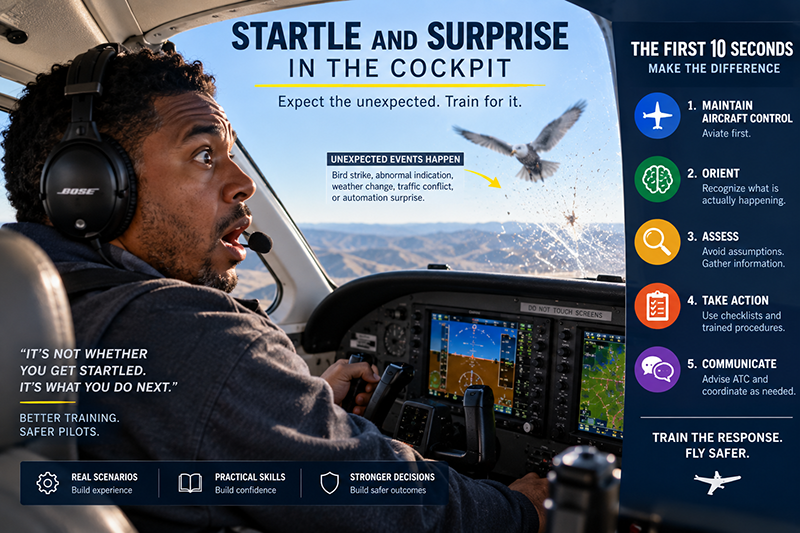
Startle and surprise in the cockpit are not rare aviation curiosities. They are normal human responses that can appear during abnormal indications, unexpected aircraft behavior, abrupt weather changes, traffic conflicts, automation surprises, or a sudden call from air traffic control. The issue is not whether a pilot can be startled. Every pilot can. The safety question is what happens in the first ten seconds after the unexpected event.
Those first seconds are important because they often determine whether the pilot regains a useful mental model or begins reacting without enough awareness. A startled pilot may freeze, overcontrol, misread an instrument, skip a basic step, or fixate on the most obvious cue while missing the bigger problem. Good training does not pretend that startle can be eliminated. Instead, it gives pilots a repeatable way to absorb the shock, stabilize the airplane, and begin thinking clearly again.
This article explains how pilots, student pilots, instructors, and aviation professionals can understand startle and surprise as trainable human factors issues. It focuses on practical cockpit application, including how to brief for the unexpected, how to train the first ten seconds, and how to avoid common mistakes that turn a manageable abnormal event into a more serious problem.
Understanding Startle and Surprise in Aviation
In everyday language, startle and surprise are often used interchangeably. In aviation training, it is useful to separate them. Startle is the immediate physiological and attentional reaction to a sudden stimulus. It may include a jolt of adrenaline, muscle tension, a gasp, a quick head movement, or a brief interruption in fine motor control and reasoning. Surprise is the cognitive reaction that occurs when what the pilot expected does not match what is happening.
A loud bang, a bird strike, a stall warning, an unexpected autopilot disconnect, or a sudden engine roughness can produce a startle response. Surprise may follow when the pilot asks, consciously or subconsciously, what just happened and what it means. The pilot expected one reality and suddenly faces another. That gap between expectation and reality can be dangerous if it delays aircraft control or leads to a rushed, inaccurate interpretation.
The cockpit is an environment where expectation is powerful. Pilots brief a departure, anticipate a clearance, configure the aircraft, and mentally rehearse the next phase of flight. That anticipation is usually helpful. It allows the pilot to stay ahead of the airplane. But when the airplane, weather, airspace, or automation does something unexpected, the same expectation can slow recognition. The pilot may spend valuable seconds trying to make the situation fit the original plan instead of accepting that the plan has changed.
Training the first ten seconds means building a disciplined pause between stimulus and action. It does not mean doing nothing. It means doing the right first things: maintain aircraft control, orient to the actual flight condition, manage the flight path, and then diagnose. The objective is to prevent the startled mind from driving the hands faster than the pilot can think.
Why This Matters in Real-World Aviation
Real-world flying rarely presents problems in neat textbook order. A pilot may experience an abnormal indication during a radio call, a gusty crosswind during a configuration change, or a navigation surprise while also managing passenger questions. In training, emergencies are often introduced with clear cues and a known instructor sitting beside the student. In actual operations, the first cue may be ambiguous, incomplete, or misleading.
Startle matters because it can affect the most basic pilot tasks. A pilot who is startled may briefly lose scan discipline, apply abrupt control inputs, forget trim, neglect airspeed, or become locked onto a single instrument. A crew may experience a communication breakdown as each pilot focuses on a different interpretation of the event. In single-pilot operations, the pilot may be forced to fly, troubleshoot, communicate, navigate, and manage workload without a second crewmember to cross-check decisions.
The issue is relevant across experience levels. Student pilots can be startled by normal training events that are new to them, such as a simulated engine failure, an unexpected go-around, or a stall warning during maneuver practice. Experienced pilots can be startled when a familiar aircraft behaves in an unfamiliar way, or when automation does not do what they expected. Flight instructors can also be surprised, especially when a student makes a sudden control input or when a training scenario develops faster than anticipated.
Startle and surprise are also central to modern cockpit automation. Automation can reduce workload, but it can also create mode confusion when pilots lose track of what the system is doing or why. An unexpected change in vertical mode, a missed altitude capture, or a lateral navigation deviation can create a moment of disbelief. The safe response is not to argue mentally with the avionics. It is to fly the airplane, verify the mode, and choose the simplest safe level of automation or manual control for the situation.
How Pilots Should Understand the First Ten Seconds
The first ten seconds after an unexpected cockpit event are not a formal regulatory interval. They are a practical training concept. The number is useful because it reminds pilots that the initial response should be deliberate, not automatic in the careless sense. Some events demand immediate memory actions or immediate control inputs. Others require a short pause to prevent misdiagnosis. The pilot must know the difference through aircraft-specific training, proficiency, and sound judgment.
A helpful way to understand the first ten seconds is to divide them into three mental tasks: stabilize, orient, and decide. Stabilize means protect the flight path. Keep the wings under control, manage pitch and power as appropriate, maintain safe airspeed, and avoid making the situation worse. Orient means look at the actual aircraft state instead of the assumed state. What is the attitude? What is the altitude? What is the airspeed? What is the configuration? What is the flight path relative to terrain, traffic, and weather? Decide means choose the next action based on the aircraft flight manual, training, checklists, and the immediate threat.
This sequence supports the familiar aviation priority of aviate, navigate, communicate. Aviate is not a slogan to recite after the fact. It is a cockpit discipline that must survive the shock of the unexpected. If the aircraft is controllable, controlling it is the first victory. Navigation and communication become more effective when the airplane is stable enough for the pilot to think.
The first ten seconds are also when breathing and verbalization can help. A controlled breath can interrupt the physiological spike of startle. A short verbal callout, even in a single-pilot cockpit, can organize attention. Examples include, aircraft control, airspeed alive, pitch and power, climb attitude, or confirm before action. The words should be simple and connected to the airplane, not theatrical or complicated.
For crews, the first ten seconds should include role clarity. One pilot flies while the other supports, verifies, communicates, and manages checklists as appropriate. For single-pilot operations, role clarity becomes task clarity. The pilot must resist the urge to troubleshoot deeply while the airplane still needs basic control. A handheld checklist, panel-mounted checklist, or memory aid is only useful after the flight path is under control.
Training Startle Without Creating Unsafe Training
Startle training must be thoughtful. The goal is not to scare students or create dramatic cockpit moments. The goal is to build a reliable recovery pattern when the expected flow of flight is interrupted. Instructors should introduce surprise in a way that is appropriate to the pilot's certificate level, experience, aircraft, environment, and current workload.
Good startle training begins on the ground. Before a flight, the instructor can brief the student that some events may be unexpected, but all training will remain within safe limits and positive aircraft control will be protected. This preserves trust while still allowing the student to practice adapting. The instructor should avoid unrealistic tricks that teach suspicion instead of skill. A student who feels ambushed may become defensive, not better prepared.
Scenario-based training is especially useful. Instead of announcing, this will be an engine failure after takeoff, the instructor may build a departure briefing that includes what the pilot will do if the aircraft does not climb normally, if the engine runs rough, or if a runway return is not practical. Later, at a safe altitude or in an appropriate simulator, the instructor can present an abnormal condition and observe whether the pilot first protects aircraft control before reaching for switches or checklists.
Simulation can be valuable because it allows exposure to events that may be impractical or unsafe to replicate in an aircraft. However, simulator training should still emphasize disciplined cockpit behavior. If the scenario becomes a game of guessing what failure comes next, the training can lose realism. The instructor should focus on recognition, communication, control, and decision-making rather than on surprising the pilot for its own sake.
Debriefing is where much of the learning occurs. After a startle or surprise scenario, the instructor should ask what the pilot saw, what the pilot believed was happening, what action was taken first, and what cues were missed. The debrief should normalize the startle response while holding the pilot accountable for building better habits. Shame is not an effective training tool. Accurate self-awareness is.
Common Mistakes and Misunderstandings
One common misunderstanding is the belief that experience alone prevents startle. Experience helps, but it does not make pilots immune. In some cases, experience can create strong expectations that make an unusual event even more surprising. A pilot who has performed hundreds of normal approaches may be caught off guard by an unexpected configuration issue, a late runway change, or an automation mode that does not behave as expected.
Another mistake is confusing speed with decisiveness. A quick response is valuable only if it is the correct response. Some cockpit actions should be immediate because delay increases risk. Other actions should be verified because the wrong switch, wrong lever, or wrong interpretation can create a new problem. The skilled pilot learns which items are immediate from aircraft-specific training and which items require confirmation.
Fixation is another significant risk. A pilot may focus on a warning light, a GPS message, an engine instrument, or a radio exchange while the aircraft drifts from altitude, heading, airspeed, or attitude. Fixation often feels productive because the pilot is working hard on something. The question is whether that something is the most important task at that moment.
Pilots also sometimes over-rehearse perfect emergencies and under-rehearse messy abnormalities. A clean engine failure at altitude with an instructor's prompt is useful training, but real abnormal events may begin with vibration, partial power, an unusual smell, conflicting indications, or passenger concern. Training should include ambiguity so pilots learn to manage uncertainty without rushing to a conclusion.
Instructors can make mistakes as well. Introducing surprise too early, too aggressively, or without a clear learning objective can overload a student. Allowing the aircraft to get close to unsafe parameters for the sake of realism is poor instructional judgment. Startle training should build resilience, not normalize unstable or poorly managed training conditions.
Practical Example: Engine Roughness After Takeoff
Consider a pilot departing a non-towered airport in a single-engine training airplane. The weather is visual, the preflight and run-up were normal, and the pilot has briefed the departure path. At about 600 feet above ground level, the engine begins to run rough. The sound changes, vibration increases, and the climb rate decreases. The pilot is startled because the event occurs at a high-workload moment close to the ground.
A poor first response would be to stare at the engine gauges, begin moving controls without a plan, or attempt an aggressive turn back toward the runway without sufficient altitude, training, aircraft performance, and situational awareness. Another poor response would be denial: continuing straight ahead as if the engine will clear itself while airspeed decays and landing options disappear.
A better first-ten-second response begins with aircraft control. The pilot sets and verifies an attitude that preserves safe airspeed, maintains coordinated flight, and points the aircraft toward the most suitable available landing area or climb path as conditions permit. The pilot avoids abrupt maneuvering and accepts that the original departure plan has changed. If time and altitude permit, the pilot may perform appropriate aircraft-specific checks, but only after protecting the flight path.
The pilot's verbal flow might be simple: airspeed, landing area, power, checklist if able. If the aircraft continues to climb, the pilot may have more options. If climb performance is not assured, the priority becomes landing under control. Communication can be made when workload permits, but a radio call should not take priority over flying the aircraft.
In debrief, the instructor would not simply ask whether the pilot completed every checklist item. The deeper questions are: Did the pilot preserve airspeed? Did the pilot recognize the change quickly? Did the pilot avoid an impulsive turn? Did the pilot select a realistic option? Did the pilot use the available time wisely? Those are the markers of startle resilience.
Best Practices for Pilots
Startle management improves when pilots train habits that are simple enough to survive stress. Complex scripts often fail when workload rises. The best habits connect directly to aircraft control, situational awareness, and disciplined decision-making.
- Brief the unexpected before it happens. Before takeoff, approach, or maneuvering, review the most likely abnormal events and the first action you will take to protect the aircraft.
- Use simple verbal anchors. Short callouts such as fly the airplane, pitch and power, or confirm can help organize attention.
- Practice recognition, not just procedures. Learn what abnormal aircraft states look, sound, and feel like before they become emergencies.
- Keep automation understandable. If the automation is not doing what you expect, verify the mode and be ready to reduce automation to a level you can manage.
- Train in scenarios. Combine aircraft control, weather, ATC, navigation, and abnormal indications so the pilot learns to prioritize under realistic workload.
- Debrief the first action. After training, evaluate what happened in the first few seconds, not only whether the final checklist was completed.
For instructors, the best practice is to make startle training progressive. Begin with discussion, then predictable demonstrations, then mild surprise, then more realistic scenarios as proficiency grows. The instructor should always maintain a margin of safety and should explain the purpose of the scenario during the debrief.
For operators and training organizations, startle and surprise should be part of a broader human factors program. The topic connects naturally to crew resource management, threat and error management, unstable approach prevention, loss of control prevention, automation management, and emergency decision-making. It should not be treated as a one-time classroom slide.
Building Better Preflight Briefings
A strong preflight briefing can reduce the shock of an abnormal event by creating mental pathways before the event occurs. This does not mean predicting every possible failure. It means identifying the few events most relevant to the phase of flight and deciding in advance what the first priority will be.
Before takeoff, a pilot might brief what to do for an abnormality on the runway, an engine problem shortly after liftoff, or an inability to climb as expected. Before an instrument approach, the pilot might brief missed approach initiation, automation use, minimums, runway environment, and what conditions would trigger a go-around. Before maneuvering practice, the instructor and student might brief transfer of controls, recovery priorities, and altitude limits.
The briefing should be short enough to remember and specific enough to matter. A vague statement such as we will handle any emergency provides little value. A more useful briefing identifies the aircraft state and first action: if the airplane does not climb normally after liftoff, maintain safe airspeed and land ahead or within a safe sector rather than attempting an unbriefed maneuver.
Briefings also help passengers. In general aviation, a passenger who suddenly speaks, points, or panics during an abnormal event can increase workload. A calm preflight passenger briefing about sterile cockpit expectations during takeoff and landing, seat belts, doors, and communication can reduce distraction when the pilot needs quiet focus.
How Automation Can Increase Surprise
Automation surprise occurs when the aircraft or avionics behave differently than the pilot expected. This can happen in advanced training aircraft, technically advanced airplanes, transport category aircraft, and even simple aircraft with modern navigators and autopilots. The more capable the system, the more important it is for the pilot to understand modes, limitations, and fallback options.
A common automation trap is assuming the system is managing the flight path when it is not. Another is changing a flight plan, altitude selection, or vertical mode without confirming the result. When the airplane begins to deviate, the pilot may spend too much time asking why instead of immediately managing attitude, power, and path.
The practical answer is not to avoid automation. It is to supervise it actively. Pilots should know what mode is active, what mode is armed, what the aircraft will do next, and how to disconnect or downgrade automation when needed. If the automation creates confusion during a high-workload moment, manual flying or a simpler mode may be the safest way to restore clarity, provided the pilot is proficient and the aircraft situation supports that choice.
Frequently Asked Questions
Can startle response be completely eliminated through training?
No. Startle is a normal human response to sudden or unexpected stimuli. Training can reduce the duration and operational impact of startle by giving pilots practiced habits for aircraft control, orientation, and decision-making.
Is surprise always bad in the cockpit?
Surprise is not automatically bad. It is a signal that the pilot's expectation does not match reality. The risk comes when surprise leads to denial, fixation, rushed action, or loss of aircraft control. A well-trained pilot treats surprise as a cue to reassess the aircraft state.
Should instructors intentionally scare students to improve startle response?
No. Effective startle training is controlled, purposeful, and appropriate to the student's experience. The objective is to build resilience and decision-making, not to frighten or embarrass the student.
What is the best first action after an unexpected event?
The best first action depends on the aircraft and situation, but protecting aircraft control is usually the foundation. Maintain a safe flight path, verify the aircraft state, and then use the appropriate checklist, procedure, or decision process.
How does startle training apply to single-pilot flying?
Single-pilot flying requires especially strong prioritization because there is no second pilot to monitor, communicate, or cross-check. Single pilots should use briefings, verbal callouts, simple flows, and disciplined checklist use to manage the first seconds of an abnormal event.
Does automation reduce or increase startle risk?
Automation can reduce workload, but it can also create surprise when pilots misunderstand modes or expected behavior. Pilots should monitor automation actively and be ready to use a simpler level of automation or manual control when appropriate.
Key Takeaways
- Startle and surprise in the cockpit are normal human responses, so pilots should train a reliable first-ten-second pattern rather than assume they will not be affected.
- The safest initial response is usually to stabilize the aircraft, orient to the actual flight condition, and avoid impulsive troubleshooting before the flight path is protected.
- Instructors and pilots should use realistic scenario-based training, careful briefings, and thoughtful debriefs to improve recognition, prioritization, and decision-making under stress.