
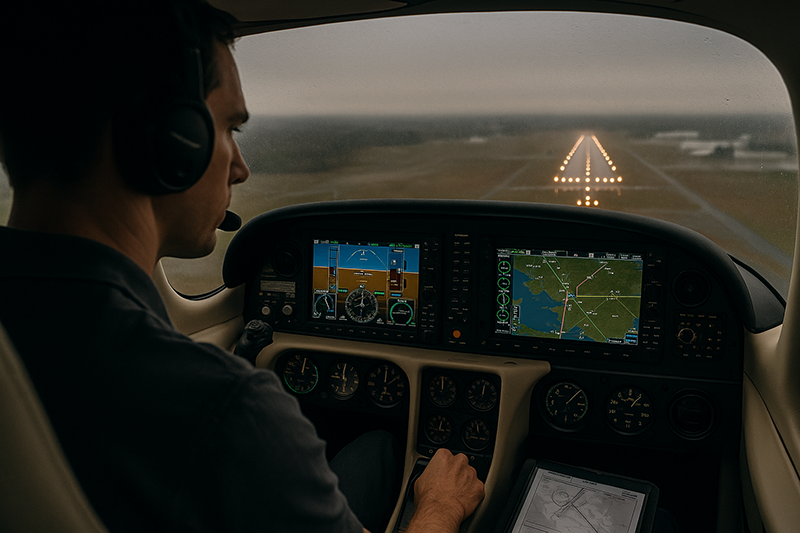
Learning how to stay ahead of the aircraft during approaches is one of the most valuable skills a pilot can develop. It is also one of the first skills that begins to erode when workload rises, weather changes, traffic compresses the pattern, or an instrument approach does not unfold exactly as briefed. An approach is not just the last few miles before landing. It is a high-workload phase of flight where planning, configuration, energy management, communication, navigation, and judgment all converge.
For student pilots, staying ahead of the aircraft often means learning to think one or two steps beyond the airplane instead of reacting to each new event. For instrument pilots, it means briefing, configuring, and verifying early enough that the final approach segment is flown with discipline rather than improvisation. For flight instructors and aviation professionals, it is a teachable habit that separates a managed approach from a rushed one. This article explains what it means to stay ahead, why pilots fall behind, and how to build practical habits that make approaches calmer, safer, and more consistent.
What It Means to Stay Ahead of the Aircraft
To stay ahead of the aircraft means to mentally arrive at the next task before the airplane physically gets there. The pilot is not surprised by the next altitude, heading, frequency, configuration change, or decision point because those items have already been anticipated. The aircraft may still be moving quickly, but the pilot's thinking is not stuck behind it.
During an approach, staying ahead includes knowing where the aircraft is, what it is supposed to do next, and what action will be required if the plan changes. A pilot who is ahead has already reviewed the approach, set up navigation, considered weather and runway conditions, planned aircraft configuration, and identified the point at which continuing no longer makes sense. A pilot who is behind may still be trying to load the procedure, find the missed approach instructions, tune a frequency, descend, slow down, and talk to ATC at the same time.
This is not simply a matter of speed or experience. A pilot can fall behind in a slow trainer if tasks are delayed until the last moment. A proficient pilot can stay ahead in a much faster airplane by using standard flows, checklists, callouts, automation discipline, and conservative decision-making. The difference is task timing. Good approach management moves work out of the most demanding moments and into the earlier, lower-workload phases of flight.
Staying ahead also means preserving enough mental capacity to detect errors. If all attention is consumed by catching up, there is little room left to notice an incorrect altitude, an unstable descent rate, a late configuration change, a wrong course selection, or a missed radio call. The best approaches are not those that require heroic correction near the runway. They are the ones that were organized early enough that the final segment becomes predictable.
Why Approaches Create High Workload
Approaches combine several demands that do not always compete for attention during cruise flight. The aircraft is usually descending, slowing, changing configuration, entering busier airspace, and operating closer to terrain and obstacles. The pilot may be interpreting weather, communicating with ATC or traffic, monitoring instruments, looking outside, adjusting power, and preparing for a landing or missed approach.
In visual conditions, the workload can still be significant. A pilot entering a busy traffic pattern must judge spacing, wind correction, runway alignment, descent angle, airspeed, flap timing, radio communication, and traffic awareness. In instrument conditions, the pilot must also maintain precise course and altitude control, monitor navigation guidance, comply with clearances, and prepare to transition visually or execute the missed approach. Neither environment leaves much room for late planning.
The workload increases when the pilot delays key decisions. A late descent means the airplane may arrive high and fast. A late checklist can distract from flight path control. A late approach briefing can lead to confusion during the most critical segment. A late runway change can cause uncertainty about frequencies, altitudes, minima, or taxi planning. Each delay adds cognitive load at exactly the wrong time.
Weather adds another layer. Wind, turbulence, low ceilings, reduced visibility, convective activity, icing conditions, or rapidly changing altimeter settings can all increase the need for deliberate monitoring. A pilot who is already behind may be tempted to continue because the runway is close, even though the airplane is not configured, stabilized, or aligned with the intended plan. Staying ahead gives the pilot time to make decisions based on conditions rather than pressure.
The Mental Model: Aviate, Navigate, Communicate, Manage
The familiar aviation priority of aviate, navigate, communicate remains central during approaches. Flying the aircraft comes first. Navigation and communication are important, but neither should take priority over aircraft control. A helpful modern extension is to include manage: manage energy, automation, configuration, workload, and risk.
Aviating during an approach means maintaining the desired attitude, airspeed, descent rate, and configuration. It also means recognizing when the aircraft is not where it should be. The airplane does not care that the pilot is busy programming avionics or responding to a frequency change. If flight path control degrades, the first corrective action is to return attention to flying.
Navigating means knowing the aircraft's position relative to the runway, procedure, terrain, traffic pattern, or assigned clearance. For an instrument approach, that includes awareness of fixes, stepdowns where applicable, final approach course, minimum altitudes, and the missed approach path. For a visual approach, it includes runway orientation, traffic pattern position, wind drift, base-to-final turn planning, and terrain or obstacle awareness.
Communicating matters, but communication should be concise and well-timed. Radio work can become a trap when the pilot gives it more attention than the airplane. If the workload is too high, a short request for delay vectors, a standby call, or an early query can prevent the pilot from trying to solve too many problems at once.
Managing is where many approach problems are prevented. Management includes deciding when to slow, when to configure, when to brief, when to use automation, when to disconnect automation, when to request help, and when to go around. The pilot who manages well does not wait for workload to become unmanageable before acting.
Build the Approach Before You Fly It
A well-flown approach usually begins long before the final approach fix or the downwind leg. It begins with building a mental picture of the arrival. That picture should include runway, weather, expected procedure or traffic pattern, descent planning, aircraft configuration, likely clearances, and the point at which a go-around or missed approach would be appropriate.
For an IFR flight, approach preparation normally includes selecting and reviewing the expected procedure, confirming navigation source and course guidance, reviewing altitudes and missed approach instructions, checking weather and airport information, and ensuring the airplane is set up for the transition from en route to terminal operations. The goal is not to memorize every chart detail. The goal is to understand the approach well enough that chart references confirm the plan rather than create the plan in real time.
For a VFR flight, the same concept applies even without an instrument procedure. The pilot should know the runway in use, pattern direction if applicable, expected entry, field elevation, traffic situation, wind, and aircraft configuration plan. A VFR approach can become rushed when the pilot treats it casually until the airplane is already abeam the numbers or turning final. The airplane still needs energy management, alignment, and a stable path.
Building the approach also includes considering alternatives. What if ATC assigns a different runway? What if the winds favor another landing direction? What if the airplane is too high? What if another aircraft creates spacing pressure? What if the runway environment is not acquired at the appropriate time during an instrument approach? The pilot does not need to dwell on every possibility, but a few anticipated branches reduce surprise.
Energy Management: The Foundation of a Controlled Approach
Energy management is one of the most practical ways to stay ahead of the aircraft. Energy is expressed mainly as altitude and airspeed. An aircraft that is high and fast has excess energy that must be managed before landing. An aircraft that is low and slow may not have enough energy margin. A stable approach requires the pilot to manage both without abrupt, last-second corrections.
Being ahead of the aircraft means planning the descent early enough that power, pitch, configuration, and speed changes occur smoothly. If the pilot waits too long to descend, the approach can become a scramble to reduce altitude and airspeed at the same time. If the pilot slows too early without considering traffic and wind, the airplane may require unnecessary power changes or create spacing issues. The right timing depends on aircraft type, performance, wind, traffic, and procedure design, so pilots should use the appropriate aircraft manual, training guidance, and instructor input rather than generic numbers.
Configuration is part of energy management. Extending flaps, gear, or speed brakes where applicable changes drag, pitch forces, and descent capability. In many aircraft, configuration changes are best made at planned points rather than in a hurried sequence close to the runway. Pilots should observe aircraft limitations and recommended procedures from the applicable POH, AFM, checklist, or operating manual. The specific speeds and settings are aircraft-dependent and should not be generalized.
Power management is equally important. A pilot who is ahead makes smaller, earlier power adjustments instead of large corrections late. On a stabilized approach, power, pitch, airspeed, and descent rate should make sense together. If the airplane requires unusual power, pitch, or descent rate to remain on path, that is a cue to reassess rather than simply continue.
Stabilized Approach Thinking Without Rigid Assumptions
The idea of a stabilized approach is widely used in aviation training and operations because it gives pilots a practical standard for deciding whether the approach is under control. A stabilized approach generally means the aircraft is on the intended flight path, at an appropriate airspeed, properly configured, using a manageable descent rate, aligned with the runway or approach course, and requiring only normal corrections to continue.
It is important to understand that specific stabilization gates and criteria vary by aircraft, operator, training program, and operating environment. Some organizations publish defined altitudes and parameters for stabilized approach calls. Individual pilots should follow the standards applicable to their aircraft, certificate level, instructor guidance, and operating procedures. The broader principle is universal: if the aircraft is not in a condition from which a normal landing can be made, continuing the approach should be questioned.
Stabilized approach thinking helps pilots avoid rationalization. When workload rises, it is easy to think, I can fix this on short final. Sometimes a small correction is appropriate. Other times the safer, more professional decision is to go around. A go-around is not an admission of poor skill. It is a normal maneuver that protects margins when the approach no longer meets the pilot's plan or standards.
In training, instructors should emphasize that a go-around decision should be made early enough to be calm and controlled. Waiting until the airplane is over the threshold, poorly aligned, fast, high, or improperly configured may leave less time and altitude to manage the maneuver. The best go-arounds often begin with the simple recognition that the approach has stopped being predictable.
How Automation Can Help or Hurt
Modern avionics and automation can significantly reduce workload when used correctly. GPS navigators, flight directors, autopilots, moving maps, altitude preselect, and electronic checklists can help pilots maintain awareness and reduce manual task loading. However, automation does not automatically mean the pilot is ahead of the aircraft. It can also create mode confusion, programming fixation, and delayed detection of an incorrect setup.
Staying ahead with automation starts with knowing what the system is doing now, what it will do next, and how to intervene if it does something unexpected. Pilots should verify navigation sources, armed modes, altitude constraints where applicable, and course guidance before they matter. If the airplane is nearing the final approach segment and the pilot is still unsure which mode is active or whether the correct procedure is loaded, workload is already too high.
Automation should be managed at a level that supports the approach. In some situations, using an autopilot during setup can preserve attention for chart review, weather monitoring, and communication. In other situations, hand-flying may be simpler than trying to reprogram a system close to the airport. The key is not to worship automation or avoid it. The key is to use it intentionally.
A practical rule is to avoid becoming heads-down during critical phases of flight. If avionics programming begins to consume attention, ask for delaying vectors, remain at a safe altitude as cleared, or simplify the plan when appropriate. If a system does not behave as expected, revert to basic flying and navigation skills. Automation should support pilot decision-making, not replace it.
Briefing the Approach So It Actually Helps
An approach briefing should reduce workload, not become a ritual recitation that the pilot barely processes. A good briefing answers the practical questions the pilot will need soon: Which runway or procedure? What navigation source? What altitudes and courses matter? What is the descent plan? What are the minimums or visual references as applicable? What is the missed approach or go-around plan? What threats could affect this approach?
The best briefing style depends on the operation. A single pilot in a training aircraft may use a concise self-brief. A crewed aircraft may use a more formal briefing with callouts and cross-checks. Either way, the briefing should happen early enough that the pilot is not trying to understand the approach while already intercepting final.
For VFR approaches, a verbal or mental briefing can be just as valuable. The pilot might review runway, wind, pattern entry, target airspeed range according to aircraft guidance, flap plan, aiming point, and go-around plan. This is especially helpful at unfamiliar airports, airports with nonstandard traffic patterns, or locations with terrain, obstacles, noise-sensitive areas, or complex taxi layouts.
A common mistake is to brief only the expected landing and ignore the escape plan. Staying ahead includes knowing what to do if the landing cannot be completed. In instrument flying, that means understanding the missed approach before reaching the missed approach point. In visual flying, that means knowing the go-around attitude, power application, configuration sequence, traffic considerations, and any runway-specific factors that could affect the maneuver.
Why This Matters in Real-World Aviation
Approach workload is not theoretical. It affects everyday flying. A student pilot returning from a solo cross-country may be tired, navigating to an unfamiliar airport, and trying to fit into a busy pattern. A private pilot on an IFR flight may be cleared for a different approach than expected. A flight instructor may need to monitor a learner while also watching traffic and weather. A corporate or airline crew may manage automation, clearances, checklists, and operational procedures in a compressed arrival environment.
In all of these situations, the same principle applies: the later the pilot recognizes and organizes tasks, the fewer options remain. If the airplane is high, fast, and close to the runway, the choices narrow quickly. If the avionics are not set up until intercept, the pilot may miss an altitude or course cue. If the go-around plan is not considered until after the approach becomes unstable, decision-making can become reactive.
Staying ahead also supports better communication. A pilot who knows the plan can respond more clearly to ATC, make timely requests, and recognize when a clearance does not match expectations. For example, if assigned a runway change late in the arrival, a prepared pilot can quickly determine whether the new approach is manageable or whether more time is needed. There is no shame in requesting vectors, a hold, clarification, or a different clearance when workload or safety margins require it.
For instructors, this skill is a major training objective. Learners often focus on the immediate control task, which is natural. Over time, they must be coached to anticipate. Instead of asking only, What is the airplane doing? instructors can ask, What will happen next? What do you need set up before then? At what point would you discontinue this approach? These questions develop judgment, not just control technique.
How Pilots Should Understand This Topic
Pilots should think of staying ahead as a time-management and attention-management skill. It is not about being perfect. It is about arranging tasks so the most important moments are not overloaded. The approach should become a series of expected events rather than a stream of surprises.
One useful way to visualize this is to divide the approach into three broad phases: preparation, transition, and final commitment. Preparation occurs before the aircraft is close to the airport or final approach segment. This is when the pilot reviews weather, runway, procedure, avionics, performance considerations, and alternate plans. Transition occurs as the aircraft descends, slows, enters the terminal area, joins the pattern, or receives approach clearance. This is when the pilot verifies setup, configures progressively, completes appropriate checklists, and monitors energy. Final commitment occurs when the aircraft is established on final or final approach path and the pilot should mainly be monitoring, making small corrections, and deciding whether the approach remains acceptable.
If preparation tasks spill into final commitment, workload rises sharply. If transition tasks are neglected, the final segment becomes unstable. The objective is to move noncritical work earlier and leave the final segment for flying, monitoring, and deciding.
This also means pilots must be honest about personal limits. Fatigue, unfamiliar avionics, weather, night operations, high-density traffic, and unfamiliar airports can reduce available capacity. A pilot who is normally comfortable with a particular approach may need more time on a different day. Staying ahead includes recognizing when to slow the operation down. That might mean asking for a longer downwind, delaying descent until cleared and ready, requesting a different approach, or going around for another attempt.
Common Mistakes or Misunderstandings
One common misunderstanding is that staying ahead means doing everything quickly. In reality, it often means doing things earlier and more deliberately. Speed is not the goal. Timely sequencing is the goal. A rushed pilot may move fast but still be behind because tasks are being completed in the wrong order or without verification.
Another mistake is treating the approach briefing as optional when the weather is good or the airport is familiar. Familiarity can be helpful, but it can also invite assumptions. Runway assignments, winds, traffic, NOTAMs, lighting, pattern activity, or taxi expectations can change. A short, thoughtful briefing is still valuable because it refreshes the plan and identifies anything unusual.
A third mistake is trying to salvage an approach simply because it is close to landing. Pilots sometimes continue from a poor energy state, late configuration, unstable descent, or uncertain alignment because they believe a go-around is inconvenient. The runway may be in sight, but that does not automatically mean the landing setup is sound. A disciplined go-around can be the most professional decision of the flight.
Automation fixation is another common trap. A pilot may spend too much time troubleshooting a navigator or autopilot while the aircraft drifts from altitude, course, or airspeed. If automation setup is not working, the priority remains aircraft control. Simplify, ask for more time if available, and use basic navigation and flying skills.
Finally, some pilots confuse being cleared for an approach with being ready for an approach. A clearance allows the operation to proceed within its terms, but readiness is a pilot responsibility. If the cockpit is not set up, the aircraft is not in a manageable energy state, or the pilot does not understand the procedure, accepting or continuing may increase risk. When in doubt, create time and space.
Practical Example: From Busy Arrival to Managed Approach
Consider a pilot flying a single-engine training aircraft into a towered airport after a cross-country flight. The pilot expected a visual approach to Runway 27, but ATIS now reports winds favoring Runway 18. Traffic is moderate, and the tower instructs the pilot to enter a right downwind. The aircraft is still at cruise speed and slightly high because the descent was delayed while the pilot copied weather information.
A pilot who is falling behind might accept the entry, rush the descent, delay the before-landing checklist, turn downwind too close, and try to correct altitude and airspeed on base. The result may be a high, fast final with late flap selection and little spare attention for traffic or runway alignment.
A pilot who stays ahead recognizes the developing energy problem early. Before entering the pattern, the pilot reduces power as appropriate, begins slowing within aircraft limitations, confirms runway and traffic pattern direction, and reviews the landing configuration plan. If the aircraft remains too high or spacing becomes uncomfortable, the pilot advises the tower and requests an extended downwind, a 360 if appropriate and approved, or another instruction that creates room. The before-landing checklist is completed before workload peaks. On final, the aircraft is aligned, configured, and descending at a manageable rate. If those conditions are not met, the pilot goes around and resets.
The same concept applies in IFR operations. Imagine an instrument pilot expecting one approach but receiving vectors for another. The ahead-of-the-aircraft response is not to frantically load and brief while intercepting the final course. It is to aviate first, confirm the clearance, request delay vectors if needed, load and verify the correct procedure, brief the essential items, and only then accept the intercept when ready. The pilot is managing time, not merely reacting to instructions.
Best Practices for Pilots
Strong approach management is built from repeatable habits. These habits should be adapted to the aircraft, training environment, and operating procedures, but the underlying principles apply broadly.
- Brief early enough to think. Review the approach, runway, weather, aircraft setup, and go-around or missed approach plan before the high-workload segment begins.
- Manage energy before it becomes urgent. Plan descent, speed reduction, and configuration changes so the airplane arrives on final in a predictable state.
- Use checklists at appropriate times. Checklists are most effective when they confirm a deliberate flow, not when they are rushed during a saturated moment.
- Verify avionics and automation. Confirm the navigation source, course guidance, frequencies, modes, and approach selection before relying on them.
- Think in decision points. Know when you will continue, when you will go around, and when you need more time from ATC or in the pattern.
- Protect the final segment. By the time the aircraft is established on final, most setup tasks should be complete so attention can remain on flight path, airspeed, alignment, and decision-making.
These practices are not a substitute for aircraft-specific procedures. Pilots should use the POH, AFM, approved checklist, instructor guidance, and applicable operating procedures for exact speeds, configurations, limitations, and callouts. The purpose of good technique is to support those procedures with disciplined timing.
Instructor Techniques for Teaching Students to Stay Ahead
Flight instructors can help students develop this skill by making anticipation visible. Many learners do not yet know what to anticipate, so simply telling them to stay ahead may not be enough. The instructor should identify what is coming next and gradually transfer that responsibility to the student.
For example, on downwind the instructor might ask, What should be completed before we turn base? On an instrument approach, the instructor might ask, What altitude matters next? What confirms we are on the correct course? What will you do if we are not stable by your chosen point? These questions encourage the student to manage the future rather than describe only the present.
Scenario-based training is especially useful. Instead of practicing only ideal approaches, instructors can introduce realistic variations: a runway change, a delayed descent, a busy frequency, a distraction, a stronger-than-expected tailwind on base, or a need to go around. The objective is not to overload the student unfairly. The objective is to teach workload management and decision-making in a controlled training environment.
Instructors should also model calm go-around decisions. If a student sees a go-around treated as normal, they are more likely to use it when appropriate. If every approach is forced into a landing, the student may learn to value completion over judgment. Staying ahead includes understanding that discontinuing an approach is sometimes the best way to regain control of the situation.
Frequently Asked Questions
What does it mean to be behind the aircraft on approach?
Being behind the aircraft means the airplane is arriving at events before the pilot is mentally or procedurally ready for them. The pilot may still be setting up avionics, reviewing altitudes, completing checklists, slowing down, or deciding what to do while the approach is already demanding precise control. It often feels rushed, reactive, and task-saturated.
How early should I brief an approach?
Brief the approach early enough that the information can guide your setup and decision-making before workload increases. The exact timing depends on the flight, aircraft, airspace, and operation. As a practical habit, complete the essential briefing before the terminal or pattern workload becomes compressed.
Is a go-around the best choice if I feel behind?
A go-around is often the safest way to reset when the aircraft is not stable, the plan is unclear, spacing is uncomfortable, or the pilot is task-saturated near landing. The decision should be based on aircraft control, flight path, configuration, runway alignment, weather, traffic, and applicable procedures. Pilots should practice go-arounds regularly so the maneuver remains familiar.
Can automation keep me ahead during approaches?
Automation can help when it is set up correctly and monitored carefully. It can reduce workload, but it can also create distractions if the pilot is uncertain about modes, navigation sources, or programming. The pilot must always be ready to simplify, hand-fly, or request more time when automation management becomes a distraction.
How can student pilots improve approach planning?
Student pilots improve by using consistent flows, timely checklists, pattern planning, verbal briefings, and instructor-guided questions about what comes next. Repetition helps, but the real goal is anticipation. Students should learn to identify runway, wind, pattern position, aircraft configuration, airspeed control, and go-around options before the airplane is close to final.
Does staying ahead differ between VFR and IFR approaches?
The details differ, but the principle is the same. VFR pilots manage pattern geometry, traffic, visual cues, wind, and landing configuration. IFR pilots add procedure compliance, navigation guidance, altitudes, minima, and missed approach planning. In both cases, early preparation and disciplined energy management reduce last-minute workload.
Key Takeaways
- Staying ahead of the aircraft during approaches means planning and verifying the next task before the airplane reaches the point where that task becomes urgent.
- Energy management, timely configuration, appropriate checklist use, and a clear go-around or missed approach plan are central to safer approach decisions.
- Pilots should follow aircraft-specific procedures and applicable operating guidance, while using conservative judgment whenever an approach becomes rushed, unstable, or unclear.