
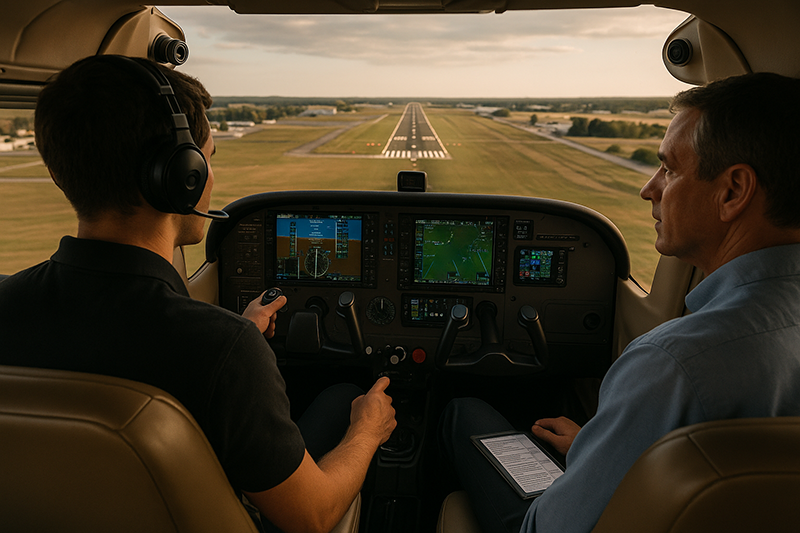
Learning how to stay ahead of the aircraft during approaches is one of the most important skills a pilot can develop. The approach phase compresses navigation, communication, configuration, energy management, weather assessment, traffic awareness, and decision-making into a short period of time. When a pilot is ahead of the aircraft, each task is anticipated before it becomes urgent. When a pilot is behind, even a normal approach can begin to feel rushed, unstable, and mentally overloaded.
Staying ahead of the aircraft does not mean moving faster. It means thinking earlier, planning deeper, and creating enough cockpit margin to fly the airplane accurately. Whether you are flying a Cessna on a visual approach, a technically advanced trainer on an RNAV approach, or a crewed aircraft under standard operating procedures, the principle is the same: the aircraft should never arrive somewhere your mind has not already been.
This article explains the practical habits that help pilots manage approaches with confidence. We will look at mental workload, briefing technique, configuration timing, descent planning, avionics management, common mistakes, and the go-around mindset. The goal is not to create another rigid checklist. The goal is to help pilots build a repeatable approach flow that supports safe, stable, and professional flying.
What It Means to Stay Ahead of the Aircraft
Staying ahead of the aircraft means maintaining a mental picture of where the aircraft is now, where it will be next, and what must be done before it gets there. During an approach, that picture includes position, altitude, airspeed, descent rate, aircraft configuration, navigation source, runway environment, missed approach plan, traffic, weather, and communications.
A pilot who is ahead of the aircraft is not surprised by predictable events. The descent point was anticipated. The frequencies were set before they were needed. The landing performance was considered before entering the pattern or intercepting final. The missed approach or go-around was reviewed before descending close to the runway environment. The next configuration change is already in mind before the aircraft reaches the point where it must happen.
Being behind the aircraft feels different. Tasks pile up. The pilot starts reacting instead of leading. Radio calls interrupt aircraft control. Avionics programming continues too close to the final approach segment. Airspeed drifts high or low. Checklists are rushed or delayed. The runway appears before the airplane is ready to land. In that condition, workload becomes the dominant cockpit threat.
The approach phase rewards preparation because time is limited. At typical training aircraft speeds, a few miles disappear quickly. In faster aircraft, the margin is even smaller. A pilot who waits until the final approach course to brief, configure, troubleshoot, or debate the plan has already given away valuable time. The better habit is to complete thinking-intensive tasks early, then use the final portion of the approach to monitor and fly.
Why This Matters in Real-World Aviation
Approaches are where many normal flights become demanding. Weather may be changing, traffic may be close, the airport may be unfamiliar, or ATC may issue a late runway change. Even on a clear day, the pilot must manage the aircraft’s energy so that altitude, airspeed, and configuration arrive together at the right place. A small delay early in the approach can create a large workload problem later.
For student pilots, staying ahead of the aircraft often starts with pattern discipline. Downwind spacing, power reduction, flap timing, before-landing checks, base turn planning, and final approach alignment all build the foundation for later instrument and cross-country flying. A student who learns to think ahead in the traffic pattern is learning the same mental skill needed for instrument approaches, night operations, and complex airspace.
For instrument pilots, the need is even more obvious. An instrument approach requires the pilot to maintain aircraft control while interpreting procedure guidance, altitude restrictions, course changes, approach mode indications, minimums, missed approach instructions, and communications. If the pilot is still building the plan after crossing an initial approach fix, the approach can quickly become task-saturated.
For flight instructors, this is a critical teaching topic because it connects technique with judgment. A learner may be able to hold altitude, track a course, or complete a checklist in isolation, yet still struggle when those tasks occur together. The instructor’s job is to help the learner organize the cockpit, prioritize tasks, and recognize when the approach is no longer developing safely.
For aviation professionals, staying ahead is also part of crew resource management and standardization. In crewed operations, the same principle appears through briefings, callouts, stabilized approach criteria, task sharing, monitoring, and go-around policies. In single-pilot operations, the pilot must create a similar structure through personal discipline, early preparation, and conservative workload management.
The Mental Model: Aviate, Navigate, Communicate, Manage
The classic priority of aviate, navigate, communicate remains useful because it protects the pilot from giving the wrong task too much attention at the wrong time. On approach, however, a fourth idea is worth adding: manage. Managing includes automation, avionics, checklists, performance planning, weather updates, and cockpit organization. These tasks are important, but they must never displace aircraft control.
Aviate means controlling pitch, bank, power, trim, airspeed, and configuration. If the airplane is not under control, no amount of navigation accuracy or radio professionalism will make the approach safe. The pilot must first keep the aircraft in the desired attitude, maintain appropriate airspeed, and manage descent rate.
Navigate means confirming where the aircraft is relative to the airport, procedure, terrain, traffic pattern, or runway. During an instrument approach, that includes verifying the correct navigation source, course, approach mode, fixes, altitude constraints, and missed approach path. During a visual approach, it includes maintaining proper spacing, runway alignment, and situational awareness around other traffic.
Communicate means using the radio effectively without letting it dominate the cockpit. A good radio call supports the operation. A poorly timed or overly complex call can distract from aircraft control. If workload is high, concise communication is better than trying to sound polished while the airplane gets away from you.
Manage means handling everything else at the right time. This is where pilots often fall behind. Programming a navigator, loading an approach, checking weather, selecting frequencies, reviewing the airport diagram, briefing the missed approach, and completing checklists are all manageable if they are done early. They become hazards when the pilot delays them until the aircraft is descending, turning, slowing, and communicating all at once.
Build the Approach Before You Fly It
The best approaches usually begin well before the descent. A pilot who waits until close to the airport to think about the approach is already compressing workload. The approach should be built mentally and procedurally while the aircraft is still in a low-workload phase of flight.
Start by identifying the runway, expected approach type, weather, wind, field elevation, traffic pattern or arrival plan, and any operational considerations that matter to the aircraft. If landing distance, runway condition, aircraft weight, density altitude, or crosswind could be a factor, consider those items early enough to change the plan if needed. A landing decision should not be improvised at the threshold.
For instrument approaches, the setup should include confirming the correct procedure, transition, minimums, final approach course, step-down or altitude restrictions if applicable, missed approach instructions, and the navigation source. The pilot should also understand how the avionics will present the approach and what mode changes are expected. Automation is helpful only when the pilot understands what it is doing and what it is not doing.
For visual approaches, the preparation is simpler but still important. Identify pattern entry, runway, traffic, wind, aiming point, expected flap and power plan, and go-around path. A visual approach can become unstable if the pilot treats it casually. The absence of an instrument procedure does not remove the need for a plan.
One effective mental question is: what do I want the aircraft to look like one minute from now? The answer may include altitude, airspeed, heading, configuration, checklist status, and next radio call. Asking that question repeatedly keeps the pilot’s mind ahead of the aircraft rather than trapped in the current moment.
Approach Briefings That Actually Reduce Workload
An approach briefing is not a speech. It is a focused review of the items that will help the pilot or crew fly the approach safely. A good briefing reduces uncertainty. A poor briefing simply consumes time.
For a single pilot, the briefing can be spoken quietly or reviewed mentally, but it should be deliberate. The pilot should know the runway, approach path, altitudes, minimums or decision points, missed approach or go-around plan, expected configuration, and any threats. Threats may include tailwind, crosswind, short runway, terrain, traffic, night visual illusions, wet runway, high workload airspace, or unfamiliar avionics operation.
In training, briefings are often either skipped or overdone. The better standard is a briefing that answers the practical question: what do I need to know before I descend toward the runway? If the briefing does not help with that question, it may be too generic. If the briefing leaves out the missed approach, runway environment, or key altitudes, it may be incomplete.
The timing of the briefing matters. It should be complete before the highest workload portion of the approach. In many operations, this means well before final approach course intercept or before entering the traffic pattern. If ATC changes the runway or approach, the pilot should recognize that the mental plan has changed and create time to rebuild it. Accepting a rushed approach clearance is not mandatory if the pilot needs vectors, delay, or clarification to maintain safety.
Energy Management: The Heart of a Stable Approach
Approach control is largely energy management. The aircraft has altitude energy, speed energy, and configuration-related drag. The pilot’s job is to arrange those elements so the aircraft reaches the landing area at an appropriate speed, descent rate, and configuration.
High and fast is the classic sign of being behind the aircraft. It usually develops before the pilot notices it. A delayed descent, late power reduction, strong tailwind, excessive vectoring speed, or late runway change can all create an energy state that is difficult to correct close to the runway. The solution is not aggressive maneuvering near the ground. The better solution is early recognition and, when necessary, a go-around or request for more space.
Low and slow presents a different risk. A pilot who is overly focused on descending, configuring, or correcting alignment may allow airspeed to decay. On approach, pitch and power coordination matters. The pilot should maintain an appropriate speed for the aircraft, configuration, wind, and phase of approach, using the aircraft’s approved guidance and training standards.
A stable approach is one in which the aircraft is on the intended path, at the intended speed, in the intended configuration, and under control with only small corrections needed. Specific stabilized approach criteria vary by operation, aircraft, and training program. The important habit is to define what stable means before the approach begins and to take corrective action if the aircraft does not meet that standard.
Energy management becomes easier when pilots plan backward from the runway. Instead of asking, can I make it down from here, ask, where should I be configured, slowed, and descending at the desired rate? That question helps prevent the late, rushed corrections that often create unstable approaches.
Configuration Timing and Checklist Discipline
Configuration changes should support the approach plan, not rescue it. Extending flaps, lowering landing gear, reducing power, adjusting propeller or mixture controls when applicable, and completing the before-landing checklist should occur at planned points that fit the aircraft and operation.
In training aircraft, many instructors teach simple pattern references because they reduce workload: power reduction at a familiar point, flap extension within appropriate speed limits, base turn at a planned spacing, and final approach stabilized with enough time to evaluate the landing. The exact technique depends on the aircraft, airport, wind, and instructor guidance, but the principle is consistent. Predictable configuration timing helps the pilot see deviations early.
In retractable gear aircraft or more complex airplanes, checklist discipline becomes even more important. The pilot must not allow radio work, traffic scanning, or avionics programming to interrupt critical configuration verification. Many pilots use flows followed by checklists, which can be effective when trained properly. A flow accomplishes the actions in a logical cockpit pattern. The checklist verifies that the required items were completed.
Checklist timing is part of staying ahead. If the before-landing checklist is delayed until short final, it may become a distraction at the exact moment the pilot should be evaluating the runway, airspeed, descent rate, and landing picture. A better approach is to complete non-time-critical items early and reserve the final segment for monitoring, minor corrections, and the landing decision.
Avionics and Automation: Use Them Early, Monitor Them Always
Modern avionics can reduce workload, but only if they are managed before workload peaks. Loading an approach, activating a leg, selecting the correct navigation source, setting minimums, adjusting altitude bugs, and confirming autopilot modes all require attention. Doing these tasks late in the approach can pull the pilot’s eyes and mind inside the cockpit when outside visual cues or instrument cross-check should be the priority.
A common automation trap is assuming that the equipment is doing what the pilot intended. The pilot should verify. Is the correct approach loaded? Is the correct transition selected? Is the final approach course correct? Is the navigation source appropriate? Is the autopilot following the expected mode? If the system does something unexpected, the pilot must be ready to simplify the operation, hand fly if appropriate, request delay, or discontinue the approach.
Another trap is using automation to continue an approach that the pilot has not mentally briefed. Automation can fly a path, but it cannot decide whether the approach still makes sense. The pilot remains responsible for aircraft control, navigation awareness, and decision-making.
For single-pilot IFR, cockpit automation discipline is especially important. A useful habit is to complete avionics programming before reaching the terminal environment whenever practical. Once the aircraft is close to the airport or established on the approach, changes should be minimized unless they are necessary and manageable. If a last-minute change requires significant reprogramming, the safer answer may be to ask for vectors, hold, or another clearance that gives time to set up correctly.
Weather, Wind, and Visual Illusions
Staying ahead of the aircraft also means staying ahead of the environment. Wind, visibility, ceiling, precipitation, turbulence, runway lighting, terrain, and sun angle can change the workload of an approach. A plan that works easily in calm, clear conditions may not work in gusty crosswinds, reduced visibility, or at night.
Wind affects both ground track and energy. A strong headwind on final may require different power management than a calm wind. A tailwind on base or final can increase groundspeed and compress the time available for configuration and descent. Crosswind requires alignment planning and may influence runway selection if another suitable runway is available.
Night and low-visibility approaches require disciplined instrument and visual cross-checks. Visual illusions can affect the pilot’s perception of glidepath and height above the runway. Runway slope, width, surrounding terrain, lighting intensity, and featureless terrain can all influence what the approach appears to look like. A pilot who is ahead of the aircraft uses available instruments, visual references, and a planned descent path rather than relying solely on an impression.
Weather decisions should be made early. If ceilings, visibility, wind, or convective activity raise concerns, the pilot should consider alternates, delays, different approaches, or diversion before reaching a high-workload point. Good approach management includes giving yourself permission to change the plan.
How Pilots Should Understand Workload Saturation
Workload saturation occurs when the number or complexity of tasks exceeds the pilot’s available attention. It can happen to new students, experienced instrument pilots, and professional crews. The risk is not a character flaw. It is a human performance limitation that must be managed.
Signs of workload saturation include missing radio calls, fixation on one instrument or display, delayed checklist completion, failure to notice airspeed or altitude deviations, confusion about aircraft position, abrupt control inputs, and a sense that events are moving too quickly. Instructors often see this when a learner becomes quiet, stops scanning, or continues a flawed approach without recognizing it.
The antidote is to reduce task demand. That may mean slowing the aircraft when appropriate, asking ATC for delaying vectors, entering a hold if cleared and appropriate, extending downwind, going around, using the autopilot correctly, transferring tasks in a crew environment, or abandoning nonessential cockpit tasks. The pilot should never feel obligated to salvage an approach simply because it was cleared or expected.
One of the most professional habits in aviation is acknowledging when a plan is no longer working. Staying ahead of the aircraft includes recognizing when you are behind and taking action early enough to restore margin.
Common Mistakes or Misunderstandings
One common mistake is treating the approach as beginning at the final approach fix or on base leg. By then, much of the approach outcome has already been shaped. The approach really begins when the pilot starts planning the arrival, reviewing weather, selecting the runway, and managing descent.
Another mistake is confusing speed with efficiency. Rushing through checklists, accepting tight vectors, or trying to force a descent may appear efficient, but it often creates instability. A smooth, deliberate approach usually saves more time than an unstable approach followed by a go-around that could have been anticipated.
Pilots also sometimes overfocus on avionics. A navigator can provide excellent situational awareness, but head-down programming during a critical phase can reduce aircraft control and traffic awareness. If a button sequence becomes confusing, the pilot should simplify. Fly the airplane first, then resolve the equipment issue when workload allows.
A fourth misunderstanding is believing that a go-around means the approach failed. A go-around is a normal maneuver and an important safety tool. The real failure is continuing an approach when the aircraft is not in a position to land safely. Pilots who brief the go-around before they need it are more likely to use it decisively when conditions call for it.
Finally, some pilots rely too heavily on habit patterns without adapting to conditions. A familiar power setting or flap timing may work well on a normal day, but wind, weight, runway length, density altitude, traffic spacing, or ATC instructions may require adjustment. Good habits are valuable, but they must remain connected to current aircraft performance and conditions.
Practical Example: Turning a Rushed Arrival Into a Managed Approach
Consider a private pilot flying a normally aspirated single-engine airplane to an unfamiliar towered airport on a clear but windy afternoon. The pilot expects Runway 18 based on the weather broadcast and begins descending from cruise. Ten miles from the airport, tower advises that traffic flow has changed and offers Runway 27 with a right base entry. The pilot accepts immediately while still above the desired descent profile, with the airport in sight but the runway layout not fully understood.
At this point, the aircraft is not in danger, but the pilot’s workload has increased. The runway changed, the pattern entry changed, the wind correction changed, and the pilot still needs to confirm traffic, complete the landing checklist, manage descent, and build a new mental picture. If the pilot continues without creating time, the aircraft may arrive high and fast on base with checklists incomplete and attention split between tower instructions and runway identification.
A more disciplined response would be to slow the process. The pilot could request a downwind entry, extended pattern, or vectors for spacing if available and appropriate. The pilot could level briefly or reduce speed within normal operating limits to create time. The airport diagram or moving map can help with orientation, but only if used without compromising aircraft control. The before-landing checklist should be completed at a planned point, not rushed on short final.
As the aircraft turns downwind or base, the pilot should reassess: correct runway identified, altitude appropriate, airspeed controlled, landing configuration planned, checklist complete, wind considered, traffic in sight or understood, go-around path in mind. If those items are not coming together, the pilot can go around or ask for re-sequencing. The key is that the pilot leads the situation instead of letting the runway change dictate a rushed approach.
This example is common because nothing dramatic happens at first. The trap is subtle. The pilot accepts a change that is reasonable only if there is enough time and mental capacity to rebuild the plan. Staying ahead means recognizing the workload increase immediately and adding margin before the final approach becomes unstable.
Best Practices for Pilots
The best practices for staying ahead of the aircraft are simple in concept, but they require discipline. They work because they move thinking-intensive tasks earlier and protect the final segment of the approach for monitoring and aircraft control.
- Plan the arrival before descent. Know the likely runway, weather, pattern or procedure, terrain considerations, and landing performance factors before workload increases.
- Brief what matters. Review the runway, approach path, key altitudes or descent plan, configuration, missed approach or go-around, and threats in a concise way.
- Use configuration points intentionally. Establish aircraft-specific habits for power, flaps, gear, and checklist timing that fit the operating handbook, training guidance, and conditions.
- Keep avionics work out of the critical phase when practical. Load, verify, and brief navigation data early. Monitor automation rather than blindly trusting it.
- Verbalize the next two events. For example: after this turn, I will intercept final, reduce power, verify configuration, and check speed. This keeps the mind moving ahead.
- Define unstable early. Know what conditions would make you discontinue the approach, and make that decision before the aircraft is too close to the runway.
- Respect workload saturation. If tasks are stacking up, create time. Slow down if appropriate, ask for help, request delay, or go around.
These practices should be adapted to the aircraft, training program, and operating environment. A student in the traffic pattern, a single-pilot IFR pilot, and a crew in turbine equipment will use different procedures, but the underlying goal is identical: reduce uncertainty before the approach becomes time-critical.
Teaching Students to Stay Ahead
Flight instructors can help students develop this skill by teaching anticipation rather than simply correcting deviations. Instead of waiting for the student to become high on final, the instructor can ask earlier: what will happen if we keep this downwind spacing? Instead of correcting a late checklist, the instructor can ask: when do you want that checklist complete so you are not doing it on short final?
Scenario-based training is especially useful. Give the student a runway change, simulated traffic spacing issue, unexpected tailwind, or avionics distraction at a safe time and observe whether the student creates margin. The lesson is not just how to complete the approach. The lesson is how to recognize that the original plan has changed.
Instructors should also model calm go-around decisions. If the instructor treats a go-around as a normal, professional choice, the student learns to do the same. If every approach is forced to a landing, the student may absorb the wrong lesson: that continuing is expected even when the approach is not developing well.
Debriefing should focus on decision points. Where did the workload start to increase? What could have been done one minute earlier? Which task should have been completed before entering the pattern or intercepting final? These questions build judgment more effectively than simply saying the approach was high, fast, or unstable.
Frequently Asked Questions
What does it mean to be behind the aircraft on approach?
Being behind the aircraft means the airplane is arriving at points in the approach before the pilot is mentally and procedurally ready. The pilot may be late configuring, uncertain about navigation, rushed on checklists, behind on radio calls, or slow to recognize altitude and airspeed deviations.
How early should I brief an approach?
Brief the approach early enough that the final approach or traffic pattern is reserved mainly for flying, monitoring, and decision-making. The exact timing depends on the operation, but the briefing should be complete before workload becomes high.
Is a visual approach less demanding than an instrument approach?
Not always. A visual approach may have fewer procedural steps, but it still requires energy management, traffic awareness, wind correction, runway identification, and a go-around plan. Visual approaches can become unstable when pilots treat them casually.
How can I tell if an approach is becoming unstable?
Warning signs include being high or low, fast or slow, not aligned with the intended path, not configured when expected, using excessive descent rate or large corrections, or feeling rushed and task-saturated. Use your aircraft guidance, training standards, and operating procedures to define specific criteria.
What should I do if ATC gives me a late runway or approach change?
First, keep flying the aircraft. If the change increases workload beyond what you can safely manage, ask for delaying vectors, clarification, a different entry, or another option. Do not accept a rushed approach if you need more time to set up correctly.
Does using an autopilot mean I am ahead of the aircraft?
No. Autopilot can reduce physical workload, but it does not replace planning, monitoring, or judgment. A pilot can still fall behind if the automation is not correctly set, verified, and understood.
Key Takeaways
- Staying ahead of the aircraft during approaches means planning early, anticipating the next event, and completing high-workload tasks before they become urgent.
- Stable approaches depend on disciplined energy management, configuration timing, checklist use, avionics verification, and the willingness to go around when the plan is not working.
- Training should emphasize judgment and anticipation, not just maneuver execution. Pilots should adapt techniques to their aircraft, procedures, and operating environment.