
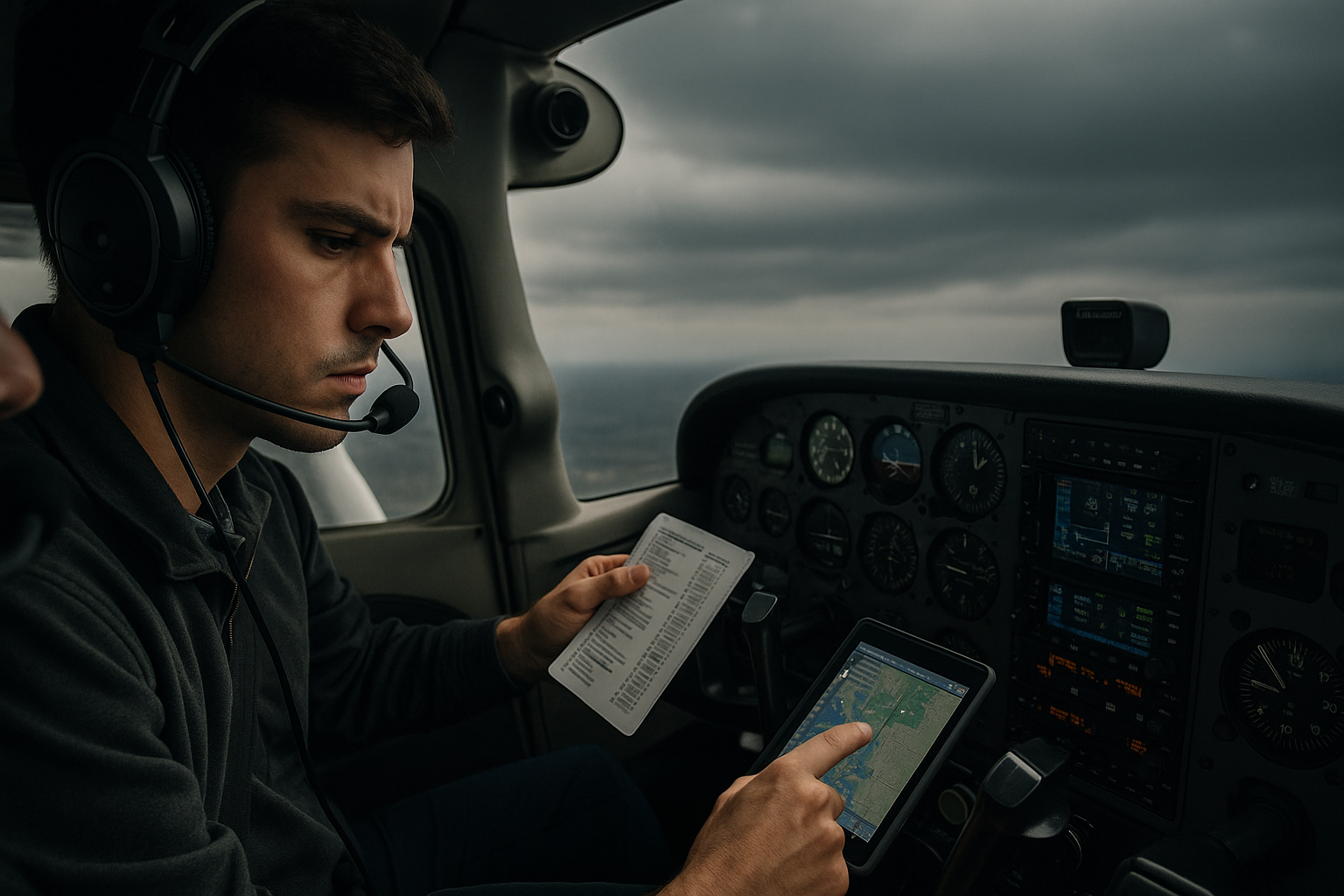
Stress-induced decision errors are among the most important human factors for pilots to recognize because they often appear when workload, time pressure, uncertainty, and personal pressure are already high. A pilot does not have to feel panicked to be affected by stress. In many cases, the more realistic hazard is subtle narrowing of attention, rushed reasoning, fixation on one solution, or reluctance to change a plan that is no longer working.
For student pilots, flight instructors, professional crews, and aviation operators, the value of understanding stress is practical rather than academic. Stress is not automatically unsafe. A reasonable level of alertness can sharpen performance and encourage disciplined cockpit management. The risk begins when stress changes how a pilot perceives information, weighs options, communicates, or follows procedures. Recognizing those changes early gives the pilot a chance to slow the event down, use available resources, and make a safer decision before the situation becomes more demanding.
What Stress Does to Pilot Decision-Making
Stress is the body and mind responding to a perceived demand or threat. In aviation, that demand may be operational, environmental, technical, social, or personal. A deteriorating ceiling, a rough-running engine, a passenger who must arrive on time, a checkride, a busy radio environment, a confusing clearance, or a sudden equipment abnormality can all create stress. The pilot’s task is not to eliminate stress completely. The task is to notice when stress is beginning to affect judgment.
Decision-making in flight requires perception, interpretation, option generation, risk assessment, and action. Stress can interfere with any part of that chain. A pilot may perceive fewer cues, interpret ambiguous information too optimistically, consider only one option, underestimate future risk, or act before verifying the situation. These are not character flaws. They are predictable human performance vulnerabilities that can appear in capable pilots when the situation becomes demanding.
One common effect is attentional narrowing, sometimes described as tunnel vision. The pilot becomes highly focused on one instrument, one problem, one route, or one desired outcome while other important cues fade into the background. Another effect is time compression. Even when there is still time available, the situation feels urgent, and the pilot may skip useful thinking steps. Stress may also make a pilot more vulnerable to confirmation bias, which means giving more weight to information that supports the preferred plan and discounting information that suggests a change is needed.
In training environments, stress-induced decision errors often show up during abnormal procedures, diversion planning, simulated emergencies, weather decisions, and high-workload traffic pattern operations. In operational flying, they may appear during go/no-go decisions, fuel planning, approach continuation decisions, missed approach decisions, and communication with air traffic control. The pattern is usually the same: the pilot is trying to solve the problem, but stress reduces the quality of the decision process.
Why This Matters in Real-World Aviation
Aviation decision-making is different from many everyday decisions because the environment keeps moving while the pilot thinks. Weather changes, fuel burns, airspace approaches, aircraft systems continue to operate or degrade, and other traffic remains part of the picture. A decision that was reasonable ten minutes ago may become questionable when new information appears. Stress makes it harder to update the plan.
This matters because pilots often operate in a chain of decisions rather than a single isolated event. A pilot may first accept a tight departure schedule, then launch with marginal weather along the route, then continue toward lowering visibility, then postpone a diversion because the destination is close. Each decision may feel manageable in isolation, but stress can reduce the pilot’s willingness to step back and evaluate the whole picture. The earlier a pilot recognizes stress-driven reasoning, the easier it is to break that chain.
Stress also affects communication. A stressed pilot may transmit too quickly, miss a readback error, avoid asking for clarification, or become quiet when help would be useful. In single-pilot operations, this can mean underusing air traffic control, flight service, onboard automation, a passenger who can help look for traffic, or a flight instructor in the right seat. In crew operations, stress can reduce the quality of challenge and response, especially if one pilot becomes fixated or the other pilot hesitates to speak up.
For flight instructors, the subject is especially important because students can appear to lose skill when the actual issue is overloaded decision-making. A student who normally flies a stable pattern may begin overshooting final, missing radio calls, and forgetting checklist items when traffic, wind, and instructor questions arrive at the same time. The lesson should not simply be “try harder.” The deeper lesson is how to manage workload, prioritize aircraft control, communicate clearly, and make decisions in a structured way while under pressure.
How Pilots Should Understand Stress-Induced Decision Errors
Pilots should understand stress-induced decision errors as a human factors issue that can be managed with awareness, discipline, and deliberate cockpit habits. The goal is not to label every stressful moment as dangerous. The goal is to identify when stress is changing the way the pilot thinks. That distinction matters because aviation often requires calm action in demanding circumstances.
A useful way to think about stress is to separate the trigger from the response. The trigger might be weather, mechanical concern, passenger pressure, airspace complexity, or schedule pressure. The response is what happens inside the pilot’s thinking process. Two pilots can face the same trigger and respond differently based on experience, training, fatigue level, preparation, and cockpit discipline. Even the same pilot may respond differently on different days.
Early warning signs often appear before the decision error itself. A pilot may notice irritability, rushing, shallow breathing, repeated checking of the same item, difficulty calculating simple estimates, or reluctance to talk through the situation. A pilot may also begin using absolute language internally: “I have to get in,” “I can’t divert now,” or “This should work.” Those phrases are warning lights. They suggest that the pilot may be narrowing the decision space instead of expanding it.
The best antidote is a deliberate pause. In aviation, a pause does not mean inaction or delay that creates additional risk. It means creating enough mental space to confirm aircraft control, identify the actual problem, and choose a defensible next step. In many situations, that pause can be as simple as leveling the wings, maintaining altitude, asking ATC for a vector or delay, engaging appropriate automation if trained and appropriate, or transferring tasks in a crew environment.
Structured decision models can also help, but only if pilots use them as thinking aids rather than classroom slogans. A good model prompts the pilot to define the problem, consider options, evaluate risk, make a decision, and monitor the result. In practice, the most important part may be the final step: monitoring. Stress can make pilots treat a decision as final when it should remain conditional. A safer mindset is, “This is my current plan, and I will change it if the next cue does not support it.”
Common Mistakes and Misunderstandings
One common misunderstanding is that only inexperienced pilots make stress-induced decision errors. Experience helps, but it does not make a pilot immune. Experienced pilots may face different stressors, such as complex missions, demanding passengers, organizational expectations, high-performance aircraft, or confidence built from many previous successful outcomes. Experience is most protective when it is paired with humility, recurrent training, and a willingness to reassess.
Another mistake is treating stress as a feeling that must be obvious. Some pilots expect stress to feel like fear or panic. In reality, it may feel like determination, impatience, annoyance, or strong commitment to the original plan. A pilot who says, “I’m fine, I just need to get this done,” may be describing exactly the mindset that deserves closer attention.
A third mistake is confusing decisiveness with rushing. Aviation rewards timely decisions, but timely does not mean impulsive. A pilot who declares a missed approach, diverts early, delays a departure, or asks for assistance is not being indecisive. Those actions often reflect disciplined decision-making. Rushing usually looks different: incomplete information, skipped verification, poor communication, and little consideration of alternatives.
Plan continuation bias is another important hazard. This occurs when a pilot continues with the original plan even after conditions have changed enough to justify reconsideration. The original plan may have been reasonable at departure, but aviation decisions must remain connected to current reality. Stress can increase attachment to the plan because changing the plan feels like admitting failure, disappointing someone, or creating inconvenience. A safer view is that changing a plan is a normal part of professional airmanship.
Pilots also sometimes overestimate the value of motivation. Wanting to complete the flight, pass the checkride, serve the customer, or impress passengers does not improve weather, fuel state, aircraft performance, or pilot capacity. Motivation can be useful in training and preparation, but it is not a substitute for risk management. When motivation becomes pressure, it can distort judgment.
Finally, some pilots misunderstand workload management. They assume they must solve every problem immediately and personally. In many situations, the first step is to stabilize the aircraft and reduce task saturation. Aviate, navigate, and communicate remains a practical priority because it protects the decision process. A pilot who is behind the aircraft will have less mental capacity available for judgment.
Practical Example: Weather, Time Pressure, and a Narrowing Plan
Consider a private pilot flying a single-engine airplane on a daytime cross-country flight. The pilot planned the route carefully, checked the weather before departure, and expected visual conditions at the destination. During the flight, the ceiling ahead appears lower than expected, the visibility is not as comfortable as forecast, and the destination is only about thirty minutes away. A passenger has an appointment, and the pilot has already told family members what time they should arrive.
At first, the pilot interprets the weather as temporary. The next airport along the route is still reporting acceptable conditions, and the moving map shows the destination getting closer. The pilot lowers altitude slightly to remain comfortably clear of clouds and continues. The radio is busy, the passenger asks whether everything is okay, and the pilot begins to feel irritated by the distraction. Rather than calling for updated weather or considering a turn toward better conditions, the pilot keeps flying toward the destination while thinking, “We’re almost there.”
This is a classic setup for stress-induced decision errors, even though nothing dramatic has happened yet. The pilot is not panicking. The aircraft is operating normally. The destination is close. But several warning signs are present: narrowing options, increased irritation, reduced information gathering, altitude changes driven by weather avoidance, and attachment to the original plan. Stress is shaping the decision process.
A safer response would begin with a deliberate reset. The pilot might climb or turn as needed to maintain legal and safe weather clearance, contact ATC or flight service for updated information if available, identify nearby airports with better conditions, and explain to the passenger that the plan may change. The pilot might choose to divert before the options become limited. The important point is not that every lowering ceiling requires an immediate diversion. The point is that stress should trigger better information gathering and wider options, not a narrower commitment to the original destination.
For instructors, this type of scenario is valuable because it can be discussed before, during, and after training flights. The instructor can ask the student to verbalize cues, identify decision points, and state what would cause a diversion. That turns stress recognition into a trainable skill rather than a vague personality trait.
Best Practices for Pilots
The best practices for recognizing stress-induced decision errors are simple in concept but require practice to become reliable in flight. The first is to brief personal triggers before they appear. If a pilot knows that weather uncertainty, passenger pressure, checkride performance, night operations, or busy airspace creates stress, that knowledge should be part of preflight planning. A known vulnerability is easier to manage than a surprise.
Second, pilots should set decision points before the flight whenever practical. A decision point is a predetermined cue that prompts reassessment. Examples include a fuel quantity, a weather minimum selected for personal risk management, a latest diversion point, a maximum acceptable crosswind based on proficiency and aircraft guidance, or a time by which the pilot must be on the ground. These are not new regulations. They are personal operating practices that help protect judgment when stress rises.
Third, pilots should practice saying the problem out loud. Verbalization is powerful because it forces the mind to convert vague discomfort into a clear statement. “The ceiling ahead is lower than expected, and I am starting to descend to stay visual” is much more useful than “It still looks okay.” In crew environments, this supports shared situational awareness. In single-pilot operations, it can still interrupt fixation and improve reasoning.
Fourth, pilots should make help easy to use. Asking ATC for clarification, delaying vectors, weather information, or assistance is not a sign of weakness. Neither is telling passengers that the plan is changing. Professional flying culture should support early communication because it increases options. Waiting until the situation is urgent can make communication harder and less effective.
Fifth, training should include realistic workload and decision-making practice, not only maneuver performance. A pilot who can fly a maneuver to standards in calm conditions may still need practice managing distractions, abnormal indications, changing weather, unfamiliar airports, and passenger pressure. Flight instructors can build this skill carefully by increasing complexity only after the student has the capacity to learn from it.
Useful habits include:
- Pause long enough to confirm aircraft control and identify the actual problem.
- Use checklists and procedures as intended rather than relying on memory under stress.
- State the current plan and the condition that would make you change it.
- Actively look for information that could disprove your preferred plan.
- Reduce workload early by slowing down, holding, diverting, delaying, or asking for help when appropriate.
These habits work because they protect mental bandwidth. They also create a cockpit culture in which changing a decision is normal when new information appears. That culture is valuable for student pilots, instructors, and professional crews alike.
Using Training to Build Stress Recognition
Stress recognition should be trained deliberately. It is not enough to hope that pilots will remain calm when the situation becomes complex. Training should help pilots experience manageable pressure, identify their personal signs of task saturation, and practice returning to a structured decision process.
In primary training, this may begin with simple scenarios. The instructor might introduce a simulated diversion, a radio distraction, or a change in wind while the student is already managing navigation. The goal is not to overwhelm the student. The goal is to teach prioritization. The student learns that aircraft control comes first, then navigation and communication, and that a good decision often begins with stabilizing the situation.
In instrument training, stress recognition becomes even more important because the pilot may have fewer outside visual cues and a higher dependence on instruments, procedures, and communication. A missed approach, unexpected hold, equipment issue, or approach change can raise workload quickly. The pilot should be trained to brief, verify, and manage automation without becoming passive or overloaded.
For certificated pilots, recurrent training can revisit these skills in ways that are relevant to actual operations. A weekend VFR pilot may benefit from weather diversion scenarios and passenger-pressure discussions. A technically advanced aircraft pilot may benefit from automation mode awareness and abnormal procedure scenarios. A commercial pilot may benefit from crew communication, fatigue awareness, and operational pressure case studies.
Debriefing is where much of the learning becomes durable. Instead of asking only whether the pilot completed the maneuver, the instructor should ask what the pilot noticed, when workload increased, what cues were missed, and what would be done differently next time. This builds metacognition, which is the ability to monitor one’s own thinking. In aviation, that ability is a major defense against stress-induced decision errors.
How Instructors Can Teach the Topic Without Overloading Students
Flight instructors have a responsibility to create learning conditions that are challenging but not chaotic. If the instructor introduces too many stressors too soon, the student may simply become saturated and stop learning. If the instructor never introduces realistic workload, the student may be surprised by normal operational pressure after certification. The balance is intentional scenario design.
A good instructional approach is to brief the objective clearly. For example, the instructor might say, “Today we will practice recognizing when workload is affecting your decisions during a diversion.” That frames the lesson around awareness rather than perfection. During the flight, the instructor can observe not only aircraft control but also communication, planning, and willingness to revise the plan.
Instructors should also model calm decision language. When a situation changes, the instructor can demonstrate phrases such as, “Let’s stabilize first,” “What information do we need?” or “What would make us choose another airport?” Students often adopt the cockpit habits they hear repeatedly. Clear language reduces ambiguity and gives the student a practical script for stressful moments.
Another useful technique is the pause-and-debrief. If safety and workload permit, the instructor can pause the scenario or reduce task demand and ask the student what changed in their thinking. This helps the student connect physical and mental signs of stress with specific decision behaviors. Over time, the student learns to recognize those signs without needing the instructor to point them out.
Frequently Asked Questions
What are stress-induced decision errors in aviation?
Stress-induced decision errors are mistakes in judgment that occur when pressure, workload, uncertainty, or emotional factors change how a pilot processes information and chooses actions. They may include fixation, rushing, plan continuation, poor communication, or failure to consider safer alternatives.
How can a pilot tell when stress is affecting judgment?
Warning signs include rushing, tunnel vision, repeated checking of one item, irritability, difficulty with simple tasks, reluctance to ask for help, and strong attachment to the original plan. A pilot may also notice internal pressure expressed as “I have to” or “I can’t change now.”
Does experience prevent stress-related decision errors?
Experience can improve pattern recognition and confidence, but it does not make a pilot immune. Experienced pilots still need disciplined procedures, honest self-assessment, recurrent training, and a willingness to change plans when conditions change.
What should a pilot do first when stress begins to rise in flight?
The first priority is to maintain aircraft control and stabilize the situation. Then the pilot should clarify the problem, reduce workload where possible, use available resources, and choose a safe next step. In many cases, slowing the event down improves the quality of the decision.
How can flight instructors teach better stress management?
Instructors can use realistic scenarios, structured debriefings, and progressive workload increases. The goal is to help students recognize personal stress cues, prioritize tasks, communicate clearly, and make decisions using current information rather than pressure or habit.
Is changing the plan a sign of poor planning?
No. Changing the plan is often a sign of good airmanship when new information makes the original plan less suitable. A well-prepared pilot expects to revise decisions as weather, aircraft status, traffic, fuel, and human factors change.
Key Takeaways
- Stress-induced decision errors often begin subtly, with rushing, fixation, narrowed options, or reluctance to revise the original plan.
- Safe pilots respond to rising stress by stabilizing the aircraft, reducing workload, gathering better information, and using available resources.
- Training should make stress recognition a practical skill through realistic scenarios, clear decision points, and thoughtful debriefing.