
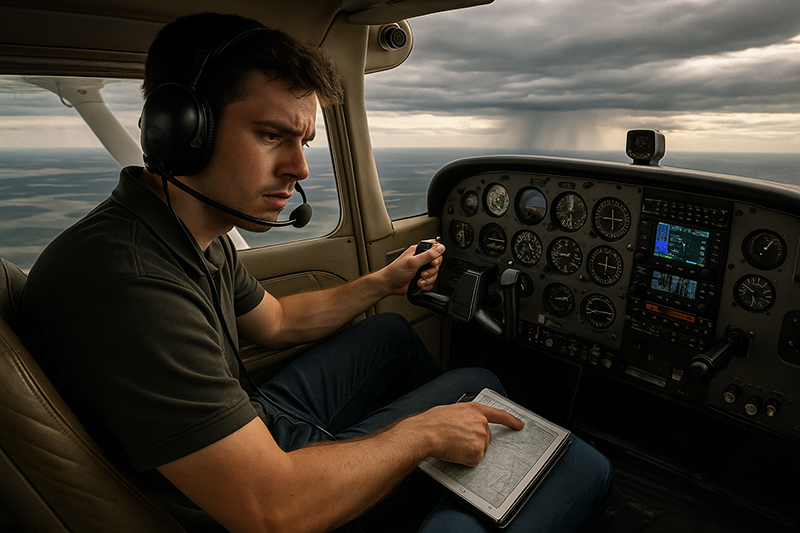
Stress-induced decision errors are among the most important human factors for pilots to recognize because they often appear at the exact moment when clear thinking matters most. A pilot under pressure may still know the correct procedure, understand the weather picture, and have the skill to fly the aircraft, yet make a poor choice because stress has narrowed attention, accelerated assumptions, or pushed the pilot toward action before analysis.
For student pilots, flight instructors, aircraft owners, professional crews, and aviation managers, the practical question is not whether stress can occur in flight. It can. The more useful question is whether the pilot can recognize when stress is beginning to distort judgment. This article explains how stress affects aeronautical decision-making, what stress-induced decision errors look like in real flight operations, and how pilots can build habits that protect judgment before a situation becomes time-critical.
What Stress-Induced Decision Errors Mean in Aviation
A stress-induced decision error is a poor aviation decision influenced by physiological or psychological pressure. The pressure may come from weather, fuel, aircraft performance, passengers, ATC workload, schedule demands, training expectations, maintenance uncertainty, unfamiliar airspace, or the pilot’s own desire to complete a flight. Stress does not have to be dramatic to affect judgment. It can build gradually through a series of small pressures until the pilot begins to accept risk that would have seemed unacceptable during preflight planning.
In aviation, stress is not automatically harmful. A manageable level of alertness can help a pilot focus, scan instruments carefully, and respond promptly. The problem begins when stress consumes working memory, narrows situational awareness, or creates an urgent need to reduce discomfort. Under that pressure, pilots may choose the option that feels like relief rather than the option that best manages risk.
Decision errors under stress often look reasonable in the moment. A pilot may continue toward lowering ceilings because turning around feels inconvenient. A student may rush a checklist because the radio is busy. A crew may delay discussing a concern because everyone appears task-saturated. A flight instructor may allow a training scenario to continue slightly too long because the lesson objective seems important. These are not necessarily knowledge failures. They are judgment failures shaped by stress, workload, and attention.
Recognizing these errors requires pilots to look beyond the final decision and examine the conditions surrounding it. Was the cockpit becoming rushed? Was the pilot trying to satisfy an expectation? Was a plan being defended after conditions changed? Was the pilot searching for confirming evidence while ignoring disconfirming cues? These questions help reveal whether stress was influencing the decision process.
Why This Matters in Real-World Aviation
Stress-induced decision errors matter because aviation rarely gives pilots perfectly isolated problems. A weather deviation may occur while fuel is decreasing. A radio issue may appear during arrival into unfamiliar airspace. A passenger concern may arise during turbulence. A minor system abnormality may occur while the pilot is already behind the aircraft. Each added pressure can reduce the mental space available for disciplined decision-making.
Real-world flying also includes social and operational pressures that do not appear on a checklist. A pilot may not want to disappoint passengers. A student may want to prove readiness. A commercial pilot may be aware of scheduling consequences. An instructor may want to complete a lesson before weather changes. These pressures can be subtle, but they can influence how pilots interpret risk.
Stress also affects how pilots use training. A pilot who calmly explains a diversion procedure on the ground may hesitate to execute it in flight if the decision feels embarrassing or inconvenient. A pilot who understands personal minimums may negotiate with them when the destination is close. A pilot who knows to slow down may instead rush because the cockpit feels chaotic. The gap between knowledge and action is where stress-induced decision errors often develop.
Flight instructors have a special role in this area. Students learn not only maneuvers and procedures, but also emotional patterns around decision-making. If training consistently rewards completion over judgment, students may internalize the idea that pressing on is a sign of competence. If training normalizes pausing, reassessing, diverting, discontinuing an approach, or asking for help, students learn that conservative decisions are part of professional airmanship.
How Stress Changes Pilot Decision-Making
Stress affects decision-making through several practical mechanisms that pilots can observe in themselves and others. The first is attention narrowing. Under pressure, a pilot may focus intensely on one problem while missing other important cues. For example, a pilot troubleshooting a navigation issue may stop monitoring fuel, weather, traffic, or altitude trends as effectively.
The second mechanism is time compression. Stress can make a situation feel more urgent than it actually is. This perceived urgency pushes pilots toward immediate action, even when the safest first step is to maintain aircraft control, stabilize the situation, and buy time. Not every abnormal situation requires instant problem-solving. Many require disciplined prioritization.
The third mechanism is confirmation bias. A stressed pilot often wants the current plan to remain valid, so the pilot may give more weight to information that supports continuing. A slight improvement in visibility may be treated as meaningful while a broader weather trend is minimized. A favorable fuel estimate may be trusted while uncertainties are ignored. Confirmation bias is especially dangerous because it can make a risky decision feel analytical.
The fourth mechanism is plan continuation tendency. Once a pilot has invested time, fuel, money, reputation, or emotion into a plan, changing the plan can feel like failure. Stress increases that attachment. Continuing may feel simpler than explaining a diversion or delay. In reality, adapting the plan is often the mark of sound aeronautical decision-making.
The fifth mechanism is reduced communication. Pilots under stress may become quieter, more abrupt, or less willing to verbalize uncertainty. In single-pilot operations, this may appear as internal silence. The pilot stops asking, “What has changed?” In crew or instructional settings, it may appear as a failure to invite input. When communication decreases, error detection decreases with it.
Recognizing the Early Warning Signs
The best time to manage stress-induced decision errors is before the aircraft is close to the edge of the envelope, the weather has deteriorated, or the pilot is fully task-saturated. Early recognition is a skill. It depends on noticing changes in thinking, behavior, and cockpit rhythm.
One early sign is a shift from deliberate reasoning to justification. Deliberate reasoning sounds like, “Here are the conditions, here are my options, and here is why this choice gives me the safest margin.” Justification sounds like, “It will probably be fine,” “We are almost there,” or “I do not want to make this harder than it needs to be.” The language of justification often appears when the pilot is trying to protect a plan from reality.
Another warning sign is checklist compression. A pilot may still use the checklist, but with less attention. Items are rushed, flows are assumed, and callouts become mechanical. Instructors often see this during busy traffic patterns, simulated emergencies, and instrument training when the student is trying to keep up with events rather than manage them.
A third sign is loss of margin awareness. The pilot may know the aircraft is legal to operate and may know the flight is technically possible, but may stop asking whether there is enough margin for weather changes, traffic delays, fatigue, passenger needs, or a simple mistake. Stress tends to push pilots toward minimum acceptable outcomes rather than comfortable safety margins.
A fourth sign is emotional narrowing. Irritation, embarrassment, impatience, and defensiveness all deserve attention in the cockpit. These emotions do not mean the pilot is unsafe, but they do mean judgment may be under pressure. A pilot who feels embarrassed about diverting may be less objective about the need to divert. A pilot who feels irritated with ATC or traffic may miss an opportunity to slow down and clarify.
Physical cues can also help. Tight grip pressure, shallow breathing, rushed speech, skipped meals, fatigue, tunnel vision, or a sense of being behind the aircraft can all indicate that stress is affecting performance. Pilots should treat these cues as operational information, not personal weakness.
Why Stress Often Hides Behind Normal Procedures
One reason stress-induced decision errors are difficult to catch is that they can occur while the pilot appears to be following normal procedures. A pilot may brief an approach, communicate with ATC, configure the aircraft, and continue the flight, all while privately feeling overloaded or uncertain. The outward structure of normal operations can hide a degraded decision process.
This is why pilots should not confuse activity with control. A cockpit can be busy and still well-managed, or busy and poorly managed. The difference is whether the pilot is preserving priorities: aircraft control, navigation, communication, configuration, terrain and traffic awareness, fuel awareness, weather awareness, and decision gates. When stress rises, pilots may continue doing tasks without stepping back to ask whether those tasks still support the safest outcome.
Procedures are powerful safety tools, but they are not substitutes for judgment. A checklist confirms actions. It does not decide whether the flight should continue into worsening conditions. An approach briefing organizes information. It does not guarantee that the approach remains wise if the pilot is unstable, fatigued, or uncertain. A clearance authorizes a path within the ATC system. It does not remove the pilot’s need to evaluate aircraft capability, weather, workload, and personal readiness.
Effective pilots use procedures as anchors. When stress increases, they return to structured habits: aviate first, stabilize the aircraft, slow the pace where possible, use the checklist, communicate clearly, and make a decision before the aircraft or environment makes it for them. The goal is not to eliminate stress. The goal is to keep stress from becoming the hidden pilot in command.
Common Mistakes and Misunderstandings
A common misunderstanding is that stress-induced errors only happen to inexperienced pilots. Experience helps, but it does not eliminate vulnerability. Experienced pilots may be better at recognizing patterns, but they may also be more confident in their ability to manage a deteriorating situation. Confidence is valuable when it is paired with current information and humility. It becomes hazardous when it turns into automatic continuation.
Another mistake is assuming that a calm voice means calm cognition. Many pilots sound professional on the radio while working very hard internally. Instructors and crew members should observe workload, task management, and decision quality, not only tone of voice. A student who is quietly overloaded may need help just as much as one who appears visibly anxious.
Pilots also sometimes treat personal minimums as flexible goals instead of decision boundaries. Personal minimums are most useful when established before the pressure of flight. If they are adjusted in the air, the adjustment should be conservative and based on actual conditions, not convenience. A personal minimum that can be negotiated every time it becomes inconvenient is not functioning as a safety tool.
Another error is delaying a decision in the hope that the situation will become clearer. Sometimes waiting is appropriate, especially when the aircraft is stable and more information is needed. But waiting can also be a disguised decision to continue. If fuel is decreasing, weather is changing, daylight is fading, or pilot fatigue is increasing, time may be reducing options. A deliberate delay should include a decision point, not an open-ended hope.
A final misunderstanding is believing that asking for help is a sign of poor skill. In aviation, asking for help is often a sign of situational awareness. A pilot can request vectors, clarify a clearance, advise ATC of workload, ask a passenger to be quiet during a critical phase, involve another qualified pilot, or discontinue a training maneuver. Good decision-making uses available resources.
Practical Example: A VFR Cross-Country Under Pressure
Consider a private pilot conducting a day VFR cross-country in a familiar single-engine airplane. The preflight weather showed acceptable conditions, but with a possibility of lower ceilings near the destination later in the afternoon. The pilot briefed a conservative route, identified alternates, and planned to turn around or divert if the ceilings lowered below personal comfort.
During the flight, the headwind is stronger than expected, and the arrival will be later than planned. A passenger begins asking whether they will still make a dinner reservation. The pilot notices scattered clouds becoming more extensive ahead. The destination is still reporting conditions that appear usable, and the GPS shows less than 35 minutes remaining. The aircraft has adequate fuel, but not enough to comfortably continue, miss the destination, and then wander while considering options. The pilot feels the pressure of being close.
This is a classic setting for stress-induced decision errors. The stressors are not dramatic by themselves: a delay, a passenger expectation, changing clouds, and a destination that is almost within reach. Together, they can create plan continuation pressure. The pilot may begin looking for evidence that supports continuing. “The destination is still reporting VFR.” “The clouds ahead might be broken.” “We are nearly there.” “I know this area.” Each statement may contain some truth, but the overall decision process is becoming biased toward completion.
A safer response begins with recognition. The pilot notices the mental shift from evaluation to justification. Instead of pressing on quietly, the pilot levels the workload: maintain aircraft control, review fuel and alternates, compare actual conditions with personal minimums, and make a decision while options remain comfortable. The pilot may tell the passenger, “Weather and fuel margins are changing, so I am going to divert now rather than continue into a tighter situation.”
The diversion may feel inconvenient, but it restores margin. It also demonstrates professional decision-making. The important lesson is that the pilot did not wait until the flight became an emergency. The stress-induced error would not have been failing to fly the airplane. It would have been allowing social pressure and destination fixation to erode a sound plan.
Best Practices for Pilots
Preventing stress-induced decision errors begins before engine start. Preflight planning should identify not only route, fuel, performance, and weather considerations, but also decision triggers. A decision trigger is a preplanned point at which the pilot will reassess or change the plan. Examples include a minimum fuel level for diverting, a ceiling or visibility condition that prompts a route change, a maximum acceptable delay, or a rule for discontinuing training when workload exceeds learning value.
Personal readiness is equally important. The IMSAFE concept, which considers illness, medication, stress, alcohol, fatigue, and emotion or eating, is useful because it reminds pilots that decision-making begins with the pilot’s condition. A pilot who is tired, distracted, hungry, or emotionally preoccupied has less reserve for in-flight stress. The aircraft may be airworthy and the weather may be acceptable, but the pilot still needs enough mental capacity to handle the unexpected.
In flight, pilots should practice verbalizing decisions. Even when alone, speaking a short decision summary can slow the mind and reveal weak reasoning. For example: “Ceilings are lower than expected, fuel is still comfortable, the alternate is behind me with better weather, and continuing reduces options. I am diverting now.” This type of self-briefing converts vague discomfort into actionable judgment.
Another best practice is to create time whenever possible. Slowing the aircraft, requesting delaying vectors, entering a hold when appropriate and cleared, climbing or descending to improve conditions when safe and authorized, or diverting early can all reduce time pressure. The specific action depends on the operation and airspace, but the principle is consistent: when stress rises, look for ways to increase time, information, and margin.
Pilots should also separate capability from wisdom. An aircraft may be capable of completing a flight, and a pilot may be capable of flying the procedure, but the decision may still be unwise if margins are thin. Sound aeronautical decision-making is not about proving capability. It is about choosing the option that preserves safety under the actual conditions of the flight.
Useful habits include:
- Briefing decision points before departure, not after stress appears.
- Reassessing weather, fuel, workload, and pilot condition at natural intervals during flight.
- Using checklists deliberately rather than as rushed rituals.
- Inviting input from instructors, crew members, ATC, or qualified passengers when appropriate.
- Discontinuing an approach, maneuver, or flight segment when the situation no longer supports a stable and well-managed outcome.
For instructors, the best practices include teaching students to recognize their own stress signatures. One student may become quiet. Another may rush. Another may fixate on instruments. Another may stop hearing radio calls. Debriefing these patterns after training flights helps students develop self-awareness before they encounter similar stress alone.
Training Stress Without Normalizing Unsafe Decisions
Training should expose pilots to manageable workload and realistic decision-making pressure, but it should not teach them to tolerate unsafe margins. There is a difference between productive training stress and unproductive overload. Productive stress stretches skill while preserving safety, learning, and instructor control. Unproductive overload causes the student to abandon judgment, chase tasks, and survive the lesson rather than learn from it.
Flight instructors can support better decision-making by pausing scenarios before the student is fully saturated and asking what cues are present. The goal is not only to practice the correct maneuver or procedure. It is to help the student identify the moment when the decision process began to degrade. A well-timed question such as “What options do you have right now?” can be more valuable than allowing the scenario to continue until the student has no good options left.
Scenario-based training is especially useful for this topic when it includes realistic pressures. A simulated passenger expectation, changing weather, a runway closure, a fuel planning challenge, or an unfamiliar arrival can reveal how pilots behave when the plan changes. The instructor should then debrief not just the final decision, but the cues, emotions, and assumptions that shaped it.
Professional aviation organizations can apply the same principle through standard operating procedures, crew resource management, safety reporting, and non-punitive discussion of close calls. The operational culture should make it easier to speak up early. When pilots believe that conservative decisions will be respected, they are more likely to act before stress forces a poor choice.
How to Debrief a Stress-Induced Decision Error
A useful debrief avoids shame and focuses on the decision pathway. The question is not simply, “Why did you make that choice?” A better question is, “What did the situation look like to you at the time?” This helps identify the cues the pilot noticed, the cues the pilot missed, and the pressures that influenced interpretation.
The debrief should examine the sequence. When did workload start to rise? When did the original plan become questionable? What information supported continuing, and what information argued against it? Were there earlier opportunities to slow down, divert, ask for help, or discontinue the task? Did the pilot feel pressure from passengers, schedule, pride, training expectations, or perceived inconvenience?
It is also important to identify a replacement behavior. Telling a pilot to “use better judgment” is too vague. A better outcome is a specific habit: verbalize the decision, set a fuel decision point, brief an alternate earlier, call for a pause in training, use a personal minimum without renegotiating it, or ask ATC for assistance before workload becomes unmanageable.
Over time, these debriefs build pattern recognition. Pilots begin to notice that their riskiest decisions often share common emotional or operational features. That awareness makes it easier to intervene early.
Frequently Asked Questions
What is a stress-induced decision error in flying?
It is a poor aviation decision influenced by stress, workload, time pressure, social pressure, fatigue, or emotional strain. The pilot may still understand the correct procedure, but stress changes how information is noticed, weighted, or acted upon.
Can experienced pilots still make stress-induced decision errors?
Yes. Experience improves judgment when it is paired with discipline and current situational awareness. However, experienced pilots can still be affected by plan continuation, confirmation bias, fatigue, schedule pressure, or overconfidence.
How can a pilot tell when stress is affecting judgment?
Warning signs include rushing, narrowing attention, defending the original plan, skipping or compressing checklists, irritability, reluctance to ask for help, and accepting margins that would have seemed too thin during preflight planning.
What should a pilot do first when feeling overloaded?
The first priority is to keep the aircraft under control and stabilize the situation. Then reduce workload where possible, use available resources, communicate clearly, and make a deliberate decision while safe options remain available.
How should flight instructors teach this topic?
Instructors should use realistic scenarios, observe each student’s stress patterns, and debrief the decision process rather than only the maneuver outcome. Students should learn that pausing, diverting, discontinuing, or asking for help can be signs of strong airmanship.
Are personal minimums useful for preventing these errors?
Yes, when they are set before the flight and treated as meaningful decision boundaries. They are less useful if they are repeatedly adjusted in flight to support a plan the pilot already wants to complete.
Key Takeaways
- Stress-induced decision errors often begin before an emergency, when pressure quietly changes how a pilot interprets risk and options.
- Early recognition of rushing, justification, fixation, and shrinking margins helps pilots intervene while safer choices are still available.
- Strong aeronautical decision-making depends on preplanned decision points, honest self-assessment, deliberate communication, and a willingness to change the plan.