
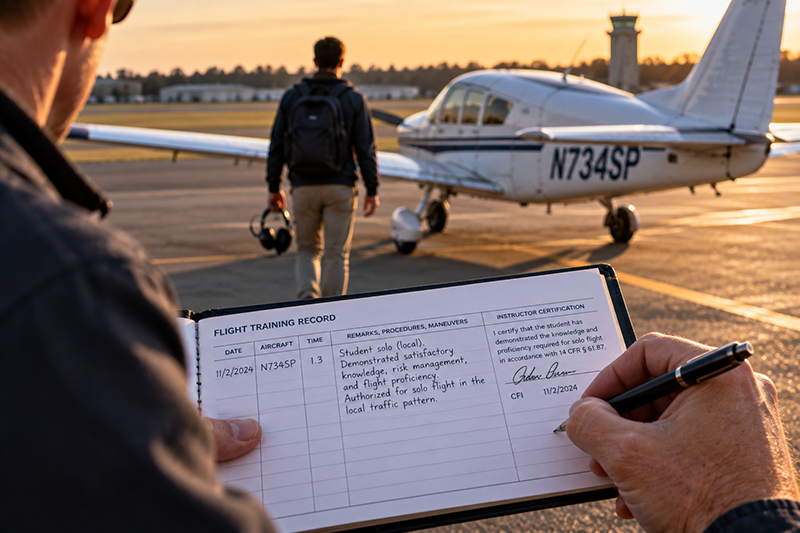
Student pilot solo endorsements are more than signatures in a logbook. They are specific instructor authorizations that define what a student pilot may do when acting as pilot in command without an instructor on board. For a new pilot, solo flight is a milestone. For a flight instructor, it is also a formal safety and regulatory decision that must match the student’s training, proficiency, aircraft, route, airspace, weather, and operating limitations.
This matters because not all solo endorsements allow the same kind of flight. A student may be authorized to fly solo in the local traffic pattern, but that does not automatically authorize solo cross-country flight. A student may be legal to solo at a quiet non-towered airport, but that does not necessarily allow solo operations in Class B airspace, at night, or to another airport. Understanding the purpose and limits of each authorization helps students avoid accidental rule violations, helps instructors document training correctly, and promotes safer decision-making during one of the most vulnerable stages of pilot development.
This article explains the major student pilot solo endorsements in practical aviation language. It is written for student pilots who want to understand what their endorsements mean, instructors who want to teach the concept clearly, and aviation professionals who need a clean overview of how solo authorizations fit into flight training. It does not replace current FAA regulations, advisory guidance, or school procedures, but it provides a useful framework for understanding what each endorsement generally allows.
What a Student Pilot Solo Endorsement Actually Does
A solo endorsement is an instructor’s documented authorization for a student pilot to conduct a particular type of solo operation. The endorsement normally appears in the student’s logbook, and some solo privileges also require appropriate documentation associated with the student pilot certificate. In practical terms, the endorsement connects three things: the student’s demonstrated competence, the specific flight operation being authorized, and the limitations that apply to that operation.
The important point is that a solo endorsement is not a general pilot certificate. A student pilot remains subject to student pilot limitations and to any restrictions placed by the instructor. The authorization may be limited by aircraft make and model, airport, practice area, route, weather minimums, time of day, airspace, or any other operational condition the instructor considers necessary. If the endorsement or instructor-imposed limitations do not allow a particular flight, the student should not assume it is permitted.
Solo endorsements also have a currency element. Certain student pilot solo authorizations are valid only for a defined period and must be renewed or reissued as appropriate. This is not just paperwork. A student’s proficiency, judgment, and consistency can change over time, especially if there are gaps in training, seasonal weather changes, airport construction, aircraft changes, or new operational pressures. A current endorsement gives the instructor a recurring opportunity to reassess readiness.
For the student, the best mental model is simple: an endorsement answers the question, “What exactly has my instructor authorized me to do today?” If the planned flight falls outside that answer, the student needs additional training, clarification, or a new endorsement before going.
The Pre-Solo Knowledge Test Endorsement
Before a student pilot flies solo, the instructor must ensure the student has demonstrated appropriate aeronautical knowledge for the intended solo operation. In everyday training, this is often handled through a pre-solo written test developed or administered by the instructor or flight school. The test typically covers applicable regulations, local procedures, airspace, aircraft systems, performance, limitations, emergency procedures, airport operations, and other knowledge areas relevant to the training environment.
The endorsement associated with this step does not, by itself, authorize the student to fly solo. Instead, it documents that the student has satisfactorily completed the required pre-solo knowledge preparation. Think of it as one prerequisite in the larger solo approval process. Passing a pre-solo written test is not the same as being released to fly alone.
In practical use, this knowledge review should be specific to the student’s operating environment. A student training at a towered airport should understand tower communications, taxi instructions, runway assignment procedures, hold-short clearances, wake turbulence considerations, and local traffic flow. A student training at a non-towered airport should understand traffic pattern entries, radio phraseology, right-of-way concepts, runway selection, wind evaluation, and how to visually scan for traffic without relying on a controller.
The best instructors use the pre-solo knowledge process as a teaching event rather than a memory contest. A student who can recite a rule but cannot apply it to a changing wind, an unexpected runway closure, or a radio communication problem still needs coaching. The goal is not simply to complete a form. The goal is to confirm that the student can think safely and legally when the instructor is no longer in the right seat.
The Pre-Solo Flight Training Endorsement
The pre-solo flight training endorsement documents that the student has received the required flight training and demonstrated proficiency in the maneuvers and procedures needed for solo flight in the aircraft being used. For airplane students, this training commonly includes takeoffs, landings, traffic patterns, go-arounds, stalls and stall recoveries, emergency procedures, ground reference maneuvers, aircraft control, collision avoidance, and other fundamentals appropriate to the aircraft category and class.
This endorsement is closely tied to aircraft operation. A student who is proficient in one make and model may not automatically be ready to solo in another. Even aircraft that appear similar can differ in sight picture, power response, trim behavior, flap operation, avionics, fuel system design, braking characteristics, checklist flow, and landing technique. The endorsement should reflect the aircraft and operation for which the instructor has actually trained and evaluated the student.
Like the knowledge endorsement, the pre-solo flight training endorsement is not always the same as the active solo authorization. It shows that the student has completed the training and demonstrated the necessary skill foundation. The instructor must still authorize the actual solo operation and may impose limitations based on conditions, proficiency, and local risk factors.
From a safety perspective, this is where instructor judgment matters most. A student may be able to land the aircraft well during a calm morning lesson but become overloaded when the wind shifts, the pattern gets busy, or a radio call is missed. A complete pre-solo evaluation looks at consistency, not just isolated performance. The student should be able to maintain aircraft control, manage workload, recognize unstable approaches, go around without hesitation, and make conservative decisions without prompting.
The Initial Solo Endorsement for Local Flight
The initial solo endorsement is the authorization most students think of when they hear the word “solo.” It allows the student pilot to act as pilot in command for solo flight within the scope approved by the instructor. In many training programs, the first solo is limited to the local airport traffic pattern, often with specific weather, runway, and traffic conditions established by the instructor.
This endorsement is not an unlimited permission slip. It generally applies to a specific category and class of aircraft, and often to a particular make and model. The instructor may restrict the flight to a named airport, a designated practice area, particular wind limits, minimum ceilings and visibility, daylight conditions, or specific maneuvers. These limitations are part of the authorization. A student who exceeds them is not operating within the instructor’s approval.
For example, a student may be endorsed to solo a Cessna 172 at the home airport with winds below an instructor-specified limit and no solo operations when crosswinds exceed a stated value. That authorization would not automatically permit the student to rent a different airplane, depart to another airport, practice landings after sunset, or fly into complex controlled airspace. The endorsement allows what it says and what the applicable rules allow, not what the student assumes it implies.
Initial solo endorsements also serve as a quality control point for training organizations. Before a student is released, the instructor should verify that the student pilot certificate is valid, the required endorsements are present, the aircraft is appropriate and airworthy for the planned operation, weather and NOTAM information have been reviewed, and local procedures are understood. The student should also know what to do if conditions change after takeoff, including when to discontinue the flight and return for landing.
Renewed or Additional Solo Endorsements
Student solo privileges are not indefinite. A student pilot needs a current solo endorsement to continue flying solo, and instructors must periodically reassess the student before extending that privilege. This recurrent endorsement process helps ensure that solo authorization remains tied to actual proficiency rather than a past milestone.
In practice, a renewed solo endorsement may look routine, but it should not be automatic. The instructor should consider the student’s recent flying, landings, aircraft control, judgment, knowledge, weather decision-making, and any changes in the training environment. If the student has not flown for several weeks, has changed aircraft, is training during a different season, or has struggled with recent lessons, the instructor may need to fly with the student before renewing solo privileges.
Additional solo endorsements may also be needed when the student changes aircraft category, class, make, or model, or when the operation changes in a meaningful way. A student who soloed a two-seat trainer may need additional instruction before soloing a more powerful or differently equipped aircraft. A student who trained only at a non-towered airport may need specific preparation before soloing at a towered airport. The paperwork should follow the training, not the other way around.
For students, the safest approach is to ask before assuming. If your aircraft, airport, route, conditions, or mission is different from what you previously discussed with your instructor, get confirmation. Solo flying is an exercise in judgment, and one mark of good judgment is recognizing when an authorization may not cover the planned flight.
Solo Cross-Country Endorsements
Solo cross-country flight is a major step beyond local solo work. It requires the student to navigate away from the home airport, manage airspace and communications, monitor fuel and weather, make diversion decisions, and arrive safely at one or more airports without an instructor on board. Because the risk profile is different, a local solo endorsement does not automatically authorize solo cross-country operations.
A student pilot must receive appropriate cross-country training and be endorsed for solo cross-country flight. The instructor must be satisfied that the student can plan and conduct the flight safely, including navigation, aircraft performance, fuel planning, weather interpretation, airport familiarization, airspace compliance, and emergency decision-making. For many students, this is the first time they must integrate nearly every part of pilot training into one independent operation.
There is also a distinction between a general authorization to conduct solo cross-country training and an endorsement for a specific solo cross-country flight. For a specific flight, the instructor normally reviews the student’s planning, route, weather, fuel, aircraft performance, airport information, and risk factors before authorizing that flight. The authorization should match the actual route and conditions, not merely the idea that the student is “working on cross-countries.”
Some training situations involve repeated solo flights over a familiar route or to an airport within a limited distance from the departure airport. These operations can have their own endorsement considerations. The practical lesson is the same: the instructor’s authorization must match the exact type of solo operation being conducted. A student should not treat one cross-country endorsement as a blanket approval for any route, any day, or any destination.
Night Solo Endorsements
Night solo flight introduces visual illusions, reduced outside references, different airport lighting cues, increased difficulty detecting weather, and a higher workload during emergencies. A student who is comfortable in daytime local solo operations may not be ready to fly alone at night without additional training and a specific endorsement.
A night solo authorization is generally tied to night training in the relevant procedures, including night takeoffs, night landings, navigation, airport lighting, electrical system awareness, emergency planning, and visual scanning. The instructor should be confident that the student can maintain orientation, judge glidepath and flare visually, manage cockpit lighting, and make conservative decisions when visibility or ceiling conditions are marginal.
For practical purposes, students should view night solo as a separate operational privilege rather than a natural extension of day solo. The same airport can feel unfamiliar after sunset. Taxi routes look different, runway slopes are harder to judge, unlit terrain disappears, and weather cues are less obvious. Even a simple pattern flight may demand more planning and discipline.
Instructors often place strict limitations on student night solo flights, such as specified airports, recent dual night practice, weather minimums above regulatory minimums, and no solo night operations if the runway lighting system or other local aids are unavailable. These limitations should be treated as part of the endorsement and part of the safety strategy.
Class B Airspace and Class B Airport Endorsements
Class B airspace surrounds some of the busiest airports in the national airspace system. It can involve dense traffic, complex arrival and departure flows, multiple altitude shelves, rapid controller instructions, and strict communication expectations. Student pilot solo operations in Class B airspace require specific preparation and authorization.
A Class B solo endorsement is not simply a radio confidence check. The student must understand the structure of the airspace, entry requirements, communication procedures, assigned altitudes, transponder and ADS-B expectations where applicable, chart interpretation, traffic awareness, and what to do if a clearance is not received or a communication problem occurs. The endorsement is commonly specific to the Class B area or airport involved, and it may have a currency period.
There is an important difference between flying through Class B airspace and operating at an airport located within Class B airspace. Depending on the operation, a student may need authorization tailored to the airspace, the airport, or both. Some major airports may not permit student solo operations under certain rules or published restrictions. Because Class B procedures and restrictions are highly location-specific, students and instructors should verify current requirements before planning any solo operation in or around Class B airspace.
The operational takeaway is straightforward: do not assume that comfort with towered airports equals readiness for Class B. A student should be able to brief the route, identify every relevant airspace boundary, anticipate likely controller instructions, maintain assigned altitudes precisely, and remain calm if workload increases. If that is not yet true, more dual instruction is the right answer.
Endorsements for Different Aircraft and Special Aircraft Characteristics
Student solo endorsements must be compatible with the aircraft being flown. A student authorized to solo one airplane is not automatically authorized to solo every airplane in the flight school fleet. Aircraft differences matter, especially during takeoff, landing, go-around, abnormal procedures, and cockpit task management.
For example, moving from a light trainer with simple avionics to a technically advanced airplane may change the student’s workload dramatically. Moving from a fixed-pitch propeller airplane to an aircraft with more complex systems may require additional training. Tailwheel airplanes, high-performance airplanes, complex airplanes, pressurized aircraft, and other aircraft with special operating characteristics may require endorsements or training considerations beyond the basic student solo authorization.
Students sometimes misunderstand this point because they focus on category and class alone. Category and class are important, but they do not tell the whole story. Two single-engine land airplanes can behave very differently. A student’s solo authorization should reflect the actual aircraft and equipment configuration in which the instructor has evaluated the student.
From an instructor’s perspective, aircraft transition training should include more than normal takeoffs and landings. It should address checklist differences, systems knowledge, fuel management, emergency procedures, avionics setup, trim behavior, performance planning, and any handling qualities likely to surprise the student. If the student cannot handle the aircraft confidently when something does not go as planned, solo authorization should wait.
What Student Pilot Solo Endorsements Do Not Allow
One of the most important safety lessons is understanding what a solo endorsement does not do. It does not allow a student pilot to carry passengers. It does not convert the student into a private pilot. It does not remove student pilot limitations. It does not authorize flight for compensation or hire. It does not allow operations beyond the aircraft, airspace, route, weather, or conditions approved by the instructor.
A student pilot acting solo is the pilot in command, but only within the privileges and limitations that apply to student pilots. That means the student must comply with the regulations, the aircraft operating limitations, air traffic control instructions, school policies, and instructor-imposed restrictions. If any of those sources are more restrictive than the student would prefer, the restrictive limitation controls the decision.
Solo endorsements also do not guarantee that a flight is wise simply because it is legal. A student may be technically authorized to fly locally, but gusty winds, convective weather nearby, a distraction at home, fatigue, aircraft maintenance concerns, or unusual airport activity may make postponement the better decision. A good solo pilot learns early that “authorized” and “advisable” are not always the same thing.
Why This Matters in Real-World Aviation
Student solo endorsements sit at the intersection of regulation, training quality, and aeronautical decision-making. In the real world, solo flight is often the first time a student experiences the full consequence of pilot-in-command responsibility. There is no instructor to fix a bounced landing, catch a missed radio call, correct a navigation error, or challenge a questionable weather decision.
That is exactly why endorsements must be specific. A student who has only practiced at the home airport may not yet have the judgment to handle an unfamiliar runway slope, a shorter runway, a displaced threshold, or an unexpected runway change at another airport. A student who has never navigated through layered controlled airspace should not be released into complex airspace simply because the airplane is capable. A student who has not practiced diversions should not be sent on a cross-country route where weather could force a change of plan.
For instructors, careful endorsement practices create a documented trail of training, evaluation, and authorization. That documentation protects safety first, but it also supports professionalism. It shows that the instructor considered the specific student, aircraft, operation, and conditions rather than treating solo authorization as a routine administrative step.
For students, understanding endorsements builds a habit that carries forward into later flying. Private pilots, commercial pilots, and flight instructors all operate under privileges and limitations. Learning to ask, “Am I trained, current, legal, and proficient for this specific operation?” is one of the most valuable habits a pilot can develop.
How Pilots Should Understand This Topic
The easiest way to understand student pilot solo endorsements is to separate them by purpose. Some endorsements document preparation, such as knowledge and flight training. Some authorize local solo flight. Some authorize continued solo flight after a review period. Others authorize specific operations, such as solo cross-country, night solo, Class B operations, or flight in a different aircraft.
Each endorsement answers a different operational question. Has the student demonstrated the required knowledge? Has the student demonstrated the required flight proficiency? Is the student authorized to fly this aircraft solo? Is the student authorized to fly this route? Is the student authorized for this airspace? Is the student authorized under today’s conditions?
Students should make endorsement review part of preflight planning. Before every solo flight, read the endorsement and compare it with the actual plan. Look at the aircraft, airport, route, airspace, weather, time of day, and instructor limitations. If anything does not match, contact the instructor before flying. This simple habit prevents many misunderstandings.
Instructors should teach endorsements as operational tools, not as hidden paperwork. A student should know what each endorsement means before signing out an aircraft. If the student cannot explain the scope of the authorization, the instructor should slow down and review it. A student who understands the limits is more likely to respect them when conditions change.
Common Mistakes or Misunderstandings
A common mistake is assuming that “I soloed” means “I can fly solo whenever and wherever I want.” The first solo is a beginning, not a general release. Local solo, cross-country solo, night solo, and complex airspace operations each involve different risks and may require separate authorization.
Another misunderstanding is treating the endorsement as valid for any aircraft in the same general family. Even a familiar model can differ if the avionics, engine, propeller, fuel system, or equipment configuration is different. Students should never switch aircraft for solo flight unless the instructor has clearly approved that aircraft.
Students also sometimes overlook instructor-imposed limitations. If the instructor writes a wind limit, runway requirement, practice area boundary, or weather minimum into the authorization, that limitation matters. It is not a suggestion. It is part of the approval. If the wind increases above the limit before departure, the correct decision is to stop and seek guidance, not to rationalize the flight.
Cross-country endorsements are another frequent source of confusion. A student may be approved for one planned route on one day after the instructor reviews the weather and planning. That does not necessarily authorize a different route, a different destination, or the same route on a later day without the required review. Solo cross-country authorization should be treated as flight-specific unless the instructor and applicable rules clearly provide otherwise.
Finally, students can confuse legality with readiness. A current endorsement is necessary, but it is not the only safety filter. Fatigue, stress, illness, deteriorating weather, unusual aircraft behavior, or uncertainty about the plan are all valid reasons to delay. The safest student pilots are not the ones who push every authorization to its edge. They are the ones who know when to stop.
Practical Example
Consider a student pilot named Maya training in a Cessna 172 at a non-towered airport. After completing her pre-solo knowledge review and demonstrating consistent takeoffs, landings, go-arounds, radio calls, and emergency procedures, her instructor endorses her for local solo flight in that aircraft. The endorsement limits her to the home airport traffic pattern and nearby practice area, with specific wind and weather limits.
On her first solo day, Maya flies three takeoffs and landings in the pattern. She remains within the endorsement limits, monitors the wind, makes clear radio calls, and returns after the planned landings. That flight is within the scope of her authorization.
Two weeks later, Maya wants to fly to a nearby airport 38 nautical miles away for lunch. She has a current local solo endorsement, but she has not yet completed the required solo cross-country preparation or received an endorsement for that route. Even though the destination is nearby and the weather is good, her local solo endorsement does not authorize the trip. She needs additional dual cross-country training, instructor review of her planning, and the appropriate solo cross-country authorization before making that flight alone.
Later in training, Maya completes dual cross-country lessons and plans a solo route to the same airport. Her instructor reviews the navigation log, fuel planning, weather, alternates, airport information, airspace, aircraft performance, and risk factors. The instructor then provides the proper endorsement for that specific solo cross-country flight. Now the authorization matches the operation.
This example shows why endorsement scope matters. The airplane did not change, and the pilot did not suddenly become less capable. What changed was the type of operation. Local pattern solo and solo cross-country flight require different preparation and different authorization.
Best Practices for Student Pilots and Instructors
The best way to manage student solo endorsements is to treat them as part of preflight risk management. They should be reviewed, understood, and matched to the actual flight. Students should not be embarrassed to ask what an endorsement allows. Instructors should welcome that question because it shows the student is thinking like a pilot in command.
Before any student solo flight, both the student and instructor should have a shared understanding of the aircraft, route, weather limits, airport procedures, airspace, and expected actions if something changes. That shared understanding is especially important before the instructor steps away from the airplane and the student becomes the sole decision-maker.
- Read the endorsement before the flight. Confirm that the planned aircraft, airport, route, airspace, and time of day match the authorization.
- Respect instructor limitations. Wind limits, weather minimums, route restrictions, and airport restrictions are part of the solo approval.
- Do not stretch a local solo into a cross-country. A different type of flight requires the proper training and endorsement.
- Ask before changing aircraft. Even similar trainers can have meaningful operational differences.
- Cancel when conditions no longer match the plan. A safe no-go decision is a sign of maturity, not failure.
Instructors should also keep endorsement language clear and operationally useful. If a limitation matters, write it in a way the student can understand. If a student is limited to a specific practice area, define it. If solo is not allowed above a certain crosswind component, make that clear. Ambiguity creates risk.
Flight schools can improve safety by standardizing how solo endorsements are reviewed with students. A short pre-solo briefing on “what this endorsement allows and what it does not allow” can prevent confusion later. The student should leave that briefing able to explain the authorization in plain language.
Frequently Asked Questions
Does a first solo endorsement allow a student pilot to fly anywhere?
No. A first solo endorsement usually authorizes a limited type of solo operation, often in a specific aircraft and within a defined local area or traffic pattern. Solo cross-country, night solo, Class B operations, and other expanded activities may require additional training and endorsements.
Can a student pilot carry a passenger after receiving a solo endorsement?
No. A student pilot solo endorsement authorizes solo flight within its limits. It does not allow the student pilot to carry passengers. Carrying passengers requires the appropriate pilot certificate and privileges beyond student pilot solo authorization.
Is a solo cross-country endorsement the same as a local solo endorsement?
No. Local solo and solo cross-country operations are different. Solo cross-country flight requires additional preparation and authorization because the student must manage navigation, fuel, weather, airspace, airport selection, and diversion decisions away from the local training environment.
Can a student solo a different aircraft if it is the same category and class?
Not automatically. The student should be trained and authorized for the specific aircraft being flown, including its make, model, systems, avionics, and handling characteristics. A change of aircraft should be approved by the instructor before solo flight.
What happens if the weather exceeds the instructor’s solo limits?
The student should not depart. Instructor-imposed limitations are part of the authorization. If winds, visibility, ceiling, runway conditions, or other factors exceed the approved limits, the correct decision is to delay, cancel, or contact the instructor for guidance.
Do student pilots need a special endorsement for Class B airspace?
Student solo operations in Class B airspace or at certain airports within Class B airspace require specific training and authorization. Requirements can be location-specific, and some busy airports may have additional restrictions. Students and instructors should verify current requirements before planning the flight.
Key Takeaways
- A student pilot solo endorsement authorizes a specific operation, not unlimited solo flying.
- Local solo, solo cross-country, night solo, Class B operations, and aircraft changes may each require separate instructor review and authorization.
- Before every solo flight, compare the endorsement with the actual aircraft, route, airspace, weather, time of day, and instructor limitations.