
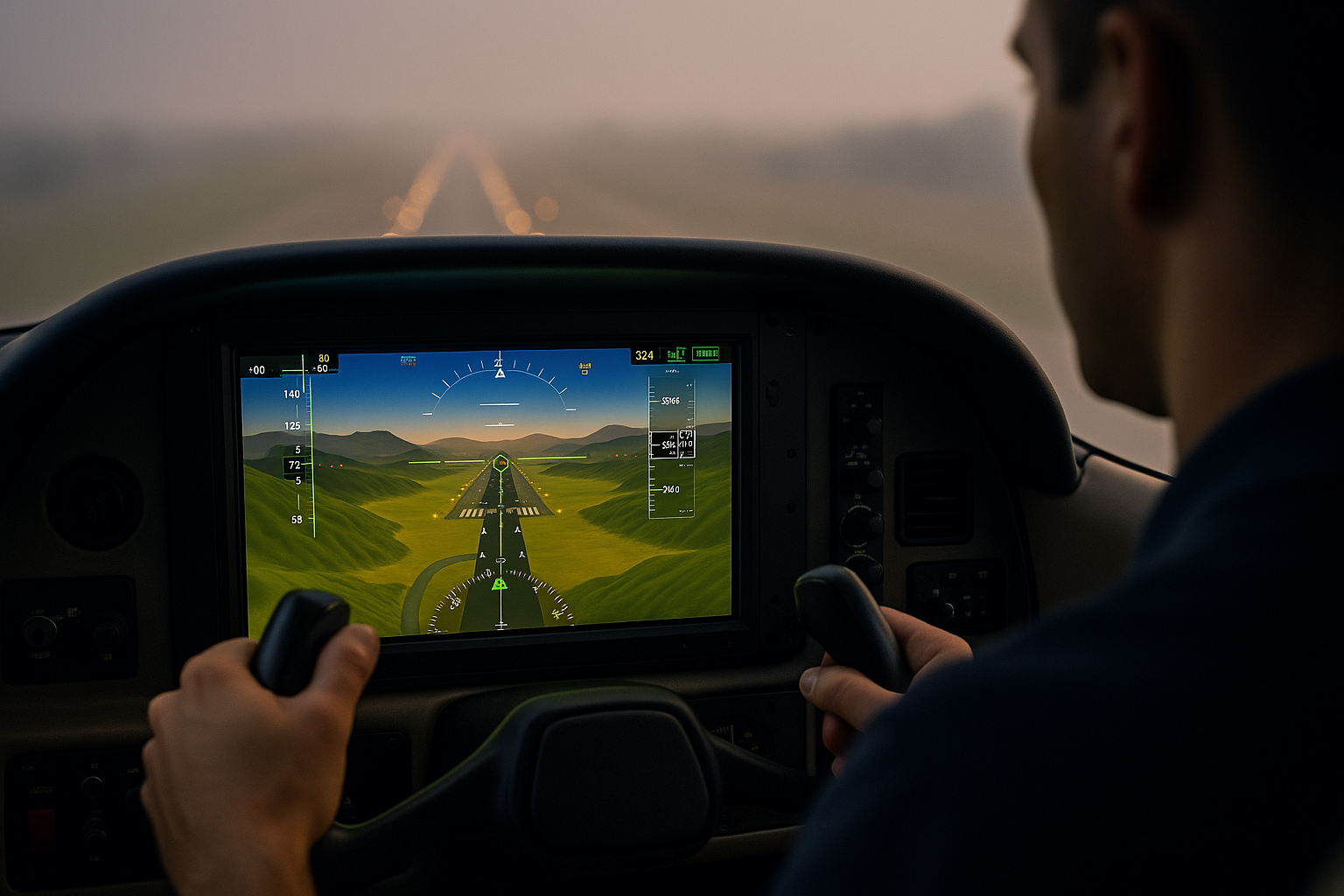
Synthetic Vision Systems (SVS) are transforming how pilots see outside the cockpit, especially in reduced-visibility conditions. SVS provides a computer-generated, three-dimensional representation of terrain, obstacles, runways, and key navigation aids using onboard databases combined with GPS and inertial data. For pilots, the primary advantage is improved situational awareness when natural visual cues are limited or absent.
This article explains what synthetic vision systems do, how they differ from other technologies, and why they matter for flight training, aircraft operation, and safety. You will learn the operational benefits and the system limitations that must shape pilot decision-making, plus practical examples, common mistakes to avoid, and instructor-focused training recommendations.
What Synthetic Vision Systems Are and How They Work
Synthetic Vision Systems create a rendered view of the external world from the pilot's perspective. The system relies on three essential inputs: an accurate aircraft position solution (GNSS and inertial sensors), a terrain and obstacle database, and a rendering engine that displays that information on a cockpit screen or primary flight display. The display typically includes a perspective terrain view, runway and airport symbology, obstacle markers, and flight path markers to show the projected trajectory based on the current flight path or autopilot guidance.
SVS is fundamentally different from Enhanced Vision Systems (EVS). EVS uses real sensors such as infrared cameras to present live imaging of the outside environment. SVS produces a synthetic scene derived from database information. Each approach has strengths: EVS gives a real-time image in the sensor's spectrum, while SVS supplies consistent, daylike visual references even when the external view is dark or obscured.
Most modern SVS installations also perform sensor fusion by combining database imagery with live data feeds and flight guidance. That fusion can include terrain color shading according to elevation, obstacle flags with height, and flight path vectors that align with current guidance. Implementation varies by manufacturer and platform, so pilots should understand the specific features and limitations of the installation in their aircraft.
Why This Matters in Real-World Aviation
For pilots, student pilots, and instructors, the operational value of synthetic vision is its effect on perception and decision-making. SVS helps reduce spatial disorientation by providing a stable visual scene tied to the aircraft attitude and position. That can be especially valuable during instrument meteorological conditions, at night, or when transitioning between visual and instrument references.
In practical operations SVS influences three important safety domains:
Terrain and obstacle awareness: SVS presents terrain and obstacles in a clear, intuitive display that can help prevent controlled flight into terrain (CFIT) by making hazardous features visible even when clouds or darkness obscure the natural view.
Approach and landing situational awareness: On approaches, SVS can render the runway environment, surrounding terrain, and published flight path. That assists pilots in recognizing runway alignment, slope, and nearby hazards earlier than they might by waiting for natural cues.
Decision-making and workload management: SVS can reduce the cognitive load required to interpret complex instrument information by presenting a unified visual scene. That can free attentional resources to manage radios, checklist items, and crew coordination.
These benefits apply across aviation segments: general aviation single-pilot operations, business aviation, airline operations, and advanced flight training. However, the value of SVS depends on correct use, redundancy, and an appreciation of the system limits.
How Pilots Should Understand Synthetic Vision Systems
Pilots need to treat SVS as a high-quality situational aid, not a replacement for fundamental piloting skills or reliable primary flight instruments. Here are practical ways to conceptualize the technology in operational terms.
First, SVS is a database-driven depiction. That means the rendered scene is only as accurate as the position solution and the database. Databases are updated periodically. Terrain and obstacle depiction may lag behind real-world changes such as temporary construction or newly erected obstacles. Pilots must continue to cross-check navigation and obstacle data with current charts and NOTAMs.
Second, understand latency and alignment. Rendering engines and position systems introduce small delays. If GNSS or inertial data degrades, the displayed aircraft position and flight path may not precisely match the true aircraft location. That can be misleading close to terrain or during low-altitude maneuvering.
Third, know what your SVS does and does not display. Some systems include approach lighting depiction, runway markings, and airport buildings. Others limit the symbology to terrain shading, obstacles, and runway location. Pilots should practice using the specific SVS configuration to recognize how information is presented during critical phases of flight.
Fourth, retain instrument scan discipline. SVS should be integrated into the scan, not allowed to dominate it. Cross-check attitude indicators, altimeters, vertical speed, navigation sources, and external visual cues where available. If SVS shows a discrepancy with primary flight instruments, follow instrument cross-check procedures and the aircraft's published guidance for suspect instruments or systems.
Common Mistakes and Misunderstandings
Pilots and operators sometimes overestimate what synthetic vision can do. Common pitfalls include:
Overreliance on the synthetic scene: Treating the visual render as the truth without cross-checks can lead to errors when databases or sensors are incorrect.
Misinterpreting runway depiction: Some SVS displays emphasize runway location but may not accurately show touchdown zone or slope details. Pilots should continue to use published approach procedures and visual cues for flare and touchdown.
Expectation of real-time obstacle updates: Temporary obstacles or changes to terrain are not always present in the SVS database immediately. Do not assume every obstacle will appear.
Poor transition training: Using SVS improperly during transitions between visual and instrument conditions can create fixation or false confidence. Training must include scenarios where SVS disagrees with raw-data inputs.
Ignoring degraded navigation states: When GNSS integrity is degraded, the positional accuracy that SVS depends on suffers. Pilots must be prepared to revert to other navigation references and to follow procedures for degraded GNSS or GPS anomalies.
Understanding these pitfalls helps trainers design scenarios that build correct mental models for students and crewmembers.
Practical Example: Night IMC Approach into Mountainous Terrain
Scenario: You're the single pilot of a light twin on an instrument approach at night into an airport surrounded by rising terrain. Ceilings and visibility are low, and the natural scene outside the windshield is featureless. Your aircraft is equipped with an SVS that displays terrain shading, obstacles, runway location, and flight path vector.
As you descend on the published approach, SVS shows a clear depiction of the surrounding ridgelines and highlights a ridge along your inbound course. With the synthetic runway depiction and a stabilized flight path vector, you can visually confirm alignment with the runway before reaching the visual descent point. Because the SVS depicts the nearby ridgeline, you also become aware of lateral clearance requirements and the need to adhere strictly to published procedure altitudes.
Operational lessons from this example:
SVS provided an anticipatory visual picture that reduced surprise on encountering terrain. That gave you additional time to verify descent profile and consider a missed approach if the visual cues were inadequate for a safe landing.
Despite the SVS depiction, you maintained instrument cross-checks and confirmed position with the underlying navigation aids. Because SVS is database-driven, you used the charted approach minima and did not descend below decision altitude without required visual references.
Your training scenario included a simulated GPS anomaly that temporarily displaced the aircraft symbol. Familiarity with this failure mode allowed you to recognize the inconsistency and fly a safe missed approach while troubleshooting.
Best Practices for Pilots and Instructors
To get the most safety benefit from synthetic vision, adopt the following best practices in operations and training.
Integrate SVS into instrument scan training. Teach students to include the SVS display as an information source while preserving the primacy of certified primary flight instruments.
Practice degraded-sensor scenarios. Train for GNSS loss, database discrepancies, and display misalignment so pilots can detect and respond to incorrect SVS imagery.
Use scenario-based training that replicates realistic operational pressures, such as night approaches, single-pilot operations, and short-field operations near obstacles. Emphasize decision-making and the conditions that should lead to a missed approach or diversion.
Follow manufacturer guidance for database updates and system limitations. Implement checklist items for verifying database currency where applicable.
Document and brief system behavior during briefings. For example, describe how runway and obstacle depictions will appear and what the flight path marker indicates before an approach or departure.
Avoid complacency. Reinforce that SVS reduces some risks but introduces new human factors considerations such as fixation and automation bias.
Training Syllabus Recommendations
Instructors and training managers should include SVS-specific elements in instrument and transition training syllabi. Useful syllabus elements include:
Introduction to SVS principles and limitations, including database currency, positional accuracy, and system latency.
Hands-on sessions that compare SVS depiction against raw sensor inputs and actual outside visuals in VMC to build trust and understanding.
Failure mode training: simulated GNSS anomalies, database mismatches, and misalignments that require reversion to other instruments and procedures.
Decision-making exercises focusing on approach continuation criteria, stabilized approach parameters, and missed approach initiation when visual cues are unreliable.
Human Factors and Automation Considerations
Synthetic vision can reduce workload but it also introduces new human factors challenges. Automation bias is a real risk where pilots accept system outputs without adequate verification. Fixation is another concern: a compelling synthetic scene can draw attention away from essential tasks such as monitoring engine instruments, radios, or air traffic control instructions.
Design training to mitigate these risks by emphasizing cross-checks, scanning discipline, and crew communication. For multi-crew operations, ensure callouts and scan responsibilities are assigned during critical phases so no single pilot fixates solely on the SVS display.
Maintenance, Database Management, and Operational Readiness
SVS reliability depends on sound maintenance and data management. Operators should establish procedures for:
Regular database updates according to the manufacturer schedule.
Verification of GNSS and inertial navigation sensor health as part of preflight and periodic maintenance checks.
Record-keeping for software and database versions to support troubleshooting when discrepancies occur.
Because SVS is a system-of-systems, coordination between avionics technicians, operators, and training departments is essential to maintain operational readiness and to ensure that pilots understand any software or data changes that affect the displayed scene.
Frequently Asked Questions
Is synthetic vision a primary flight reference?
Synthetic vision is an advanced situational aid but whether it can be used as a primary flight reference depends on the specific certification and approval of the installation. Pilots should follow the approved flight manual or operating handbook for their aircraft. In practice, many operators treat SVS as an important aid while retaining certified primary instruments as the normative references.
How is synthetic vision different from terrain awareness warnings?
Terrain awareness systems provide alerts and advisories based on ground proximity logic and sensor inputs. SVS provides a continuous, rendered visual scene. Both can complement each other: SVS improves pilot understanding of terrain layout, while terrain awareness systems provide specific cautionary alerts when terrain proximity reaches hazardous thresholds.
Can synthetic vision show temporary obstacles or construction?
Generally, SVS relies on published obstacle databases that are updated periodically. Temporary obstacles or recent changes may not appear immediately. Pilots must consult current charts, NOTAMs, and visual references to avoid relying solely on SVS for temporary or uncharted hazards.
What failures should pilots practice for SVS?
Pilots should practice GNSS position anomalies, database mismatch indicators, display misalignment, and total display loss. Training should teach recognition of inconsistency between SVS and primary navigation or attitude instruments and the appropriate reversion actions.
Will SVS eliminate spatial disorientation?
SVS reduces some contributors to spatial disorientation by providing a consistent visual scene, but it is not a cure-all. Pilots must still use attitude instruments, maintain scanning discipline, and adhere to instrument flight rules when external references are unreliable.
Common Operational Scenarios and Decision Points
Two practical scenarios illustrate common decision points where SVS can influence outcomes:
Scenario A: Single-Pilot Night Cross-Country with Intermittent IMC
Use SVS to maintain lateral situational awareness and anticipate terrain when entering cloud layers. However, set conservative personal minimums and be prepared to divert early if database updates are uncertain or if GNSS accuracy degrades.
Scenario B: Multi-Crew Approach at Low Visibility Airport
Brief how SVS will appear during the approach, assign monitoring duties, and use SVS to aid visual acquisition while continuing to meet stabilized approach criteria. If SVS and EVS are both installed, clearly define which display is primary for visual cues.
Regulatory and Operational Considerations
Because certification, operational approval, and allowed use cases vary with aircraft type and regulatory authority, operators should consult aircraft flight manuals, approval letters, and manufacturer documentation for specific guidance. Training syllabi should incorporate regulatory constraints so that pilot use of SVS aligns with approved operating practices.
Key Takeaways
- Practical takeaway: Use SVS to enhance terrain and approach situational awareness while keeping primary flight instruments as the normative reference.
- Safety takeaway: SVS reduces some CFIT risk but introduces new failure modes such as database discrepancies and automation bias; train to detect and respond to these.
- Training and decision-making takeaway: Include SVS failure modes, degraded-sensor scenarios, and cross-check procedures in recurrent and transition training.
Closing Thoughts for Pilots and Instructors
Synthetic vision systems represent a meaningful step forward in cockpit situational awareness. When used properly, they give pilots a clear, intuitive picture of the external environment that can reduce surprise and improve decision-making. However, the safety gains depend on realistic training, procedural discipline, and an informed appreciation of system limitations.
Instructors should make SVS training scenario-rich and failure-oriented so students develop robust mental models for how the technology behaves in normal and abnormal conditions. Operators should maintain rigorous database and maintenance practices, and pilots should resist the temptation to treat synthetic imagery as a substitute for sound instrument flying and judgment.
Adopt SVS as a complementary tool that supports safe flying rather than as an authoritative replacement for fundamental airmanship.