
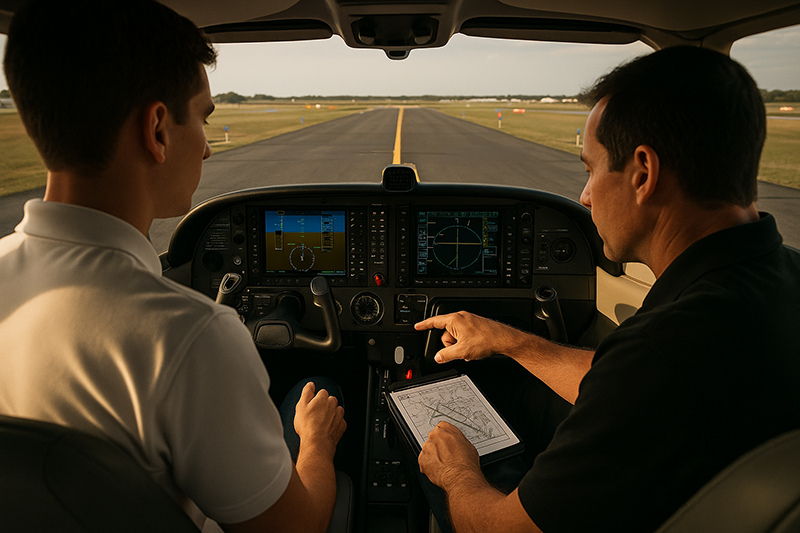
Taxi risk management techniques deserve the same disciplined attention pilots give to takeoff, approach, and landing. Taxiing may happen at low speed, but it places an aircraft in a complex operating environment with other aircraft, vehicles, pedestrians, signage, markings, lighting, radio communication, clearance limits, propeller or jet blast concerns, brake and steering limitations, and constant decision-making. For student pilots, flight instructors, and experienced crews alike, the ground phase is not a break from flying. It is a phase of operation that demands planning, situational awareness, communication discipline, and conservative aircraft control.
The goal of taxi risk management is not to make ground operations complicated. It is to make them deliberate. A pilot who understands the airport surface, anticipates hotspots, manages cockpit workload, and is willing to stop when uncertain is far less likely to create confusion or drift into an unsafe situation. This article explains practical techniques pilots can use before engine start, during taxi, at runway crossings, after landing, and in training environments. It is written for pilots who want to strengthen everyday habits, not just memorize procedures.
What Taxi Risk Management Really Means
Taxi risk management is the process of identifying, reducing, and controlling hazards while moving an aircraft on the ground. It includes route planning, airport diagram use, radio communication, aircraft handling, runway incursion avoidance, collision avoidance, checklist management, and crew or instructor coordination. In practical terms, it means knowing where you are, knowing where you are cleared to go, moving at a controllable speed, and never allowing uncertainty to continue while the aircraft is in motion.
Many taxi risks begin before the aircraft moves. A pilot may be unfamiliar with the airport layout, may not have reviewed the expected taxi route, may be distracted by avionics programming, or may accept a clearance without understanding it. Once the aircraft begins moving, workload increases. Steering, braking, communications, checklist items, traffic scanning, and navigation all compete for attention. Good taxi technique reduces this workload by preparing early and using simple operating habits that preserve mental capacity.
Taxiing also requires a different kind of awareness than flight. In the air, pilots often think in terms of altitude, heading, airspeed, and aircraft performance. On the ground, the pilot must interpret a three-dimensional airport environment from a low cockpit viewpoint while following painted markings, signs, lights, and instructions. The difference between a taxiway, runway, holding position, non-movement area boundary, or ramp lane may be visually obvious at a familiar airport and surprisingly subtle at night, in rain, during construction, or at a large unfamiliar field.
A useful way to think about taxi risk management is to treat every ground movement as a navigation task. The aircraft has a starting point, an intended route, possible hold-short points, potential conflict areas, and a destination. If the pilot cannot describe the route and identify the risk points, the aircraft is not yet ready to move.
Why Taxi Risk Matters in Real-World Aviation
Taxi risk matters because the airport surface is shared. A single misunderstanding can place an aircraft near a runway, across a clearance boundary, behind a running engine, near another aircraft’s wingtip, or in a congested ramp area. Even when no collision occurs, a ground deviation can create serious operational disruption and may indicate breakdowns in planning, communication, or cockpit discipline.
For student pilots, taxiing is often the first place where aircraft control, radio communication, and airport procedures come together. A student may be learning nosewheel or tailwheel steering, brake modulation, wind correction, signage recognition, and ground communication at the same time. This workload can be surprisingly high. Instructors who treat taxi as a teachable phase help students build habits that later protect them at larger airports and in higher-performance aircraft.
For experienced pilots, the risk often changes rather than disappears. Familiarity can lead to expectation bias, especially at a home airport. A pilot may assume the usual runway, the usual taxi route, or the usual controller instruction, then miss a change caused by traffic, construction, a runway closure, or airport lighting conditions. Larger aircraft add additional issues such as wingtip clearance, thrust management, brake energy considerations, and cockpit sightline limitations. While details vary by aircraft, the core risk management principle is constant: do not let routine replace verification.
Ground operations are also vulnerable to time pressure. Late passengers, weather approaching, an amended clearance, maintenance coordination, training schedule pressure, or a busy traffic pattern can push pilots toward haste. Hurrying during taxi rarely saves meaningful time, but it can remove the safety margin needed to detect a wrong turn, misunderstood clearance, or aircraft control issue. A professional taxi mindset recognizes that a stop on the taxiway is often the safest and most efficient way to resolve uncertainty.
Build the Taxi Plan Before the Aircraft Moves
The strongest taxi risk management begins before engine start. A taxi plan does not need to be elaborate, but it should be specific enough that the pilot can visualize the expected route. At a familiar airport, this may take only a moment. At an unfamiliar or complex airport, it may require a more deliberate review of the airport diagram, departure runway, likely taxiways, hotspots, hold-short locations, construction notices, and ramp procedures.
A practical taxi plan answers several questions. Where am I starting from? Which runway or parking area am I likely to use? What taxiways will probably connect those points? Where are the runway crossings or hold-short lines? Are there hotspots, closed taxiways, unusual intersections, or complex geometry? Where can I stop safely if I need clarification? These questions create a mental map that helps the pilot recognize whether a clearance makes sense.
Before calling for taxi, the pilot should be ready to copy and interpret the clearance. That means headsets on, chart or airport diagram available, pen or electronic note method ready when appropriate, and cockpit distractions reduced. If a clearance includes multiple taxiways or hold-short instructions, writing it down can prevent memory errors. In a crew environment, one pilot can read back and the other can trace or verify the route. In single-pilot operations, the pilot can pause briefly after readback to confirm the route before releasing brakes.
The taxi plan must remain flexible. Air traffic control may assign a different runway, traffic may require holding short, or ground control may amend the route. Risk management does not mean clinging to the original plan. It means comparing any new instruction against the airport diagram and stopping long enough to understand the change. If the clearance is unclear, asking for clarification is not a sign of poor skill. It is a sign of disciplined operation.
Understand the Airport Surface Environment
Airport surface awareness depends on a pilot’s ability to interpret the visual language of the airport. Taxiway signs, runway holding position markings, centerlines, edge markings, lighting, and painted surface indications all help pilots maintain position awareness. These cues are especially important when visibility is reduced, the sun angle is low, snow or water obscures markings, or the airport layout is unfamiliar.
Runway holding position markings deserve special respect. They identify a boundary that should not be crossed unless the pilot has the appropriate clearance or authorization for the operation. The practical habit is simple: identify the hold-short point before reaching it, slow early, and stop with enough margin to avoid creeping beyond the marking. When in doubt, stop before the marking and ask.
Hotspots are areas on an airport surface where confusion or conflict has been identified as more likely. They may involve complex intersections, closely spaced runways, unusual geometry, or locations where pilots have historically made wrong turns. A hotspot is not a prediction that something will go wrong. It is a prompt to increase attention and reduce speed. During pre-taxi planning, pilots should identify hotspots along or near the expected route and brief what makes them noteworthy.
Ramp areas add another layer of risk because they may involve marshallers, parked aircraft, fuel trucks, baggage carts, pedestrians, and aircraft pushing back or starting engines. ATC instructions may not cover every movement within a non-movement area, depending on the airport. Pilots should understand local procedures and maintain a slow, defensive taxi posture in any ramp environment. The closer the aircraft is to people, vehicles, or parked airplanes, the more conservative the taxi technique should become.
Communication Discipline During Taxi
Clear communication is one of the most important taxi risk management techniques. A pilot should listen before transmitting, use the correct call sign, read back instructions accurately, and resolve any uncertainty immediately. Taxi instructions can involve route assignments, runway crossings, hold-short instructions, frequency changes, or movement area boundaries. A readback that sounds confident but is wrong can be worse than a request for clarification.
Good communication also includes cockpit communication. In training aircraft, the instructor and student should agree on who is controlling the aircraft, who is handling radios, and when the instructor may intervene. In two-pilot operations, the crew should use standard callouts or clear verbal coordination for hold-short lines, runway crossings, and route changes. In single-pilot operations, self-briefing and verbalizing critical points can help maintain awareness, especially at unfamiliar airports.
A common communication risk is expectation bias. The pilot hears what they expected rather than what was actually said. This can occur when the same runway is used all day, when the pilot knows the airport well, or when a clearance sounds similar to a common route. To counter this, pilots should actively compare the clearance to the airport diagram and avoid moving until the instruction has been mentally processed.
If a pilot becomes unsure of position or clearance, the correct response is to stop the aircraft when safe and ask for assistance. Continuing to taxi while trying to solve a navigation or communication problem increases workload and reduces time available to correct an error. Stopping turns a moving problem into a stationary one.
Aircraft Control: Speed, Steering, Braking, and Wind
Taxi risk management is not only procedural. It is also physical aircraft control. The aircraft should move at a speed that allows the pilot to stop promptly, maintain centerline or desired path, and avoid excessive brake use. The appropriate taxi speed depends on aircraft type, ramp congestion, surface condition, visibility, slope, wind, and proximity to obstacles. Rather than thinking in a fixed number, pilots should think in terms of control margin. If the aircraft cannot be stopped smoothly within the visible clear area, the taxi speed is too fast.
Steering technique varies by aircraft. Some airplanes steer primarily through the nosewheel, others use differential braking, and tailwheel aircraft require particular attention to directional control and wind effects. Pilots should use the aircraft flight manual, training guidance, and instructor input for type-specific procedures. The general safety principle is to avoid abrupt inputs, avoid riding the brakes, and keep the aircraft aligned so that turns are planned rather than improvised.
Wind correction remains important on the ground. Control positioning during taxi helps reduce the risk of wind lifting a wing or affecting the tail, particularly in light aircraft. Pilots should apply the appropriate control inputs for the wind direction and aircraft configuration, as taught during aircraft-specific training. This is one area where student pilots often know the concept for the practical test but apply it inconsistently during routine taxi. Instructors can improve retention by asking students to explain the wind correction during actual taxi rather than only during ground lessons.
Brake management also matters. Excessive or continuous braking can create unnecessary wear and heat, and it may indicate that power is too high or taxi speed is not being managed well. Smooth power reduction, anticipation, and early deceleration are usually better than carrying excess power and correcting with brakes. On sloped or contaminated surfaces, pilots should be especially conservative and consider whether conditions are suitable before taxiing.
Managing Cockpit Workload While Taxiing
Many taxi problems are not caused by a lack of knowledge. They are caused by poor workload timing. Avionics programming, checklist use, clearance copying, passenger questions, instructor critique, or troubleshooting can distract the pilot from taxi navigation and aircraft control. A key taxi risk management technique is to decide what must be done while moving and what can wait.
Whenever possible, complete high-workload tasks before taxi begins or during a full stop at a safe location. Programming a flight plan, loading a procedure, adjusting cockpit displays, briefing a departure, or solving a maintenance question should not compete with steering through a congested ramp or approaching a runway hold-short line. If something requires focused attention, stop the aircraft first, if safe and appropriate.
Checklists are essential, but they should be integrated into taxi flow in a way that does not degrade outside scanning. Some checklist items are commonly completed before taxi, some during taxi, and some at the run-up area or before takeoff. The exact flow depends on aircraft and operator procedures. The safety habit is to avoid head-down fixation while moving. Instructors should watch for students who become so absorbed in the checklist that they stop scanning for traffic, signs, and turns.
Passenger management is part of workload management. A pilot should brief passengers before engine start about sterile cockpit expectations during taxi, takeoff, approach, and landing. In plain terms, passengers should know when conversation should stop so the pilot can listen and focus. This is especially valuable for single-pilot operations, where a casual question at the wrong time can interrupt a radio clearance or taxiway turn.
Runway Incursion Avoidance as a Taxi Habit
Runway incursion avoidance is one of the central goals of taxi risk management. Pilots should treat every runway environment as a critical area, whether the airport is towered or non-towered, busy or quiet, familiar or unfamiliar. A runway is not just pavement. It is an active operating surface where aircraft may be taking off, landing, back-taxiing, crossing, or lining up.
Before crossing or entering any runway, pilots should confirm they are at the correct runway, verify clearance or traffic coordination appropriate to the airport environment, visually scan final approach and the runway surface, and maintain awareness of other traffic. At a towered airport, a clearance or instruction should be understood and read back correctly. At a non-towered airport, pilots must use appropriate traffic awareness, radio communication, and judgment consistent with local procedures and the operating environment.
One effective technique is to make runway crossings verbal and deliberate. In a crew or instructional setting, call out the runway, the clearance or traffic status, and the scan before crossing. In single-pilot flying, a quiet verbal callout can reinforce the same discipline. The purpose is not to create needless ritual. It is to interrupt automatic behavior at the exact point where a mistake can have serious consequences.
Hold-short discipline is equally important. Pilots should slow early, stop with margin, and avoid creeping forward while waiting. If a clearance changes, the pilot should mentally reset rather than assume the next step. For example, being instructed to taxi to a runway is not the same as being authorized to enter or cross a runway unless the instruction clearly includes that authorization in the applicable operating context. Pilots should rely on current training and ATC instructions rather than assumptions.
Common Mistakes and Misunderstandings
One common mistake is treating taxi as administrative time instead of operational time. Pilots may use taxi to finish setup tasks, brief passengers, reconfigure avionics, or troubleshoot minor issues. Some tasks are necessary, but they must not compromise directional control or surface awareness. If the task requires sustained attention, stop first.
Another frequent error is moving before the taxi route is understood. A pilot may read back a clearance but begin taxiing while still trying to find the first taxiway on the diagram. This creates an immediate workload problem. The aircraft should not move until the pilot knows the initial direction and has a reasonable picture of the route.
Overconfidence at familiar airports is also a real concern. The home airport can lull pilots into assuming that everything is as usual. A taxiway closure, temporary marking, changed runway assignment, construction vehicle, or unusual traffic flow can defeat habit patterns. Familiarity should reduce workload, not eliminate attention.
Taxi speed is another area where small errors accumulate. Excessive speed can make turns wider, reduce stopping margin, increase brake use, and leave little time to interpret signs or markings. A pilot who routinely taxis fast may not notice the risk until faced with a wrong turn, vehicle conflict, or slippery surface. Professional ground handling looks calm because it is anticipatory.
Some pilots also misunderstand the value of asking for progressive taxi instructions or clarification. Asking for help is not a failure. At a complex or unfamiliar airport, it may be the safest choice. The key is to ask before uncertainty becomes a deviation. Pilots should also remember that progressive instructions do not remove the need for independent awareness. The pilot remains responsible for maintaining control of the aircraft and understanding the clearance.
In training, a common misunderstanding is that taxi technique is mastered early and does not need continued coaching. In reality, taxi skills evolve with airport complexity, aircraft type, wind, traffic density, night operations, and radio workload. Flight instructors should revisit taxi risk management throughout training, especially before cross-country flights, towered airport operations, night lessons, and checkride preparation.
Practical Example: A Busy Training Airport Taxi Scenario
Consider a student pilot and instructor departing from a busy training airport on a clear afternoon. The aircraft is parked on a crowded ramp near several flight school airplanes. The expected departure runway is familiar, but ground control assigns a route that differs from what the student usually receives because of traffic and a closed taxiway. The student reads back the instruction correctly but begins to release the brakes while still trying to trace the route on the airport diagram.
The instructor stops the aircraft and turns the moment into a short risk management lesson. Before moving, the student points to the starting position, traces the assigned taxiways, identifies a runway hold-short point, notes the closed taxiway, and describes where they will stop if unsure. The instructor then has the student taxi at a slow pace, verbalizing the next turn before reaching it. Approaching the hold-short line, the student slows early, confirms the runway, completes the required checks at a stop, and waits for the next instruction.
The scenario is ordinary, which is exactly why it is valuable. No emergency occurred. The clearance was not unusually difficult. The airport was familiar. Yet the risk increased when the aircraft began moving before the route was understood. The corrective technique was simple: stop, orient, brief, then move. This habit scales well from a training airport to a larger airport with complex taxiways, multiple runways, and higher traffic density.
Best Practices for Pilots
The best taxi risk management habits are simple, repeatable, and conservative. They should work in a basic trainer, a high-performance single, a twin, or a professional crew environment. The details may vary, but the mindset is the same: plan before moving, taxi slowly enough to think, communicate precisely, and stop whenever uncertainty appears.
- Brief the taxi route before movement. Use the airport diagram, expected runway, hotspots, closures, and hold-short points to form a mental map.
- Keep the aircraft under positive control. Taxi at a speed appropriate for visibility, surface condition, traffic, aircraft type, and available stopping distance.
- Use sterile cockpit discipline. Minimize nonessential conversation and head-down tasks during taxi, especially near runways or complex intersections.
- Read back and verify critical instructions. Pay particular attention to hold-short instructions, runway crossings, route changes, and clearance limits.
- Stop when uncertain. If position, clearance, route, or traffic status is unclear, stop the aircraft when safe and ask for clarification.
- Verbalize runway crossings and hold-short points. A brief callout can prevent automatic behavior from carrying the aircraft into a critical area.
- Use progressive taxi when appropriate. At unfamiliar or complex airports, requesting assistance early can reduce workload and confusion.
These practices are not intended to replace aircraft-specific procedures, operator guidance, airport rules, or ATC instructions. They are practical risk controls that support those procedures. Pilots should always adapt their technique to the aircraft, airport, weather, and operational context.
Instructor Techniques for Teaching Taxi Risk Management
Flight instructors play an important role in shaping how pilots think about taxi operations. If instructors treat taxi as an afterthought, students will often do the same. If instructors brief taxi as a real phase of operation, students learn that professionalism begins before takeoff.
One effective teaching method is to ask students to brief the taxi route out loud before calling ground control or before moving at a non-towered airport. The student should identify the current location, expected path, runway environment, hotspots, and potential stop points. This builds airport diagram literacy and makes route changes easier to manage.
Another useful technique is to create controlled pauses. For example, before reaching a runway hold-short line, the instructor can ask, “What runway is this, what are we cleared or not cleared to do, and what traffic do you see?” The goal is not to surprise the student. It is to build a habit of deliberate verification before entering critical areas.
Instructors should also manage intervention carefully. If a student makes a wrong turn or appears uncertain, safety comes first. The instructor should take or direct control as needed, stop the aircraft if appropriate, and then debrief. Taxi errors can be powerful learning events when handled calmly. The lesson should focus on the decision process, not just the mechanical error.
Taxi Risk Management at Towered and Non-Towered Airports
Taxi risk exists at both towered and non-towered airports, but the cues and responsibilities feel different. At towered airports, pilots interact with ground and tower controllers, receive taxi instructions, and may be cleared to cross or hold short of runways as appropriate. The presence of ATC does not remove the need for pilot awareness. Controllers provide instructions, but pilots must still navigate correctly, read back accurately, and stop if unsure.
At non-towered airports, pilots rely more heavily on traffic awareness, published airport information, local procedures, radio communication when appropriate, and visual scanning. The absence of a control tower does not mean the airport surface is simple. Training aircraft, transient traffic, gliders, agricultural aircraft, maintenance vehicles, or pedestrians may be present depending on the airport. Pilots should be especially careful when back-taxiing, crossing runways, entering the movement area, or operating where sightlines are limited.
In both environments, the core technique is the same: know the airport layout, communicate clearly, look outside, and keep the aircraft slow enough to make good decisions. The pilot should never use silence on the radio as proof that the surface is clear, and should never use a clearance as a substitute for looking.
Night, Weather, and Low-Visibility Considerations
Night and weather can increase taxi risk by reducing visual cues and making airport geometry harder to interpret. Rain on the windshield, glare from lights, wet pavement reflections, snow cover, fog, or low sun can make markings, signs, and other aircraft more difficult to see. Even at a familiar airport, the scene may look different enough to cause hesitation or wrong turns.
In these conditions, pilots should slow down, increase reliance on the airport diagram, and brief the route more carefully. If the aircraft is equipped with moving-map or surface awareness tools, those systems can support situational awareness, but they should not replace outside scanning or compliance with ATC instructions and airport markings. Technology is an aid, not a clearance and not a guarantee.
Lighting can also create illusions. A taxiway centerline light, runway edge light, ramp light, vehicle beacon, or aircraft landing light may draw attention away from the intended route. Pilots should cross-check lights with signs, markings, compass orientation, and the airport diagram. If the surface environment does not match the expected route, stop and resolve the discrepancy.
Using Technology Without Becoming Dependent
Modern avionics, tablets, airport diagrams, own-ship position displays where authorized and available, and electronic flight bags can significantly improve taxi situational awareness. They are especially helpful at unfamiliar airports and during complex routing. However, technology introduces its own risk if the pilot becomes head-down, follows a display without verifying outside cues, or assumes the display is always current and precise.
A good technique is to use technology strategically. Review the route before moving, glance to confirm position when workload permits, and return attention outside. The pilot should still identify taxiway signs, hold-short markings, runway labels, and traffic visually. If the display and the outside environment disagree, the pilot should stop and investigate rather than choose one while moving.
Electronic tools are particularly useful for pre-taxi briefing. A pilot can zoom in on complex intersections, locate hotspots, review runway crossing points, and anticipate likely turns. Once moving, the tool should support awareness rather than consume it. Instructors should teach students how to integrate technology without letting it replace basic airport surface navigation skills.
Frequently Asked Questions
What is the most important taxi risk management technique?
The most important technique is to stop when uncertain. Many taxi risks become more serious because the aircraft keeps moving while the pilot is trying to solve a route, clearance, traffic, or cockpit workload problem. Stopping when safe gives the pilot time to think, ask for clarification, and regain situational awareness.
Should pilots brief the taxi route at familiar airports?
Yes. The briefing may be brief, but it should still happen. Familiar airports can create expectation bias, especially when runway assignments, taxiway closures, construction areas, or traffic flows change. A quick route review helps prevent routine from becoming assumption.
When should a pilot ask for progressive taxi instructions?
A pilot should ask for progressive taxi instructions when the airport layout, clearance, visibility, or workload makes navigation uncertain. It is better to request assistance early than to continue moving with an unclear route. Progressive taxi support should still be combined with diagram use and outside scanning.
How can student pilots improve taxi situational awareness?
Student pilots can improve by tracing the taxi route before movement, verbalizing the next turn, identifying hold-short lines early, using proper wind correction, and keeping nonessential tasks out of the taxi phase. Instructors can help by making taxi briefings and runway-crossing callouts a normal part of every lesson.
Is taxiing mainly a radio communication task?
No. Radio communication is important, especially at towered airports, but taxiing is also an aircraft control, navigation, traffic awareness, and workload management task. A correct readback does not help if the pilot turns onto the wrong taxiway or loses awareness of a hold-short point.
How fast should an aircraft taxi?
Taxi speed should be slow enough to maintain positive control, follow the intended path, and stop smoothly within the available clear area. The appropriate speed depends on the aircraft, surface condition, visibility, congestion, wind, and airport layout. Pilots should follow aircraft-specific guidance and use conservative judgment.
Key Takeaways
- Plan the taxi route before movement, including likely taxiways, hold-short points, hotspots, and places where you can stop safely if clarification is needed.
- Maintain a conservative taxi speed, keep your attention outside, and treat runway crossings and hold-short lines as critical decision points.
- If position, clearance, route, or traffic status is uncertain, stop the aircraft when safe and resolve the uncertainty before continuing.