
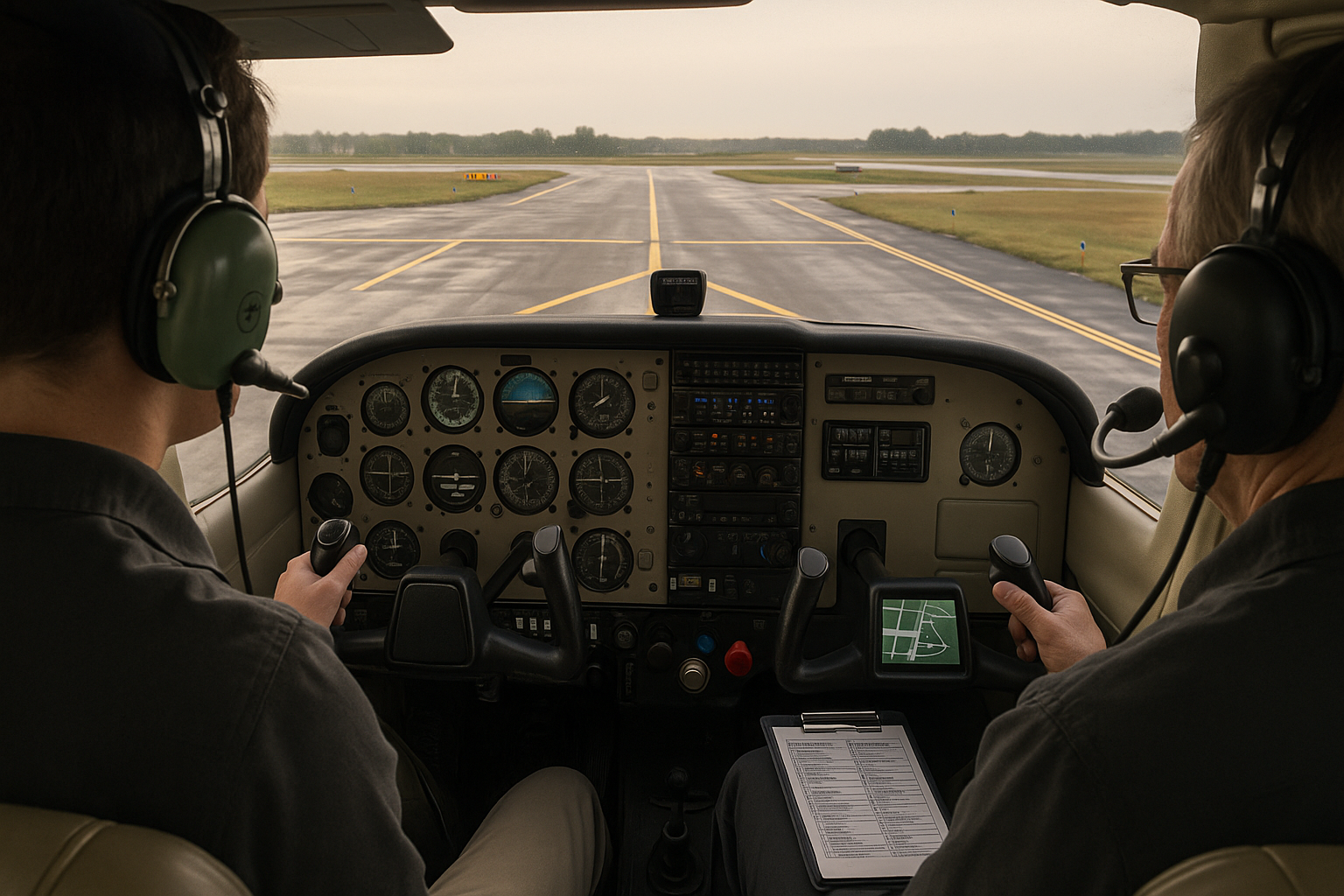
Taxiway operations are a core part of everyday flying, yet they receive less structured attention than takeoff, approach, or emergency procedures. Developing confident, consistent taxi performance matters because the ramp and movement areas are where pilot judgment, communication, situational awareness, and aircraft control must align in a dynamic, constrained environment. This article examines taxiway operations that build pilot confidence by combining training philosophy, human factors, airport technology, and practical operational techniques.
Readers will find practical training frameworks, an explanation of how technology and procedures interact with pilot decision-making, examples of common misunderstandings that erode confidence, and concrete steps instructors and students can use immediately. The primary keyword, taxiway operations, appears early because understanding how to move safely and confidently on the ground starts with clear priorities and repeatable habits.
Core idea: What modern taxiway operations should deliver
At its heart, modern taxiway operations are about predictable, observable behavior that reduces risk and supports efficient traffic flow. Confidence grows when pilots can anticipate what will happen next, recognize and resolve abnormal situations, and communicate effectively with ground controllers and other pilots. The elements that produce that outcome are training, standard operating procedures, environmental awareness, and tools designed to augment pilot situational awareness without creating distraction.
Why this matters in real-world aviation
Taxiway operations are not trivial. Most airports have complex geometry, closely spaced taxiways, variable signage, and movement of other aircraft, vehicles, and personnel. In training environments, student pilots often first learn to manage runway incursions, proper taxi clearance readbacks, and taxi speed control. For flight instructors and operators, taxiway performance is an operational safety metric that affects fuel use, engine wear, schedule adherence, and risk exposure. Confident taxiing reduces time spent second-guessing clearances, minimizes runway incursions, and limits wear on brakes and tires caused by unnecessary speed or braking corrections.
Decision-making on the ground also connects to broader risk management. Poor lighting or low visibility conditions change the tolerance for speed and route planning. Tight ramps or complex intersections change the margin for error during taxi turnoffs. When pilots understand the environment and their options, they manage these variables deliberately, rather than reacting under pressure.
How pilots should understand taxiway operations
Taxi is a transition phase between the parked or deiced state and the airborne state. It requires a balance of aircraft control, navigation, communications, and continuous scanning. In practical terms, this means pilots must:
- Confirm clearances early and read back key constraints precisely.
- Use airport diagrams and progressive taxi instructions to build a mental map of the route.
- Manage speed to maintain steering authority, braking capability, and time to react to unexpected conflicts.
- Interpret signage, surface markings, and lighting consistently.
- Apply sterile cockpit discipline as appropriate for taxi, especially in complex or low-visibility operations.
Taxonomy of taxi tasks: There are navigation tasks, control tasks, communication tasks, and monitoring tasks. Navigation tasks involve following a route and verifying position. Control tasks cover throttle, brakes, steering, and cockpit systems. Communication tasks include ground frequency exchanges and relevant ATC coordination. Monitoring tasks include scanning for other traffic, checking signage, confirming position with the airport diagram, and maintaining awareness of external threats such as jet blast, snow contractors, or service vehicles.
Training models that produce confidence
Confidence emerges from structured repetition, scenario-based practice, and immediate feedback. Training models that work for taxiway operations share several characteristics:
- Progressive complexity. Start in uncrowded, well-marked airports and move to complex layouts and low-visibility operations as competence increases.
- Scenario-based practice. Introduce real-world variations: closed taxiways, temporary signage, wrong-surface incidents, and equipment failures such as nosewheel steering anomalies.
- Task-based decomposition. Teach navigation, speed control, and communication independently before integrating them in full taxi scenarios.
- Use of technology as training aids. Airport diagrams, electronic moving maps, and simulators let pilots rehearse routes and emergency responses without operational pressure.
For instructors, the goal is to create training briefs that isolate the critical decision points on a taxi route, let the student execute, and then debrief focusing on mental model, checks, and observable actions. Use closed-loop coaching: identify what the student intended, what they did, and how the observed actions matched the intended outcomes.
How technology supports better taxiway operations
Technology can significantly reduce uncertainty on the ground if used as an aid rather than a replacement for fundamental skills. Relevant technologies include airport moving maps, surface surveillance displays, advanced lighting systems, and automated alerts designed to prevent runway incursions.
Moving maps and position-aware displays help pilots confirm where they are in relation to the assigned taxi route. Surface surveillance tools used by airports and ATC reduce controller workload and provide better situational awareness for traffic sequencing. Lighting systems, including enhanced taxiway edge lights and centerline lights, aid navigation during night and low-visibility operations.
While these tools are valuable, pilots must avoid over-reliance. Displays can provide incorrect situational cues if not configured or updated properly. Electronic navigation must be cross-checked with physical signage, markings, and the airport diagram to avoid complacency and mistakes.
Common mistakes and misunderstandings
Several recurring errors degrade performance and confidence on taxiways:
- Over-speeding. Pilots often taxi too fast, reducing reaction time for turns, signage recognition, and conflict resolution.
- Poor readback discipline. Incomplete or incorrect readbacks can obscure critical taxi constraints, such as hold-short points or crossing clearances.
- Misreading signage or confusing similarly numbered taxiways. Similar names or close spacing increase the risk of wrong-turn events.
- Excessive cockpit distraction. Non-essential conversations or checklist interruptions during complex taxi segments compromise attention.
- Blind reliance on technology. Assuming the moving map or electronic display is always correct without cross-checking actual signage increases risk.
Training gaps are also common. Many curricula treat taxi as an afterthought with fewer defined proficiency objectives. Without structured assessment and scenarios, students may leave training with incomplete mental models of how to manage busy or degraded taxi conditions.
Practical example: a busy, low-visibility taxi at a medium airport
Imagine a two-pilot single-engine turboprop departing a medium-sized airport with parallel taxiways and several intersecting runways. Visibility is reduced by mist, centerline lights are operational, and ground is managing a sequence of flights for departure. The clearance: taxi via Alpha, Bravo, cross Runway 27, hold short Runway 09, then taxi to runway 27 via Charlie.
Practical application of confident taxi operations:
- Brief the route before engine start. The pilot monitoring confirms the taxi diagram and highlights the hold-short instructions and the planned runway crossing.
- Use low taxi speeds to increase reaction time. Maintain gentle control inputs to preserve steering authority and avoid abrupt braking that could confuse following traffic.
- During the taxi, verify taxiway signage at each major intersection. If any sign appears inconsistent with the charted airport diagram, stop and query ground before proceeding.
- When approaching the hold-short line for Runway 27, confirm the runway crossing clearance orally and visually. Perform a sterile, full-scan approach to the hold line to detect any conflicting traffic or vehicles in the movement area.
- If visibility drops below safe margins or the crew feels uncertain about the route, request progressive taxi instructions or ask for a follow-me vehicle. Use ATC as a resource rather than a burden.
These behaviors reduce the cognitive load on pilots, maintain control, and keep the aircraft aligned with ATC expectations. The key is preventing ambiguous perceptions and ensuring both pilots share the same mental map of the environment.
Best practices for pilots
Consistent habits create predictable outcomes. Adopt these practices to strengthen taxi confidence:
- Brief the taxi route out loud before engine start and again before leaving the ramp.
- Use the airport diagram proactively. Mark or highlight the route when possible.
- Keep taxi speeds conservative and variable according to airport geometry and visibility.
- Apply sterile cockpit principles during complex taxi segments. Limit non-essential conversation and tasks.
- Read back all taxi clearances, including hold-short instructions and runway crossings, with clear emphasis on critical constraints.
- Cross-check moving map position with signs and markings, especially at complex intersections or when runways are close together.
- If unsure, stop. Confirm the route with ATC rather than guessing or attempting to correct a wrong turn while moving.
Training activities instructors can use right away
Flight instructors can incorporate targeted activities into routine training to improve taxi proficiency:
- Progressive taxi complexity: Start with unhurried, daytime taxi in simple airports, then add traffic, low visibility, and distractions.
- Simulated wrong-surface drills in ground training or simulators to practice recognition and recovery from wrong turns.
- Radio mastery exercises focusing on precise readbacks, including hold-short readbacks and readbacks of runway crossing instructions.
- Timed taxi tasks to develop speed control without promoting haste. Focus on smooth control and situational checks.
- Use of cockpit resources: teach how to configure and interpret moving maps and how to cross-verify them with external cues.
Human factors: confidence versus complacency
There is a balance between confidence and complacency. Confidence comes from training, experience, and predictable procedures. Complacency grows when a pilot becomes over-reliant on routine or technology and begins to ignore anomalies. Recognize risk cues such as unusual ground vehicle behavior, inconsistent signage, or changing weather conditions. Treat each as a prompt to slow down, reassess, and ask for clarification.
Teamwork is essential. In multi-crew environments, verbalize the mental model, confirm intentions, and maintain a clear division of duties. In single-pilot operations, use external resources such as ATC, airport fire or operations, and follow-me vehicles when necessary.
Infrastructure and airport procedures that matter
Airport design and procedures influence how pilots taxi. Clear signage, logical taxiway layouts, effective lighting, and surface condition reporting reduce ambiguity. Pilots should be aware of airport-specific procedures such as mandatory progressive taxi, noise abatement routes, and temporary construction signs. Before operating at unfamiliar fields, review NOTAMs and airport diagrams to identify potential deviations from standard layouts.
When operators and airports invest in surface movement technologies, the benefit multiplies if crews are trained to use them correctly. Syncing operational procedures with technology reduces friction and helps pilots maintain consistent expectations regarding taxi clearances and route confirmation.
Common misunderstandings about taxiway technology
Pilots sometimes assume that any moving map or surface traffic display is authoritative. In reality, these systems can lag, show outdated airport diagrams, or misalign due to GPS errors. Treat electronic displays as helpful secondary references. Physical signage, markings, and ATC clearances remain the definitive authorities for taxi routing.
Another misconception is that automation reduces the need for communication. Even with advanced surface surveillance, a clear verbal readback to ground control remains essential to avoid misinterpretation of complicated instructions or temporary changes.
Implementing change in training programs
To integrate improved taxiway operations into a training program, organizations should create clear objectives, measurable proficiency standards, and scenario-driven evaluations. Include taxi performance in stage checks and practical tests. Provide instructors with structured lesson plans that address both basic taxi techniques and degraded or complex conditions.
Documented syllabi and assessment rubrics help maintain consistency across different instructors and student cohorts. Record and review taxi scenarios using cockpit voice and video, when appropriate, for targeted feedback and to reinforce correct decision-making under stress.
Frequently Asked Questions
How fast should I taxi to build confidence without slowing operations?
Taxi speed depends on the aircraft, airport geometry, visibility, and surface conditions. Prioritize control and the ability to stop within available distance. Slower speeds increase reaction time and reduce error likelihood. Operators should specify recommended taxi speeds in SOPs based on aircraft type and typical airport environments.
When should I request progressive taxi or a follow-me vehicle?
Ask for progressive taxi or a follow-me vehicle when you do not have a clear mental map of the route, when visibility is reduced, or when airport signage is confusing. Using ATC resources to confirm the route is preferable to proceeding with uncertainty.
Can electronic moving maps replace paper airport diagrams?
Electronic moving maps provide position awareness but should not replace cross-checks with current airport diagrams and signage. Use both together. Paper or official electronic diagrams contain critical information such as hot spots, temporary closures, and local procedures that moving maps may not display or may show incorrectly.
What are the most effective instructor techniques for taxi training?
Break taxi tasks into teachable segments, use scenario-based practice, and require students to brief and confirm the route before movement. Provide immediate feedback focusing on mental modeling, decision points, and observable actions. Debrief with emphasis on what went well and what to improve.
How do I avoid becoming overly reliant on taxiway lighting at night?
Use lighting as an aid but maintain active scanning for signage and markings. Practice night taxi in well-known environments before attempting unfamiliar fields. Keep speed conservative and confirm visual references at each key intersection.
Key Takeaways
- Practical takeaway: Brief and confirm your taxi route, and use conservative taxi speeds to preserve time to detect and correct errors.
- Safety takeaway: Cross-check electronic displays with physical signage and ATC clearances to prevent wrong turns and incursions.
- Training takeaway: Integrate progressive scenarios, technology familiarization, and measurable taxi proficiency standards into training syllabi.
Taxiway operations that build confidence do not rely on a single technique or technology. They emerge from an integrated approach combining sound training, disciplined cockpit habits, the intelligent use of tools, and clear communication. Pilots who develop a repeatable process for planning, executing, and verifying taxi routes reduce ambiguity, improve safety margins, and increase operational predictability. Instructors and operators who prioritize these skills produce crews that handle both routine and degraded conditions with clarity and control.
Adopting these practices will not eliminate every ground-side hazard, but they will change how crews perceive and manage risk on the surface. Confident crews are deliberate crews, and deliberate crews create safer movement areas for everyone.