
TCAS is a cockpit system designed to reduce the risk of midair collisions by detecting and advising pilots about proximate transponder-equipped aircraft. For pilots and instructors, understanding TCAS collision avoidance logic, alert types, and appropriate cockpit responses is critical to safe operations in busy airspace.
This article explains how TCAS works in practical terms, how it fits into pilot decision-making, common misunderstandings to avoid, and concrete training and cockpit practices that reduce risk. Expect operational examples, common mistakes, best practices, and a focused FAQ to help translate system behavior into safe, timely pilot actions.
How TCAS Works: Core Concepts
At its heart, TCAS uses transponder replies to determine the relative position and vertical rate of nearby aircraft. It interrogates Mode S or Mode C transponders, receives replies, and computes range, bearing, and closure rates. When traffic gets close enough, TCAS issues a traffic advisory and, if necessary, a resolution advisory that gives specific vertical guidance to increase separation.
Two alert categories are fundamental: a traffic advisory (TA) that warns the flight crew of potential conflict and a resolution advisory (RA) that recommends an immediate vertical maneuver. A TA is intended to increase pilot awareness; an RA is intended to prompt an evasive action to prevent collision. TCAS also provides visual displays showing relative traffic geometry and advisory information on a cockpit display.
Why TCAS Matters in Real-World Aviation
TCAS directly affects in-flight decision-making where traffic density, airspace complexity, and human factors converge. In terminal areas and on arrival or departure corridors, pilots often rely on a combination of ATC traffic information, visual acquisition, and onboard traffic systems. TCAS provides an independent, automated layer of safety by detecting proximate transponder-equipped traffic irrespective of controller workload or pilot scan limitations.
For training and operations, TCAS changes priorities in three ways: first, it shortens the time available to recognize and respond to an impending conflict; second, it requires crews to coordinate their actions with the system's advisories and with ATC; third, it imposes a requirement for regular procedural training so crews respond consistently and safely when an RA occurs.
How Pilots Should Understand TCAS in the Cockpit
Pilots should know the limits and outputs of TCAS in everyday terms. TCAS does not see traffic that has no transponder or whose transponder is turned off or set to standby. It may not detect slowly closing traffic with a low relative closure rate until the geometry changes. TCAS computes advisories based on predicted trajectories; it does not factor in aircraft performance beyond vertical speed limits the system assumes pilots can achieve.
Operational interpretation matters. A TA is a prompt to look for and track the traffic visually and to prepare for possible further action. An RA is a directive-like advisory that requires an immediate and appropriate response to alter vertical trajectory. In practice, crews should assess whether autopilot or flight director coupling is appropriate for following RA guidance and execute the RA promptly while maintaining control and awareness of other flight parameters.
Common Mistakes or Misunderstandings
Pilots and instructors often make predictable errors around TCAS that can reduce its effectiveness or increase risk. One is treating TAs as nuisances rather than useful early warnings. Another is delaying RA response while trying to verify traffic visually or query ATC. By the time visual acquisition is possible, the RA may already require action.
A second common issue is confusion about the relationship between TCAS RAs and ATC instructions. Misunderstanding priorities and failing to communicate effectively with ATC after responding to an RA can create secondary conflicts or complicate traffic flow. A third mistake is improper automation management. Some crews instinctively disconnect the autopilot or autothrottle in ways that cause large, abrupt control inputs instead of smooth, RA-compliant maneuvers.
Practical Example: Approach Phase RA
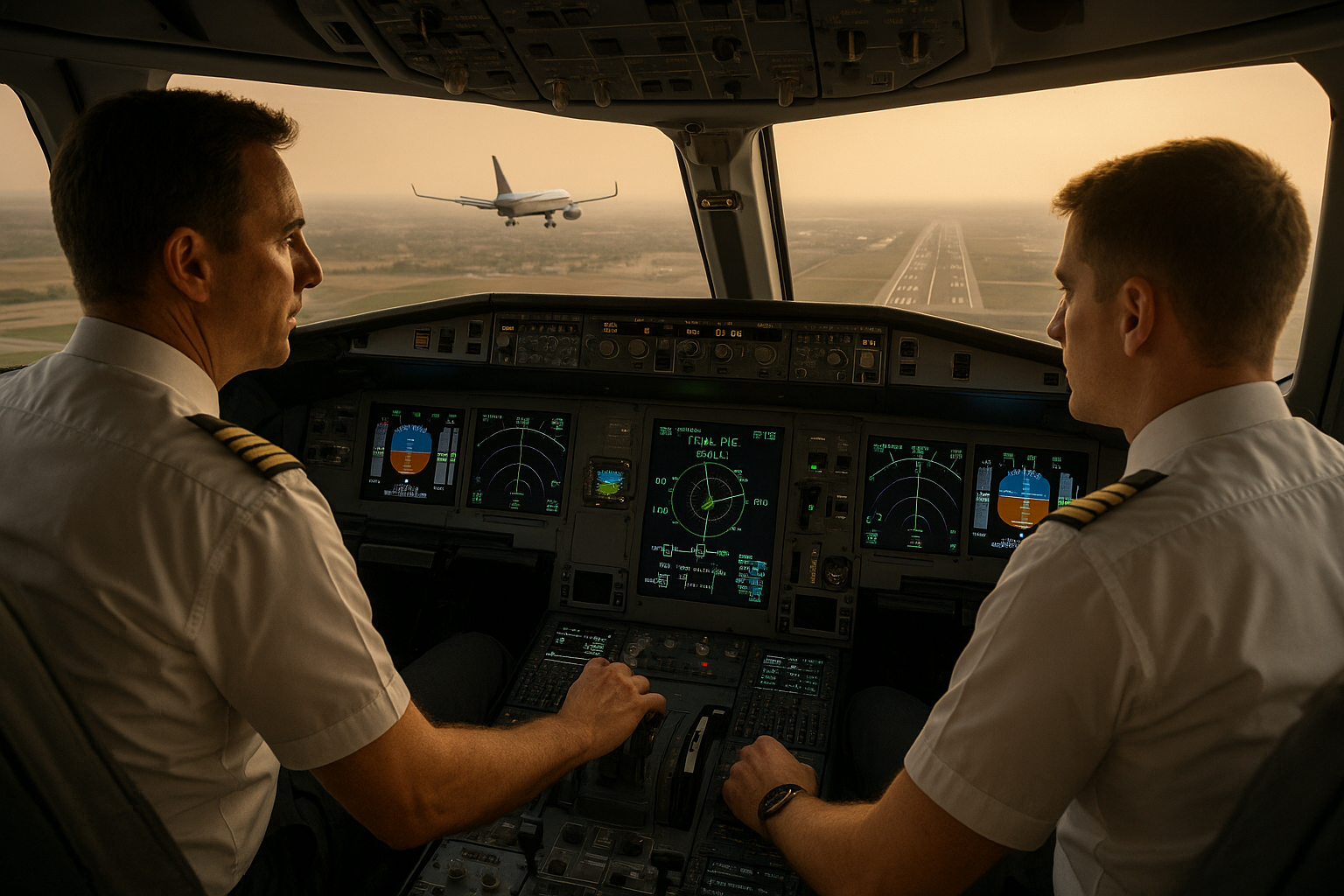
Imagine a two-pilot transport-category crew on final approach. The flight is stabilized at approach speed, configured, and cleared to land. The TCAS issues a TA: a bright symbol and an audio alert. The pilot monitoring scans the TCAS display and identifies a target above and slightly behind. Before the crew can complete visual contact, TCAS escalates to an RA commanding a climb.
The appropriate response is immediate: the pilot flying follows the RA guidance while maintaining attitude and airspeed control. The autopilot behavior varies by aircraft and operator procedures; some aircraft will automatically follow RA commands if the autopilot remains engaged and properly coupled. If manual flying is required, apply moderate pitch changes as needed to achieve the commanded vertical rate while avoiding abrupt control inputs that could create secondary hazards. After establishing the RA response and ensuring aircraft control, the crew informs ATC of the deviation as soon as practical and returns to the cleared profile when the TCAS advisory ends and it is safe to do so.
This example highlights the importance of prior procedural agreement within the crew and recurrent training so responses are automatic and measured under pressure.
TCAS Display and Alert Interpretation
Understanding the display symbology and how to interpret relative traffic is essential. A TCAS display typically shows the own-ship at the center and traffic symbols positioned according to relative bearing and range, often with altitude difference labeling. Color and shape coding help prioritize targets. Pilots should use the display to build a mental picture of the encounter geometry, but they must avoid over-reliance on exact numeric ranges; TCAS displays are tools for situational awareness rather than precise radar targets.
Interpreting an RA requires reading both the text (or voice) instruction and the visual cues that indicate whether the command is to climb or descend and the magnitude of vertical speed expected. RAs may include a corrective vertical speed target or a simpler direction command. Pilots must execute the RA promptly while monitoring airspeed and flight load factors, especially in high-workload phases of flight.
Integration with ATC and Communication
TCAS events always have an ATC interaction component. When an RA occurs, crews should communicate with ATC as soon as immediate flight safety is assured. The form and timing of that communication are part of operator procedures and should be practiced. Informing ATC that you are deviating due to an RA, stating the direction of the RA maneuver, and advising when you have resumed cleared flight helps restore traffic flow and avoid confusion.
Because TCAS advisories are automatic and independent of ATC, controllers may not be aware of the initiating traffic or system status at the time of the advisory. Timely cockpit-to-controller information reduces the likelihood of contradictory instructions and helps ATC re-sequence traffic after the event.
Automation, Autopilot, and RA Responses
Automation interaction is a complex area. Some autopilots can couple to and follow TCAS resolution advisories automatically, which can reduce manual workload and improve precision, but system behavior varies by aircraft type and installation. Unless the operator's procedures and the flight manual provide clear guidance, crews should brief how they will handle autopilot and autothrottle during potential TCAS events before flight.
When manual control is necessary, pilots should make smooth inputs to meet the RA without inducing excessive pitch or bank. Avoid rapid or overcontrolling responses that could create secondary flight path problems. Maintaining airspeed and structural load limits remains essential even while complying with an RA.
Training and Recurrent Practice
Effective TCAS use relies on recurrent training that includes both simulator and briefing elements. Simulators allow crews to experience realistic TA/RA scenarios, practice RA execution under workload, and coordinate communications with ATC. Training should cover recognition of TCAS symbols and voice cues, proper prioritization of RA response, coordination between pilots, and the transition back to ATC-cleared flight paths after an event.
Instructors should emphasize decision-making under pressure: quick recognition, immediate safe response, and concise communication. Training should also include non-normal scenarios such as multiple or conflicting advisories, near-simultaneous TAs, and operations where traffic lacks transponders. These scenarios foster better judgment in cases where TCAS cannot provide complete information.
Limitations of TCAS and Safety Considerations
TCAS has important limitations pilots must respect. It does not detect non-transponder traffic or transponders inoperative or set to standby. Terrain, weather, and line-of-sight geometry can affect detection. The system predicts conflicts based on current trajectories and cannot foresee pilot or controller actions that change those trajectories quickly.
Another limitation is target resolution in dense traffic. When multiple targets are close, advisories can become complex, and the system may prioritize the most immediate threat. In these situations, pilot workload and spatial disorientation risks rise. Pilots must trust the system but remain prepared to manage the aircraft and external environment manually if necessary.
Common Misunderstandings and How to Address Them
Misunderstanding 1: TCAS replaces visual scan and ATC. Some pilots assume that TCAS absolves them of the need to scan visually and maintain awareness. In reality, TCAS is a complementary tool. Visual acquisition and listening to ATC remain essential.
Misunderstanding 2: RAs are suggestions rather than commands. While RA wording varies, the correct operational stance is that an RA requires immediate corrective action to ensure separation. Treat RAs as high-priority directives for conflict resolution.
Misunderstanding 3: TCAS always provides the best vertical solution. TCAS provides a computation based on predicted geometry, but in some rare cases a manual judgment will be required to avoid terrain, airspace restrictions, or other hazards. Training should help crews identify when a deviation from the RA is necessary for safety, and how to manage that deviation and subsequent communications.
Best Practices for Pilots
Below are practical habits and procedural recommendations to incorporate into everyday operations:
- Brief expected TCAS responses and autopilot behavior before high-traffic phases such as descent and approach.
- Respond to a TA by visually or instrumentally acquiring the traffic and preparing for escalation to an RA.
- Execute RAs promptly and smoothly, prioritizing aircraft control and the RA guidance.
- After the immediate RA response, communicate with ATC as soon as practicable and follow-up with the appropriate reports required by operator procedures.
- Regularly practice RA responses in the simulator under normal and non-normal scenarios, including time pressure and degraded visual conditions.
- Ensure transponder settings are correct and that the equipment is serviceable during flight planning and preflight checks.
Frequently Asked Questions
What is the difference between a TA and an RA?
A traffic advisory (TA) warns the crew of potential traffic nearby and is intended to prompt increased attention and situational awareness. A resolution advisory (RA) provides a vertical maneuver guidance aimed at preventing a collision; an RA normally requires an immediate corrective action to alter the aircraft's vertical path.
Should I follow ATC or the RA when they conflict?
In the immediate term, complying with an RA to ensure separation is the safe action. After you have responded and the aircraft is under control, inform ATC of the deviation. Exact company procedures and training material should be reviewed to confirm the expected communications protocol after an RA event.
Will TCAS detect aircraft without transponders?
No. TCAS relies on transponder replies to detect and track targets. Traffic without a transponder, transponders inoperative, or transponders set to standby will not appear on TCAS displays and will not generate advisories.
Can autopilots follow TCAS RAs?
Some autopilot systems are capable of following RA commands when the installation and procedures allow coupling. However, behavior varies by aircraft type and operator policy. Pilots must know their aircraft-specific guidance and brief automation handling before high-traffic operations.
How should crews communicate with ATC after an RA?
After ensuring aircraft control, crews should notify ATC that they deviated due to a TCAS RA, describe the direction of the maneuver, and state when they have resumed the cleared altitude or flight path. Concise, timely communication reduces the potential for further conflicts.
Training Scenario: Simulated Midair Conflict on Final
Training scenario outline: conduct a simulator session where an arriving aircraft receives a TA that escalates to an RA while both aircraft are on converging final profiles. The exercise should require the crew to execute the RA, maintain stabilized flight parameters, communicate with ATC, and manage automation. Debrief should focus on reaction time, control technique, communications, and return-to-profile procedures.
Use variations of the scenario to practice manual aircraft control when the autopilot disconnects, multiple traffic advisories, and situations where the RA might require releasing the approach to ensure safety. These exercises build instinctive, measured responses that translate directly to in-flight safety.
Key Takeaways
- Practical takeaway: Treat TAs as early warnings and RAs as immediate-required vertical responses to maintain separation.
- Safety takeaway: Execute RAs promptly and smoothly while maintaining aircraft control and then inform ATC as soon as practical.
- Training/decision-making takeaway: Practice RA scenarios in simulators and brief autopilot/automation behavior before high-traffic phases to ensure predictable crew responses.
TCAS is a powerful safety layer when integrated with disciplined cockpit procedures, clear crew coordination, and recurrent training. Pilots who understand both the capabilities and the limits of TCAS are better positioned to make safe, timely decisions when traffic conflicts arise.