
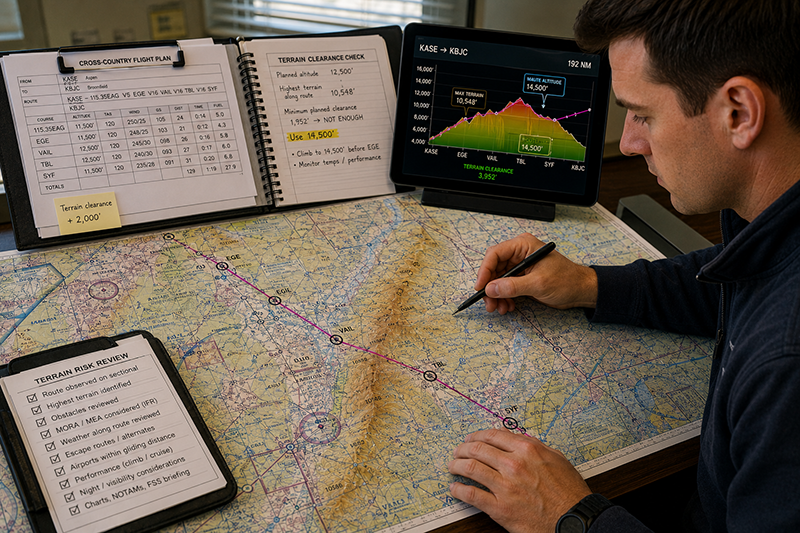
Evaluating terrain risks along your route is one of the most important parts of preflight planning, especially when a flight crosses rising terrain, sparsely populated areas, mountain passes, coastal cliffs, high plateaus, or unfamiliar night routes. Terrain is not just a mountain problem. It can affect a short VFR cross-country, an instrument training flight, a commercial repositioning leg, or a routine hop into an airport surrounded by towers, ridges, or rapidly changing weather.
Good terrain planning is more than drawing a line on a chart and checking the highest number nearby. It is a disciplined process of understanding what the aircraft must clear, how weather and performance may change the margin, what options exist if the flight cannot continue, and where pilot workload is likely to increase. For student pilots, this skill builds strong cross-country judgment. For experienced pilots, it helps prevent overconfidence on familiar routes. For instructors and operators, it provides a practical framework for teaching route selection, altitude planning, and risk management in a way that connects chart knowledge to real decisions in the cockpit.
What Terrain Risk Really Means in Flight Planning
Terrain risk is the possibility that terrain, obstacles, weather, aircraft performance, navigation error, or pilot decision-making may reduce the safe clearance between the aircraft and the surface. The risk is not limited to striking terrain. It also includes situations where terrain restricts escape options, forces a climb the aircraft cannot comfortably achieve, blocks radio or radar coverage, increases turbulence, or funnels a pilot into deteriorating visibility.
A route that looks simple on a flat map can become more demanding when viewed in vertical profile. A valley may provide a lower crossing altitude but fewer places to turn around. A direct route may be shorter but require a long climb over rising ground. A route around terrain may add time but provide better airports, more open landing areas, lower weather exposure, and reduced workload. Evaluating terrain risk means comparing those tradeoffs before the flight, not discovering them while already committed.
For VFR pilots, terrain planning often begins with sectional charts, topographic awareness, route altitude selection, weather evaluation, and a realistic assessment of visibility and ceilings. For IFR pilots, the process includes charted minimum altitudes, published procedures, obstacle clearance areas, approach and departure planning, and understanding when a clearance or route assignment does not relieve the pilot from maintaining situational awareness. In both cases, the goal is the same: keep enough vertical and horizontal margin to make conservative decisions while the aircraft is still in a good position.
Why Terrain Risk Matters in Real-World Aviation
Terrain compresses choices. Over flat farmland on a clear day, a pilot may have many diversion options, broad visual references, and generous areas for an off-airport landing if needed. Over rugged terrain, the same aircraft may have fewer suitable emergency landing sites, limited radio coverage, stronger localized wind effects, and a narrower margin between the desired altitude and the tops of ridges or obstacles. The pilot may also have fewer visual cues at night or in haze, making the terrain appear farther away, lower, or less threatening than it really is.
Terrain also interacts with weather. A ceiling that is acceptable over low terrain may become limiting as the route rises. Visibility that is legal may still be operationally poor if the terrain ahead blends into haze, smoke, snow, or shadows. Wind flowing across ridges can produce turbulence, downdrafts, and rapidly changing groundspeed. Clouds may form along slopes and passes before the surrounding area appears significantly affected. These conditions can turn an otherwise routine flight into a high-workload decision-making exercise.
Aircraft performance is another critical part of the picture. A route that requires sustained climb over rising terrain should be evaluated against the actual aircraft, loading, temperature, pressure altitude, and pilot technique. A lightly loaded aircraft on a cool morning may perform very differently than the same aircraft near gross weight on a hot afternoon. Terrain planning should not assume book performance will be achieved exactly in real operations. A prudent pilot leaves room for normal variations in aircraft condition, technique, wind, and unexpected ATC or weather delays.
In training, terrain risk is also a powerful way to teach aeronautical decision-making. Students often learn altitude planning as a numerical exercise, but the real lesson is judgment: Where is the route most constrained? Where could the pilot turn around? What altitude is needed before reaching rising ground? What happens if the weather lowers by 1,000 feet? What if the climb rate is less than expected? Those questions build the habits that separate route planning from simple navigation planning.
Building a Terrain Picture Before the Flight
The first step is to create a mental and visual picture of the route in three dimensions. Pilots should look beyond the magenta line and study the surrounding terrain, obstacle concentrations, passes, valleys, ridges, towers, special-use airspace, nearby airports, and possible diversion routes. The route should be viewed as a corridor, not a single line. Navigation errors, wind correction issues, ATC reroutes, traffic avoidance, or weather deviations can easily move the aircraft away from the planned track. A terrain-aware plan considers what lies to either side of the route as well as directly ahead.
On VFR charts, terrain tinting, spot elevations, contour patterns, obstacle symbols, and maximum elevation figures help pilots identify high terrain and obstacles. Electronic flight bags can add terrain shading, synthetic vision, profile view, and route alerting. These tools are valuable, but they should support chart interpretation rather than replace it. A pilot who understands the underlying terrain picture is much better prepared when a display is zoomed incorrectly, a layer is disabled, or workload prevents detailed screen management.
For IFR planning, charted minimum altitudes and published procedures provide essential structure. Minimum enroute altitudes, minimum obstruction clearance altitudes, off-route obstruction clearance altitudes, and procedure altitudes all have specific meanings and limitations. Pilots should use the appropriate charted information for the type of operation being conducted and avoid mixing concepts casually. A number that is useful for broad situational awareness may not be the same as an altitude that provides route navigation reception, obstacle clearance, communications expectations, or procedure compliance.
A helpful technique is to identify the highest-risk segments of the route before calculating the final altitude. These may include the initial climb near obstacles, a ridge crossing, a valley with limited turn radius, a descent into an airport surrounded by terrain, or a section where weather is forecast to be lowest. Once the demanding segments are identified, the pilot can plan conservative altitudes, decision points, and alternate routing around them.
Understanding Vertical Margin
Vertical margin is the space between the aircraft and terrain or obstacles, but it is more than a simple subtraction problem. A planned altitude may appear adequate on paper, yet the real margin can be reduced by altimeter setting errors, temperature effects, turbulence, downdrafts, navigation drift, pilot workload, or an early descent. In mountainous or hilly terrain, the ground may rise faster than expected, especially when the route follows a valley toward a pass or approaches a ridge at a shallow angle.
For VFR operations, pilots should choose cruising altitudes that provide comfortable terrain clearance, allow visual navigation, and leave room for weather decisions. The altitude should support the entire route segment, not just the highest point on the planned line. If the aircraft cannot reach that altitude well before the terrain rises, the route may need to be changed, delayed, or flown under different conditions. Terrain clearance that depends on perfect climb performance and perfect navigation is not a robust plan.
For IFR operations, pilots must respect published altitudes and ATC clearances while maintaining independent awareness of terrain. IFR routing can reduce workload when properly planned, but it should not create complacency. During departures and arrivals, terrain risk often increases because the aircraft is closer to the surface, the workload is higher, and the pilot may be managing communications, configuration, navigation changes, and weather at the same time. Understanding the vertical path before takeoff or before beginning descent is essential.
Descent planning deserves special attention. Many terrain-related threats develop when pilots descend too early, accept a visual clearance without a complete terrain picture, cancel IFR prematurely, or follow a direct-to path that cuts across higher ground. A safe descent plan considers where descent may begin, what altitude must be maintained until clear of terrain, how the aircraft will remain oriented to the airport environment, and what options exist if visual references are lost or weather deteriorates.
Route Selection: Direct Is Not Always Safer
The shortest route is often attractive because it saves time, fuel, and mental effort during planning. However, direct routing across terrain can increase risk if it removes intermediate airports, reduces emergency landing options, requires higher climb performance, or crosses ridgelines at unfavorable angles. A slightly longer route along lower terrain, near roads, or through wider valleys may be more conservative and easier to manage.
A strong route selection process weighs distance against exposure. A route that spends ten minutes over difficult terrain may be preferable to one that spends forty minutes over gradually rising, unlandable ground. Conversely, a longer route around the highest terrain may be safer if it keeps the airplane within reach of airports, improves weather options, and reduces the need for aggressive climb or descent profiles. The best route is not always the most direct route. It is the route that provides the best combination of clearance, performance, weather margin, navigation reliability, and escape options.
Ridge crossings require particular care. Crossing a ridge at a shallow angle can leave the aircraft close to rising terrain for an extended period and may reduce options if downdrafts or turbulence are encountered. Many experienced mountain pilots prefer to approach ridges in a way that preserves the ability to turn away from terrain if conditions are not acceptable. The exact technique depends on aircraft performance, wind, terrain shape, altitude, and training, so pilots should seek qualified instruction before operating in mountainous environments.
Valleys can be helpful routes through terrain, but they can also create traps. A valley may narrow, rise, curve, or end in a pass that is obscured by cloud or precipitation. A pilot flying low in a valley may have limited room to reverse course, especially with a tailwind or reduced visibility. Before using a valley route, pilots should study its elevation trend, width, escape options, possible wires or towers, wind direction, and weather behavior.
Weather, Visibility, and Terrain Illusions
Weather is often the factor that turns terrain from a planning consideration into an immediate hazard. Ceilings and visibility must be evaluated in relation to terrain elevation, not just airport elevation. A weather report from a nearby airport may not describe conditions over ridges, in valleys, or near passes. Terrain can generate local cloud, precipitation, turbulence, and visibility restrictions that are not obvious from a broad regional forecast.
VFR flight in marginal visibility near terrain requires disciplined judgment. The pilot may be legal under certain conditions but still lack the visual definition needed to identify terrain, maintain orientation, and choose a safe path. Haze, smoke, sun glare, snow cover, rain showers, and low contrast can make slopes and ridges difficult to see. At night, terrain may be invisible unless it is outlined by lights, moonlight, or contrast with the sky. A dark area ahead may be open terrain, water, a mountain slope, or simply unlit countryside.
Wind is another major contributor. Airflow over ridges can create mechanical turbulence, wave activity, rotor, and downdrafts. Even when severe conditions are not present, a downdraft near rising terrain can reduce climb margin and increase pilot stress. A headwind on one side of a route may become a tailwind in a valley or at a ridge crossing. Pilots should consider winds aloft, terrain orientation, and the potential for localized effects, especially when the flight requires climbing over or maneuvering near terrain.
Temperature and density altitude also matter. High density altitude can reduce climb performance, increase takeoff distance, and make a planned terrain crossing less comfortable. This is not limited to high-elevation airports. Hot temperatures, high field elevations, and heavy loading can combine to reduce performance in ways that affect the entire route. Before committing to flight over terrain, pilots should compare expected climb capability with the route’s elevation profile and build in practical margins.
Electronic Tools Help, but They Do Not Replace Judgment
Modern avionics and electronic flight bags have improved terrain awareness significantly. Terrain shading, route profile view, obstacle alerts, synthetic vision, moving maps, and GPS-derived groundspeed can all help pilots understand where they are in relation to terrain. These tools are especially useful during preflight planning because they allow pilots to visualize the route vertically and test alternate paths quickly.
However, electronic tools can create a false sense of precision. The display may show terrain clearly while the pilot’s attention is elsewhere. A terrain alert may come late if the aircraft is maneuvering, descending, or flying toward rapidly rising ground. A route profile may not account for every operational factor the pilot must consider. Databases require currency, settings matter, and screen interpretation is only as good as the pilot’s understanding.
One common problem is excessive zoom. When a moving map is zoomed in too far, the pilot may lose awareness of the larger terrain system. A route may look clear within the current screen view while higher terrain sits just beyond the display edge. Conversely, zooming too far out can hide narrow valleys, obstacle clusters, and local terrain features. Terrain planning should include multiple scales: a broad overview for route strategy, a medium scale for terrain corridors, and a detailed view for departure, arrival, and critical segments.
Pilots should also avoid letting a magenta line become a command. GPS direct routing is a navigation convenience, not a guarantee that the route is operationally wise. If the direct path crosses higher terrain, reduces options, or puts the aircraft into weather, the pilot should modify the route. A safe pilot uses technology to support decisions, not to avoid making them.
Common Mistakes and Misunderstandings
A frequent mistake is planning terrain clearance only from the highest charted elevation near the route without considering obstacles, route width, navigation error, or the climb and descent path. The aircraft is not guaranteed to remain exactly on the line, and the highest risk may be slightly off course or during a maneuver around weather. Treating the route as a corridor helps prevent this narrow-line error.
Another misunderstanding is assuming that being above a charted number always means the flight is safe. Charted terrain and obstacle information is essential, but it must be used correctly. Some numbers are designed for broad planning awareness, some for IFR obstacle clearance in defined areas, and some for procedure compliance. Pilots should understand what each charted altitude or elevation figure represents before using it as a decision point.
Early descent is a classic terrain risk. Pilots may begin down because the destination is close, the runway is in sight, or ATC has issued a descent. But terrain between the aircraft and airport may still require attention. In visual conditions, the runway environment can draw attention away from intervening ridges, towers, or rising ground. In instrument conditions, an early descent outside protected segments can remove the obstacle clearance the pilot was relying on.
Overconfidence on familiar routes is also common. A pilot who has flown the same valley or ridge crossing many times may normalize marginal conditions. Familiarity can be helpful, but it can also reduce curiosity. The weather, winds, aircraft loading, time of day, and pilot fatigue are rarely exactly the same from one flight to the next. A route that was comfortable last month may be unsuitable today.
Finally, pilots sometimes underestimate workload near terrain. Navigation, weather avoidance, communications, mixture management, engine monitoring, passenger questions, and traffic scanning can all compete for attention. When terrain is nearby, there is less time to catch mistakes. A terrain-aware plan reduces workload by identifying decisions before the cockpit becomes busy.
Practical Example: Planning a Cross-Country Near Rising Terrain
Consider a private pilot planning a daytime VFR cross-country in a normally aspirated training aircraft. The departure airport sits in relatively low terrain, but the destination is beyond a broad area of hills and ridges. The direct route is the shortest, but it crosses a high ridgeline about halfway through the flight and offers few airports for diversion. Forecast conditions are VFR, but the winds aloft suggest a moderate headwind during the climb, and the afternoon temperature is expected to be warmer than the morning departure.
A superficial plan might simply choose a cruising altitude that appears to clear the highest terrain on the chart and proceed direct. A better plan starts by asking whether the aircraft can reach that altitude comfortably before the ridge, whether the ridge crossing allows a safe turn away if the air becomes rough, and whether a descent toward the destination would begin before all significant terrain is behind the aircraft. The pilot also studies nearby valleys, roads, airports, and lower terrain corridors.
After comparing options, the pilot selects a slightly longer route that follows a lower corridor near two intermediate airports. The planned altitude still provides comfortable terrain clearance, but the aircraft is not forced to outclimb rising ground as aggressively. The pilot marks a decision point before the terrain begins to rise. If the aircraft has not reached the planned altitude by that point, if the ceiling is lower than expected, or if turbulence is uncomfortable, the pilot will turn back or divert before entering the more constrained area.
During the flight, the pilot monitors actual climb rate, groundspeed, visibility, and cloud bases. The route remains flexible. If the lower corridor remains clear, the flight continues with reduced workload. If conditions change, the pilot has already identified where to go and what altitude to maintain. The important lesson is not that one route is always best. The lesson is that terrain risk should be managed through margins, options, and timely decisions.
Best Practices for Pilots Evaluating Terrain
Effective terrain planning is a habit pattern. It begins before the flight, continues during the flight, and becomes especially important during departures, descents, and route changes. The following practices are useful for pilots at all experience levels, provided they are applied with the aircraft, weather, operation, and pilot qualifications in mind.
- Plan the route as a corridor. Look several miles to either side of the planned track and understand what terrain or obstacles exist if the aircraft drifts, deviates, or receives a reroute.
- Build a vertical profile. Know where the ground rises, where the aircraft must climb, where descent can safely begin, and where the route becomes most constrained.
- Use multiple information sources. Combine current charts, electronic planning tools, weather products, airport information, NOTAM review, and aircraft performance data.
- Set decision points before terrain becomes limiting. Decide in advance where to turn back, divert, climb, or hold if conditions do not match the plan.
- Respect performance reality. Use actual loading, temperature, pressure altitude, winds, and expected climb performance rather than optimistic assumptions.
- Keep descent disciplined. Do not descend below a safe and appropriate altitude simply because the destination is nearby or visually acquired.
- Maintain technology awareness. Use terrain displays and alerts, but verify settings, zoom level, database currency, and the larger route picture.
For instructors, terrain planning is an excellent scenario-based training topic. Instead of asking only what altitude the student selected, ask why that altitude works, where it stops working, and what the student would do if the climb rate, visibility, or ceiling were worse than expected. This turns a planning exercise into real decision-making practice.
Special Considerations for Night and Instrument Operations
Night flight over terrain deserves conservative planning because visual cues are reduced. A pilot may see town lights, highway lights, or airport beacons while terrain between those lights remains invisible. Black-hole illusions, reduced horizon references, and reflections from cockpit lighting can make attitude and position awareness more demanding. Even in excellent weather, pilots should plan night routes with strong terrain clearance, reliable navigation, and clear diversion options.
Instrument operations add a different kind of discipline. Published procedures and charted altitudes are designed to be flown as published, with careful attention to segment boundaries, navigation sources, and required climb or descent gradients when applicable. A pilot should not improvise shortcuts around terrain in instrument conditions without a clear understanding of obstacle clearance. If an ATC clearance creates uncertainty about terrain clearance, the pilot should ask for clarification or request an alternate clearance.
Instrument approaches into airports near terrain require early briefing. The pilot should understand the arrival direction, intermediate and final approach altitudes, missed approach procedure, step-down fixes if applicable, and terrain around the airport. A visual approach in terrain can be appropriate when conditions and pilot awareness support it, but it should not become a reason to abandon disciplined altitude management. If the pilot is not comfortable with the terrain picture, flying a published instrument procedure or delaying the descent may be the safer choice.
Teaching Terrain Risk to Student Pilots
Student pilots often learn terrain through sectional chart symbols, maximum elevation figures, and cross-country altitude selection. Those skills are necessary, but they should be connected to operational thinking early in training. A student should learn to ask, “What is the terrain doing along my route?” rather than simply, “What altitude did I choose?”
A useful instructional method is to compare two routes to the same destination. One route may be direct and shorter but crosses higher terrain. Another may be longer but follows lower ground and passes near airports. The student can evaluate weather, performance, fuel, diversion options, and workload. This creates a natural discussion about why safe planning is not always the same as shortest-distance planning.
Instructors should also discuss how terrain affects emergency planning. Over difficult terrain, the best available landing area may be behind the aircraft, off to one side, or in a valley that requires an immediate turn. Students do not need to become mountain specialists during basic training, but they should understand that terrain changes the emergency mindset. The pilot should always know where the better options are, not merely hope to find them after a problem occurs.
Frequently Asked Questions
How far from my route should I evaluate terrain?
Think in terms of a route corridor rather than a single line. The appropriate width depends on the operation, altitude, weather, navigation accuracy, and possible deviations. At a minimum, evaluate terrain and obstacles far enough to account for realistic off-course drift, weather avoidance, traffic maneuvering, and alternate routing.
Are electronic terrain alerts enough for safe terrain planning?
No. Terrain alerts are valuable safety tools, but they are not a substitute for preflight planning, chart understanding, route selection, and pilot judgment. Alerts may not provide enough time or context to solve a poor route decision, especially near rising terrain or during high workload.
What is the biggest terrain risk for VFR pilots?
One of the most significant risks is continuing into reduced visibility or lowering ceilings while terrain options become more constrained. A VFR pilot may still be able to see forward but may not have enough visual definition, altitude, or turning room to continue safely. Conservative decision points are essential.
Should I always fly higher over terrain?
Higher altitude often improves terrain clearance and options, but it is not the only answer. The aircraft must be able to reach and maintain the altitude safely, winds may be stronger, oxygen considerations may apply at higher altitudes, and weather may limit the benefit. The best altitude is one that provides clearance, performance margin, weather margin, and operational practicality.
How should IFR pilots think about terrain on assigned routes?
IFR pilots should comply with clearances and published procedures while maintaining independent terrain awareness. Charted minimum altitudes, procedure segments, and obstacle clearance concepts must be understood in context. If a clearance or descent creates uncertainty, the pilot should request clarification before accepting unnecessary risk.
When should I choose a longer route around terrain?
A longer route may be the better choice when it improves weather options, keeps the aircraft near airports or lower terrain, reduces climb demands, avoids narrow valleys or high ridges, or provides better emergency landing possibilities. Time saved on a direct route is not valuable if it removes safety margin.
Key Takeaways
- Evaluate terrain risks along your route as a three-dimensional planning problem that includes altitude, route width, climb performance, weather, and escape options.
- Terrain risk increases when weather, night conditions, early descent, downdrafts, navigation error, or overreliance on electronic tools reduces the pilot’s margin.
- Sound pilot judgment means selecting routes, altitudes, and decision points that preserve options before terrain limits the ability to change the plan.